


Key Takeaways
Women fall for how you make them feel, not what you buy them
Attraction runs on emotion, not logic. Mann's core claim is that a woman's desire is triggered by a man's behavior, because for most of human history his behavior signaled whether he could protect her and any offspring. Gifts, favors, and flattery do not move this needle. The feeling a man generates in her does.
The book's whole program flows from this. If attraction is a felt response rather than a rational calculation, then earning a woman's affection through good deeds is a category error. You cannot argue someone into desire. Mann's prescription is blunt: whatever the insecure "nice guy" instinctively does, invert it. Lead instead of ask, assert instead of appease, and prioritize your own standards over her approval.
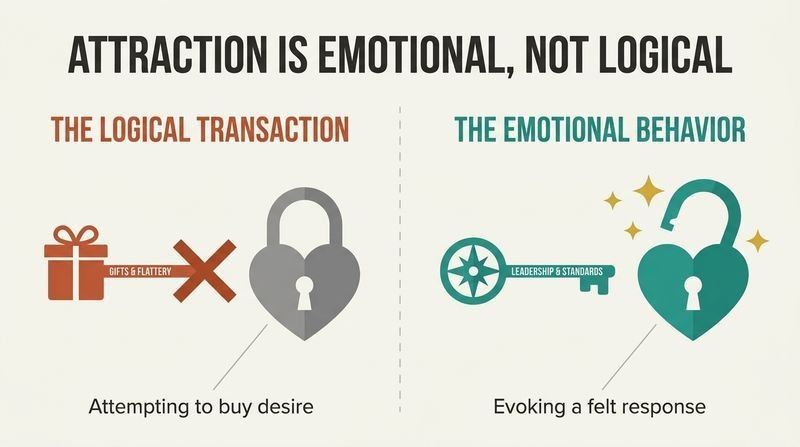
The premise that attraction is felt rather than reasoned has real support. Psychologists distinguish between liking (warmth, trust) and desire (arousal, tension), and the two do not always overlap. Where Mann overreaches is the leap from "attraction is emotional" to a rigid caveman narrative. Evolutionary psychology is contested precisely because almost any behavior can be retrofitted with a survival story. A steelman: signaling theory across biology shows organisms respond to hard-to-fake cues of fitness. A fair caution: humans also bond through vulnerability, reciprocity, and shared values, which this framework treats as weakness rather than the foundation of lasting partnership.
The "nice guy" is not kind; he is fear wearing a mask
Niceness here is a strategy, not virtue. Mann redefines the "nice guy" as a man too afraid to state his romantic intent, so he disguises desire as friendship and performs favors hoping she eventually notices. When she does not, he grows resentful and feels cheated. The tell is not generosity but concealment: he hides what he actually wants.
This timidity leaks into everything. The same man struggles to say no, to voice an opinion, or to risk disapproval anywhere in life. Mann argues women read this instantly. Unassertiveness broadcasts weakness, and weakness kills desire. His fix is to become more invested in your own self-regard than in others' opinions: try to impress yourself, act on your wants, and tolerate the discomfort of being disliked.
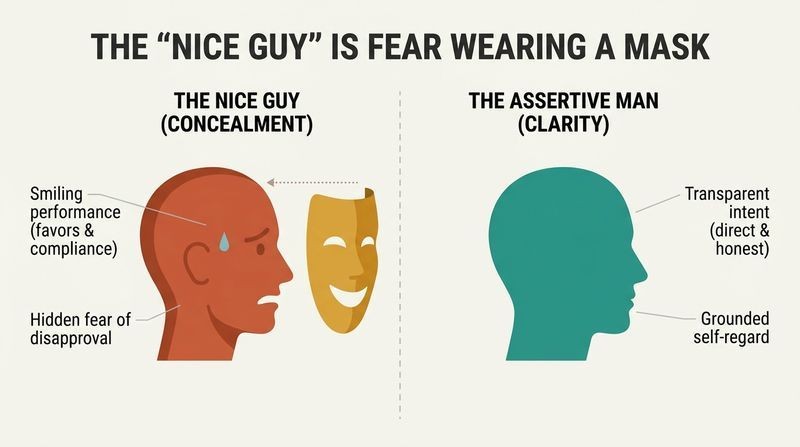
The distinction between genuine kindness and covert contract-making is the book's sharpest insight, echoing Robert Glover's "No More Mr. Nice Guy," which coined the idea of the "covert contract": I do for you secretly expecting sex or love in return. The resentment such men feel is real and corrosive. The blind spot is framing all agreeableness as pathology. Research on relationship satisfaction consistently rewards responsiveness and warmth. The problem was never kindness; it was kindness deployed as manipulation without honesty about one's desires. Authentic directness, not manufactured aloofness, is the actual antidote the evidence supports.
Confidence is the aphrodisiac, and looking calm beats feeling calm
Perceived confidence outperforms real confidence. Mann insists the world's most secure man reads as unattractive if he acts unsure, while a terrified man who appears composed is received warmly. Since observers cannot see your inner state, the outward performance is what registers. His shortcut: ask what a confident person would do, then do it.
Confidence is comfort with uncertainty. It is not the guarantee of success but ease with not knowing the outcome, and a willingness to enter exposed situations like approaching a stranger. It shows physically: slower movements, upright posture, taking up space, unhurried speech. Mann cites the finding that confident speakers are judged more expert and credible even when they are wrong, which is why a bold man saying something dull outperforms a nervous man saying something brilliant.
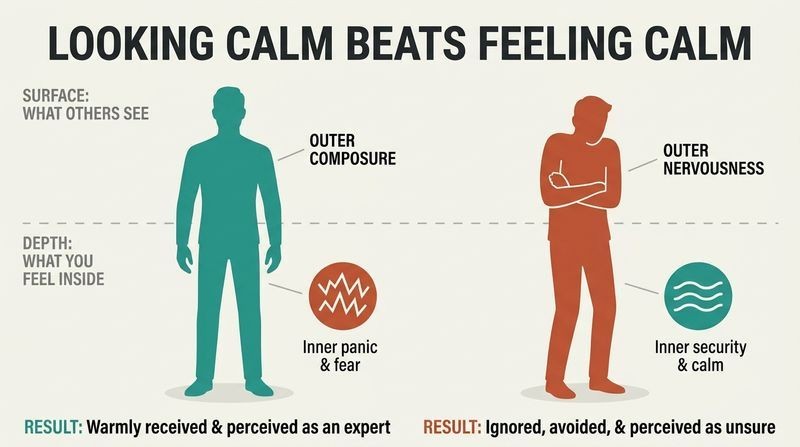
The claim that confidence gets read as competence is well documented. Studies on the "confidence heuristic" show groups defer to the most self-assured member regardless of actual accuracy, and Cameron Anderson's work found overconfident individuals gain status they have not earned. So the mechanism is sound. The risk is the "fake it" instruction curdling into hollow performance that anxious people cannot sustain, breeding impostor stress. A richer path pairs behavioral practice with genuine exposure: repeated approaches build real self-efficacy, per Bandura, so the posture eventually stops being a mask and becomes true. Mann gestures at this but leans too hard on appearance alone.
Predictability bores; unpredictable men hijack the brain's reward circuit
The brain craves surprise. Mann argues nice guys fail partly because they are boringly foreseeable. Everyone knows they will cater to her every wish. He cites research that the brain releases more dopamine when a reward is unexpected than when it arrives on schedule, meaning women can become almost addicted to men whose responses they cannot predict.
Non-conformity is the engine. The man who says and does what he wants, who does not bend to please, becomes a moving target. Each interaction carries a small charge of not-knowing. Mann frames this as a byproduct of genuine self-direction rather than a trick: when you act from your own preferences instead of scanning for approval, unpredictability happens naturally, and it signals the confidence and self-possession women find magnetic.
The dopamine point is legitimate and traces to Wolfram Schultz's primate studies and B.F. Skinner's variable-ratio reinforcement, the same mechanism that makes slot machines and social media notifications compulsive. Intermittent reward is genuinely more habit-forming than consistent reward. The ethical hazard is obvious: engineering intermittent affection to create something resembling addiction describes the dynamics of manipulative and even abusive relationships, not healthy ones. Attachment research shows unpredictable partners generate anxious attachment, which people often mistake for passion. What feels like magnetic intensity can be nervous-system dysregulation. The line between charismatic spontaneity and cruel hot-and-cold games is one the book does not draw carefully enough.
Everything you do secretly broadcasts your value; mind the subtext
Actions carry hidden messages. Mann's term is sub-communication: the inferred reason behind what you say and do, which matters far more than the literal content. Approaching a woman directly sub-communicates you are unafraid of rejection, therefore you have options, therefore you are desirable. Orbiting as a secret admirer sub-communicates the opposite: fear of rejection implies no other options implies low value.
This resolves the book's central paradox. How can bold approaching be attractive while pursuit is repellent? Because they sub-communicate different things. A confident approach signals abundance. Needy chasing signals scarcity. Mann claims women are extraordinarily skilled at reading these implied signals, decoding a man's status from small behavioral tells long before conscious thought kicks in. Manage the subtext and you manage the attraction.
Sub-communication is essentially signaling theory rebranded, and the underlying logic is sound. In behavioral economics, costly and honest signals reveal hidden qualities: the peacock's tail, the expensive suit, the relaxed demeanor that says "I am not worried." Thorstein Veblen made similar points about status a century ago. Thin-slicing research (Nalini Ambady) confirms people extract accurate impressions from seconds of behavior. The weakness is determinism. Treating women as flawless subconscious lie-detectors who always decode scarcity as low value ignores how much genuine compatibility, context, and conversation shape real attraction. Signals open doors; they rarely sustain relationships on their own.
Her investment in you fuels desire, not your investment in her
Attraction tracks her effort, not yours. Mann inverts the nice-guy assumption that lavishing time, money, and emotion earns love. The more you invest in her, the more attached you become and the less she does. The more she invests in you, the more attracted she grows. Over-investment sub-communicates you have no life, are trying to compensate, or are attempting to "buy" her, all repellent.
Two flavors of respect. He distinguishes emperor respect, the awe and slight intimidation you feel toward a powerful mentor, from grandfather respect, the fond regard for someone harmless. Only the first breeds desire. He adds the Law of Least Effort: whoever exerts the least effort in an interaction reads as most powerful, so cultivating effortlessness raises your perceived value and, with it, her attraction.
The investment asymmetry echoes the sunk-cost fallacy and effort justification: Aronson and Mills famously showed people who endure more to join a group value it more. So her effort genuinely can deepen her commitment. Cialdini's consistency principle reinforces this. Yet the framing has a dark edge. Deliberately withholding investment to manufacture her one-sided sacrifice is a recipe for imbalanced, often exploitative relationships, and it contradicts decades of findings that stable love rests on mutual, roughly reciprocal investment (Gottman's research on turning toward bids). The emperor-versus-grandfather distinction is memorable and useful for men who confuse being liked with being wanted, but healthy long-term intimacy requires both kinds of respect, not a permanent power gap.
When she tests you, agree and amplify to absurdity
The "shit test" decoded. Mann describes moments when a woman throws out a provocation to gauge a man's steadiness: a jab, an unreasonable demand, or loaded questions like "Do I look fat?" or "Do you like me?" The obvious reassuring answer is always the wrong one, because it reveals a man performing to keep her happy. Nice guys reflexively reassure and lose ground.
Four ways to pass. Mann offers responses that show unbothered strength:
1. Agree and amplify the accusation to something ridiculous.
2. Ignore the remark and change the subject.
3. Do not react at all.
4. Pressure-flip it back onto her with a playful counter-question.
He claims these tests never stop, from first meeting through a long relationship, because passing them repeatedly reassures her she is with a man who can handle things.
Strip away the crude label and there is a real interpersonal truth: people probe for emotional stability, and reacting defensively to bait signals insecurity. Therapists call the healthy version non-anxious presence, the capacity to stay grounded when someone is provoking you. Playful non-reactivity does defuse manufactured tension. The framework's flaw is interpreting every difficult question as a manipulative "test" to be gamed rather than sometimes a sincere bid for reassurance. A partner asking "do you like me?" may genuinely need connection, and meeting that with a mocking deflection can wound rather than attract. Emotional steadiness is the durable skill here; treating your partner as a perpetual adversary running exams is not.
Lead everything; feminine energy follows a decisive man
Someone has to drive. Mann argues women are drawn to men who take charge because leadership lets her relax into a feminine, playful role. The indecisive man who asks "whatever you want to do" forces her into the masculine driver's seat, which he claims women resent. His replacement script is an invitation into your existing life: "I'm doing X on Saturday, come along," rather than deferential negotiation.
Own the whole arc. From approach to date to bedroom, Mann says the man must initiate each step because feminine women typically will not. He cites the NoFap movement, men abstaining from masturbation and pornography, some of whom report that heightened drive pushes them to pursue and escalate faster, which reads to women as attractive decisiveness. The lesson: err toward boldness, take responsibility, and expect to be followed.
The kernel worth keeping: decisiveness reduces friction and relieves the tyranny of "I don't know, what do you want?" Choice overload is real (Barry Schwartz), and someone confidently proposing a plan is genuinely appealing. Where the book calcifies is rigid gender polarity, casting leadership as male and following as female essence. Contemporary relationship research and the lived reality of countless couples show initiative flows both ways and shifts by context. The NoFap claim is largely anecdotal; controlled evidence for abstinence boosting dating success is thin, though reduced compulsive porn use has documented wellbeing benefits for some. Decisiveness attracts; enforced gender scripts are optional and increasingly dated.
Stop auditioning; make her prove she's good enough for you
Trying to impress backfires. Mann says nice guys, feeling unworthy, recite their job, salary, and possessions to earn a woman's attraction. This sub-communicates compensation: the truly high-value man has nothing to prove. The reversal is to qualify her, asking questions that imply you are evaluating whether she meets your standards, like a company running several interview rounds signals it is worth working for.
Connect through emotion, not interrogation. Even men who stop bragging often fall into "interview mode," firing surface questions ("What's your job? Where are you from?") that feel like an interrogation. Instead, dive into the feeling behind facts: ask a nurse what it feels like to save a life, then relate genuinely. Two more tools: speak in statements and guesses rather than questions to manufacture familiarity, and compliment who she is, not how she looks.
"Qualifying" maps neatly onto scarcity and status psychology: the selective party in any exchange reads as higher value, which is why exclusive institutions attract applicants. And the emotional-depth advice is genuinely good listening practice, aligning with research showing that escalating self-disclosure builds intimacy fast (Arthur Aron's 36 questions). Statements over questions does create rapport, since interrogation feels transactional. The manipulation risk lies in performing curiosity as a tactic rather than feeling it; people detect instrumental interest, and Mann himself warns that fakery shows. The genuinely transformative reframe for insecure men is subtle: you are allowed to have standards and evaluate her, rather than begging for acceptance.
Kill the friend zone with polarity and playful role-play
Neutrality creates the friend zone. Mann defines sexual tension as polarity, the charge generated by emphasizing masculine-feminine difference, like opposite poles of a magnet. Men who talk to desirable women exactly as they would a friend should not be surprised to become a friend. Nice guys stay sexually neutral and get neutral results.
Flirting is playful role-play. The remedy is to make the man-woman dynamic obvious through teasing scenarios that cast you as the masculine authority:
1. Play a mock authority figure giving her detention.
2. Pretend to hire then fire her as your secretary.
3. Become the selector, awarding and deducting points.
4. Accuse her playfully of trying to seduce you.
5. Tease with an obviously false criticism.
The non-negotiable rule is playfulness signaled through a smile, laughter in the voice, and a light touch, so she knows it is a game.
The friend-zone diagnosis is fair: many men signal platonic interest and then feel betrayed by the platonic response they engineered. Flirtation as licensed play is also well described here. Anthropologically, teasing and mock-conflict are near-universal courtship behaviors because they create ambiguity and let both parties advance while saving face. The polarity concept, borrowed from David Deida's masculine-feminine energy work, resonates for many but rests on a binary essentialism that does not fit everyone. The strongest practical point is subtle and gender-neutral: attraction needs a spark of tension and mutual playfulness, and pure niceness supplies neither. The scripted routines risk feeling canned; the underlying willingness to be flirtatiously bold is what transfers.
Escalate touch gradually so intimacy never arrives as a shock
Touch must build in steps. Mann says physical contact matters from first approach to bedroom, but a sudden kiss after a touchless evening gets rejected out of pure surprise. The path is incremental: a tap on the shoulder when you meet, a light touch on the arm during a laugh, then an arm around her, a hand held, fingers entwined. Once she is accustomed to your touch, escalation feels natural rather than jarring.
The gradualness is the point. He invokes the (mythical) image of a frog that stays in slowly heated water, arguing small increments go unnoticed until you have gone far. The contrast: nice guys court for weeks without a single touch, while skilled seducers get physical early and steadily. The instruction is to start small and ramp up, using touch also to punctuate playful teasing.
The boiling-frog analogy is scientifically false; frogs jump out. That matters, because the metaphor describes getting someone accustomed to escalation "before it's too late," language that skates dangerously close to disregarding consent. The legitimate insight is that comfort with touch builds progressively and that calibrated, responsive physical contact reads warmer than sudden lunges. The essential missing ingredient is consent as an active, ongoing signal, not an obstacle to be smuggled past. Modern research and basic ethics reframe escalation as reading and respecting reciprocal cues: she touches back, leans in, holds eye contact. Gradual and attentive is good advice; gradual as a way to bypass her awareness is not.
Analysis
This is a short, thesis-driven seduction manual in the "pickup" and men's dating-advice genre that flourished online in the 2010s, descended from Robert Glover's "No More Mr. Nice Guy" and Neil Strauss's "The Game." Its structure is a single inversion repeated twelve ways: identify what the insecure "nice guy" does, then do the opposite. The through-line is coherent and, at the level of pop psychology, occasionally sharp.
The book's real value is narrow but genuine. Its best insight is the reframe of covert niceness as manipulation: men who perform kindness while concealing desire, then resent women for not reciprocating an unspoken bargain. Naming that pattern helps people. Its observations about confidence signaling status, intermittent reward driving compulsion, effort justification deepening commitment, and playful tension beating platonic neutrality all have footing in behavioral science.
The liabilities are serious. The evolutionary framing is just-so storytelling that treats contested hypotheses as settled fact and flattens women into a uniform "cavewoman subconscious" that mechanically rewards dominance and punishes investment. This gender essentialism ignores enormous individual and cultural variation. The relationship model it implicitly endorses (manufactured unpredictability, deliberate under-investment, treating a partner as a perpetual adversary running tests) describes the architecture of anxious attachment and, at the extreme, emotional manipulation, not durable intimacy. Gottman's decades of data point the opposite direction: love lasts through responsiveness, reciprocity, and turning toward bids for connection.
Most troubling is the touch-escalation chapter, whose false boiling-frog metaphor frames the goal as acclimating a woman "before it's too late," language that sidelines consent. Read charitably, the book cures a specific pathology: paralyzing approval-seeking. Its closing note, be authentically yourself rather than a chronic pleaser, is sound. But the surrounding tactics often replace one inauthentic performance (the doormat) with another (the calculated aloof operator), and neither is the honest, self-respecting directness that actually attracts.
Review Summary
Bad Boys Finish First receives mixed reviews, with an overall rating of 4.20 out of 5. Readers appreciate its concise, straightforward approach to dating advice for men. The book emphasizes not being overly eager to please, maintaining independence, and building polarity to attract women. Some readers find it insightful and accurate, while others criticize its lack of scientific citations and oversimplification of human behavior. Critics argue that it perpetuates stereotypes, but supporters claim it offers valuable insights into masculine energy and effective dating strategies.
People Also Read










Glossary
Nice guy
Insecure man hiding romantic intentMann's redefinition of a man who is too afraid to state his desire directly, so he disguises it as friendship and performs favors hoping to be chosen, then grows resentful when he is not. The term marks concealed insecurity and approval-seeking rather than genuine kindness, and the same timidity shows up as an inability to say no across his life.
Sub-communication
Hidden message behind actionsThe inferred reason behind what a man says or does, which Mann claims matters far more than the literal words. A bold approach sub-communicates fearlessness and abundance of options; needy pursuit sub-communicates fear of rejection and scarcity. He argues women rapidly decode a man's underlying value from these implied signals before conscious thought.
Shit test
Provocation gauging a man's composureA remark or demand, sometimes conscious, often not, that a woman uses to probe a man's emotional steadiness, such as an insult, an unreasonable request, or a loaded question. Mann says the obvious reassuring reply always fails; strong responses agree and amplify to absurdity, ignore it, or flip the pressure back onto her.
Emperor respect vs grandfather respect
Awe-based versus fondness-based respectMann's two-type distinction. Emperor respect is the awe and slight intimidation felt toward a powerful figure and is what generates female sexual attraction. Grandfather respect is warm, harmless fondness that generates no desire. He argues low investment and self-possession earn the first; over-investment and appeasement earn the second, if any.
Law of Least Effort
Least effort signals most powerA principle Mann invokes stating that whoever exerts the least effort in a social interaction is perceived as the most powerful, and that women feel more attraction toward those they perceive as powerful. The practical takeaway is that projecting effortlessness raises perceived value and desirability.
Polarity
Charge from masculine-feminine contrastMann's term for sexual tension, framed as the attractive charge created by emphasizing the difference between masculine and feminine roles, like opposite poles of a magnet. He argues men who stay sexually neutral land in the friend zone, while playful role-play that dramatizes gender difference generates desire.
Agree and amplify
Exaggerate an accusation to absurdityMann's primary technique for passing a shit test. Rather than defending yourself against a jab or loaded question, you agree with it and exaggerate to a ridiculous, obviously untrue degree, signaling that the provocation does not rattle you and demonstrating unbothered confidence.
About the Author


Download PDF
Download EPUB
.epub digital book format is ideal for reading ebooks on phones, tablets, and e-readers.








































