

Key Takeaways
Your mind is a prison you've mistaken for freedom
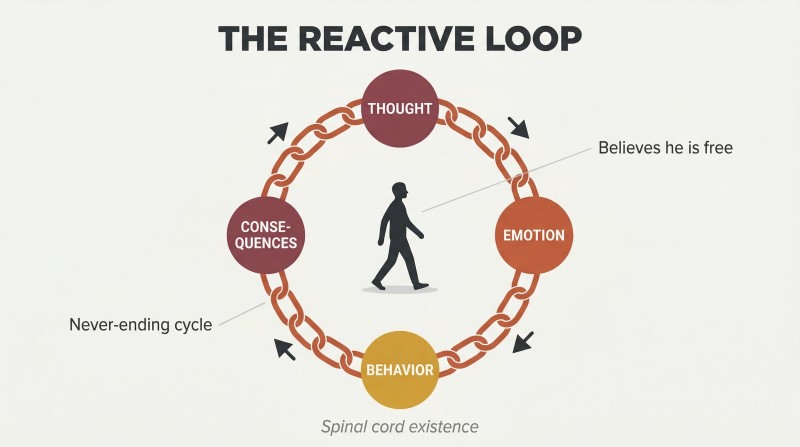
The reactive loop that runs your life. Gupta argues that 99.9% of humans live in what he calls a Spinal Cord Existence — a reactive cycle where thought produces emotion, emotion drives behavior, behavior creates consequences, and consequences trigger new thoughts. Like a knee-jerk reflex, your entire life is one long kick. You believe your decisions come from conscious reasoning, but they're scripted by a mind you never chose. The man who recognizes his prison can escape; the one who mistakes captivity for freedom stays locked inside forever.
Every preference is a chain. Your likes, dislikes, and desires aren't yours — they belong to the mind. Having preferences means the mind is doing the preferring. Desire for one thing automatically creates aversion for another, and this dual pull keeps you imprisoned while feeling free.
Atmamun isn't about calming the mind — it's about transcending it
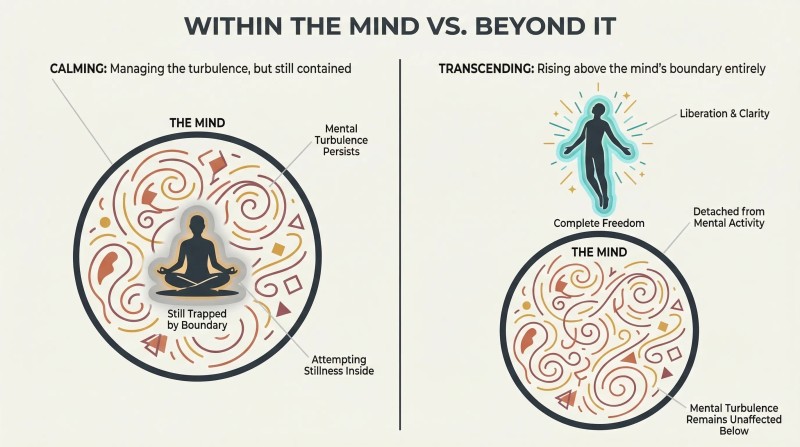
Atmamun means "Mind of the Spirit" in Sanskrit — both a process and a state of transcending the mind entirely. Gupta distinguishes it from flow states or "the zone," which are brief flickers of what he calls No-Mind (known in Japanese as Mushin): moments where the mind doesn't just quiet down — it disappears. You've tasted this in rare flashes of unexplained bliss while driving or cooking, completely independent of circumstance. Atmamun aims to make that disappearance permanent.
Understanding, not technique, is the key. Gupta uses a vivid analogy: if someone tells you there's a snake under your chair, you don't need instructions on how to move. The insight itself produces the action. Truly understanding the mind's patterns transcends it — no mantras, breathing exercises, or ten-step programs required.
Your personality is a costume you forgot you put on
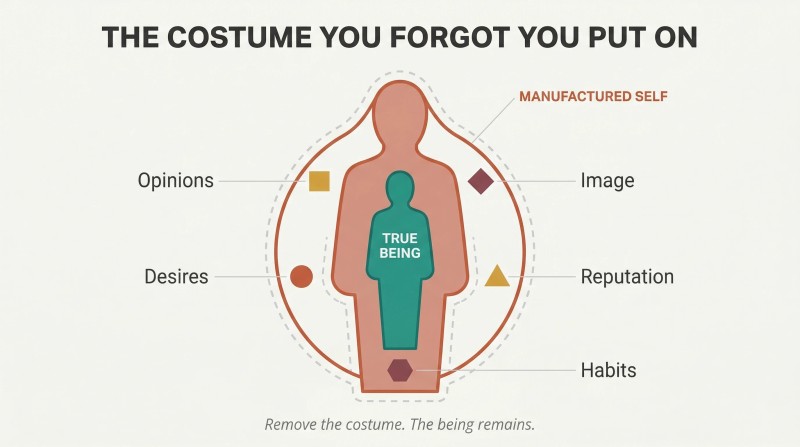
You are not who you think you are. Gupta introduces the Manufactured Self — the persona constructed from acquired opinions, preferences, philosophies, and habits. Like a manicured lawn demanding constant watering and trimming, this persona requires endless maintenance: protecting its reputation, satisfying its desires, adorning its image. A natural wooded area, by contrast, thrives without any care at all.
Consider a woman named Naomi Johnson. She believes she IS Naomi, so everything in life happens "to" her — breakups, failures, and conflicts batter her like a piñata. But Gupta argues she is actually the Being that knows a persona called Naomi Johnson was created. The persona is the source of all suffering. Remove it, and life's troubles may continue, but they lose their power to wound.
Positive thinking is just a prettier prison cell
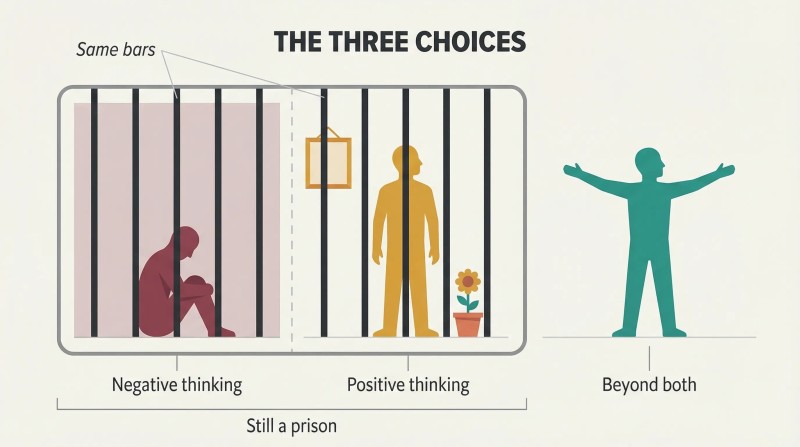
Three choices, not two. Gupta uses a cancer analogy: Medicine A causes vomiting four times weekly with daily headaches. Medicine B cuts vomiting to twice weekly with headaches every other day. Option C eliminates the cancer entirely — no side effects at all. Positive thinking is Medicine B. It's marginally better but still treats symptoms of the same disease. You're still imprisoned by the mind; you've merely redecorated the cell.
Bliss lives beyond positive and negative. Any disruption to equilibrium is a disruption — whether upward or downward. Nature doesn't label storms as "bad" and sunshine as "good." It exists in equanimity. True bliss is not a positive emotional state but a state beyond categorization — one that remains unbroken regardless of circumstance.
Stop chasing happiness — it always arrives alongside misery
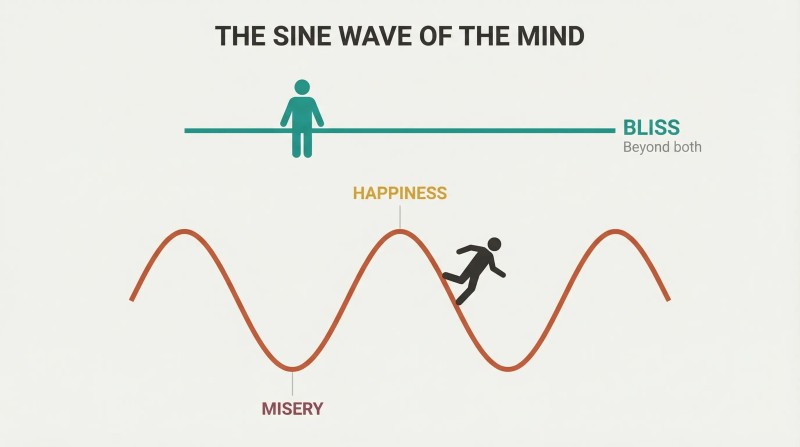
Life is a sine wave. Gupta describes human existence as an endless oscillation between peaks and troughs. Happiness and misery aren't opposites — they're two sides of the same coin. If you're happy, misery is around the corner. If you're miserable, happiness is approaching. You live vacillating between poles, loving this while hating that, striving for this while receiving that. This purgatory is inescapable as long as you live within the mind's construct.
Bliss is the exit ramp. The only escape is to stop riding the wave entirely. Bliss isn't happiness — it's beyond both happiness and sadness. It's a byproduct of wisdom: seeing that life's events carry no real value or lasting satisfaction. The one who sees the sine wave for what it is and cares for it no more steps off the ride.
Every conflict you've ever had was actually with yourself
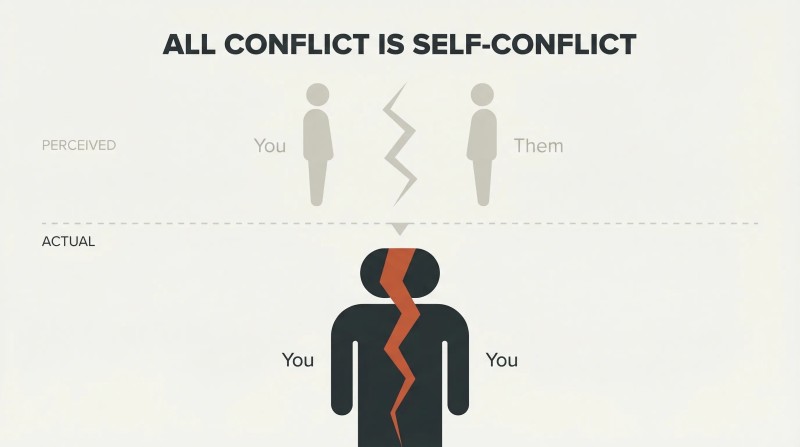
The "idiot" test reveals the mechanism. When someone calls you an idiot and anger flares, the conventional approach is to manage the anger — deep breaths, counting to ten, reframing. Gupta says this misses the root entirely. Anger arises because something within you entertains the possibility that the insult is true. The other person merely set the stage for you to examine how you feel about yourself. If internally there were zero chance of being an idiot, anger would simply not arise.
There is no "other" in conflict. Gupta states categorically that you have never had a single conflict with another human being. All conflict is self-conflict. This reframe eliminates the need to change others, seek apologies, or win arguments. Instead, examine the inner insecurity the conflict exposed.
Mindfulness keeps you asleep — wakefulness sets you free
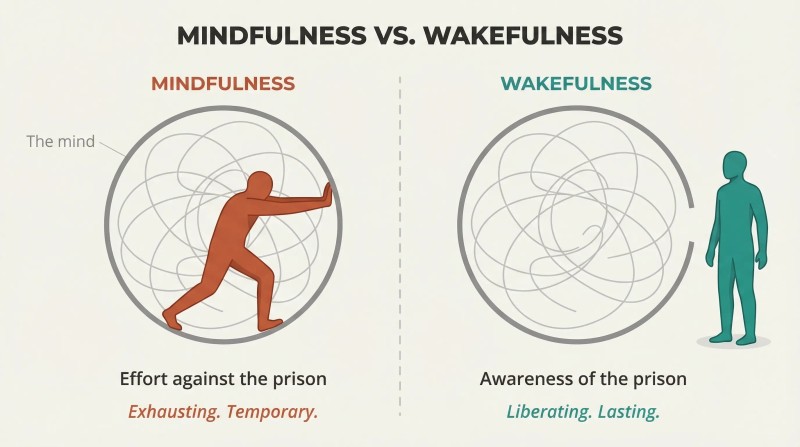
Emptying an ocean with a teacup. Gupta's critique of mindfulness is practical, not philosophical. The mind has been producing torrents of thought for millennia. You started your mindfulness practice last year. You will tire of being "present"; the mind will not. The moment you loosen your grip for a fraction of a second, it floods back in. Mindfulness, he argues, is simply not sustainable — and those who practice it for a decade remain afflicted by the same turmoil.
The Buddha didn't learn mindfulness. What Siddhartha Gautama discovered under the Bodhi Tree was wakefulness — awareness of the mind's patterns — not a technique for corralling attention into the present. Gupta distinguishes between "attempting to be mindful" (exhausting, doomed) and "becoming aware that you are not mindful" (insight-based, lasting). Awareness of your prison, not effort against it, is what liberates.
Dissolve the doer and the masterpiece appears
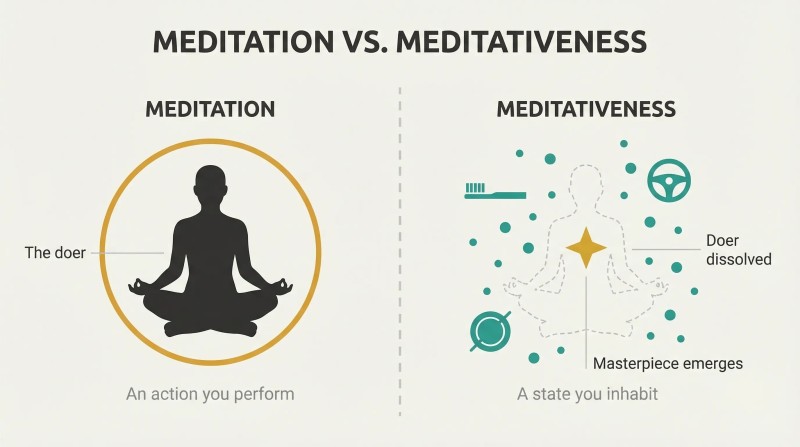
Twenty minutes of peace buys you twenty minutes. Gupta argues that sitting meditation only delivers calm while you're sitting. Resume daily activities and turmoil returns immediately. The alternative is meditativeness — making every single activity a meditation. Brushing teeth, driving to work, washing dishes, talking to your children: when you dissolve completely into each act, you become meditative. The distinction is crucial. Meditation is an action you perform; meditativeness is a state you inhabit.
Kill the meditator. The secret to masterpieces — in art, athletics, any craft — is the disappearance of the doer. When performers have the performance of their life, it's because they dissolved into the act and simply vanished. For as long as a "meditator" is "meditating," nothing transformative happens. Once the meditator disappears, all things suddenly become possible.
Your misery persists because you secretly relish it
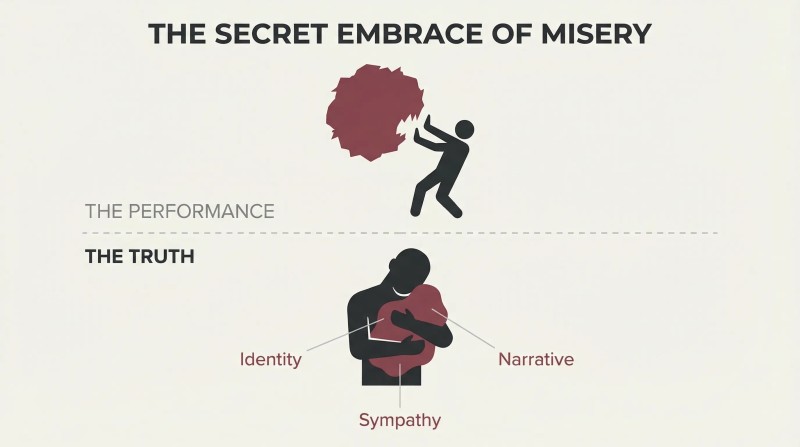
Your soap opera has a willing producer. Gupta makes a jarring claim: you don't merely tolerate your problems — you invite them. You enjoy sorrow's comfort. You find wallowing in guilt a delicacy. Playing the victim is a luxury. If someone tried to remove all your disappointments, anxieties, and miseries in a single instant, you'd fight to keep them. Because without your problems, who would you be? What would you do with your time?
Problems add meaning to an unlived life. Human beings create problems as filler for the void left by not truly living. The perceived gain from misery — identity, narrative, sympathy — exceeds the perceived gain from peace, which feels terrifyingly empty. Until you honestly admit you're keeping misery alive because it serves you, the pattern will never break.
Act as if death arrives tomorrow — it's the only real clock
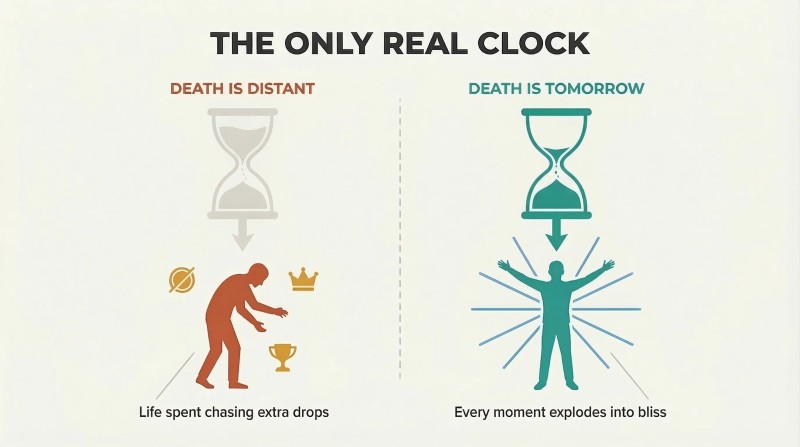
A kingdom for a bottle of water. Alexander the Great once told an Indian sage he would trade his entire kingdom for water if he were dying of thirst in the desert. The sage replied: "You are a very silly man. Devoting your entire life to waging wars and conquering lands. All for a bottle of water." We are even more foolish — we have refrigerators full of water yet waste our lives seeking an extra drop, because the urgency of death never registers.
Intellectual knowing doesn't count. You "know" you'll die the way you "know" the sun is a star — abstractly, harmlessly. Gupta insists the only useful knowing is visceral. If birth certificates displayed your death date in bold letters, you would never waste another day. If you truly grasped that you might die tomorrow, today would explode into bliss.
Analysis
Gupta's Atmamun occupies a provocative niche in spiritual philosophy — part Advaita Vedanta, part Zen, part anti-self-help manifesto. His intellectual lineage runs through Jiddu Krishnamurti, who similarly rejected all organized paths, gurus, and techniques, and echoes Eckhart Tolle's emphasis on presence — but with a sharper edge and far less accommodation for the reader's comfort.
The book's most radical proposition is not that the mind causes suffering — Buddhism established this millennia ago — but that every remedy the modern world offers (mindfulness, meditation, positive thinking, therapy) is itself part of the trap. This is genuinely destabilizing. If techniques can't free you, what can? Gupta's answer — pure understanding — is philosophically elegant but practically circular. 'When you understand, you'll understand' offers no foothold for the sincere seeker at step one.
This circularity is both the book's greatest strength and its most significant vulnerability. It mirrors the Zen koan tradition where confusion is the point and rational analysis is the obstacle. But it also means the book functions as an unfalsifiable system: if you haven't achieved No-Mind, you haven't truly understood; if you have, no further argument is needed.
Where Gupta excels is in diagnosis. His description of the Manufactured Self as the root of suffering — not life events, not other people, not circumstances — is rigorous and relentless. His reframe of ego ('not that which says you are great, but that which says you exist at all') surpasses most popular treatments of the concept. And his critique of mindfulness as 'emptying an ocean with a teacup' is among the sharpest available.
The book's implicit audience — ultra-wealthy clients who've exhausted material satisfaction — shapes its philosophy in ways worth noting. Gupta can dismiss 'jobs' and 'paychecks' partly because his clients have transcended those concerns. For readers still navigating material survival, some claims land differently. Nevertheless, the core insight — that you are not the mind that torments you — remains universally powerful and genuinely worth sitting with.
Review Summary
Atmamun is praised as a thought-provoking and transformative book that challenges conventional wisdom about life, spirituality, and self-discovery. Readers appreciate Gupta's direct and uncompromising approach to addressing fundamental questions about existence and the human mind. Many find the book's insights on mindlessness, detachment, and inner peace particularly valuable. While some consider it life-changing, others find it difficult to digest or disconnected from reality. The book is often recommended for those seeking deeper self-awareness and spiritual growth, with many readers planning to revisit it multiple times.
People Also Read





Glossary
Atmamun
Mind of the SpiritSanskrit term (Atma = spirit/soul, Mun = mind) referring to both a process and resulting state of transcending the mind entirely. Developed by Gupta over two decades, Atmamun encompasses understanding the mind's true nature, patterns, and control mechanisms in order to move beyond them—ultimately reaching a permanent state of bliss, equanimity, and freedom that goes beyond temporary flow states.
No-Mind
Mind's complete temporary disappearanceA state in which the mind does not merely quiet down but disappears altogether. Called Mushin in Japanese tradition. Gupta considers it the gateway to Atmamun. Briefly experienced during athletic 'zone' or flow states and rare flashes of unexplained bliss, No-Mind is distinguished from a calm mind—it is the absence of mind entirely, allowing direct experience without the intermediary of thought.
Spinal Cord Existence
Reactive, reflexive living loopGupta's term for the automatic cycle governing most human lives: thought produces emotion, emotion drives behavior, behavior creates a consequence, and that consequence triggers a new thought. Named after the spinal reflex (like a knee-jerk response), it describes how an estimated 99.9% of people live as 'naked nerves' twitching to every stimulus—reactive, robotic, and programmed rather than conscious and free.
Manufactured Self
Identity built from acquired conditioningThe persona or personality a person constructs over a lifetime from opinions, preferences, ideologies, habits, and social conditioning. Gupta compares it to a manicured lawn requiring constant maintenance—watering, trimming, fertilizing—versus a natural wooded area that thrives unattended. The Manufactured Self is the entity people mistake for their true identity, and Gupta identifies it as the single greatest obstacle to freedom and the root source of all suffering.
Meditativeness
All-activity meditative state of beingGupta's distinction from traditional sitting meditation. Rather than dedicating a set period to formal practice, meditativeness means transforming every activity—brushing teeth, driving, washing dishes, conversing—into a meditation by dissolving completely into the activity. The key difference: meditation is something you do for twenty minutes; meditativeness is a permanent state where the 'doer' disappears and only the activity remains.
FAQ
What's "Atmamun: The Path To Achieving The Bliss Of The Himalayan Swamis" about?
- Author's Exploration: The book is an exploration of achieving bliss and freedom akin to the Himalayan Swamis and living as a God. It delves into the nature of the mind and how it binds us.
- True Seeker's Guide: It is intended for those who are sincerely searching for transformation beyond organized religion and self-help.
- Path to Bliss: Atmamun is presented as a path to achieving unbridled freedom and the bliss experienced by the Himalayan Swamis.
- Mind and Freedom: The book emphasizes the need to break free from the mind's control to realize one's true self and experience life fully.
Why should I read "Atmamun: The Path To Achieving The Bliss Of The Himalayan Swamis"?
- Transformative Insights: The book offers insights into achieving personal transformation and freedom from the mind's constraints.
- Unique Perspective: It challenges conventional self-help and religious teachings, offering a unique perspective on achieving inner peace.
- Practical Guidance: Through dialogues and commentary, the author provides practical guidance for those seeking a deeper understanding of themselves.
- For True Seekers: It is particularly beneficial for those who are genuinely seeking a path to enlightenment and personal freedom.
What are the key takeaways of "Atmamun: The Path To Achieving The Bliss Of The Himalayan Swamis"?
- Mind as a Prison: The book emphasizes that the mind is a prison, and true freedom comes from transcending it.
- No-Mind State: Achieving a state of No-Mind is crucial for experiencing Atmamun, where one lives in clarity and freedom.
- Self-Realization: Understanding that one's manufactured self is the source of misery and that true self lies beyond the mind.
- Living in the Present: The book advocates for living in the present moment, free from the burdens of past and future.
What is the concept of "Atmamun" as described by Kapil Gupta?
- Mind of the Spirit: Atmamun translates to "Mind of the Spirit," a state where one experiences life without the interference of thought.
- Experiencing Without Thought: It involves experiencing the world directly, without thoughts registering, leading to a state of peace and wisdom.
- Beyond Flow States: Atmamun goes beyond flow states, offering a deeper understanding and transcendence of the mind.
- Freedom from Mind: It is about transcending the mind's control and using it as a tool rather than being enslaved by it.
How does Kapil Gupta define the mind in "Atmamun"?
- Intricate Web: The mind is described as a deeply intricate web that controls our thoughts, emotions, and behaviors.
- Not You: The author emphasizes that the mind is not you; it is a filter through which you experience life.
- Source of Turmoil: The mind is the source of all turmoil, and understanding its nature is key to transcending it.
- Illusion of Control: People believe they control their lives, but in reality, they are controlled by their minds.
What is the "No-Mind" state in "Atmamun"?
- Gateway to Atmamun: No-Mind is described as the gateway to Atmamun, where one transcends the mind's control.
- State of Clarity: It is a state of clarity and freedom, where one experiences life directly without the mind's interference.
- Transcending Thought: Achieving No-Mind involves transcending thought and experiencing life as it is.
- Ultimate Freedom: It represents ultimate freedom and the ability to use the mind as a tool rather than being enslaved by it.
What does Kapil Gupta say about meditation in "Atmamun"?
- Beyond Traditional Meditation: The book argues that traditional meditation practices are insufficient for achieving true peace.
- Meditative Living: It advocates for a meditative approach to life, where every action becomes a meditation.
- Allowing, Not Doing: Meditation is about allowing and stillness, not about doing or achieving something.
- Killing the Meditator: True meditation involves losing oneself in the activity, allowing the doer to disappear.
How does "Atmamun" address the concept of happiness and misery?
- Happiness as a Reaction: The book suggests that the search for happiness is a reaction to unhappiness and both are sides of the same coin.
- Beyond Moods: Happiness and sadness are moods, and true bliss lies beyond these transient states.
- Wisdom and Bliss: Bliss is a byproduct of wisdom and understanding the true nature of life.
- Abandoning the Search: The path to bliss involves abandoning the search for happiness and pleasure.
What role does the concept of death play in "Atmamun"?
- Instant Bliss: The realization of one's mortality is presented as a path to instant bliss.
- Finite Time: Understanding that time is finite encourages living fully in the present moment.
- Motivator for Living: Death is seen as a motivator to live life fully and not waste time on trivial pursuits.
- Perspective on Life: The awareness of death brings perspective, helping one focus on what truly matters.
How does Kapil Gupta view the concept of parenting in "Atmamun"?
- Nature Raises Children: The book argues that nature, not parents, raises children, and parents often interfere with this process.
- Power and Control: Parents often abuse their power, imposing their minds and prejudices on their children.
- Learning from Children: Instead of teaching, parents should learn from their children's natural joy and spontaneity.
- Creating an Environment: The role of a parent is to create an environment of peace and freedom for the child to thrive.
What does "Atmamun" say about the pursuit of success and wealth?
- Attachment is Poison: The book emphasizes that attachment to success and wealth is the source of misery.
- True Freedom: True freedom comes from being unattached to possessions and achievements.
- Rich Man's Luxury: The greatest luxury of wealth is the ability to turn inward and seek true freedom.
- Beyond Material Success: Atmamun encourages looking beyond material success to find inner peace and fulfillment.
What are the best quotes from "Atmamun" and what do they mean?
- "The moment that man gains freedom from his mind, he becomes a living, breathing God!" This quote encapsulates the book's central theme of transcending the mind to achieve ultimate freedom and divinity.
- "Man’s greatest dilemma is that he lives in a prison and he believes that he is free." It highlights the illusion of freedom while being controlled by the mind.
- "If you knew that you were going to die tomorrow, today would be the most blissful day of your life." This quote emphasizes the importance of living fully in the present moment, aware of life's impermanence.
- "The greatest freedom that we have is the freedom to walk away from ourselves." It suggests that true liberation comes from shedding the manufactured self and embracing one's true nature.
Download PDF
Download EPUB
.epub digital book format is ideal for reading ebooks on phones, tablets, and e-readers.








































