
Plot Summary
The Unyielding Morning
Antigone rises before the world, slipping out into the gray, expectant morning. Her solitude is heavy with purpose, her mind already set on a course that will pit her against the world. The Nurse, her childhood caretaker, senses something amiss but cannot reach the depths of Antigone's resolve. This morning is not like others; it is charged with the knowledge of impending doom. Antigone's youth and longing for life are palpable, yet she is drawn inexorably toward her destiny. The world, still asleep, is indifferent to her turmoil, but Antigone is already awake to the demands of conscience and the inevitability of sacrifice.
Sisters in Dissonance
Antigone confides in her sister Ismene, revealing her plan to defy King Creon's decree and bury their disgraced brother Polynices. Ismene, cautious and fearful, pleads for reason, urging Antigone to consider the consequences. Their conversation is a collision of temperaments: Antigone's fierce idealism against Ismene's pragmatic caution. Ismene's love is real, but her fear of death and the mob's cruelty is stronger. Antigone, unmoved, insists that some acts must be done for their own sake, regardless of the cost. The sisters' bond is tested, and Antigone's isolation deepens as she chooses the path of defiance alone.
The King's Edict
Creon, newly crowned, issues a harsh edict: Eteocles, the loyal son, will be honored in death, while Polynices, the rebel, is to remain unburied, a warning to traitors. The city is tense, the wounds of civil war still fresh. Creon's decision is not born of cruelty but of a desperate need for order and legitimacy. He is weary, burdened by the demands of leadership, and determined to suppress chaos at any cost. The edict is both a political necessity and a personal trial, setting the stage for the inevitable clash between public duty and private loyalty.
Love's Fragile Dawn
In a rare moment of intimacy, Antigone seeks comfort in Haemon, Creon's son and her fiancé. Their love is tender but shadowed by unspoken fears. Antigone's vulnerability surfaces as she imagines a future that will never be, confessing her longing for a simple, happy life. Haemon's devotion is unwavering, but Antigone's words are tinged with finality. She asks for forgiveness, hinting at the sacrifice to come. Their embrace is bittersweet, a fleeting respite before the storm. The promise of love is overwhelmed by the demands of conscience and fate.
The Secret Burial
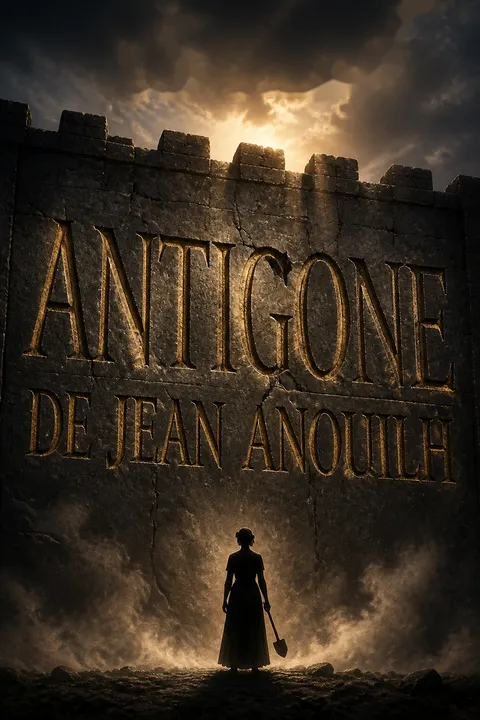
Under cover of darkness, Antigone performs the forbidden rites for Polynices, using a child's shovel to cover his body. Her act is both a gesture of love and a declaration of autonomy. The guards, indifferent and preoccupied with their own lives, are nonetheless vigilant. The burial is discovered, and suspicion falls on an unknown perpetrator. Antigone's resolve is unshaken; she has done what she believes is right, regardless of the consequences. The act sets the machinery of tragedy in motion, and Antigone's fate is sealed.
Guards and Games
The guards, comic and banal, discuss their duties with a mixture of fear and self-interest. Their world is one of routine, bonuses, and petty anxieties. When Antigone is caught attempting to rebury Polynices, they treat her with a mixture of roughness and bemusement. Their indifference underscores the impersonality of the state's power. For them, Antigone is just another prisoner, her suffering irrelevant to their daily concerns. The machinery of authority grinds on, oblivious to the moral stakes of the drama unfolding before them.
Antigone Exposed
Brought before Creon, Antigone confesses without hesitation. She claims responsibility for both burials, refusing to hide or plead for mercy. Her confrontation with Creon is stark and uncompromising. She insists that her actions were dictated by duty to her brother and to herself, not by any hope of reward or recognition. Creon is both infuriated and bewildered by her intransigence. The personal becomes political, and the private act of mourning becomes an act of rebellion. Antigone's isolation is complete, but her dignity remains intact.
Creon's Dilemma
Creon is torn between his role as king and his feelings as uncle. He tries to reason with Antigone, offering her a way out if she will only recant. He reveals the sordid truth about her brothers, hoping to disillusion her and save her life. But Antigone is unmoved; her faith is not in her brothers' virtue but in the necessity of her own act. Creon's authority is challenged, and his humanity is exposed. He is forced to choose between compassion and the demands of the state, knowing that either choice will bring suffering.
Clash of Wills
The confrontation between Antigone and Creon escalates into a battle of philosophies. Antigone's "no" is absolute, a refusal to compromise or accept the world as it is. Creon's "yes" is the acceptance of responsibility, the burden of leadership, and the necessity of order. Their debate is fierce, each accusing the other of cowardice and blindness. Neither can yield without betraying their deepest convictions. The tragedy is not in their failure to understand, but in the impossibility of reconciliation. The machinery of fate moves inexorably forward.
The Cost of Obedience
As the news of Antigone's defiance spreads, Creon is trapped by his own edict. The people demand punishment, and exceptions cannot be made without undermining his authority. Haemon pleads for Antigone's life, but Creon cannot relent. The law must be upheld, even at the cost of personal happiness. The consequences of obedience are devastating: love is sacrificed, innocence destroyed, and the city's wounds are deepened. The price of order is paid in blood and sorrow.
The Impossible Choice
Imprisoned and awaiting death, Antigone contemplates her fate. She is visited by a guard, whose mundane concerns contrast sharply with her existential anguish. Antigone writes a final letter, struggling to articulate the meaning of her sacrifice. She is afraid, uncertain, yet resolute. The act of dying becomes an assertion of selfhood, a refusal to be reduced to silence or submission. The impossible choice is made: to die rather than betray her own sense of justice.
Haemon's Despair
Haemon, devastated by Antigone's impending death, confronts his father. The bond between father and son is shattered by the demands of the state. Haemon's pleas are met with resignation; Creon cannot save Antigone without destroying himself. Haemon's grief turns to rage and despair. The personal cost of political necessity is laid bare, and the cycle of suffering continues. Love, once a source of hope, becomes another casualty of the tragic order.
The Prison Cell
Alone in her cell, Antigone faces the end. The guard, awkward and well-meaning, offers small comforts, but nothing can alleviate her isolation. Antigone's thoughts turn to her family, her lost childhood, and the meaning of her actions. She is both terrified and defiant, clinging to the integrity of her choice. The world outside is indifferent, and even the machinery of execution is banal. Antigone's solitude is the price of her freedom, and her death is both a defeat and a victory.
Letters and Farewells
Antigone attempts to send a final message to Haemon, but the words fail her. She cannot explain her actions or justify her death. The letter becomes a simple plea for forgiveness and love. The guard, unable to comprehend the depth of her anguish, is left with a sense of unease. Antigone's farewell is incomplete, her longing for connection unresolved. The tragedy of communication—of words that cannot bridge the gap between souls—echoes in her final moments.
Death in the Cave
Antigone is led to her death, entombed alive in a cave outside the city. The act is both ritual and punishment, a spectacle for the city and a private agony for the victim. Haemon, unable to bear her loss, takes his own life beside her. Their deaths are swift, brutal, and final. The machinery of tragedy has run its course, leaving only silence and grief in its wake. The lovers are united in death, their defiance transformed into legend.
The Queen's Silence
News of Haemon's death reaches Eurydice, Creon's wife. She receives the blow with calm resignation, finishing her knitting before retreating to her room. There, in silence and solitude, she takes her own life. Her death is understated, a final act of withdrawal from a world she cannot change. The cost of power is measured in the quiet suffering of those left behind. The palace is emptied of joy, and Creon is left alone with his burdens.
The Weight of Power
Creon, stripped of family and comfort, confronts the emptiness of victory. The demands of leadership have left him bereft, his authority intact but his soul wounded. The chorus reminds him—and us—that the work of the world continues, indifferent to individual suffering. Creon's tragedy is not only in what he has lost, but in what he must continue to endure. The machinery of the state grinds on, and the survivors are left to forget and move forward.
The Enduring Tragedy
As the dust settles, the chorus reflects on the nature of tragedy. All those who were meant to die have died, and those who remain will soon forget. The guards resume their card game, indifferent to the suffering that has passed. The city returns to its routines, and the memory of Antigone fades. Yet the questions she raised—the meaning of justice, the cost of obedience, the possibility of happiness—linger in the silence. The tragedy endures, not in the spectacle of death, but in the quiet persistence of life.
Analysis
Anouilh's Antigone is a meditation on the conflict between individual conscience and the demands of authority, set against the backdrop of war and occupation. The play's enduring power lies in its refusal to offer easy answers: Antigone's defiance is both heroic and self-destructive, while Creon's pragmatism is both necessary and devastating. The tragedy is not simply the result of stubbornness or misunderstanding, but of the irreconcilable demands of justice, love, and order. Anouilh strips the myth to its essentials, exposing the existential core of the conflict: the need to say "no" in a world that demands "yes." The play resonates in any era where power seeks to suppress dissent, and where the cost of integrity is isolation or death. Ultimately, Antigone asks whether happiness is possible in a world built on compromise, and whether the refusal to compromise is an act of courage or futility. The silence that follows the tragedy is both a warning and a challenge to the living.
Review Summary
Readers broadly admire Anouilh's modern retelling, praising its morally complex characters and its resonance as a covert critique of Nazi-occupied France. Many note that Creon becomes surprisingly sympathetic — reasonable rather than tyrannical — while Antigone appears more emotionally driven than nobly principled, unlike Sophocles' version. The play's secular, pessimistic tone strips away religious justification, leaving Antigone's defiance as purely personal. Several reviewers highlight the remarkable historical context of its 1944 Paris premiere under German censorship, and many consider it a timeless exploration of idealism versus pragmatic compromise.
People Also Read



Characters
Antigone
Antigone is the play's moral center, a young woman driven by an unyielding sense of duty and justice. Her love for her brother Polynices and her refusal to accept Creon's edict propel her into open defiance. Antigone's psychology is marked by a fierce independence and a longing for meaning, even at the cost of her own life. She is isolated by her convictions, unable to compromise or accept the world's limitations. Her relationships—with Ismene, Haemon, and Creon—are defined by her refusal to yield. Antigone's development is a journey from youthful longing to tragic martyrdom, her death both a defeat and a triumph of integrity.
Creon
Creon is a man transformed by power, forced to choose between personal affection and public duty. Once a lover of art and music, he is now hardened by the demands of kingship. His edict against Polynices is both a political necessity and a personal torment. Creon's psychology is complex: he is neither a villain nor a tyrant, but a man trapped by circumstance and responsibility. His attempts to save Antigone reveal his humanity, but his inability to bend leads to catastrophe. Creon's tragedy is the isolation that comes with power, and his final reckoning is one of profound loneliness and regret.
Ismene
Ismene is Antigone's foil, embodying caution, pragmatism, and a deep fear of suffering. She loves her sister and mourns their brother, but cannot bring herself to defy Creon's law. Ismene's psychology is shaped by a desire for safety and normalcy, her reluctance to act rooted in a realistic appraisal of danger. Her eventual offer to share Antigone's fate is too late, a gesture of love that cannot undo her earlier hesitation. Ismene's development is a study in the limits of empathy and the tragedy of missed courage.
Haemon
Haemon is Creon's son and Antigone's fiancé, caught between filial duty and passionate love. His initial optimism and faith in reason are shattered by the intransigence of both Antigone and Creon. Haemon's psychology is marked by vulnerability and idealism; he is unable to reconcile the demands of authority with the needs of the heart. His despair at Antigone's death leads him to suicide, a final act of protest and union. Haemon's arc is a poignant exploration of love's power and its ultimate impotence in the face of fate.
The Nurse
The Nurse is a figure of comfort and stability, representing the world of childhood and domestic order. Her love for Antigone is practical and protective, but she cannot comprehend the depth of Antigone's resolve. The Nurse's psychology is rooted in habit and routine, her anxieties focused on the small details of daily life. She is powerless to prevent the tragedy, her role limited to offering solace and warmth. The Nurse's presence underscores the loss of innocence and the irretrievability of safety.
Eurydice
Eurydice, Creon's wife, is a background presence until the play's end, when her quiet despair culminates in suicide. She is a figure of endurance, tending to her knitting and her household even as her family unravels. Eurydice's psychology is marked by resignation and a stoic acceptance of suffering. Her death is understated but devastating, a final withdrawal from a world she cannot change. Eurydice's fate highlights the collateral damage of power and the silent suffering of those left behind.
The Chorus
The Chorus serves as commentator and conscience, framing the action and reflecting on its meaning. Detached yet empathetic, the Chorus articulates the inevitability of tragedy and the futility of resistance. Its psychology is one of resignation, accepting the machinery of fate as inexorable. The Chorus connects the audience to the larger themes of the play, offering perspective and, ultimately, a sense of closure. Its presence is both comforting and chilling, a reminder of the limits of human agency.
The Guards
The Guards are the play's most ordinary characters, concerned with pay, routine, and minor pleasures. Their psychology is marked by indifference and self-interest; they are cogs in the machinery of authority, unmoved by the suffering they witness. The Guards' banter provides comic relief, but their actions are a chilling reminder of the impersonality of state violence. They are both perpetrators and victims of the system, their humanity dulled by habit and necessity.
The Messenger
The Messenger appears briefly but crucially, delivering news of death and disaster. His role is to bridge the gap between action and aftermath, translating private suffering into public knowledge. The Messenger's psychology is marked by a sense of foreboding and helplessness; he is a witness to catastrophe, unable to intervene. His presence underscores the inevitability of loss and the relentless advance of fate.
The Page
The Page is Creon's young attendant, a minor character who represents innocence and the promise of the future. His psychology is unformed, shaped by obedience and curiosity. The Page's interactions with Creon highlight the generational divide and the cost of growing up in a world marked by tragedy. He is a silent witness to the play's events, his presence a reminder of what is lost in the pursuit of order and authority.
Plot Devices
The Machinery of Tragedy
Anouilh's Antigone is structured as a classical tragedy, with the Chorus explicitly framing the action as predetermined and inescapable. The narrative unfolds with a sense of inevitability, each character trapped by their role and unable to alter the course of events. Foreshadowing is used throughout, with the Chorus and characters themselves acknowledging the futility of resistance. The play's structure emphasizes the contrast between individual agency and the impersonal forces of history and power. Dialogue is sharp and philosophical, serving both as exposition and as a means of exploring existential questions. The use of ordinary, even comic, elements—such as the Guards' banter—heightens the sense of absurdity and futility. The tragedy is not in the spectacle of death, but in the relentless logic that drives each character to their doom.
Download PDF
Download EPUB
.epub digital book format is ideal for reading ebooks on phones, tablets, and e-readers.








































