
Key Takeaways
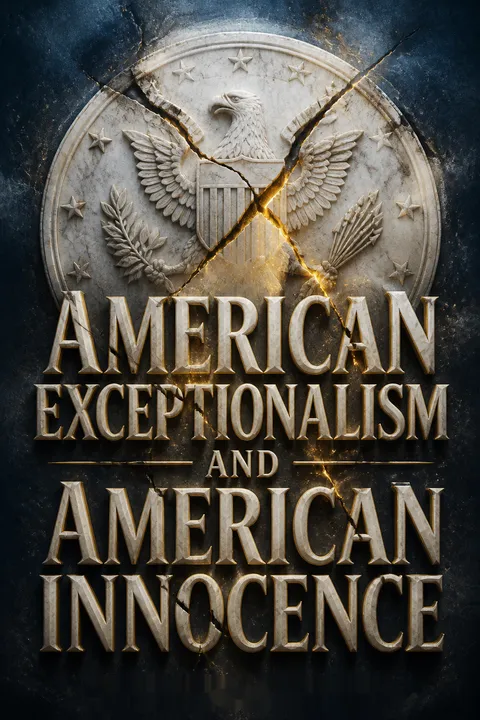
1. American Exceptionalism and Innocence are Foundational Myths
Thus, the only “news” ever reported by various channels of U.S. empire is the news of American exceptionalism and American innocence. And as this book will hopefully show, it’s all fake.
Pervasive narratives. American exceptionalism and innocence are deeply embedded ideologies, functioning as "fake news" that shape public understanding of the United States. These narratives are not new, predating figures like Donald Trump, and are consistently disseminated through various channels, from political slogans to popular media. They present the U.S. as a unique beacon of democracy and freedom, inherently superior and acting with benevolent intentions on the global stage.
Obscuring realities. These ideologies serve to mask the destructive human toll of U.S. colonial occupation, imperial expansion, and structural racism. They rationalize centuries of war and plunder by framing them as necessary ventures to defend or expand "founding values." This "social organization of forgetting" allows Americans to believe the present is innocent of the past that produced it, preventing critical examination of the nation's true character.
Consequences of belief. The belief in American exceptionalism and innocence leads to a psychological tension, where the nation can claim fidelity to universal values while systematically assaulting them. This allows for the acceptance of state violence, economic sanctions, and military interventions without apparent contradiction. Challenging these narratives is crucial for disrupting the "psychosocial logics" that limit imagination and prevent the pursuit of socially transformative alternatives.
2. U.S. History is Rooted in Settler Colonialism and Slavery
The United States is a nation defined by its original sin: the genocide of American Indians [. . .]
Foundational violence. The formation of America is fundamentally anchored in the colonial genocide of Indigenous peoples and the enslavement of African peoples. This history is often erased or minimized by an origins myth that glorifies the "American Revolution" as a progressive step for humanity, detached from its violent context. The "Founding Fathers," many of whom were slave owners and land thieves, are venerated as democratic standard-bearers, obscuring the subjugation they imposed.
Liberalism's contradiction. Western liberalism, with its emphasis on individual rights and autonomy, emerged through the clash with Africa and the Americas, making "freedom" dependent on the "un-freedom" of others. The Proclamation of 1763, which restricted colonial expansion into Indigenous territory, was seen as an infringement on "liberty," highlighting how the desire for land and profit drove the "revolution." This framework cemented private property and racialized classifications to justify dispossession.
Afterlives of oppression. The "afterlives of slavery" and settler colonialism persist today, manifesting in mass incarceration, racial wealth disparities, and the continued marginalization of Indigenous communities. Narratives of American exceptionalism and innocence dismiss these ongoing realities as "past events" or "mistakes," rather than recognizing them as enduring structures. This prevents genuine redress and the imagining of a decolonial future.
3. Wars are Driven by Imperial Ambition, Not Benevolence
The United States’ decisive entrance into the war supposedly made it the force that saved the world from the spectre of fascism and barbarity.
Profit and dominance. By the 1840s, the burgeoning American capitalist economy, fueled by genocide and slavery, sought global expansion. World War I and II were not merely struggles between "good" and "evil" but intense drives for colonial expansion and the division of the world among imperialist nations for profit. The U.S. emerged from WWII as the sole superpower, taking credit for defeating the Great Depression and Fascism, bolstering its exceptionalist narrative.
Hidden motivations. The "good war" narrative of World War II, for instance, obscures the U.S.'s initial corporate support for Nazi Germany (seeing it as an "antidote against Bolshevism") and its provocation of Japan prior to Pearl Harbor. The atomic bombings of Hiroshima and Nagasaki, often justified as necessary to end the war, were also strategic moves to intimidate the Soviet Union in preparation for the Cold War. This pattern reveals that U.S. involvement in wars is primarily driven by strategic and economic interests, not purely humanitarian ones.
Endless conflicts. The Korean War, often called "the Forgotten War," exemplifies how American exceptionalism and innocence erase the true costs and motivations of U.S. aggression. The war, which killed three million Koreans, was framed as a "police operation" against communism, dehumanizing Koreans as "fanatics" and "gooks." This narrative served to secure Japan's economic and military role as a bulwark against communism, demonstrating how U.S. wars are preconditions for broader imperial arrangements.
4. White Supremacy is Embedded in American Structures
If the systems of American capitalism and imperialism possess white supremacy at the root, then every branch of the American nation-state is a monument to white supremacy.
Systemic design. White supremacy is not merely individual hatred or a relic of the past; it is a foundational pillar in the architecture of American society, permeating every institution. Events like the Charlottesville protests, while highlighting overt racism, often distract from the deeper, structural ways white supremacy operates. The mainstream discourse tends to frame white supremacy as an aberration, rather than a core design feature of the American way of life.
Monuments of oppression. The U.S. prison regime, with its disproportionate incarceration of Black Americans, serves as a stark monument to white supremacy, rooted in the Thirteenth Amendment's exception clause for criminal punishment. Wall Street, too, is a monument to white supremacy, having been built on the financing of the slave trade and continuing to extract wealth from Black communities. Even popular culture, such as the National Anthem (written by a slave owner) and musicals like "Hamilton" (which "blackwash" slave-owning founders), reinforces these white supremacist narratives.
Racial innocence. "Racial innocence" allows white Americans to acknowledge racial inequality while construing it as separate from their own advantages, interpreting economic privilege as individual merit. This prevents them from recognizing their active participation in systems that benefit them at the expense of people of color. The "product of their time" argument for slave-owning founders, for example, erases the agency and resistance of enslaved people, perpetuating a narrative of white benevolence.
5. The "American Dream" is a Myth of Racialized Capitalism
The ability to distinguish between the ideology of the American Dream and the experience of the American nightmare requires political analysis, history, and often struggle.
False promise. The "American Dream" is a core principle of American exceptionalism, promoting the myth of meritocracy where wealth is achievable through hard work. This narrative legitimizes the opulent wealth of the ruling class while obscuring the systemic exploitation and racialized inheritance that underpin American capitalism. For most Black Americans, due to the legacies of white supremacy and mass enslavement, the "American Dream" has always been an "American Nightmare."
Wealth disparity. Studies reveal a dramatic decline in Black wealth, with projections of it reaching zero by 2053, while white wealth has increased. This disparity is exacerbated by policies like subprime "ghetto loans" that targeted Black families. The "hero mentality," where Black politicians and celebrities are presented as proof of the American Dream, further masks these systemic issues, diverting attention from the fact that wealth accumulation is often predicated on exploitation.
Systemic, not individual. The "American Dream" ideology relies on individualism, which renders the collective punishment of capitalism invisible. It ignores how banks, businesses, and corporations depend on government intervention (military contracts, bailouts, tax shelters for nonprofits) to maximize profits, creating a "trickle up" economy where the poor subsidize the wealthy. Challenging this myth requires recognizing capitalism as a racialized inheritance system and imagining a world without private property and the "American Dream."
6. U.S. Imperialism Extends Domestically and Globally
For blacks, the ‘war on terror’ hasn’t come home. It’s always been here.
Interconnected oppression. The Black Lives Matter movement highlights the deep connection between police violence against Black Americans and U.S. imperialism and militarism abroad. Police departments, often armed with military-grade weaponry transferred from the Pentagon, act as occupation armies in Black communities, mirroring the tactics used by U.S. forces in countries like Iraq or Afghanistan. This demonstrates that the "war on terror" is not a new phenomenon for Black communities but a continuation of historical oppression.
Global reach. The U.S. military, with its trillion-dollar budget and over 800 bases worldwide, is the armed body of the state, enforcing exceptionalism through ideological and material violence. This global apparatus is designed to protect the profits of multinational corporations and financial monopolies, often through drone strikes, proxy wars, and destabilization campaigns that kill millions and leave countries in ruin. The militarization of American society, including "paid patriotism" in sports, reinforces this global empire.
Black internationalism. Historically, Black radical thinkers like Claudia Jones, Paul Robeson, and Malcolm X understood the symbiotic relationship between capitalism, sexism, colonialism, racism, and empire. They advocated for Black internationalism, recognizing that Black liberation in the U.S. is intertwined with the freedom of oppressed nations globally. This perspective challenges the single-issue reform projects often promoted by the ruling class, which seek to neutralize movements by divorcing domestic struggles from global imperialism.
7. "Human Rights" and "Inclusion" are Imperialist Tools
The belief that marginalized and hated populations can find freedom by being recognized by law, allowed to serve in the military, allowed to marry, and protected by anti-discrimination law and hate crime statutes is a central narrative of the United States [. . .]
Selective application. The U.S. selectively deploys "human rights" discourse to justify its global actions, framing military interventions as righteous motivations for "doing something" about violations abroad. This narrative masks the U.S.'s own extensive record of war crimes and human rights abuses, often portraying itself as a "bystander" rather than a perpetrator. This double standard is evident in its condemnation of adversaries while supporting allies like Saudi Arabia and Israel, who commit egregious human rights violations.
Violence of inclusion. The "politics of inclusion," particularly prominent during the Obama era, offers cosmetic changes to empire by integrating women, people of color, and LGBTQ+ individuals into positions of power. However, this "violence of inclusion" often comes at the expense of structural change, enhancing public acceptance of oppressive institutions like the military. "Pinkwashing," for example, markets oppressive institutions as LGBTQ+-friendly to distract from their inherent exploitation and war aims, as seen with the U.S. military and Israel.
False promises. Legal reforms, such as hate crime legislation or the legalization of gay marriage, are often presented as progress but fail to address the root causes of oppression. These top-down reforms are dictated by the ruling class and can even expand the war apparatus, as hate crime bills have been tied to increased military spending. This approach assumes the imperial state is designed to serve the vulnerable, rather than manage their exploitation, ultimately reinforcing American exceptionalism and innocence.
8. Blaming External Enemies Distracts from Internal Crises
Governments and societies of exceptionalist states develop a need to have external enemies; for this reason, threats are often concocted or, where minor, are inflated to extreme proportions.
Concocted threats. The ongoing "Russia hysteria" in the U.S. political establishment and corporate media exemplifies how exceptionalist states create external enemies to distract from internal crises. Despite Russia's economy and military being a fraction of the U.S.'s, and allegations of election interference lacking conclusive evidence, the narrative of Russian subversion has been heavily promoted. This serves to exonerate figures like Hillary Clinton from accountability for electoral losses and to achieve broader bipartisan objectives.
Imperial objectives. The demonization of Russia justifies continued U.S. military expansion worldwide, including NATO's encroachment on Russia's borders and increased military budgets. This "new Cold War" frames Russia as "bad" for alleged actions that are, ironically, staples of U.S. foreign policy (e.g., undermining elections, causing instability). This narrative allows the U.S. to maintain its self-proclaimed "good" status, regardless of its own war crimes and human rights abuses.
Suppressing dissent. Domestically, the Russia blame game has led to a counterinsurgency against dissent, similar to the first Cold War. Progressive and radical voices, including movements like Black Lives Matter, have been accused of being Russian dupes, leading to censorship and the suppression of alternative media. This strategy diverts attention from the deep crisis of legitimacy facing the American political system, which many observers describe as an oligarchy, not a democracy.
9. Militarism is Central to American Identity and Control
In Christianity the revivified totem is the risen Christ. In American nationalism the transformed totem is the soldier resurrected in the raised flag. On the basis of his sacrifice the nation is rejuvenated.
Ritualistic worship. The ritualistic celebration of militarism is fundamental to American exceptionalism, codifying nationalism into the American psyche. The flag serves as a central totem, inspiring a religious-like devotion where citizens are coerced into giving their bodies to the state. This worship permeates all aspects of American life, from sporting events and beer commercials to federal holidays and Hollywood films, which often valorize military dominance and combat.
Propaganda machine. The U.S. military and intelligence agencies actively shape popular culture, influencing over 1,800 movies and TV shows to portray the military favorably and remove any critiques. This propaganda, combined with "paid patriotism" in sports leagues like the NFL and NCAA, normalizes war and commodifies soldiers as "heroes." This ensures that the military is seen as a force for "American unity" and "sacrifice," rather than an agent of repression and plunder.
Hypocrisy and cost. While holidays like Veterans Day celebrate military "sacrifice," they obscure the true costs of war, including the millions killed abroad and the suffering of veterans at home (poverty, suicide, addiction). Figures like Frederick Douglass exposed the hypocrisy of celebrating "liberty" while perpetrating slavery. This selective glorification of militarism, often racialized, serves to unite white Americans in service of conquest and profit, while silencing those who challenge the state's violence.
10. Dismantling These Ideologies Requires Radical Unlearning
To abandon our attachment to American exceptionalism, American innocence, and to “America” itself requires transformative change.
Unlearning the myths. To move beyond the U.S.'s current course of global destruction, progressive and radical movements must actively unlearn the ideologies of American exceptionalism and innocence. This process is "messy and unsettling" because these narratives are deeply tied to personal and collective identities, as well as the material benefits derived from "American-ness." It requires confronting the "fake news" that portrays the U.S. as benevolent and freedom-loving, despite its history of violence and exploitation.
Questioning foundations. A radical anti-war movement must question the very foundations of the American nation-state, including its borders, concepts of belonging, and citizenship. This means recognizing that U.S. borders are "demarcations of war and corporate plunder" and that "citizenship" has historically been defined by proximity to whiteness, excluding and criminalizing vast populations. The "Indigenous dream" of a "world without an America" offers a vision beyond a "kinder, gentler settler state founded on genocide and slavery."
Transnational solidarity. True liberation requires moving beyond narrow American nationalism and embracing international solidarity. This involves connecting domestic struggles against racism, poverty, and mass incarceration with global anti-imperialist movements. It means rejecting the U.S. military's definition of "liberation" and instead advocating for a new, socialist system where solidarity replaces borders, self-determination guides nations, and the needs of the dispossessed determine control over production for the benefit of the planet.
People Also Read


Download PDF
Download EPUB
.epub digital book format is ideal for reading ebooks on phones, tablets, and e-readers.








































