

Key Takeaways
You don't enjoy vaping; you enjoy briefly ending nicotine's own discomfort
The book's central reframe: vaping delivers no genuine pleasure. Every satisfying puff simply relieves the mild, empty, insecure feeling created by the previous dose withdrawing. It is like wearing shoes a size too small all day just for the relief of taking them off. Painful and pointless.
Carr uses a con-artist analogy: imagine a thief secretly steals $100 from your account, then hands you back $10. You feel grateful until you learn the whole setup. Nicotine is that thief. Before your first vape you felt calm and complete. Nicotine created the void, then poses as the thing that fills it. Non-vapers never feel this emptiness, and neither did you until you started.
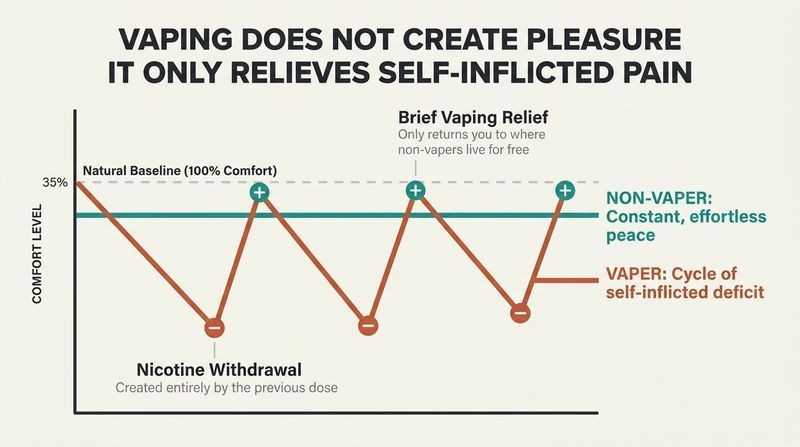
This inversion, that the reward is escape from a self-inflicted deficit rather than a genuine gain, echoes the opponent-process theory in psychology, where the body counteracts a stimulus and the relief of that counteraction becomes the real driver. It also parallels behavioral economics on reference points: addiction resets your baseline downward, so mere restoration feels like a win. The claim that literally zero pleasure exists is arguably overstated (nicotine does modestly affect attention and mood in controlled studies), but as a therapeutic frame it is powerful because it dismantles the perceived trade-off addicts believe they are making.
Nicotine withdrawal is 1% physical, 99% mental panic
Carr splits addiction into two enemies. The Little Monster is the physical craving: a barely perceptible, hunger-like emptiness as nicotine leaves the body. It is genuinely feeble. Within eight hours of quitting you are 97% nicotine-free, and within three days, completely clean.
The Big Monster is the mental belief that vaping provides pleasure or a crutch. This is what causes real suffering. The agonizing symptoms people report when quitting are not the drug leaving; they are the response to a thought loop: I want a vape, I can't have one, aaargh. Carr's proof: ex-vapers still pining years later have zero nicotine in their bodies. Kill the Big Monster with understanding first, and the Little Monster dies painlessly on its own.
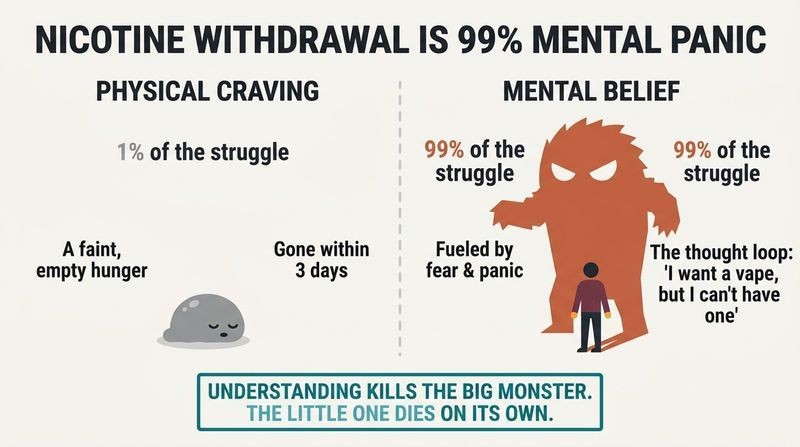
The physical/psychological split is broadly consistent with addiction neuroscience: nicotine clears fast, and much relapse is cue-driven and cognitive rather than pharmacological. The precise 1%/99% figures are rhetorical rather than measured, and some clinicians would argue physical withdrawal (irritability, poor concentration) is more substantial than Carr allows. Yet the core point that expectation and framing amplify discomfort is well supported by placebo and nocebo research. What is clinically shrewd here is targeting belief before behavior, the reverse of willpower approaches, anticipating cognitive behavioral therapy's insistence that thoughts, not events, generate feelings.
Quit by killing desire, not by grinding through willpower
Willpower quitting fails because it leaves the Big Monster alive. You stop vaping but still believe you're sacrificing a pleasure, so you feel deprived, endure a tug-of-war, and eventually cave. Carr compares it to opening a door by shoving on the hinge side: enormous effort, no result. Push the correct side (understanding) and it swings open effortlessly.
He argues heavy nicotine users are usually strong-willed, not weak. It takes determination to keep feeding a habit that harms you. The strongest-willed people often struggle most with willpower quitting, because they stubbornly keep pushing the wrong way. Easyway removes the desire entirely, so there's no craving to resist and no finish line to wait for. You become a happy non-vaper the instant you finish your last dose.
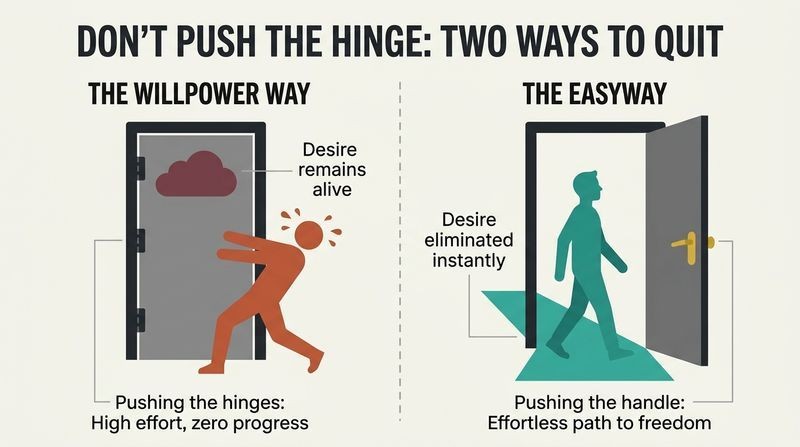
This directly challenges the dominant self-control paradigm and aligns with research on ego depletion's limits: sustained resistance is fragile precisely because it pits desire against restraint indefinitely. Motivational interviewing and acceptance-based therapies similarly find that resolving ambivalence beats brute suppression. The reframe that willpower quitters remain forever vulnerable matches relapse data showing many abstinent smokers still report cravings. A fair critique: Carr presents willpower and understanding as mutually exclusive, when many succeed with combined approaches. Still, his insight that felt deprivation is itself the enemy is a genuinely useful clinical lever.
Fear on both sides keeps you trapped like a released prisoner
Carr likens the vaper to a long-term convict who reoffends to return to the familiar security of prison. The outside world seems daunting; the cell, though miserable, feels safe. Vapers are caught in a tug-of-war of fear: on one side, fear of what vaping does to health, money, and dignity; on the other, fear of coping with life without their crutch.
Both fears are generated by the addiction itself. Health scare tactics backfire because a vaper's response to stress is to vape, so frightening them just sends them reaching for the device. Easyway deliberately ignores the downsides you already know and instead dissolves the fear by proving nothing is being lost. Remove both fears and the prison door simply opens.
The counterintuitive claim that fear-based health messaging is counterproductive has empirical backing: strong fear appeals can trigger defensive avoidance and reactance rather than behavior change, especially in the already-addicted. This is why graphic cigarette warnings show mixed results. Carr's prison analogy captures institutionalization and status-quo bias, the tendency to prefer a known bad over an unknown good. The framework's elegance is treating both fears as symptoms of the same disorder rather than opposing forces to be balanced. The risk is dismissing legitimate health concern entirely, though Carr reframes it as a bonus of freedom rather than a motivator.
The same drug cannot both calm stress and sharpen focus
Vapers claim nicotine relaxes them under stress and helps them concentrate when focusing. Carr exposes the contradiction: one drug cannot simultaneously distract your mind and improve concentration. Both beliefs are illusions from the trap's topsy-turvy logic. Nicotine addiction is itself a constant low-grade distraction and stressor; vaping only removes the aggravation it created, restoring you toward how a non-vaper feels all the time.
His proof is the exam room. Students who cannot study without vaping sit through hours of finals without a single craving, because vaping isn't an option, so it never becomes a distraction. Same with long flights. When the brain knows the drug is off the table, the Big Monster goes quiet. The craving thrives only on the possibility of giving in.
The stress-relief illusion is well documented: population studies consistently show smokers report higher anxiety than non-smokers, and anxiety typically falls after quitting, contradicting the self-medication narrative. Carr's observation that certainty eliminates craving anticipates research on decision fatigue and the paradox of choice: removing an option can reduce distress more than having it. The exam-room example is a neat natural experiment in cue availability. A nuance: nicotine does have measurable acute cognitive effects in withdrawn users, so the felt concentration boost isn't pure fiction, it's relief of deficit masquerading as enhancement, which is precisely Carr's deeper point.
There's no addictive personality; the drug created the traits
Many cling to the idea that they're genetically prone to addiction. Carr calls this a convenient excuse that guarantees lifelong imprisonment. The traits addicts share are the result of being trapped, not the cause. People bond with fellow addicts not because of shared personality but because company that won't challenge the habit feels safer.
His statistical demolition: if an addictive gene existed, addiction rates would stay roughly constant. Yet US smoking fell from over 40% in 1965 to 13.7% by 2018, a two-thirds drop, while rates soared across Asia. Genes don't shift that fast or migrate between continents. The JUUL youth epidemic wasn't a genetic mutation; it was a $38 billion marketing machine targeting kids. Even if you believe you have the trait, freedom is equally available.
Carr's population-genetics argument is sound in spirit: rapid changes in prevalence implicate environment over fixed biology. But it oversimplifies. Behavioral genetics does find meaningful heritability in addiction liability (twin studies suggest 40-70%), yet heritability describes variation within a population, not immutable destiny, and cannot explain society-wide trend shifts, which is exactly Carr's valid point. His deeper therapeutic insight aligns with growth-mindset research: believing your condition is fixed becomes self-fulfilling. Reframing addiction as a learned trap rather than an identity restores agency, which predicts better quit outcomes than fatalistic self-labeling.
Substitutes fail because they keep the sacrifice illusion alive
Nicotine gum, patches, and e-cigarettes attack only the 1% physical side while leaving the 99% mental belief untouched, which is why they so often fail. Switching devices just relocates the addiction. Even non-nicotine substitutes like candy or gum backfire: they reinforce the false idea that you've given something up and now need a replacement.
Carr offers a linguistic proof that nicotine's high is imaginary. We have vivid words for the effects of alcohol (tipsy, sloshed), cannabis (stoned, baked), and cocaine (wired). But after centuries of tobacco use, there is no word for being pleasurably nicotined. English has 14 words for rain but none for a nicotine high, because it doesn't exist. Citing Professor Robert West, Carr notes dopamine reinforcement forges the smoking-situation link without the smoker feeling any actual pleasure.
The West citation is notable because it comes from mainstream addiction science, not Carr's own tradition: reward learning can operate without hedonic pleasure, the wanting-versus-liking distinction Kent Berridge's neuroscience made famous. Dopamine drives incentive salience (wanting) even when the substance is not liked, which precisely validates Carr's claim that habit persists absent enjoyment. The absence-of-vocabulary argument is clever rhetoric though not proof; languages fail to lexicalize plenty of real experiences. On substitutes, the evidence is genuinely mixed: nicotine replacement therapy outperforms placebo in many trials, so Carr's blanket dismissal overstates. His stronger point is that unaddressed belief undermines any method.
Vaping doesn't keep you slim; deprivation-eating after quitting does
The weight-control myth rests on people who quit via willpower, feel deprived, and eat to compensate, then blame the nicotine loss. Carr notes the empty feeling of nicotine withdrawal mimics hunger, but the two cannot substitute for each other: food won't quiet a nicotine craving, and vaping won't satisfy real hunger. Trying is like topping up your car's oil with water.
He points to the obvious counter-evidence: plenty of heavy vapers are overweight, and if vaping truly burned fat, the heaviest users would be thinnest. The metabolic effect is negligible. His killer question: why is there no Diet Vape? If manufacturers had proof, they'd shout it from the label. Because Easyway removes desire, there's no deprivation and no compulsion to substitute food, so no weight gain.
The physiology is more mixed than Carr concedes: nicotine genuinely is a mild appetite suppressant and slightly raises metabolic rate, and post-cessation weight gain averaging a few kilos is well documented. But Carr's central causal claim holds up: much of that gain is behavioral, driven by using food to fill the perceived void, not by metabolism alone. The no-Diet-Vape argument is rhetorically sharp and legally shrewd, since health claims require substantiation. Framing weight fear as a myth manufactured largely by willpower-quitters' visible struggles is a useful correction to a widespread deterrent that keeps people, especially women, hooked.
Reframe every craving as a mortal enemy dying, not a friend lost
After the final dose, cravings may still surface for days as the Little Monster dies. Carr's instruction is to reinterpret them. Most quitters mourn nicotine like a lost friend, which is why they whine for years. But nicotine was never a friend: it stinks, drains your money, controls you, and tries to kill you. When you rid yourself of an enemy, you celebrate, you don't grieve.
He uses the moved-parking-space analogy. Park in the same spot daily for a year, then have it reassigned one space over. You'll pull into the old spot by mistake at first. That doesn't mean you love the old space; your brain just needs time to update. Likewise, an I-want-a-vape thought after quitting means only that your brain briefly forgot. Brush it off, think yippee I'm free, and move on.
This is applied cognitive reappraisal, the same mechanism cognitive behavioral therapy uses to change emotional response by changing interpretation of a stimulus. The instruction not to suppress thoughts is well grounded: Daniel Wegner's ironic-process research showed that trying not to think of something (his white bear, Carr's pink elephant) makes it more intrusive. The parking-space analogy elegantly normalizes intrusive cravings as harmless memory lag rather than signs of relapse, defusing the panic spiral that often precedes actual relapse. Reframing loss as liberation also leverages what positive psychology calls benefit-finding, reliably associated with better coping and lower relapse.
Quit for yourself alone, and never believe there's just one
Two final instructions anchor lasting freedom. First, quit for your own happiness, not for a partner or your kids. Quitting for others breeds a sense of deprivation and sets up a moment where you reward or defy them with a single vape. The health, savings, and relief for loved ones are wonderful bonuses, but the reason must be selfish: you'll simply enjoy life more.
Second, reject the fantasy of a single harmless puff. There is no such thing as one. One dose restarts the entire chain of a hundred thousand doses. Carr's cold-sore analogy captures the whole trap: imagine an ointment that instantly soothes a sore but secretly causes it to regrow bigger. Once you learn the ointment is the cause, stopping requires no willpower and no misery, only relief. Nicotine is that ointment.
The one-puff rule mirrors the abstinence-violation effect in relapse-prevention research: a single lapse triggers all-or-nothing thinking and full relapse, so framing zero as the only stable target is psychologically defensible for a fast-hooking drug. The quit-for-yourself principle aligns with self-determination theory, which finds autonomous, internally driven motivation far more durable than externally imposed goals; smokers who quit for their own reasons show higher long-term success than those pressured by others. The cold-sore parable is the book's most compact statement of its thesis: reclassify the supposed remedy as the disease, and the entire motivational calculus flips from sacrifice to liberation.
Analysis
This is a self-help book with a single, relentlessly repeated thesis, adapted from Allen Carr's blockbuster stop-smoking method (over 17 million copies sold) and applied to the newer world of JUUL, IQOS, and disposables. Its structure is deliberately recursive rather than linear: the same core idea is restated from a dozen angles across twenty chapters. That repetition, tedious to summarize, is actually the mechanism. The book is less an argument than a guided cognitive-restructuring session in print, engineered to erode a belief through saturation.
What makes Carr distinctive is his contrarian inversion of every conventional quit-smoking assumption. Where public health uses fear, Carr forbids it. Where cessation programs prescribe nicotine replacement and gradual reduction, Carr calls substitutes counterproductive. Where the culture prizes willpower, Carr treats it as the reason people fail. The method's unfalsifiable edge is worth naming: if you quit, the method worked; if you relapse, you didn't truly kill the Big Monster or follow all instructions. This closes the system against disconfirmation, a feature it shares with many therapeutic frameworks.
Yet the underlying psychology is more legitimate than its folksy packaging suggests. The wanting-versus-liking distinction from Berridge's neuroscience, the ironic-process theory of thought suppression from Wegner, the abstinence-violation effect from relapse-prevention research, and self-determination theory's emphasis on autonomous motivation all independently corroborate Carr's intuitions, and he even cites Professor Robert West approvingly. The book's real innovation is sequencing: dismantle belief before changing behavior, so that abstinence feels like relief rather than sacrifice.
Its weaknesses are its absolutism. Blanket dismissals of physical withdrawal, nicotine replacement efficacy, and any hedonic effect overstate a real case. The reported 90%-plus clinic success rate is self-selected and self-defined. For vaping specifically, long-term health data barely exist, which Carr sidesteps by design, insisting freedom, not fear, is the point. As a psychological reframe, it is genuinely powerful; as science, it is confident beyond its evidence.
Review Summary
Allen Carr's Easy Way to Quit Vaping receives overwhelmingly positive reviews, with many readers reporting success in quitting vaping after reading the book. Readers appreciate the psychological approach that changes their mindset about nicotine addiction. Some find the repetitive content helpful, while others find it annoying. Many express gratitude for the book's effectiveness and recommend it to others struggling with addiction. A few readers found the book less effective or outdated. Overall, most reviewers feel freed from their nicotine dependence and optimistic about their smoke-free future.
People Also Read


Glossary
The Little Monster
Mild physical nicotine withdrawalCarr's name for the physical addiction: a faint, empty, insecure, hunger-like sensation created the first time nicotine enters the body and felt whenever the drug leaves the system. It is almost imperceptible and dies within a few days of the final dose once starved of nicotine. Its only real danger is that it triggers the Big Monster.
The Big Monster
Mental belief in nicotine's benefitCarr's name for the psychological addiction: the brainwashed belief that vaping delivers genuine pleasure or a crutch. Built by advertising, films, and other addicts, it interprets the Little Monster's faint signal as I want a vape. It causes the real suffering of quitting and must be killed through understanding before the final dose.
Easyway
Carr's belief-first quitting methodAllen Carr's method for escaping addiction by dismantling the beliefs that sustain it rather than relying on willpower, substitutes, or fear. It removes the desire to vape so that quitting involves no felt sacrifice or deprivation, allowing the person to become a happy non-vaper immediately upon their final dose of nicotine.
The pitcher plant
Analogy for the trap's lureCarr's central metaphor for the nicotine trap. A carnivorous plant lures flies with nectar; the fly feeds confidently, slides deeper, and only realizes the danger once escape is impossible. Vapers are lured by psychological illusions rather than real reward, but unlike the fly, they can escape the trap at any moment they choose.
Tug-of-war of fear
Two opposing fears trapping addictsCarr's term for the mental conflict keeping vapers stuck: fear of the harm, cost, and slavery of continuing versus fear of not coping with life without nicotine. Both fears are generated by the addiction itself. Easyway resolves the conflict by removing both fears rather than balancing them.
The moment of revelation
When belief in nicotine collapsesThe point when all the brainwashing falls away and doubt disappears, marking the death of the Big Monster. For some it arrives as a sudden liberating flash, for others as a quiet logical conclusion, and for some only days after quitting when they realize they haven't thought about vaping at all.
FAQ
What's "Allen Carr's Easy Way to Quit Vaping" about?
- Purpose of the book: "Allen Carr's Easy Way to Quit Vaping" by Allen Carr is designed to help individuals quit vaping and other forms of nicotine addiction without feeling deprived or using willpower.
- Methodology: The book employs the Easyway method, which focuses on changing the reader's mindset about nicotine addiction, dismantling myths, and removing the desire to vape.
- Target audience: It is aimed at anyone who uses nicotine products, including JUUL, IQOS, disposables, tanks, or any other nicotine delivery systems.
- Outcome: The goal is to enable readers to quit vaping easily, immediately, and permanently, while enjoying the process and feeling liberated.
Why should I read "Allen Carr's Easy Way to Quit Vaping"?
- Proven success: The Easyway method has helped millions of people worldwide quit smoking and other addictions, boasting a high success rate.
- No willpower needed: Unlike traditional methods, this book claims you can quit without relying on willpower, making the process less daunting.
- Comprehensive approach: It addresses both the physical and psychological aspects of addiction, ensuring a holistic approach to quitting.
- Life-changing benefits: Readers can expect improved health, more money, greater self-esteem, and freedom from nicotine slavery.
What are the key takeaways of "Allen Carr's Easy Way to Quit Vaping"?
- Nicotine does nothing for you: The book emphasizes that nicotine provides no real pleasure or crutch, only the illusion of relief from withdrawal.
- Addiction is 1% physical, 99% mental: Understanding this helps readers focus on changing their mindset rather than fearing physical withdrawal.
- No sacrifice involved: Quitting is not about giving up something valuable but about gaining freedom and happiness.
- Freedom from fear: The book aims to eliminate the fear of quitting by showing that life without nicotine is more enjoyable and fulfilling.
How does the Easyway method work in "Allen Carr's Easy Way to Quit Vaping"?
- Mindset change: The method focuses on changing the reader's perception of nicotine, removing the belief that it provides any benefit.
- Dismantling myths: It addresses common misconceptions about vaping, such as it being a stress reliever or a way to control weight.
- No willpower required: By removing the desire to vape, the method eliminates the need for willpower, making quitting easier.
- Immediate results: Readers are encouraged to quit immediately after finishing the book, with the promise of becoming a happy non-vaper.
What are the best quotes from "Allen Carr's Easy Way to Quit Vaping" and what do they mean?
- "Nicotine does absolutely nothing for you whatsoever." This quote emphasizes the core message that nicotine provides no real benefits, only the illusion of relief.
- "You are your own jailer." It highlights the idea that the addiction trap is mental, and freedom is a choice that readers can make.
- "The only pleasure from vaping is the partial relief of the discomfort caused by vaping." This underscores the cycle of addiction, where each vape only temporarily alleviates the withdrawal it caused.
- "Yippee! I’m free!" This phrase is used to encourage readers to celebrate their freedom from nicotine addiction, reinforcing the positive mindset shift.
How does "Allen Carr's Easy Way to Quit Vaping" address the fear of quitting?
- Fear is an illusion: The book explains that the fear of quitting is based on misconceptions and brainwashing, not reality.
- No trauma involved: It reassures readers that quitting is not a painful or traumatic process when approached with the right mindset.
- Focus on gains: By highlighting the benefits of quitting, such as improved health and freedom, the book shifts focus from fear to excitement.
- Supportive guidance: The method provides step-by-step instructions and reassurance, helping readers feel confident in their decision to quit.
What myths about vaping does "Allen Carr's Easy Way to Quit Vaping" debunk?
- Vaping helps with stress: The book argues that nicotine actually increases stress levels, rather than alleviating them.
- Vaping aids concentration: It explains that nicotine addiction distracts from concentration, rather than enhancing it.
- Vaping controls weight: The book debunks the myth that nicotine is an effective weight control method, attributing weight gain to willpower-based quitting methods.
- Vaping is a habit: It clarifies that vaping is not a habit but an addiction, which requires a different approach to quit.
How does "Allen Carr's Easy Way to Quit Vaping" redefine the concept of withdrawal?
- Minimal physical symptoms: The book states that physical withdrawal from nicotine is almost imperceptible, contrary to popular belief.
- Mental struggle: It emphasizes that the real challenge is the mental process, not the physical symptoms.
- Rejoicing in withdrawal: Readers are encouraged to view withdrawal as the death throes of the addiction, a positive sign of freedom.
- No waiting period: The book assures that there is no need to wait for withdrawal to end before enjoying life as a non-vaper.
What role does mindset play in "Allen Carr's Easy Way to Quit Vaping"?
- Central to quitting: Changing the mindset is the key to removing the desire to vape and achieving freedom from addiction.
- Rewiring the brain: The book guides readers through a process of rewiring their brain to see nicotine for what it truly is.
- Positive outlook: It encourages readers to approach quitting with excitement and positivity, rather than fear and dread.
- Certainty in decision: A clear, confident mindset ensures that readers do not feel deprived and can enjoy life as non-vapers.
How does "Allen Carr's Easy Way to Quit Vaping" ensure long-term success?
- No substitutes: The book advises against using nicotine substitutes, which can perpetuate addiction.
- Avoiding triggers: It prepares readers to handle situations that might trigger the desire to vape, reinforcing their freedom.
- Celebrating freedom: Readers are encouraged to celebrate their non-vaper status, reinforcing the positive change.
- Continuous support: The book offers ongoing support through Allen Carr's Easyway centers and resources, ensuring readers stay free.
What is the significance of the "final dose" ritual in "Allen Carr's Easy Way to Quit Vaping"?
- Marking the occasion: The ritual of the final dose is a significant moment that marks the transition to a non-vaper.
- Focus on reality: It encourages readers to focus on the reality of nicotine addiction one last time before saying goodbye.
- Commitment to freedom: The ritual involves making a solemn vow to never let nicotine into the body again.
- Symbolic closure: It provides a sense of closure and finality, reinforcing the reader's commitment to their new, nicotine-free life.
How does "Allen Carr's Easy Way to Quit Vaping" address the concept of an "addictive personality"?
- Debunking the myth: The book argues that the idea of an addictive personality is a convenient excuse, not a reality.
- Addiction is not genetic: It emphasizes that addiction is not caused by personality traits but by the addictive nature of nicotine.
- Universal susceptibility: Anyone can fall into the nicotine trap, but anyone can also escape it with the right approach.
- Empowerment through understanding: By understanding the true nature of addiction, readers are empowered to break free, regardless of perceived personality traits.
About the Author
Other books by Allen Carr




Download PDF
Download EPUB
.epub digital book format is ideal for reading ebooks on phones, tablets, and e-readers.








































