


Key Takeaways
Treat love as a verb you choose, not a feeling that seizes you
Love is action, not sensation. hooks builds her entire vision on a definition borrowed from psychiatrist M. Scott Peck and echoing Erich Fromm: love is the will to extend oneself to nurture one's own or another's spiritual growth. That word "will" matters. It implies intention, choice, and accountability. We do not fall into love helplessly; we decide to love, then act.
Why the reframe liberates. If love is merely a feeling, we bear no responsibility for it (hence "crimes of passion"). But if love is what love does, then care, affection, respect, commitment, trust, and honest communication must all be present in the act. hooks distinguishes love from cathexis, the psychological term for simply investing emotion in someone. Many people cathect and call it love while neglecting or hurting the person they claim to cherish.
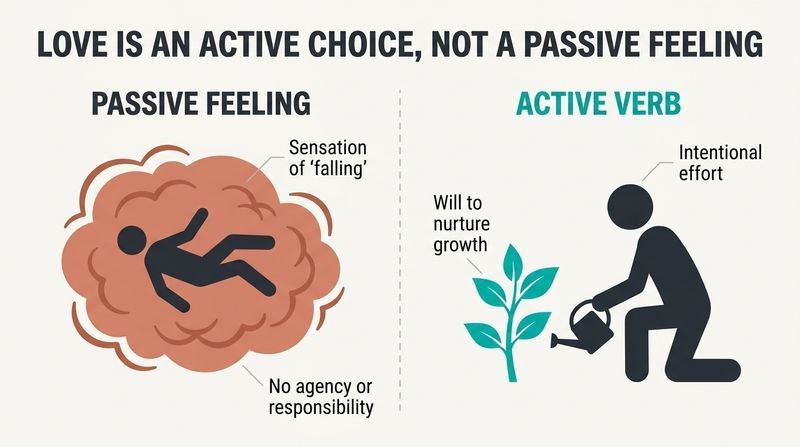
The behavioral reframe aligns love with what psychologists call committed action rather than affect, echoing Acceptance and Commitment Therapy's emphasis on values-driven behavior over fleeting moods. What's striking is how it dissolves the alibi of passivity: if love is chosen, no one can hide behind "I couldn't help it." A fair challenge: neuroscience shows infatuation genuinely does hijack dopamine circuits, so the felt experience of "falling" is real, not imagined. hooks would not deny the chemistry; she simply denies it deserves the name love. The distinction between cathexis and love is her sharpest tool, exposing how easily attachment masquerades as devotion.
Love and abuse cannot coexist, so stop calling harm affection
A definition with teeth. Once love is understood as nurturing growth, an uncomfortable verdict follows: abuse and neglect are its opposites and therefore negate it. The man who beats his family then swears he loves them is not loving them, no matter how sincerely he believes it. hooks applies this to her own upbringing, admitting through therapy that her caring but shaming household left her feeling cared for yet not loved.
Care is not the whole of love. hooks separates care (one ingredient) from love (the full recipe of trust, commitment, knowledge, responsibility, and respect). Many families deliver affection laced with humiliation, and children absorb the lie that cruelty and love mix. That faulty lesson then shapes adult relationships, where people tolerate mistreatment because childhood taught them it was love.
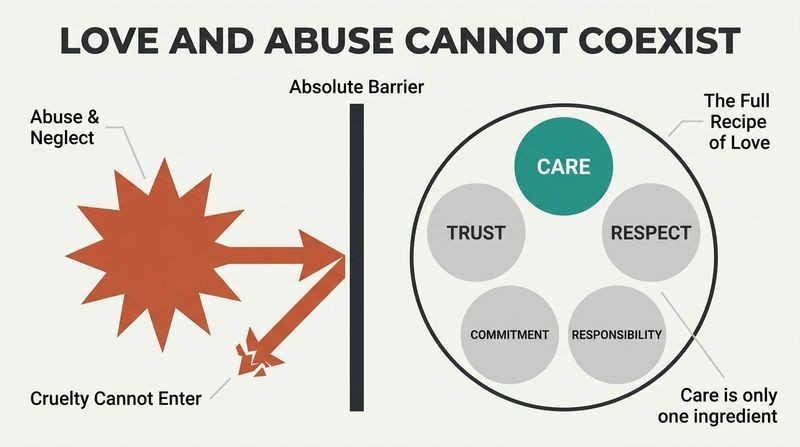
This is the book's most bracing claim, and it cuts against a cultural reflex to protect parents from judgment. Attachment research supports her: children form bonds even with abusive caregivers because attachment is a survival mechanism, not proof of love received. The distinction between care and love resembles the difference between provision and attunement in developmental psychology. A nuance worth holding: hooks risks a binary that could invalidate genuinely mixed relationships. Most families are neither purely loving nor abusive. Her point still lands, though, because naming a lack of love is not condemnation; it is the honest precondition for healing rather than repeating the pattern.
Without justice for children, there can be no love
Children are the unprotected class. hooks argues that love requires justice, and children in our culture have almost none. The private family remains the one sphere where autocratic power goes unchallenged; parents can hit, shame, and coerce with no legal recourse for the child. She recounts a dinner party of educated liberals who defended spanking and pinching, imagining the same acts done to an adult partner would horrify everyone present.
Discipline without punishment. She insists loving parenting sets boundaries before misbehavior and teaches self-discipline rather than inflicting pain. Teaching a child to clean up after play models responsibility; time-outs and lost privileges replace whipping. She also champions multiple parenting figures, godparents and extended kin, who can mediate conflicts and show a child that no single adult holds absolute, unaccountable power.
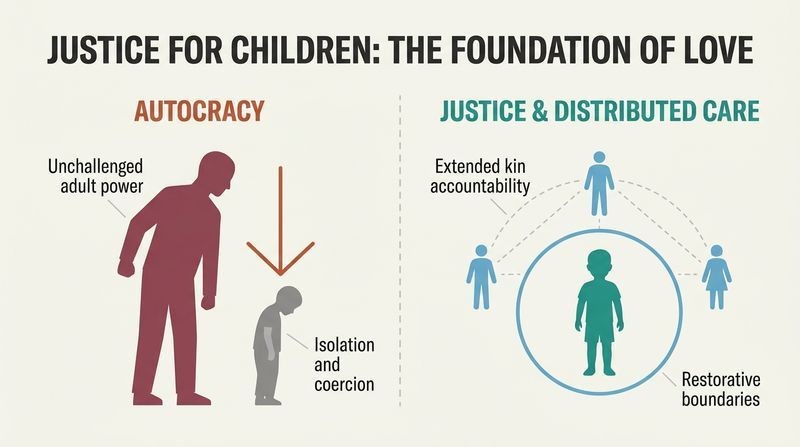
hooks anticipates decades of research now confirming that corporal punishment predicts aggression, anxiety, and impaired parent-child bonds, findings that led over sixty nations to ban it outright. Her framing of the family as a potentially fascistic institution echoes political theory applied to intimate life, a move both radical and clarifying. The strongest extension is her insistence that we would never accept toward adults what we routinely do to children. One tension: she leans on idealized television families like Leave It to Beaver, a thin evidentiary base. But her core demand, that love without justice is a contradiction, reframes parenting as a civil rights question, not merely a style preference.
Truth-telling is the beating heart of every loving bond
Trust cannot survive deception. hooks makes honesty non-negotiable because love requires believing another person always intends your good, an impossible faith inside a web of lies. She distinguishes privacy (a healthy need for solitude and chosen disclosure) from secrecy (hiding information to hold power), invoking the recovery maxim that we are only as sick as our secrets.
Lying is gendered and cultural. Drawing on research suggesting men lie more and with graver consequences, she links male dishonesty to patriarchy: boys learn early that masculine power means operating above the rules, and that honesty is "soft." Women, socialized into patriarchal femininity, learn to lie by pretending weakness, manipulating, and wearing masks to please. Consumer culture compounds this, since advertising keeps us in perpetual craving through falsehood. Lovelessness, she notes, is a boon to the marketplace.
The connection between private lying and public consumer culture is one of hooks's more original moves, anticipating later critiques of attention economies built on manufactured dissatisfaction. Her gendered analysis finds support in deception studies, though the picture is contested; some research shows men and women lie at similar rates but about different things. What elevates the chapter is the reframe of privacy versus secrecy, a distinction couples therapists still use to separate healthy autonomy from corrosive concealment. A useful caution she raises: radical honesty can be weaponized as cruelty. Her answer is that truth must be spoken judiciously and caringly, not as a license for bluntness.
You cannot give yourself away from a place of emptiness
Self-love is the foundation, not narcissism. hooks tackles the cliche that you must love yourself before loving others, noting it rings hollow to those taught they were unlovable by forces beyond their control. Rather than leaving it as a slogan, she operationalizes it using Nathaniel Branden's pillars of self-esteem: living consciously, self-acceptance, self-responsibility, self-assertiveness, living purposefully, and personal integrity.
Practical routes to self-worth. She found daily affirmations, once dismissed as corny, genuinely restored her emotional equilibrium. She stresses that the work we choose matters, invoking the Buddhist concept of right livelihood: doing any job with total commitment protects self-esteem even when the work itself disappoints. Crucially, she reframes self-love as giving yourself the unconditional acceptance you keep fantasizing a lover will provide, which lets you reach toward others from fullness instead of lack.
hooks corrects a genuine flaw in pop-psychology's self-love talk, that it names a goal without a method. Branden's pillars give the abstraction traction, and her insight about right livelihood connects inner worth to daily labor in a way most relationship books ignore. The observation that we withhold from ourselves the very acceptance we demand from partners is quietly devastating and clinically astute; it mirrors what self-compassion researchers like Kristin Neff later documented, that self-kindness predicts resilience better than self-esteem alone. One caveat: her critique of self-love as isolated quest, expanded in her community chapter, prevents the concept from curdling into the self-absorption she warns against.
A culture drowning in greed cannot teach us to love
Materialism is love's rival. hooks argues, following Fromm, that the principles of capitalism and love are fundamentally incompatible. A society organized around endless consumption and the worship of money produces narcissism, and narcissism is soil where love cannot grow. When emotional needs go unmet, the passion to connect gets replaced by the passion to possess, because material desires are far easier to satisfy than the difficult work of intimacy.
Greed demands domination. She links addiction, from drugs to shopping to gambling, to a psychotic lust for consumption that makes love impossible; the addict holds only the drug sacred. Citing Marianne Williamson on America's backlash against compassion, she notes one-fifth of the nation's children live in poverty while brotherly love is treated as weakness. Living simply, she concludes, makes loving simple.
The thesis that consumer capitalism structurally crowds out love finds unexpected empirical company in research showing materialistic values correlate with lower relationship satisfaction and well-being. hooks's framing of greed as needing domination, and domination as always excluding love, tightens Carl Jung's aphorism that where the will to power reigns, love is lacking. A fair challenge: she sometimes treats an entire economic system as a monolithic love-killer, understating how markets can also enable generosity and connection. Yet her observation that instant gratification trains us to treat partners as disposable, like Dixie cups, captures something real about how consumer habits bleed into how we discard relationships.
Friendship, not romance, is where most of us first taste real love
Community sustains life, not the couple. hooks challenges the cult of romantic love and the nuclear family, arguing that communities, not isolated pairs or rugged individualists, keep humans alive. She contends capitalism and patriarchy deliberately shrank extended kinship into the privatized nuclear unit, which increased isolation and made abuse easier by concentrating unchecked power in one father and one mother.
Friendship as love's training ground. Because we choose friends, many of us learn care, respect, and honest feedback there first, then carry it into family and romance. hooks confesses she once tolerated verbal and physical abuse in a fourteen-year romance she would never have accepted from a friend, because she had been socialized to revere romantic bonds above all others. The values of love, she insists, are identical across every relationship; there is no special love reserved for lovers.
hooks dismantles the romantic-supremacy that ranks a spouse above all other bonds, a hierarchy sociologists now critique as "greedy marriage" that impoverishes friendship networks. Her claim that we hold friends to higher standards of treatment than lovers is a piercing diagnostic tool; asking "would I accept this from a friend?" exposes tolerated abuse instantly. The developmental point, that extended kinship buffers dysfunction through what Alice Miller called enlightened witnesses, aligns with resilience research showing one stable caring adult can protect a child. The nuclear-family critique is historically contestable, since extended families also harbored abuse, but her structural insight about isolation concentrating power is sound.
Choose partners deliberately instead of surrendering to the myth of falling
Mutuality kills the power struggle. hooks names the true obstacle to love as the will to power. In the Mars-and-Venus model she rejects, men want control and women want connection, so nobody actually knows love. Genuine love requires mutuality, where each person's growth matters equally. She describes her own two long relationships with emotionally withholding men, recognizing she was trying to extract from partners the fathering she never received.
Evaluate before you fall. Borrowing from therapist Harriet Lerner, she notes we scrutinize a car or appliance more carefully than a prospective mate. She actually wrote a ten-item list of qualities she wanted, then faced the painful gap between it and whom she chose. Approaching romance with care, knowledge, and honest communication, she insists, intensifies rather than kills eroticism; a frank lunch about sexual likes and fears can itself be electric.
hooks joins Fromm and Peck in treating partner selection as deliberate rather than fated, a stance that clashes with romantic ideology but fits attachment theory's finding that we unconsciously recreate early caregiver dynamics. Her honesty about seeking a father in her partners illustrates repetition compulsion vividly. The provocative claim, that talking increases eroticism, is now echoed by intimacy researchers who find that vulnerability and self-disclosure predict desire more reliably than mystery. One limitation: pure deliberation can slide into a consumerist checklist mentality, the very thing she elsewhere condemns. Her safeguard is that evaluation must begin with honest self-assessment of what love you can actually give.
True love changes you, so it feels less safe than power
Soul connection versus heart connection. Drawing on John Welwood, hooks distinguishes a heart connection (appreciating someone as they are) from a soul connection (recognizing who they could become and who you could become through them). True love, she argues, is not blissful ease but work; Rilke insisted love, being the extreme happiness, can be nothing but work. Its essence is mutual recognition, two people seeing each other stripped of masks.
Why people flee it. Because true love exposes exactly the self we hide, many who claim to want love run when it arrives. It offers no place to hide, threatens our defenses, and demands we surrender the will to power for vulnerability. hooks recounts meeting a true love who appeared in a dream, only to find he was already committed, teaching her that a life-altering connection need not become a lasting relationship to transform her.
The heart-versus-soul distinction gives readers a precise vocabulary for why some relationships feel comfortable yet inert while others feel dangerous yet expansive. hooks reframes relational difficulty as a feature of growth, not a failure signal, converging with research on "the Michelangelo phenomenon," where partners sculpt each other toward their ideal selves. Her claim that people flee genuine intimacy maps onto avoidant attachment and fear of engulfment. The dream anecdote risks romantic mysticism, and skeptics will bristle. Yet her larger point holds under scrutiny: love that demands transformation triggers threat responses, which is why choosing it requires the same courage as choosing to be fully known.
Befriend death and grief becomes love's final act, not its defeat
A death-worshipping culture forgets how to love. hooks contends that endless spectacles of violence numb rather than prepare us, feeding a fear that makes us shoot the lost stranger at the door and wall ourselves into gated communities. Citing Fromm's dying question about why humans prefer love of death to love of life, she argues fear of dying is a disease of the heart that only love can cure.
Grief as commitment. She recounts Elisabeth Kubler-Ross learning from a hospital cleaning woman who spoke of death as an old acquaintance, not a stranger. Loving fully lets us grieve without shame, because mourning is a form of continued commitment and communion with the dead. Living with awareness that death is always present, drawing on Thich Nhat Hanh's call to inhabit the present moment, lets us leave no words unsaid and no reconciliation undone.
hooks weaves terror management theory avant la lettre: her claim that our violence spectacles are anxious attempts to master mortality anticipates research showing death-reminders intensify in-group loyalty and out-group hostility. The reframe of grief as an expression of love rather than a problem to medicate away pushes against a culture that pathologizes lingering mourning, a stance grief scholars increasingly defend through concepts like continuing bonds. Her example of the shooting driven by white-supremacist, capitalist, patriarchal conditioning connects intimate psychology to structural fear compellingly. The chapter's strength is showing that learning to love and learning to die are the same skill, since both require surrendering the illusion of control.
Reclaim your woundedness as a blessing that opens you to healing
Shame keeps the wound infected. hooks retells Jacob wrestling the angel through the night and refusing to release it without a blessing, a blessing that arrives as a wound to his hip. The lesson: woundedness is not shameful but necessary for spiritual growth. Citing Gershen Kaufman and Alice Miller, she argues our culture shames people for naming their pain, mocking victims and calling silence about suffering a virtue.
Healing happens in communion, never isolation. She rejects the New Age emphasis on solitary self-recovery, pointing to Alcoholics Anonymous as proof that acceptance inside a caring community heals what isolation cannot. Forgiveness dissolves the shame that separates us; prayer offers a space of confession that lifts the burden of secrets. Naming a wound is not blaming others, she clarifies, but insisting on accountability so love can finally enter the broken place.
hooks anticipates the contemporary tension between trauma-informed culture and the backlash against "victimhood." Her resolution is elegant: acknowledging a wound demands accountability rather than perpetual grievance, distinguishing healing from wallowing. The Jacob story reframes injury as initiation, resonating with post-traumatic growth research showing many survivors report deepened meaning after suffering. Her insistence that healing is communion, not a solo project, corrects the individualism of much self-help and aligns with findings that social support is the strongest predictor of recovery from trauma. A gentle challenge: not all wounds yield blessings, and framing suffering as necessary can pressure survivors to redeem pain that simply hurt. hooks keeps it honest by refusing to sentimentalize.
Analysis
All About Love is best read as philosophy disguised as self-help, a genre hybrid that explains why it both moves and frustrates readers. bell hooks, a Black feminist cultural critic, does something the male love-theorists she cites (Fromm, Peck, Welwood) rarely attempt: she fuses a rigorous behavioral definition of love with a structural critique of the systems, patriarchy, capitalism, white supremacy, that make loving nearly impossible. Her central intellectual move is the insistence on definition. By anchoring the whole book in Peck's formulation of love as the will to nurture spiritual growth, she converts a slippery feeling into an accountable practice, then follows the logic ruthlessly: if love is action, then abuse negates it, families that shame are not loving, and a nation obsessed with domination and profit is structurally loveless.
What distinguishes hooks from the therapeutic mainstream is her refusal to privatize the problem. Where most love literature treats dysfunction as an individual or couple-level issue, she politicizes it, arguing that the same power dynamics governing nations govern bedrooms. This is her debt to the liberation theology of Martin Luther King and to Erich Fromm's socialist reading of love. It is also her vulnerability: the analysis sometimes outruns its evidence, leaning on anecdote, memoir, and a somewhat idealized vision of extended community and pre-war American values.
The book's enduring power lies in its diagnostic reframes, cathexis versus love, care versus love, privacy versus secrecy, heart versus soul connection, tools readers can immediately apply. Its weakness is a tendency toward the homiletic; chapters on spirituality and destiny drift into affirmation. Yet the throughline is coherent and radical: love is a learnable ethic, not a lottery. Written from love's absence rather than its possession, the book carries the authority of hard-won honesty. Two decades on, its claim that cynicism is merely the mask of a betrayed heart, and that choosing love is an act of courage against a fearful culture, reads less like sentiment and more like resistance.
Review Summary
All About Love received mixed reviews. Many praised hooks' insights on love as an action and her critique of societal views, finding it thought-provoking and healing. However, some found it preachy, heteronormative, and lacking in academic rigor. Readers appreciated hooks' exploration of self-love, abuse, and capitalism's impact on relationships, but criticized her religious references and generalizations about gender. The book's relevance was debated, with some finding it dated and others considering it timeless. Overall, it sparked significant reflection on love's role in personal and societal transformation.
People Also Read






Glossary
Love as the will to extend oneself
Love defined as nurturing actionhooks's foundational definition, adapted from M. Scott Peck and Erich Fromm: love is the will to extend one's self for the purpose of nurturing one's own or another's spiritual growth. It frames love as an intentional act combining care, affection, recognition, respect, commitment, trust, and honest communication, rather than as an involuntary feeling.
Cathexis
Investing emotion in someoneA psychological term hooks borrows to name the process of investing feeling or emotion in another person so they become important to us. She argues people constantly confuse cathecting with loving, insisting they love someone even while neglecting or abusing them, because the emotional investment feels like love but lacks love's nurturing action.
Love ethic
Living by love's valueshooks's proposed foundation for all spheres of life: politics, work, family, and intimacy. Living by a love ethic means applying care, commitment, trust, responsibility, respect, and knowledge to every decision, valuing collective well-being over domination and material gain, and letting love guide public policy as well as private relationships.
Soul connection versus heart connection
Transformative bond versus easy affinityA distinction hooks draws from John Welwood. A heart connection lets us appreciate people as they already are. A soul connection is a deeper resonance in which two people recognize each other's essential natures and commit to helping each other realize their fullest potential, seeing who they could become together. True love requires the soul connection.
Right livelihood
Work that nurtures the spiritA Buddhist concept hooks applies to self-love: choosing or approaching work in a way that enhances rather than assaults one's spiritual well-being. Even a disliked job can support self-esteem if done with total commitment, and doing work we love strengthens our overall capacity to give and receive love.
Enlightened witness
Caring adult who restores hopeA term hooks takes from psychoanalyst Alice Miller for any individual, often outside the immediate family, whose kindness, understanding, and concern restore a wounded child's sense of hope and possibility. hooks credits extended kin and mentors as enlightened witnesses who let her survive a dysfunctional household by modeling alternative ways to live.
FAQ
What's "All About Love: New Visions" by bell hooks about?
- Exploration of Love: The book delves into the concept of love, examining its various forms and the ways it impacts our lives. It challenges traditional notions and encourages a broader understanding.
- Cultural Critique: bell hooks critiques the culture of lovelessness and the societal structures that hinder genuine love, such as patriarchy and consumerism.
- Personal and Social Change: The book advocates for love as a transformative force that can lead to personal healing and social justice.
- Practical Guidance: It offers practical advice on how to cultivate love in everyday life, emphasizing the importance of honesty, commitment, and community.
Why should I read "All About Love: New Visions"?
- Insightful Perspective: bell hooks provides a unique and thought-provoking perspective on love, challenging readers to rethink their understanding of this fundamental emotion.
- Cultural Relevance: The book addresses contemporary issues such as sexism, racism, and materialism, making it relevant to current social dynamics.
- Personal Growth: It offers guidance on how to heal from past wounds and cultivate self-love, which is essential for healthy relationships.
- Inspiration for Change: Readers are encouraged to embrace love as a powerful tool for personal and societal transformation.
What are the key takeaways of "All About Love: New Visions"?
- Love as a Choice: Love is not just a feeling but a deliberate choice and action that requires commitment and effort.
- Importance of Honesty: Honest communication is crucial for building trust and intimacy in relationships.
- Community and Connection: True love extends beyond romantic relationships and includes community and friendship.
- Healing Power of Love: Love has the potential to heal past traumas and foster personal and collective well-being.
How does bell hooks define love in "All About Love: New Visions"?
- Action-Oriented Definition: Love is defined as "the will to extend one's self for the purpose of nurturing one's own or another's spiritual growth."
- Beyond Feelings: It emphasizes that love is not just an emotion but involves care, respect, knowledge, and responsibility.
- Choice and Will: Love is a conscious choice that involves intention and action, not something that happens passively.
- Spiritual Growth: The definition links love to spiritual growth, highlighting its transformative potential.
What are the best quotes from "All About Love: New Visions" and what do they mean?
- "Love is an action, a participatory emotion." This quote emphasizes that love requires active participation and is not just a passive feeling.
- "To love well is the task in all meaningful relationships, not just romantic bonds." It highlights the importance of love in all types of relationships, including friendships and community ties.
- "The practice of love is the most powerful antidote to the politics of domination." This quote suggests that love can counteract societal structures of power and control.
- "Love is the only sane and satisfactory answer to the problem of human existence." It underscores the fundamental role of love in giving life meaning and purpose.
How does "All About Love: New Visions" address the concept of self-love?
- Foundation of Love: Self-love is presented as the foundation for all other forms of love, essential for healthy relationships.
- Overcoming Low Self-Esteem: The book discusses the importance of overcoming negative self-perceptions and embracing self-worth.
- Self-Reflection and Growth: It encourages readers to engage in self-reflection and personal growth as part of the journey to self-love.
- Unconditional Acceptance: Self-love involves giving oneself the unconditional acceptance and care that one might seek from others.
What role does community play in "All About Love: New Visions"?
- Source of Love: Community is seen as a vital source of love and support, providing a space for individuals to learn and practice love.
- Beyond the Nuclear Family: The book challenges the notion that love is confined to the nuclear family, advocating for broader community connections.
- Healing and Growth: Communities offer opportunities for healing and personal growth through shared experiences and mutual support.
- Collective Well-Being: Emphasizes the importance of working together for the collective good, fostering a sense of belonging and interconnectedness.
How does bell hooks critique traditional gender roles in "All About Love: New Visions"?
- Patriarchal Limitations: The book critiques how patriarchal gender roles limit both men and women in their ability to love fully.
- Emotional Expression: It highlights how traditional masculinity discourages men from expressing emotions, hindering their capacity for love.
- Women's Roles: Women are often socialized to be caregivers, which can lead to imbalanced relationships if not mutually reciprocated.
- Call for Change: Encourages both genders to move beyond these roles to embrace a more equitable and loving dynamic.
What practical advice does "All About Love: New Visions" offer for cultivating love?
- Honest Communication: Emphasizes the importance of open and honest communication in building trust and intimacy.
- Commitment to Growth: Encourages individuals to commit to personal and relational growth as a foundation for love.
- Acts of Service: Suggests that love is demonstrated through acts of service and care for others.
- Forgiveness and Compassion: Advocates for practicing forgiveness and compassion as essential components of loving relationships.
How does "All About Love: New Visions" connect love with social justice?
- Love as a Transformative Force: Love is seen as a powerful tool for social change, capable of challenging systems of oppression.
- Ethic of Care: The book promotes an ethic of care that extends beyond personal relationships to include societal well-being.
- Interconnectedness: Emphasizes the interconnectedness of all people and the importance of working together for justice and equality.
- Vision for Change: Encourages readers to envision a world where love guides public policy and social interactions.
What is the significance of spirituality in "All About Love: New Visions"?
- Spiritual Awakening: Spirituality is presented as a path to awakening to love and its transformative power.
- Divine Love: The book explores the concept of divine love as a guiding force in life.
- Connection to the Sacred: Encourages readers to connect with the sacred in everyday life as a way to cultivate love.
- Spiritual Practice: Suggests that spiritual practices, such as meditation and prayer, can enhance one's capacity to love.
How does "All About Love: New Visions" address the challenges of romantic love?
- Beyond Romance: The book challenges the notion that romantic love is the ultimate form of love, advocating for a broader understanding.
- Intentional Love: Encourages approaching romantic relationships with intention and will, rather than passively "falling in love."
- Work and Commitment: Highlights that sustaining romantic love requires work, commitment, and mutual growth.
- Facing Reality: Emphasizes the importance of facing the realities of love, including its challenges and imperfections, with openness and honesty.
About the Author
Other books by bell hooks



Download PDF
Download EPUB
.epub digital book format is ideal for reading ebooks on phones, tablets, and e-readers.








































