

Key Takeaways
Stop romanticizing depression; it is a brain disease, not a badge of depth
The core argument is a polemic. Kramer, the psychiatrist who wrote Listening to Prozac, noticed a strange double standard. We say depression is a disease, yet we secretly value it. He tests audiences with one question: would you eradicate depression as we eradicated smallpox? For every other illness (multiple sclerosis, psoriasis, malaria) the answer is an easy yes. For depression, people hedge, invoking van Gogh, Kierkegaard, and the tragic artist.
He distinguishes two lenses: what depression "is" (the emerging science) versus what it "is to us" (our inherited cultural habit of mind). The gap between them is his subject. No serious cancer patient, on recovery, praises the tumor. Yet depression memoirs routinely claim the illness "gave me my soul."
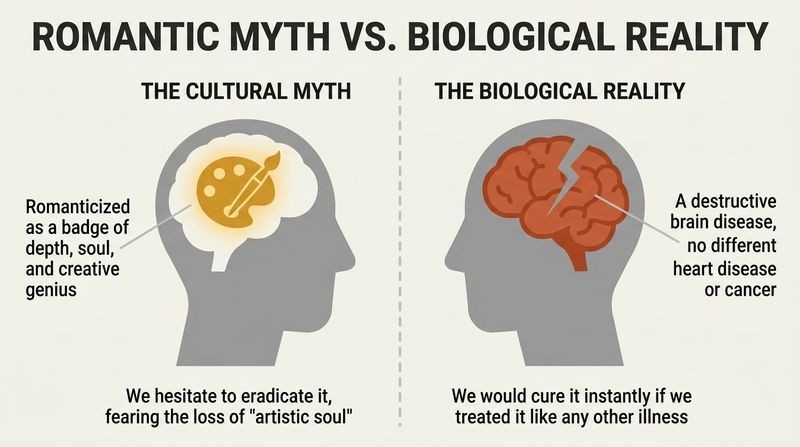
What's striking is how Kramer weaponizes a thought experiment to expose a bias hiding in plain sight. The move resembles Peter Singer's use of hypotheticals to surface inconsistent moral intuitions. His polemic anticipates a real tension in disability studies and the neurodiversity movement, which argue that pathologizing difference erases identity. Kramer would counter that progressive brain damage is not identity. The strongest version of his case rests not on rhetoric but on the accumulating anatomical evidence that follows, which shifts the burden of proof onto those who would preserve the condition.
Depression physically shrinks the brain, and every depressed day compounds the damage
The science caught up with the clinic. Two 1999 studies transformed the debate. Grazyna Rajkowska examined the prefrontal cortex of deceased depressives and found disorganized, weakened cells and a striking deficit of glia, the support cells that protect and repair neurons. Yvette Sheline scanned 24 recovered women and found their hippocampi (the memory and stress-regulation structure) were 8 to 10% smaller, with some later studies finding 20%.
Duration, not age, predicted the loss. A 70-year-old depressed three years looked like a 30-year-old depressed three years. The damage persisted into remission and tracked verbal memory decline. The clinical implication is urgent: recovery cannot wait. Depression is progressive, each episode raising the odds and severity of the next.
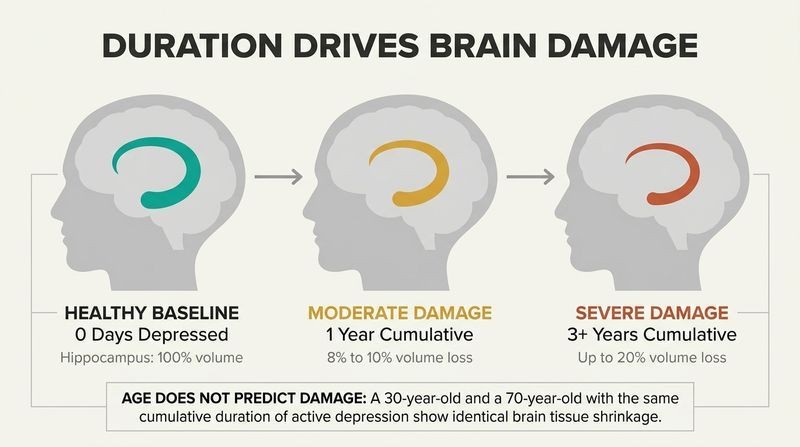
These findings recast depression as closer to a neurodegenerative process than a mood. Yet caution is warranted. Cross-sectional imaging cannot fully prove direction of causation, and Kramer himself acknowledges contradictory data suggesting some people carry small hippocampi before illness. The chicken-and-egg problem persists. Still, the convergence with animal stress research (Sapolsky's work on glucocorticoids killing hippocampal cells) makes the mechanism plausible. The reframe matters clinically: if delay causes irreversible loss, the old psychoanalytic patience of letting patients "hit bottom" becomes not just cruel but negligent, akin to leaving a fracture unset.
Depression is failed resilience: a stress switch stuck in the on position
The unifying model is the stuck switch. Robert Sapolsky's decades of research show that chronic stress floods the brain with stress hormones (glucocorticoids), which damage hippocampal cells. A healthy hippocampus normally signals the body to shut off the stress response. When damaged, it cannot, so hormones keep flowing, extending the harm in a vicious cycle.
Two failures define depression. The brain becomes vulnerable to injury and loses its capacity to repair. A resilience protein called BDNF (brain-derived neurotrophic factor), essentially the opposite of stress hormones, is depleted in depressed patients. Depression, in this myth, is a disorder of neuroprotection. The opposite of depression is not happiness but resilience: a mind and brain that bend under adversity and then spring back.
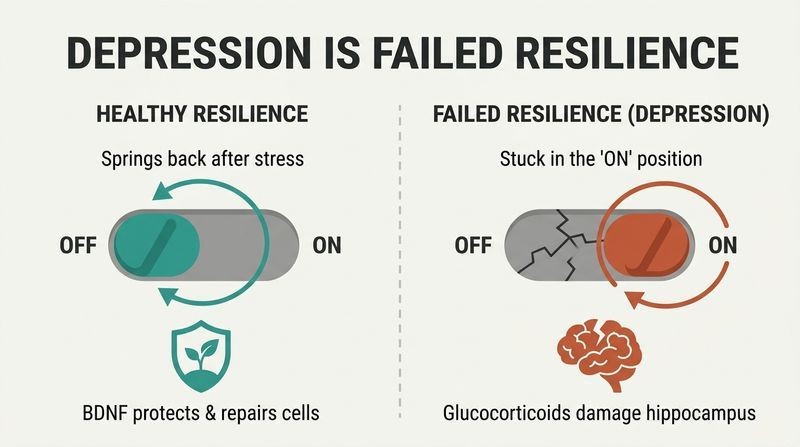
The elegance here is that the brain-level story mirrors the psychological one: vulnerability, withdrawal, failure to recover. That poetic correspondence is seductive but also a warning sign, since narratives that feel too neat can outrun the evidence. Kramer honestly calls it a "myth," meaning a productive working model, not settled truth. The framing dovetails with modern resilience research in psychology (Bonanno's work showing most trauma survivors are resilient by default) and with the neuroplasticity revolution. Reframing recovery as regrowth rather than mere symptom relief reoriented an entire field toward neurogenesis, a genuinely generative shift.
Only about 38% heritable, depression is built as much by experience as genes
Kendler's twin studies mapped the pathways. Behavioral geneticist Kenneth Kendler, using registries of over 20,000 twin pairs, pegged depression's heritability near 38%, rising above 50% for chronic cases. That places it alongside high blood pressure, not schizophrenia.
The environment that matters is "nonshared." Surprisingly, growing up in the same troubled household does not reliably produce depression in all siblings. What matters is experience filtered through an individual's perceiving brain. A landmark New Zealand study showed the effect vividly: people with two "long" versions of the serotonin transporter gene stayed depression-free even after abuse or loss, while those with "short" versions succumbed. Genes and environment interact so thoroughly that genes can create the very stressful environments (bad marriages, job loss) that trigger illness.
The gene-environment interaction insight was revolutionary in 2003, though the specific Caspi-Moffitt serotonin transporter finding has since faltered in large replication attempts and meta-analyses, a cautionary tale about candidate-gene studies before the genome-wide era. The broader architecture Kramer describes holds up better: depression is polygenic, with thousands of small-effect variants, and environment acts through individual perception. His point that "nonshared" experience dominates remains counterintuitive and important. It undercuts both genetic fatalism and simplistic blame-the-parents narratives, pointing instead toward the irreducibly personal way each brain metabolizes its own life.
Depression is the single most disabling disease on Earth, costing $40 billion yearly in the US
Measured by lost healthy years, nothing beats it. Using disability-adjusted life years (a metric combining severity, prevalence, and premature death), the World Health Organization, World Bank, and Harvard found depression already the most burdensome chronic disease of midlife by 1990, projected to rank second only to heart disease globally by 2020. It outranks AIDS, breast cancer, and grouped cancers.
The harm spans the lifespan. Over 16% of Americans suffer major depression in their lifetime. It starts young, recurs, and shortens life independent of suicide: depressed elderly patients were 24% more likely to die even after controlling for other factors, rivaling congestive heart failure as a risk. It also worsens arthritis, diabetes, and heart attack recovery.
The disability-adjusted life year metric revolutionized global health priorities, forcing mental illness onto agendas dominated by infectious disease. Kramer's marshaling of this data is his most rhetorically devastating move: even halving the estimates leaves depression atop the list. A skeptic might note that self-reported disability weightings are culturally contingent and that measuring "good days stolen" involves subjective tradeoffs. Yet the convergence across methodologies (twin studies, workplace absenteeism, mortality data) is hard to dismiss. The mortality link to heart disease, via sticky platelets and rigid heart rhythms, reframes depression as a whole-body vascular illness, not merely a disorder of mood.
Treat the mildest symptoms, because leftover sadness predicts relapse and more damage
Depression sits on a continuum, like blood pressure. There is no clean biological line separating major depression from minor forms. Kendler found that four symptoms for two weeks, or five symptoms for ten days, all predict poor outcomes. Every criterion (number, severity, duration) sits on a slope of risk.
Residual symptoms are dangerous. The NIMH long-term study found patients who recovered with even one or two mild lingering symptoms relapsed three times faster than those who became fully symptom-free. The old goal of "response" (halving symptoms) gave way to "remission" (eliminating them). Because depression is progressive and each episode primes the next, the practical rule became aggressive: the time to interrupt depression is yesterday, and the target is zero symptoms.
This continuum view aligns depression with cardiology's treatment of borderline hypertension and cholesterol, where risk, not a bright diagnostic line, drives intervention. It is clinically powerful but ethically double-edged. Expanding the boundary of pathology invites the critique, voiced by figures like Allen Frances, that psychiatry medicalizes ordinary sadness and serves pharmaceutical interests. Kramer anticipates this, insisting the data (family clustering, suicide risk, shortened REM latency) show minor depression is genuinely continuous with major. The tension between vigilant early treatment and overdiagnosis remains unresolved in the field, and honest readers should hold both truths.
The charm of depressed people is often a symptom, not a virtue
Kramer's most uncomfortable clinical observation. Depressed patients can be exquisitely charming: attentive, self-effacing, socially fastidious, emotionally attuned. He describes Betty, whose depression manifested as a paralyzing inability to do laundry, yet who was so delightful and considerate that friends adored her not despite but because of her handicaps.
These graces may be scars. Children of depressed parents learn hypervigilant attunement to survive. That compulsive generosity, low self-regard as selflessness, and alienation-as-critique all carry social value while masking a progressive illness. Empathy is not depression, and many sensitive people never fall ill. But when charm shades into desperate people-pleasing and indiscriminate trust, it becomes a risk factor. Attractiveness can even extend to eros: many are erotically drawn to the languorous, unreachable, depressive lover.
This is Kramer at his most Gladwellian, turning a familiar social type inside out. The insight connects to attachment theory: anxious and "parentified" children develop precocious caretaking that reads as maturity but reflects insecurity. It also echoes research on the "good enough" versus over-adapted self in Winnicott and Alice Miller's work on gifted children who learn to read parents' needs. The provocative claim, that we sexualize and romanticize the markers of illness, unsettles because it implicates the observer, not just the patient. The risk is over-pathologizing genuine kindness; Kramer concedes empathy and depression are distinct, only frequently correlated.
"Heroic melancholy" is a 2,000-year-old myth built to explain suffering we couldn't cure
The idea has a genealogy. An Aristotelian text asked why great men (Socrates, Plato, poets, heroes) tend toward melancholy, birthing the notion that black bile confers genius. Kramer traces the tradition through Renaissance Florence, Elizabethan "melancholic malcontents," Hamlet, Goethe's suicidal Werther, and Kierkegaard's poet whose cries become beautiful music.
But "melancholy" was a catchall. It once bundled hemorrhoids, epilepsy, mania, and schizophrenia. As medicine split off each condition, only depression remained to carry the mystique. Kramer's thesis: because depression was universal, intractable, and untreatable for millennia, cultures had to make meaning of it, decorating an affliction with nobility the way spandrels in Gothic churches (accidental architectural gaps) were later filled with saints. The meaning is a byproduct, not proof of value.
The spandrel metaphor, borrowed from Stephen Jay Gould's critique of adaptationism, is deployed brilliantly: a feature can exist without having been selected for its apparent purpose. Kramer's cultural history is erudite but selective, and a literary scholar might object that reducing Hamlet or Kierkegaard to symptom-bearers flattens genuine philosophical content. The stronger claim survives: our aesthetic reflex equating depth with despair is contingent, not eternal. Compare Carl Rogers, cheerful yet profound, or Camus's Sisyphus, whose rebellion springs from happiness. The equation of sadness with wisdom may be, as Kramer suggests, an artifact of therapeutic impotence rather than a truth about the human condition.
The evidence that depression fuels creativity is far weaker than the myth suggests
Most creativity research points to mania, not depression. The best-known study, Nancy Andreasen's survey of Iowa Writers' Workshop faculty, found excesses of bipolar disorder and alcoholism, not unipolar depression. Kay Jamison's Touched with Fire centers on bipolar poets (Byron, Shelley, Coleridge). Hypomania, with its energy, confidence, and racing ideas, is the productive engine, not the leaden paralysis of depression.
Day to day, depression is a straightforward handicap. Patients report doing better work before and after episodes. Writers thrive on difference of any kind (autism, epilepsy-like detachment, Updike's psoriasis and stutter). Depression may aid writing only as plebeian ailments do: by providing raw material and, practically, because writing is something the isolated depressive can still manage in the small hours when a job feels impossible.
Kramer performs a useful demolition of a beloved cliche. The manic-versus-depressive distinction is crucial and often blurred in popular discourse. His point about anthology bias is subtle and sharp: if editors, steeped in centuries of melancholic taste, selected the canon, then finding depression in "great poets" is circular. Recent large-register studies (Kyaga et al. in Sweden) do find modest associations between creative professions and bipolarity, partially vindicating the mania thread while leaving unipolar depression's claim thin. The deeper move is epistemic: extraordinary claims about preserving a devastating disease require extraordinary evidence, and the creativity defense simply does not clear that bar.
Alienation and depression are not the same, so demand alienation prove itself
A patient's angst may be pathology in disguise. Kramer clashed with philosopher Carl Elliott, who argued that treating a dislocated suburban accountant's "is this all there is?" alienation with Prozac commits a category error, like treating Holy Communion as a dietary issue. Kramer's rebuttal: the very patients Elliott cited as existentially alienated (calling them Hillary and Sally) were clinically depressed, with anhedonia, insomnia, and childhood sexual abuse.
Most literary alienated heroes are ill. Camus's Meursault erupts in violence, Salinger's and Kerouac's protagonists are suicidal, nearly every Walker Percy hero carries a diagnosis. Kramer, who grew up in the shadow of the Holocaust and treasured Sisyphus, insists he honors true alienation: the contemplative, joyous, or politically active kind. But when brooding becomes paralyzing and the horizon turns black, that is illness masquerading as insight.
This is the book's philosophical crux and its most contestable. Kramer risks a totalizing move where any dark worldview becomes suspect for underlying pathology, which could pathologize legitimate political despair or existential clarity. He guards against this by distinguishing depressive alienation from its vigorous cousins, but the line is genuinely hard to draw in a clinical encounter. The debate maps onto a live tension in bioethics between authenticity (honoring a person's given self) and welfare (relieving suffering). His demand that alienation "prove its bona fides" as separate from disease is reasonable, yet it places enormous diagnostic weight on the clinician's judgment about what counts as too much.
Grief with resilience looks different from depression, and often nobler
They are distinguishable in practice. Careful observers find that the mental and physical slowing (psychomotor retardation) central to depression is nearly absent in normal grief. Hopelessness, worthlessness, suicidal thoughts, and early-morning waking mark depression; crying is actually more common in grief than in blunted depression. Grief's guilt tends to be about omissions rather than deep unworthiness.
Resilient grief contains hints of competence. Kramer invokes critic Philip Fisher's case for vehement, active passions: grief that rouses to action, as it did for Antigone or Achilles setting out against Hector. Crucially, the depressed often cannot grieve at all; depression's blankness mutes even the pain of loss, so mourning stalls. Understanding depression as disease may recover an older, more vigorous ideal of grieving, one that plumbs the depths knowing it will resurface.
This distinction has real clinical stakes and shaped a long controversy over the DSM's "bereavement exclusion," eventually removed in DSM-5, a decision that ignited exactly the medicalization fears Kramer's continuum view invites. His nuance is valuable: he does not claim grief is depression, but that grief can trigger it in the vulnerable. The Fisher-inspired vision of grief-as-vigor draws on a pre-Romantic, classical sensibility that modern therapeutic culture, with its emphasis on "stages" and passive processing, has largely lost. Bonanno's empirical work on resilient bereavement (the majority who grieve without collapsing) provides strong contemporary support for Kramer's core claim that paralysis is neither the only nor the most admirable response to loss.
Imagine curing depression as a side effect of building better, more resilient brains
Eradication may arrive indirectly. Sapolsky engineered viruses (stripped-down herpes, which naturally invade neurons and activate under stress) to deliver protective genes that fire only when stress hormones threaten cell death. In rats facing simulated strokes, treated brains lost almost no cells while controls suffered massive damage. Such neuroprotection is a general goal of medicine, sought against stroke, aging, and dementia.
The fantasy is precision, not blandness. A future intervention might leave personality untouched, permitting anxiety, sadness, even extended despair, activating only when a stress response threatens to become the self-perpetuating stuck switch. Depression would then fall incidentally, in the wake of efforts to protect learning and memory. Kramer envisions freedom: no longer bracing against collapse, people could love more generously and risk more openly, unafraid of decompensation.
Written in 2005, this speculative finale reads as remarkably prescient about the neuroplasticity and gene-therapy trajectory, though the timeline proved optimistic and viral CRF-blocker trials hit liver-toxicity and suicidality snags Kramer honestly reports. The ethical framing is shrewd: by tying depression prevention to uncontroversial goals like preventing dementia, he sidesteps the "cosmetic psychopharmacology" objections that dogged his earlier work. Yet the dream of surgically removing only pathology while preserving authentic emotion assumes a cleaner separation than biology may allow. The vision that resilience "makes the world safe for caring," letting us attach without fear of destruction, is the book's quietly radical emotional payoff, reframing treatment as liberation rather than dulling.
Analysis
Against Depression is a physician's polemic disguised as a meditation, and its structure mirrors its argument: three movements titled what depression "is to us" (cultural values), what it "is" (science), and what it "will be" (speculation). Kramer, already famous for Listening to Prozac, writes as an insider troubled by his own field's and culture's ambivalence. The book's difficulty for a summarizer is that it is not a how-to; it delivers few instructions and instead wages a sustained assault on a habit of mind. Its power lies in accumulation, weaving clinical vignettes (Margaret, Emily, Betty, Harry) with laboratory findings (Rajkowska, Sheline, Sapolsky, Kendler) and literary history (Hamlet, Werther, Kierkegaard).
The central intellectual achievement is reframing depression as a disorder of failed resilience with anatomical signatures, dissolving the mind-body dualism that let us treat it as meaningful suffering rather than tissue damage. This was genuinely paradigm-shifting circa 2005. Seen now, parts have aged unevenly: the serotonin-transporter gene finding largely failed replication, the chemical-imbalance framing has been retired, and hippocampal-shrinkage causation remains debated. Yet Kramer hedged carefully, repeatedly calling his synthesis a "myth," a productive working model, which protects the book from looking dated.
The deeper contribution is philosophical and rhetorical. His eradication thought experiment (would you eliminate depression as we did smallpox?) elegantly exposes an inconsistency no other disease provokes. His genealogy of "heroic melancholy" as a coping myth for millennia of therapeutic impotence is a bracing piece of cultural criticism. The book's blind spot is the medicalization risk: by placing depression on a seamless continuum with ordinary sadness and demanding aggressive early treatment, Kramer opens doors that critics like Allen Frances would later warn about, and the removed DSM bereavement exclusion echoes his logic. Still, as a work that changed how a generation of clinicians and readers morally regarded an illness, it endures.
Review Summary
Against Depression argues that depression is a serious disease, not a romantic or artistic trait. Kramer challenges cultural myths about depression's benefits and emphasizes its harmful physical effects on the brain. He advocates for viewing depression as a treatable illness rather than a normal part of the human experience. While some readers found the book insightful and well-researched, others criticized its writing style and repetitiveness. Overall, the book presents a compelling case for taking depression seriously as a medical condition that should be eradicated.
People Also Read







Download PDF
Download EPUB
.epub digital book format is ideal for reading ebooks on phones, tablets, and e-readers.








































