


Key Takeaways
Not one man in the room said he felt like a man
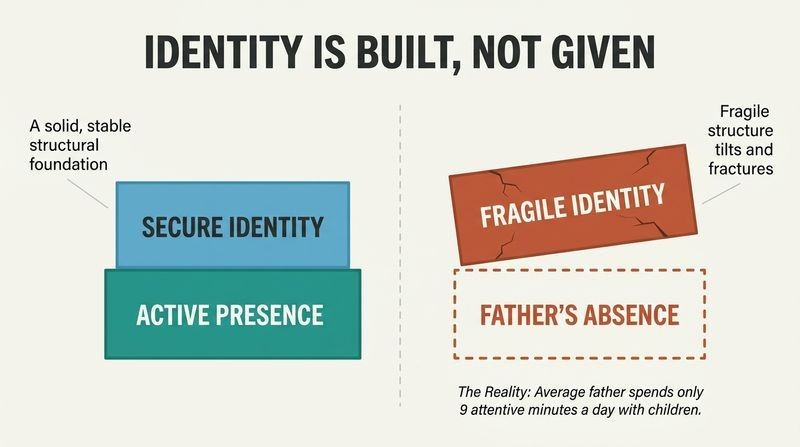
When Corneau, a Jungian analyst in Montreal, gathered twenty-one men for a workshop and asked whether they felt like men, not a single one said yes, including fathers married for two decades. His thesis: masculine identity is not a fact you possess but a fragile structure that must be built, and it collapses when fathers are absent. Absence here is broad. It includes the physically gone father, but also the father who is home yet emotionally mute, drunk, tyrannical, or hiding behind a newspaper.
He backs this with data: in his era, one in five US children lived in a fatherless home, and American studies clocked the average father's attentive time with his kids at nine minutes a day. Sons pay the bill in shaky identity.
The framing lands because it separates biography from felt reality. A man can be a father and still feel like a boy playing a role. Contemporary research echoes the mechanism if not the mysticism: father absence correlates with poorer emotional regulation and higher risk behavior in boys, though causation is tangled with poverty and conflict. What's valuable is Corneau reframing masculinity as an achievement rather than a given, which anticipates later scholarship on masculinity as a performance requiring social validation. The nine-minutes figure is dated and imprecise, but the underlying claim, that presence is measured in attention rather than proximity, remains sharp.
Fathers pass down silence like a hereditary disease
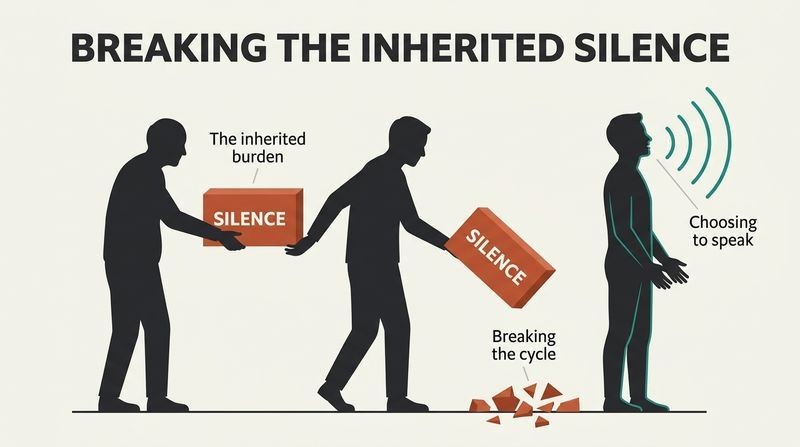
Corneau opens with his own wound: as a boy he would sit in his mother's armchair beside his father, inventing questions about rockets and work, desperate for a word that never came. The father's silence was mistaken for strength. He calls this the law of silence, an unspoken code that a father who truly speaks somehow threatens male solidarity. Men flee into taverns, cars, television, and work, avoiding their bodies and relationships under a pseudo-independence that is really self-absorption.
He reads the pattern into the Christian myth: Saint Joseph barely appears in his son's life and is absent at the crucifixion, while Christ cries out that even his heavenly father has forsaken him. The silence is inherited, generation to generation, until a son decides to break it.
The insight cuts against the flattering story men tell themselves, that reticence signals depth or stability. Corneau reframes it as transmitted avoidance. This dovetails with attachment theory: emotionally unavailable caregivers produce children who learn that needs go unmet, so they stop expressing them. It also connects to work on alexithymia, the difficulty naming feelings, which appears more frequently in men socialized toward stoicism. One caveat: not all quiet fathers are absent, and some cultures encode love in action rather than words. Corneau grants this, noting his own father made possible the education denied to himself. Silence wounds most when a son reads it as rejection.
Women simply are; men have to be made
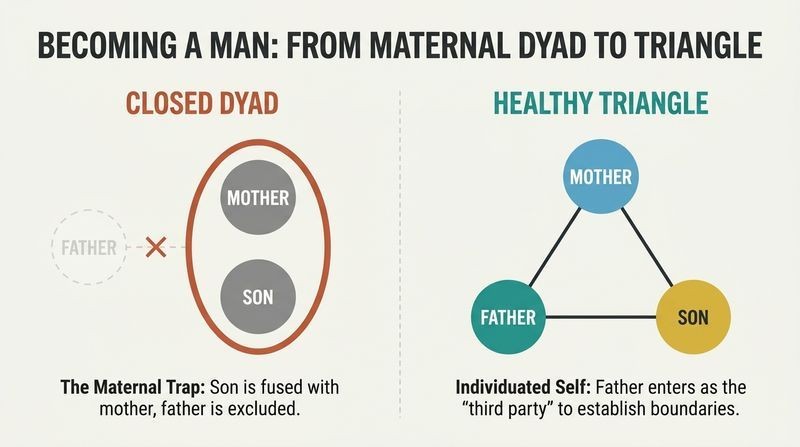
Biology sets the stage, Corneau argues. Every embryo begins female, and masculinity is added later, which he treats as a clue to its fragility. A child's first identification is with the mother. To become a man, a boy must transfer that identification to the father, a delicate handoff so risky that nearly every tribal society enforces it with elaborate male initiation rites, while female rites are rarer because menstruation offers girls a natural passage into womanhood.
The healthy configuration is a triangle: father, mother, son. The father is the first non-mother, the third party whose presence ends the blissful mother-child fusion and says, in effect, she is my wife and loves me too. Without him, the boy stays trapped in the mother-son dyad, a giant with feet of clay.
The embryology-as-metaphor is poetic but should not be mistaken for a scientific argument that masculinity is inherently unstable; that is interpretive leap, not fact. Still, the anthropological core is well documented: initiation rituals for boys are strikingly widespread across cultures, a pattern scholars like Van Gennep and later David Gilmore studied closely. Gilmore found that manhood is treated as a precarious status that must be won and can be lost, almost everywhere he looked. Corneau's triangle also echoes Lacan's paternal function, the father as the one who introduces law and separation. The framework is powerful, though its heteronormative and binary assumptions feel dated to modern readers.
Boys raised only by mothers grow afraid of their own bodies
Because the mother creates and tends the infant's body, the child associates sensuality, touch, tears, and tenderness with her. When the father stays outside, the son concludes that the entire realm of the body and feeling belongs to women. So to prove he is not a woman, he amputates his own sensitivity. Real men, the code says, do not cry, dance, or feel too much. Masculinity gets defined by everything it refuses.
The cruel irony: society then expects these emotionally amputated men to be intimate partners and warm fathers. Corneau argues men need to be touched and held to feel alive, and that a father who cuddles his son does not become a mothering father, he becomes simply a father, giving reality to a word that was nearly empty of meaning.
This is the book's most humane thread. The claim that masculinity is constructed negatively, as a flight from the feminine rather than a positive identity, aligns with sociologist Nancy Chodorow's influential argument that boys form identity through rejection of the mother while girls form it through connection. The physiological point about touch is underrated and now better supported: skin contact regulates cortisol and oxytocin across the lifespan, and touch deprivation has measurable effects. Corneau's leap to men polluting Mother Earth as unconscious revenge against the female body is more provocative than persuasive, a speculative flourish that stretches a clinical observation into planetary metaphor without evidence.
Homophobia is terror of your own buried tenderness
Corneau uses Jung's concept of the shadow, the disowned parts of ourselves we cannot bear to see. Men conditioned to repress emotion and sensuality do not eliminate those traits; they project them onto other men, especially gay men, and then attack them. The more a man denies his own heart and body, the more venomously he hates homosexuals. He notes the irrational prejudice that gay men cannot be trusted around children, despite most child molestation being committed by timid heterosexual men.
Every person, he argues, feels erotic and affectionate impulses toward the same sex, the root of friendship and admiration. Men confuse identity with orientation. The fear of being gay poisons male friendships and stops fathers from touching their sons.
Written in 1991, this reads as strikingly progressive for its psychoanalytic lineage, which historically pathologized homosexuality. Corneau explicitly refuses to treat gay clients as needing conversion and cites Kinsey's finding that 37% of American men had a same-sex experience to ejaculation after puberty, reframing orientation as a continuum. The projection thesis has empirical support: studies have found that men expressing the strongest anti-gay hostility sometimes show heightened arousal to same-sex stimuli, consistent with reaction formation. Where the argument strains is in reading all homosexuality as an unconscious search for the missing father, a reductive interpretive move he himself flags as necessarily incomplete.
Missing a father is like missing a spine, so men fake one
Corneau's structural claim: an absent father leaves a son without inner scaffolding, a condition he calls the negative father complex. Such a man cannot easily set goals, make choices, or tell love from lust or affection from appetite. He feels sure of nothing. So he builds structure from the outside instead of within.
Each compensation has a signature. The overachiever fills every empty moment with important tasks. The Don Juan structures his days around sexual conquest. The bodybuilder armors a fragile interior in muscle. The dogmatist masks uncertainty with categorical opinions. The rebel joins a gang to obey a primitive father. Corneau's rule of thumb: the louder the outer shell, the emptier the inner house. All these strategies exist to hide a craving to be touched, loved, and recognized.
The spine metaphor is memorable and clinically useful. It reframes braggadocio, workaholism, and compulsive seduction not as strength but as prosthetics for an absent internal structure. This resonates with self-determination theory, which distinguishes intrinsic motivation, action driven from within, from externally regulated behavior dependent on approval and reward. Corneau essentially describes men stuck in external regulation. The parallel to narcissism literature is explicit; he invokes Kohut and Lasch. A fair challenge: the framework is so flexible it risks unfalsifiability, since almost any male behavior can be read as compensating for absence. Its value is heuristic rather than diagnostic, a lens for self-examination, not a test.
Ten male masks that keep men repeating childhood scripts
Corneau stages a mock theater, the Theater of Virility, casting ten types of lost sons who compulsively replay roles learned in childhood. The trouble is not the role itself but the total identification with it, which imprisons the man. A few:
1. Bob the Hero, who performs endlessly for applause and secretly feels like an impostor.
2. Vince the Good Boy, gentle on the surface, seething underneath, a passive-aggressive Incredible Hulk.
3. Eric the Eternal Adolescent, the puer, endlessly promising, never committing, high on dreams.
4. Peter the Seducer, collecting fragments of women to build an ideal mother he never had.
5. Chris the Addict, drowning in a search for Dionysian ecstasy that becomes a devouring dark mother.
Each mask, he insists, is really a story about a missing father dressed up as a story about a controlling mother.
The theatrical device is more than charm; it externalizes the Jungian complex as a script that plays the actor rather than the reverse. The move recalls transactional analysis and Eric Berne's Games People Play, where people run repetitive life scripts, and modern schema therapy, which maps early maladaptive patterns that reactivate under stress. Corneau's key therapeutic claim is liberating: the goal is not to stop being a hero or a seducer but to stop being unconsciously ruled by the part, so one can play it by choice. The risk of typologies is that readers cherry-pick a flattering label. Corneau hedges by noting most men blend several masks.
Repressed aggression does not vanish; it possesses you
Corneau retells the Grimm tale of Iron Hans, the wild rust-colored man found at the bottom of a pond, caged in the castle courtyard. The boy can only free him with a key hidden under his mother's pillow, a vivid image of the truth that a son's raw instinctive energy is controlled by the mother. Aggression here is not violence but healthy self-affirmation, the capacity to push back, set limits, and defend oneself.
When a boy is punished for anger, that energy does not disappear. It turns inward as self-hatred and depression, finds a scapegoat, worships the aggressor, or becomes eroticized as sadomasochism. His patients dream of robbers and tigers they refuse to confront, projecting their own ferocity outward. Because they will not have their aggression, it has them.
The distinction between aggression as vitality and aggression as violence is the load-bearing idea, and it is sound. Clinical work on anger suppression links chronic inhibition to depression and psychosomatic symptoms, consistent with Corneau's cases. His therapeutic method, having a client vividly imagine violence toward the mother-complex rather than the real mother, is essentially guided active imagination, a catharsis contained in symbol. Modern evidence on catharsis is mixed; venting can sometimes rehearse rather than discharge anger. But Corneau's aim is subtler than venting: it is conscious integration of the shadow so the impulse can be owned and governed. The Robert Bly connection situates this within the men's movement of the era.
Men chase women as mirrors to prove they are men
Corneau argues that when a father never confirmed a son's manhood, the son spends life seeking that confirmation in women's eyes. He calls it running short of women. Fellini's Casanova makes love to countless women without ever being emotionally touched, because feeling would bind him and binding feels like death. Pornography works the same way: the paper women whisper that he is powerful, offering a mirror of virility with no risk of real contact.
He connects this to a fear of intimacy rooted in the mother. The female body is where he came from, so she who gave life may also take it. Voyeurism, he notes, is sex from a safe distance. The cure is not condemning desire but honoring it, celebrating Eros rather than degrading it into getting one's rocks off.
The reframe of promiscuity and pornography as identity-repair rather than mere appetite is genuinely useful and non-moralizing. It anticipates later clinical framing of compulsive sexuality as an attachment and affect-regulation problem, not simply excess libido. Corneau's insistence that a man running short of women is really running short of male confirmation is a sharp inversion. His plea to celebrate Venus, citing the Kama Sutra and the Song of Solomon against a repressive Christian inheritance, positions sexual shame as the true pathology. A limitation: his account centers the male gaze and treats women largely as instruments in the man's drama, a framing feminist readers rightly interrogate, though Corneau's larger project is to dismantle exactly that instrumentalization.
The Fisher King's wound: manhood built only on the outside
In the Grail legend, young Percival kills the Scarlet Knight and dons his shining armor, but underneath still wears the soft clothes his mother sewed. He is macho outside, mommy's boy within. He meets the wounded Fisher King, injured in the thigh (a veiled castration), whose kingdom cannot heal until a guest breaks silence and asks about the bleeding lance. Percival stays polite and silent, and everyone suffers.
Corneau's reading: Western masculinity, like Percival's armor, is constructed entirely externally, disciplined, competitive, disincarnated. Christianity split the noble upper body from the lower instinctive one. Tribal initiation, by contrast, was wet, dirty, and bodily, reconnecting the boy to earth and blood. The wound heals only when a man breaks his silence and speaks.
The Grail exegesis is the book's mythic centerpiece and its most literary. Reading the thigh wound as symbolic castration and the required question as the breaking of male silence gives the legend a therapeutic charge. The high-versus-low body split he attributes to Christian dualism echoes Nietzsche's critique of otherworldly morality and body-denial, and anticipates somatic psychology's insistence that healing must be embodied, not merely cognitive. Corneau's contrast between dry, armored, heroic initiation and wet, earthy, tribal initiation is evocative, though it risks romanticizing indigenous rites, some of which involved real trauma. The enduring point stands: an identity that is all surface and no interior stays perpetually wounded.
Your breakdown may be a delayed initiation demanding attention
Since fathers no longer initiate sons and rituals have vanished, Corneau argues the psyche improvises. He calls this initiation hunger, and its modern forms are ugly: divorce, car accidents, ulcers, bankruptcy, burnout, and above all depression. Men rarely enter therapy for self-inquiry; they come only when everything collapses, hoping the analyst will repair them like a mechanic without their having to change.
Depression, he insists, can be beneficial if fully experienced rather than fought. It shatters the ego's illusion of control and forces a man to confront his shadow and his real needs. He recounts his own ulcerative colitis, foreshadowed by a dream of a feverish woman named Maria, as a bodily revolt that ultimately returned him to life. What is creative in us, like the ugly god Hephaistos flung from Olympus, often first appears in repulsive form.
Reframing depression as initiation rather than malfunction is the book's boldest therapeutic claim, and it carries real risk alongside real insight. The danger is romanticizing serious clinical depression, which sometimes requires medication and can be lethal, not merely a passage to meaning. Corneau's own colitis returning repeatedly, which he honestly notes, undercuts any tidy redemption arc. Yet the core resonates with post-traumatic growth research and with Jung's view of symptoms as meaningful communications from the unconscious. The idea that crisis dismantles a false self built on external validation parallels midlife-transition literature. Best read as: do not waste your breakdown; interrogate what it is trying to correct.
Become the father you never had by fathering yourself
Corneau's resolution is self-fathering. First, mourn the ideal father, the impossible archetype who would be athlete, artist, intellectual, and friend all at once. No human, only a god, could satisfy that. Traditional initiation was never done by one biological father anyway, but by the tribe's many fathers. Then forgive the real father, who mostly did what he could, provided, sacrificed, and stayed silent because silence was all he was given.
The void the absent father left becomes the space a man fills with his own presence and creativity, whether he raises children or makes cultural works. Practical tools include therapy, men's groups as a symbolic second womb, male friendships, and imaginary written dialogues with the father. The final revolutionary act is simple and hard: break the inherited silence and speak.
The closing move is the most constructive in the book because it shifts agency from grievance to responsibility without denying the wound. Mourning the idealized parent is a recognized developmental task in psychoanalysis, and forgiveness research links it to lower rumination and better health. Corneau's line that we can only give what we never received captures the generativity at the heart of self-fathering, echoing Erikson's stage of generativity versus stagnation. The men's-group prescription proved culturally prescient, presaging the 1990s mythopoetic movement Robert Bly led. The honest limit: speaking and self-fathering are easier prescribed than done, and the book offers inspiration more than a step-by-step method for men without access to therapy or community.
Analysis
Corneau writes from the Jungian tradition, and that lineage is both the book's power and its ceiling. Published in Quebec in 1991 as Pere manquant, fils manque, it belongs to the same cultural moment as Robert Bly's Iron John, part of a mythopoetic men's movement reacting to second-wave feminism by asking what, positively, a healthy masculinity might be. Its method is triangulation: clinical case material, dream analysis, myth (Iron Hans, the Grail, Dionysus, Narcissus), and cross-cultural anthropology of initiation. The recurring thesis is elegant and falsifiable-adjacent: masculine identity is not innate but constructed through identification with a present father, and its widespread modern fragility traces to the father's physical or emotional absence.
The strongest contribution is diagnostic reframing. Bravado, workaholism, compulsive seduction, homophobia, and even burnout are recast as compensations for a missing inner structure rather than as strengths or moral failings. This is genuinely useful and has aged well alongside attachment theory and research on emotional suppression in men. The treatment of homosexuality is notably humane for its psychoanalytic era, refusing conversion while still, less defensibly, subordinating gay identity to a search for the father.
The weaknesses are characteristic of the genre. The argument is heavily interpretive and rarely falsifiable; almost any behavior confirms the theory. The mother is frequently cast as devouring or omnipotent, with the father's absence blamed for her outsized role, an analytically convenient but sometimes evasive move. The gender binary is rigid, and grand claims (men pollute the earth as revenge against the female body) outrun evidence. The book is best read not as science but as a symbolic map for self-inquiry. Its enduring gift is permission: for men to grieve, to feel their bodies, to break inherited silence, and to father themselves. Three decades on, amid renewed debate about boys and men, its central wound still bleeds.
Review Summary
Absent Fathers, Lost Sons receives mixed reviews. Many readers find it insightful, praising its exploration of masculinity and father-son relationships. Some appreciate the Jungian perspective and find it helpful for understanding themselves. However, critics argue it's outdated, overgeneralizes, and lacks scientific rigor. The book's discussions on homosexuality and gender roles are particularly controversial. While some readers find it life-changing, others see it as simplistic or difficult to read. Overall, it's considered thought-provoking but polarizing.
People Also Read




FAQ
What's "Absent Fathers, Lost Sons: The Search for Masculine Identity" about?
- Exploration of Masculine Identity: The book delves into the psychological impact of absent fathers on their sons, exploring how this absence affects the development of masculine identity.
- Role of Fathers: It examines the crucial role fathers play in the psychological and emotional development of their sons, and how their absence can lead to a fragile sense of self.
- Cultural and Psychological Analysis: The author, Guy Corneau, uses a blend of cultural analysis and Jungian psychology to discuss the broader implications of father-son relationships in society.
- Case Studies and Personal Stories: The book includes various case studies and personal stories to illustrate the struggles and journeys of men dealing with the absence of their fathers.
Why should I read "Absent Fathers, Lost Sons"?
- Understanding Masculine Identity: It provides insights into the formation of masculine identity and the psychological challenges faced by men with absent fathers.
- Jungian Perspective: The book offers a unique perspective by integrating Jungian psychology, which can be enlightening for those interested in depth psychology.
- Personal Growth: Readers may find guidance and understanding in their own experiences with father figures, aiding in personal growth and healing.
- Cultural Relevance: It addresses contemporary issues of masculinity and fatherhood, making it relevant for both men and women interested in these topics.
What are the key takeaways of "Absent Fathers, Lost Sons"?
- Impact of Absence: The absence of a father can lead to a fragile masculine identity, affecting a man's self-esteem, relationships, and life choices.
- Need for Initiation: The book emphasizes the importance of initiation rites and father figures in helping young men transition into adulthood.
- Healing Through Understanding: Understanding and forgiving one's father, and self-fathering, are crucial steps in healing and developing a healthy masculine identity.
- Cultural and Psychological Insights: The book provides a deep dive into the cultural and psychological aspects of father-son relationships, offering a broader understanding of these dynamics.
How does Guy Corneau use Jungian psychology in the book?
- Archetypes and Complexes: Corneau uses Jungian concepts like archetypes and complexes to explain the psychological patterns that arise from absent father figures.
- Symbolic Imagery: The book employs symbolic imagery from dreams and myths to explore the unconscious mind and its influence on masculine identity.
- Integration of the Shadow: It discusses the importance of integrating the shadow, or repressed parts of the self, to achieve psychological wholeness.
- Personal and Collective Unconscious: Corneau explores how the personal and collective unconscious shape men's experiences and perceptions of masculinity.
What are the best quotes from "Absent Fathers, Lost Sons" and what do they mean?
- "The father’s silence dictates the fragility of the son’s sexual identity." This quote highlights the profound impact a father's absence or silence can have on a son's development and self-perception.
- "A man is not a man until he has accessed his raw, untamed energy." It suggests that embracing one's inherent aggression and energy is essential for developing a complete masculine identity.
- "The road to responsibility is the road to freedom." This emphasizes the importance of taking responsibility for one's life and actions as a path to personal liberation and growth.
- "We must learn again to trust the animal within us." This quote encourages reconnecting with one's instincts and natural impulses as a way to achieve balance and authenticity.
How does "Absent Fathers, Lost Sons" address the concept of self-fathering?
- Mourning the Ideal Father: The book suggests that men must mourn the loss of the ideal father they never had to move forward.
- Forgiving the Real Father: It emphasizes the importance of forgiving one's real father for his shortcomings to heal and grow.
- Becoming One's Own Father: Men are encouraged to fill the void left by their fathers by nurturing and guiding themselves.
- Creativity and Self-Care: Self-fathering involves creativity and self-care, allowing men to develop their own identities and strengths.
What role do initiation rites play in "Absent Fathers, Lost Sons"?
- Transition to Adulthood: Initiation rites are seen as crucial for helping young men transition from adolescence to adulthood.
- Connection to Masculinity: These rites connect young men to their masculine identity and community, providing a sense of belonging and purpose.
- Symbolic Death and Rebirth: Initiation often involves symbolic death and rebirth, marking the end of childhood and the beginning of a new phase of life.
- Modern Society's Lack: The book discusses how the absence of such rites in modern society contributes to the struggles men face in developing a strong masculine identity.
How does "Absent Fathers, Lost Sons" explore the fear of intimacy?
- Impact of Absent Fathers: The absence of a father can lead to a fear of intimacy, as men struggle with vulnerability and emotional connection.
- Role of the Mother: Overbearing or absent mothers can exacerbate this fear, as men may associate intimacy with being overwhelmed or smothered.
- Repressed Emotions: Men may repress emotions and desires, leading to difficulties in forming deep, meaningful relationships.
- Healing Through Awareness: The book suggests that awareness and acceptance of one's fears and emotions are key to overcoming the fear of intimacy.
What does "Absent Fathers, Lost Sons" say about the role of aggression in masculine identity?
- Natural Aggression: The book views aggression as a natural and necessary part of masculine identity, essential for self-affirmation and defense.
- Repression and Consequences: Repressing aggression can lead to self-hatred, scapegoating, and unhealthy expressions of anger.
- Integration and Control: Men must learn to integrate and control their aggression to achieve psychological balance and healthy relationships.
- Cultural Misunderstandings: The book addresses cultural misunderstandings about aggression, advocating for a more nuanced understanding of its role in masculinity.
How does "Absent Fathers, Lost Sons" address the concept of the shadow?
- Repressed Parts of the Self: The shadow represents the repressed parts of the self that are often projected onto others.
- Integration for Wholeness: Integrating the shadow is essential for achieving psychological wholeness and self-acceptance.
- Awareness and Acceptance: The book emphasizes the importance of awareness and acceptance of one's shadow to prevent it from controlling behavior.
- Cultural and Personal Shadows: It explores both cultural and personal shadows, highlighting their impact on individual and collective behavior.
What are the psychological effects of absent fathers according to "Absent Fathers, Lost Sons"?
- Fragile Masculine Identity: Absent fathers can lead to a fragile sense of masculine identity, affecting self-esteem and life choices.
- Emotional and Psychological Struggles: Sons may experience emotional and psychological struggles, including depression, anxiety, and relationship issues.
- Search for Father Figures: Many men seek substitute father figures or engage in behaviors to compensate for their father's absence.
- Healing and Growth: Understanding and addressing these effects are crucial for healing and personal growth, as emphasized in the book.
How does "Absent Fathers, Lost Sons" suggest men can break the cycle of silence?
- Open Communication: Men are encouraged to break the cycle of silence by openly communicating their feelings and vulnerabilities.
- Building Relationships: Developing strong relationships with other men and seeking support can help break the silence.
- Self-Expression: Engaging in self-expression through therapy, writing, or creative outlets can facilitate healing and growth.
- Cultural Change: The book advocates for cultural change, encouraging men to challenge traditional norms and embrace a more open and expressive masculinity.
Download PDF
Download EPUB
.epub digital book format is ideal for reading ebooks on phones, tablets, and e-readers.








































