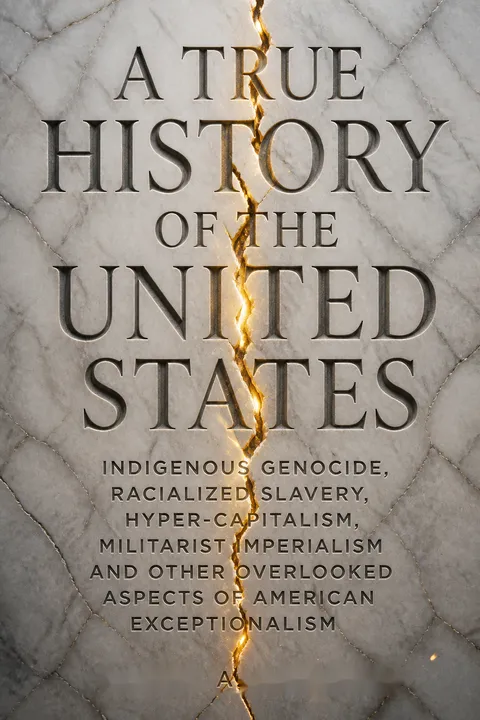

Key Takeaways
1. America's Foundational Myths Mask Dark Truths
Exposure to the historical myths and flaws—in addition to the well-worn triumphs—of the country they might very well die for seemed appropriate. Anything less would have felt obscene.
Comforting narratives. American history is often presented through comforting origin myths, such as the Pilgrims escaping religious persecution and founding a "shining beacon" in Massachusetts. This narrative, however, conveniently sidelines the murkier beginnings in Virginia and the true motivations of early English colonists. The focus on Plymouth Rock over Jamestown reveals a conscious choice to whitewash a past driven by profit and exploitation.
Eurocentric lens. The traditional starting point of 1607 for U.S. history inherently adopts a Eurocentric and narrow perspective, omitting thousands of years of complex Native American civilizations. This "Age of Discovery" language implies a void before European arrival, effectively erasing indigenous history and justifying subsequent conquest. Such selective storytelling shapes national identity, often at the expense of inconvenient truths.
Challenging exceptionalism. The author argues that a "true history" requires confronting these myths to achieve intellectual maturity and a more honest self-perception. America is exceptional, but "not always in ways that should engender patriotic pride, but rather often in ways that should cause us to reflect, take stock, and strive to do better." This critical approach is essential for forming a more perfect union.
2. Slavery and White Supremacy: America's Enduring Original Sins
American slavery arose alongside and intertwined with American freedom.
Jamestown's dark origins. The first permanent English colony in Jamestown, Virginia, was founded on the pursuit of profit, not religious freedom. Its early struggles led to reliance on indentured servants and, increasingly, African slaves. This economic model, driven by cash crops like tobacco, quickly established a race-based labor system.
Bacon's Rebellion's legacy. The interracial populist uprising of Bacon's Rebellion (1675–1676) terrified the planter class. To prevent future unity between poor whites and blacks, the elite solidified a racial caste system. This led to:
- Increased reliance on chattel slavery for life.
- The creation of "white privilege" through lowered taxes and political representation for poor whites.
- The inseparable association of "blackness" with slavery and the lowest social classes.
Enduring racial caste. This devil's bargain transformed Virginia into a slave society, linking land, labor, and race in nefarious ways that persisted for centuries. The contradiction of white liberty built upon black enslavement became a foundational aspect of American society, with its echoes still visible in contemporary racial and economic disparities.
3. Native American Conquest: A Consistent and Tragic Imperial Project
The frenzied Americans’ desire for land ultimately posed a greater threat to native autonomy than that of any of the other European imperialists.
Early conflicts and displacement. From the Puritan settlements in New England (Pequot War) to the Virginia frontier, conflict with Native Americans was a constant feature. European diseases decimated indigenous populations, weakening their ability to resist. The Seven Years' War, often called the French and Indian War, ultimately removed French influence, leaving Native Americans alone against an insatiably expansionist British colonial population.
Jackson's brutal legacy. Andrew Jackson's presidency marked a dark chapter, epitomized by the Indian Removal Act of 1830. Despite Supreme Court rulings protecting Cherokee land rights, Jackson defied the law, using federal troops to forcibly march tribes along the "Trail of Tears." This act of "ethnic cleansing" opened vast territories for white settlement, particularly for cotton plantations.
Four phases of tragedy. U.S. policy towards Native Americans consistently led to their dispossession and cultural destruction:
- Removal: Forcing tribes west of the Mississippi.
- Concentration: Confining them to vast "Indian territories."
- Confinement: Shrinking these territories into smaller, often barren, reservations.
- Assimilation: Forcing cultural change and individual land allotments (Dawes Act), further eroding tribal lands and identity.
This relentless expansion, driven by land hunger and exceptionalist ideology, proved an existential threat to indigenous ways of life.
4. The American Revolution: A Complex Struggle Beyond Simple Liberty
The war [of independence] was not just about home rule, but about who would rule at home.
Challenging the myth. The American Revolution is often romanticized as a unified, democratic rebellion against tyranny. However, the reality was far messier. Probably no more than one-third of colonists were "patriots," another third were loyalists, and the rest remained neutral. The motivations for rebellion were diverse, encompassing ideology, economics, and class interests.
A civil war at home. The conflict was as much a civil war as a fight for independence. Loyalists, enslaved Africans, and Native Americans often sided with the British, seeing them as better protectors of their interests than the hypocritical colonial rebels. Lord Dunmore's proclamation offering freedom to slaves who joined the British army radicalized many southern planters, pushing them towards independence to protect their "property."
Hypocrisy of liberty. While white patriots clamored for liberty, they simultaneously denied it to enslaved blacks and sought to expand into Native American lands. The British, having abolished slavery within the UK and offering protection to indigenous tribes, often appeared more liberal on these issues than the colonists. This fundamental contradiction at the heart of the revolution complicates any triumphalist narrative.
5. Democracy's "Excesses" and the Rise of Elite Control
The framers, men you know and revere as 'democrats'—George Washington, Alexander Hamilton, James Madison, and Benjamin Franklin—would soon craft a document that would curtail what these men actually saw as the 'excesses' of democracy in America.
Fear of popular rule. The post-Revolutionary era under the Articles of Confederation saw a "flowering of democratization" for white males, with expanded voting rights and responsive state legislatures. However, this alarmed wealthy elites who feared "excesses of democracy," such as debt relief and paper money, which they believed threatened social order and their financial interests.
The Constitutional "coup." The Constitutional Convention of 1787, convened in secret by unelected delegates, unilaterally scrapped the Articles of Confederation. This act, arguably unconstitutional, aimed to create a stronger central government less susceptible to popular pressure. The framers, largely aristocrats and creditors, sought to protect property and establish a more stable, less democratic republic.
Limiting the franchise. The resulting Constitution, while a foundational document, was designed to distance government from the people. It included:
- Indirect election of senators (until 1913) and the president (Electoral College).
- The Three-Fifths Compromise, which empowered slaveholding states.
- A strong executive and federal power capable of suppressing unrest, as demonstrated by the response to Shays's Rebellion.
The Bill of Rights, protecting civil liberties, was largely a concession forced by Anti-Federalist opposition, highlighting the framers' initial intent to limit, rather than expand, popular democracy.
6. Militarism and Overseas Imperialism: An Enduring American Trait
The United States was an empire before it had even gained its own independence.
A history of expansion. American imperialism did not begin in 1898; it was a continuous process from the earliest colonial settlements, marked by the conquest and displacement of Native Americans and the annexation of Mexican territories. The "closing of the frontier" in 1890 fueled anxieties about national virility and economic stagnation, prompting a search for new markets and lands abroad.
The "splendid little war." The Spanish-American War (1898) marked America's overt entry into overseas imperialism. Driven by a confluence of factors—corporate interests, missionary zeal, naval strategy, and sensationalist media—the U.S. seized Puerto Rico, Guam, Hawaii, and the Philippines. This "splendid little war" was framed as liberation, but quickly devolved into brutal occupation and the suppression of indigenous independence movements.
A global hegemon. The Philippine-American War, a brutal counterinsurgency, revealed the dark side of "benevolent assimilation," with widespread atrocities and civilian deaths. This era solidified America's role as a global empire, establishing precedents for:
- Presidential war powers without congressional declaration.
- Extensive military bases worldwide.
- A foreign policy often driven by economic interests and a messianic sense of mission.
This shift laid the groundwork for a century of interventionism, shaping America's contemporary role as a militarized global power.
7. Economic Inequality and Corporate Power: A Recurring American Theme
By several measurements, the US in the late 20th century led all other major industrial countries in the gap dividing the upper fifth of the population from the lower — in the disparity between top and bottom.
Early capitalist excesses. From Jamestown's profit motive to Hamilton's economic program favoring wealthy speculators, American history is marked by the concentration of wealth. The Market Revolution, while bringing growth, also created vast disparities, leaving many farmers and workers behind. The Gilded Age saw unprecedented wealth accumulation by a few, with the richest 1% owning over half the national wealth by 1890.
Reaganomics and deregulation. Ronald Reagan's presidency ushered in a new era of "supply-side economics," characterized by massive tax cuts for the wealthy and deregulation. This led to:
- A tripling of the national debt.
- Stagnant wages for the working class.
- A dramatic increase in income inequality, with CEOs earning hundreds of times more than average workers.
- The growth of a consumerist culture and a "second Gilded Age."
Persistent corporate influence. Despite economic downturns and growing inequality, corporate interests consistently influenced policy, from the railroads of the 19th century to the financial deregulation of the 1990s and 2000s. This entrenched power, often at the expense of workers and the poor, has ensured that wealth disparity remains a defining, and often worsening, feature of American society.
8. Civil Liberties Often Fall Victim to Fear and War
Things are lost in war—freedom, liberties, individualism. Some are never recovered.
Early suppressions. The Alien and Sedition Acts (1798) under John Adams, passed during a "Quasi-War" with France, curtailed free speech and press, targeting political opponents. Lincoln's suspension of habeas corpus during the Civil War and the WWI Espionage and Sedition Acts further demonstrated how wartime exigencies erode constitutional protections.
World War II and the Cold War. The "Good War" saw the internment of over 100,000 Japanese Americans, many of them citizens, based on racial prejudice and unsubstantiated fears. The Cold War ushered in decades of "Red Scares," where:
- McCarthyism led to widespread accusations, blacklisting, and imprisonment of alleged communists and sympathizers.
- The FBI engaged in illegal surveillance and harassment of citizens, including civil rights leaders.
- Legislation like the Internal Security Act (1950) curtailed First Amendment rights.
Post-9/11 era. The "war on terror" after 2001 led to a new wave of civil liberties infringements, including:
- The Patriot Act and massive domestic surveillance programs.
- Indefinite detention at Guantanamo Bay.
- Drone assassinations of U.S. citizens without due process.
- Increased prosecution of whistleblowers under the Espionage Act.
These actions, often justified by national security fears, have permanently expanded executive power and normalized the erosion of individual freedoms.
9. Reconstruction's Failure: A Betrayal with Lasting Consequences
The slave went free; stood a brief moment in the sun; then moved back again toward slavery.
A lost opportunity. Reconstruction (1865-1877) was a radical, yet ultimately failed, experiment to achieve racial equality and integrate four million freed slaves into American society. Despite initial federal efforts and the passage of the 14th and 15th Amendments, guaranteeing citizenship and voting rights for black men, white racism and political apathy doomed the project.
Presidential and societal betrayal. President Andrew Johnson, a virulent racist, actively undermined Reconstruction by pardoning Confederates and allowing southern states to enact "black codes" that re-enslaved blacks in all but name. Northern weariness, economic depression, and the rise of white supremacist terrorism (Ku Klux Klan) led to the withdrawal of federal troops in 1877, effectively abandoning black Americans.
Jim Crow's long shadow. The failure of Reconstruction ushered in a century of Jim Crow laws, lynching, and systemic disenfranchisement, creating a new form of racial apartheid. This betrayal ensured that the economic and social gains for blacks were minimal, leaving a legacy of inequality that continues to plague American society and demonstrates the enduring power of white supremacy.
10. The Presidency: A Source of Both Strength and Danger
So, potentially, are all powerful presidents…even, maybe especially, the popular ones.
Washington's precedents. George Washington, though revered, set precedents for executive power, including leading troops against the Whiskey Rebellion, demonstrating the federal government's willingness to use force against its own citizens. His decision to step down after two terms, however, was a crucial act of restraint that solidified republican norms.
Jackson's populism and power. Andrew Jackson, a populist war hero, expanded presidential power by:
- Using the "spoils system" to reward political allies.
- Vetoing more bills than all predecessors combined.
- Defying the Supreme Court on Indian Removal.
- Crushing the nullification crisis, asserting federal supremacy.
His actions, while popular with white males, often came at the expense of minorities and constitutional checks.
FDR's expansion and Nixon's abuse. Franklin D. Roosevelt's New Deal dramatically expanded federal and presidential power in response to the Great Depression, though he ultimately respected constitutional limits. Richard Nixon, however, pushed the "imperial presidency" to its extreme, engaging in illegal surveillance, cover-ups, and abuses of power that led to his resignation and a lasting public distrust in government.
Modern executive overreach. From Kennedy's Bay of Pigs and Cuban Missile Crisis brinkmanship to Obama's drone warfare and mass surveillance, presidents have consistently expanded executive authority, often without congressional approval. This trend, rooted in historical precedents, highlights the inherent danger of unchecked presidential power, regardless of the occupant's intentions.
11. The "Good War" Myth and the Cold War's Costly Legacy
If, even at its best, a 'necessary' war against totalitarian fascism was so brutally vicious and imprecise, then perhaps we should carefully scrutinize American military hegemony—a gift of World War II—in the world today.
Challenging the "good war." World War II, while necessary to defeat fascism, was far from "good." The U.S. engaged in brutal tactics, including the firebombing of German and Japanese cities, killing hundreds of thousands of civilians. The decision to drop atomic bombs on Hiroshima and Nagasaki, while justified by some as saving lives, remains a controversial act of unprecedented destruction.
Contested Cold War origins. The Cold War was not inevitable, and both the U.S. and Soviet Union shared responsibility for its escalation. While Stalin was a brutal dictator, Soviet actions were often driven by legitimate security fears after devastating invasions. U.S. policies, such as cutting off aid, refusing to share nuclear secrets, and forming military alliances (NATO), exacerbated Soviet paranoia and fueled the arms race.
Militarization and perpetual conflict. The Cold War transformed the U.S. into a global military hegemon, establishing a permanent military-industrial complex and a foreign policy of interventionism. This led to:
- Costly proxy wars (Korea, Vietnam) and countless covert operations.
- The erosion of civil liberties at home through Red Scares.
- A world living under the constant threat of nuclear annihilation.
The legacy of the Cold War is a militarized, anxious world, where the U.S. continues to engage in "forever wars" with seemingly no end in sight.
12. Political Polarization and Culture Wars: An Enduring American Divide
The turmoil of the eighteenth century is with us still.
Early partisan divides. From the Federalist-Republican clashes of Washington's era to the Jacksonian "King Andrew" controversies, American politics has always been deeply divided. The lead-up to the Civil War saw extreme sectional polarization over slavery, culminating in a fractured two-party system.
20th-century culture wars. The 1920s, often romanticized as the "Jazz Age," was also an era of intense culture wars:
- Prohibition, reflecting rural-urban and religious-secular divides.
- The Scopes Monkey Trial, battling science against fundamentalism.
- The rise of the "new" Ku Klux Klan, fueled by nativism and anti-immigrant sentiment.
These conflicts demonstrated deep societal fissures over values, race, and modernity.
Nixon's legacy and contemporary polarization. Richard Nixon's "southern strategy" expertly channeled white resentment over civil rights and antiwar movements into a lasting Republican majority, using coded language to appeal to racial anxieties. This laid the groundwork for today's hyper-partisan landscape, where:
- Political parties are deeply tribal and often prioritize obstruction over cooperation.
- Culture wars over race, immigration, and social values continue to dominate discourse.
- The media often exacerbates divisions, reflecting a public appetite for conflict.
This enduring polarization, rooted in historical divisions, continues to challenge the notion of a unified American identity.
People Also Read







Download PDF
Download EPUB
.epub digital book format is ideal for reading ebooks on phones, tablets, and e-readers.








































