


Plot Summary
Poisonous and Bound
Kat1 regains consciousness in Elfhame's Hall of Healing, wrists strapped to a bed. Elthea,5 a cool-eyed fae healer, informs her the aconite poison she ingested has fused with magic from Bastian2's blood, Asher's healing, and the changeling's tampering. Now her skin is lethal to anyone except Bastian,2 whose touch delivers the only working antidote.
She must receive it before each sunset or the poison resumes. The purple stain bleeding over her fingers is permanent. Bastian,2 cold and formal, tells her she cannot return to Albion. Locked in his palace suite, Kat1 faces indefinite captivity, bound to the man who betrayed her2 in Lunden, now her sole lifeline. The city outside glitters with alien beauty, but she feels like a caged, venomous thing.
This opening establishes the central metaphor of the book: Kat has been made into a weapon, her body a site of violation that now endangers everyone. The irony is cruel: the only person she can safely touch is the one she has reason to hate. The leather straps and locked suite literalize her lifelong lack of autonomy as a married woman and political pawn. Her purple-stained hands become a visual mark of otherness and self-loathing. The reversal of the antidote needing Bastian's touch inverts the typical romance dependency into a forced intimacy that both characters must reckon with.
The King's Attention
Bastian2 inspects Hydra Ascendant graffiti in the city, sensing an organized threat to Dusk. Meanwhile, Kat1 begins using her pearlwort necklace, a gift from the changeling unCavendish, to trace whoever sent him. Accompanied by Rose,9 her new human-turned-werewolf bodyguard, she visits jewelers across the divided city. On a Dawn-dominated street, she encounters King Lucius.6
He approaches her with a predator's smile, calls her by name, and implies she would be welcome in his court. The encounter leaves her chilled. Later, she meets Prince Cyrus,7 whose oily flirtation masks sharp calculation. Kat1 learns the two courts coexist uneasily, and being noticed by Dawn's royals is dangerous for a human under Dusk's protection.
Kat's investigation reveals her survivor's instinct: she refuses to be a passive victim of unCavendish's schemes. By actively hunting his masters, she reclaims agency. Lucius's knowing use of her name establishes him as a threat aware of her significance to Bastian. The necklace, once a shackle, becomes a clue, transforming a symbol of violation into a tool of empowerment. Rose's presence as a fellow human navigating fae politics introduces the theme of chosen family versus blood, while the city's dual nature mirrors Kat's own split identity between the woman she was and the one she is becoming.
Ending the Sleep
Using his network of secret passages, Bastian2 eavesdrops on a meeting between King Lucius6 and the fae lord Caelus. Caelus reports that during his time in Albion, he confirmed the existence of an artifact capable of ending the Sleep, the magic that forces the Night Queen3 and Day King6 to relinquish consciousness for half each day.
Lucius6 gloats that he will secure the relic for himself, breaking the balance between courts and granting Dawn permanent ascendancy. Bastian2 realizes the coded note Kat1 nearly burned contained this very intelligence. The revelation adds a catastrophic dimension to the Hydra Ascendant threat: if the Sleep ends, civil war between the courts becomes inevitable.
This moment shifts the story's scale from personal stakes to realm-shattering consequences. Bastian's clandestine knowledge forces him into a impossible calculus: protect his queen by finding the relic first, or risk everything. His guilt over Kat burns hotter now that he understands what was at stake in Lunden. The Sleep as a mechanism for enforced cooperation becomes a metaphor for the fragile peace Bastian has built within himself, compartmentalizing his violence and his longing. Lucius's ambition mirrors the serpent of creation and destruction, a motif that will recur as Kat learns her own balance.
The Orrery Returns
After Bastian2 bitterly accuses her of handing the note to unCavendish, Kat1 retrieves his orrery from her belongings and shoves it at him. The crumpled coded message falls out, unburned. She tells him she stopped spying long before the wedding, because what grew between them became real. She guarded his secrets, including the existence of his shadow-double.
Bastian,2 who came to her rooms exhausted and hostile, is disarmed. He had believed the worst of her out of his own guilt. The confrontation cracks his Business Bastian armor; he mumbles an incomplete apology. Kat1 sees the wounded man beneath the spymaster. Their distrust begins to dissolve, but the barrier of her marriage contract remains a wall neither knows how to scale.
This is the first genuine turning point in their relationship, built on mutual acknowledgment of dual betrayal. Kat's possession of the note is a Chekhov's gun that recontextualizes her entire arc in Lunden: she was never truly the enemy. Bastian's accusation reveals his deepest fear, that he was used and his feelings were manufactured. Her response shows she has begun to separate her identity from the roles forced on her. The orrery, a symbol of Bastian's private self (his tinkering, his broken things), becomes an offering of trust.
Erasing the Agony
Elthea5's 'treatments' escalate: she slices Kat1 open while awake to trace the poison's path, injects her with writhing manticore venom that stops her heart, and straps her down for hours of searing pain. Kat1 endures silently, her father's childhood training to suppress any sound overriding her survival instinct.
Afterwards, she stumbles into Kaliban,8 a reclusive fae whose mind-reading ability overwhelms him in crowds. In exchange for bringing him groceries, Kat1 bargains for him to erase the memories of each session. The gaps leave her with a gnawing unease but allow her to function. Neither Kaliban8 nor Kat1 yet grasp that the accumulating interventions are destabilizing her mind's architecture.
Elthea embodies a particular horror: the healer who treats a patient as a specimen, devoid of empathy. Kat's silence under torture is a trauma response drilled into her by an upbringing that valued female obedience over pain. Her bargain with Kaliban is simultaneously resourceful and dangerously self-destructive; she is psychologically severing parts of herself to survive. The mind-erasure echoes the larger theme of fae bargains that take more than they give. Kaliban, for all his gruffness, becomes an unlikely ethical counterpoint to Elthea, respecting consent when he could easily exploit Kat's vulnerability.
Innesol's Ashes
Elthea5 calls in the favor Bastian2 owes her: retrieve a music box from her childhood home in Innesol, a town destroyed during the Wars of Succession. Kat1 accompanies him into Horror territory. Inside the ruins, Bastian2 is overwhelmed by vivid, intrusive memories of herding civilians into pens for the ravenous monsters.
He confesses these are not his own; his father, a former general, passed his worst memories through magic during Bastian2's childhood nightmares. Kat1 sees the shame that has shaped him. They retrieve the box while fighting off Horrors; Kat1's pistol-shot wounds one. On the ride back, exhausted, Bastian2 lets Kat1 hold him. They sleep curled together in a hayloft, the old enmity replaced by fragile tenderness.
Innesol literalizes inherited trauma. Bastian has absorbed his father's guilt like a poison, and Kat, who knows what it is to carry the sins of others, is the first person to witness the wound without recoiling. The Horrors, created as weapons of war, are a mirror for Bastian's own weaponized self. The music box, a relic of childhood innocence lost, symbolizes the parts of Elthea that exist beyond her cold science. Kat's choice to climb into the chimney, to risk herself, demonstrates her growing capacity to act not from desperation but from love.
Kneeling Shadow
During a tipsy birthday party for Ella,10 Kat1 forgets her poison and hugs her. Ella10 collapses, black veins spreading across her cheek. Kat1 fumbles the emergency antidote necklace and barely saves her. The horror shatters Kat;1 she hides in her room. That night, Bastian2 finds her.
He sinks to his knees, an act he performs for no one, and swears on his magic that he will never again manipulate or use her, that she is free with him. The land's ancient power seals the vow. He then uses his shadows to bind and pleasure her, giving touch without breaking her marriage contract. For the first time, Kat1 feels release without shame, held in his control that asks only for her surrender.
This is the emotional midpoint of the book. The near-death of Ella forces Kat to confront that her poison is not just an inconvenience but a lethal threat to those she loves. Bastian's kneeling subverts every power dynamic between them: the feared spymaster humbles himself before the human woman. His vow on his magic is the fae equivalent of a wedding oath, yet he frames it as apology and protection, not possession. The shadow sex scene becomes a ritual of trust, where Kat's obedience is a chosen gift, not an extraction. She begins to understand that surrender, under the right conditions, can be the freest act of all.
Solstice Horrors
On the Winter Solstice, someone removes the wardstones and channels Horrors into Tenebris. Kat1 is swept up in a panicking crowd, then separated. She witnesses a Horror slaughter stags in a stable yard and understands her touch is useless against its carapace. Desperate, she slices her arm and coats an arrow with her poisonous blood.
The shot to the eye kills the Horror. A second monster charges; she fells it too, but its collapsing body pins her legs. The sun sets. Without Bastian2's antidote, the aconite in her system will reset and kill her. He finds her just in time, pressing his palm to her cheek. She wakes to his relieved face and the knowledge that her curse is also a weapon.
The Solstice attack transforms Kat's relationship with her magic. Where before she saw only liability, she now discovers lethal utility. The stags slaughter echoes the earlier Innesol trauma, but this time Kat is not the one herding innocents to death; she is fighting the monster. The setting sun as a literal deadline heightens tension and underscores her dependency on Bastian, which is about to shift. His desperate search through the city reveals how integral she has become to his world. The image of Kat, coated in blood and sweat, two dead Horrors at her feet, marks her evolution from prey to predator.
The Lake's Riddles
Bastian2 and Kat1 ride north to consult the eldest Lady of the Lake. En route, they share secrets: he explains his subconscious block about breaking her marriage contract, though he wants her desperately. He uses his shadows to bring her to climax without kissing or intercourse, skirting his own rules.
At the volcanic lake, the Lady accepts Bastian2's childhood dice as an offering and whispers his truest desire. She tells them answers lie in the Asharan Forest and that Kat1 must learn to let go of control. On the return journey, armed riders wearing deer insignia herd them into a canyon dead end. They are captured by Hydra Ascendant, the rebels Bastian2 has been hunting.
The quest functions as both a fairy-tale set piece and an intimate crucible. Bastian's confession about his contract reverence reveals the last unbroken part of his self-image; even his shadows' violation of her marriage is a compromise he rationalizes. The Lady's cryptic counsel on letting go will echo through Kat's subsequent training with Kaliban. Her acceptance of childhood toys as a meaningful offering reinforces the motif that the personal is the powerful. The capture by Hydra Ascendant pivots the external plot, merging the rebel threat with the relic hunt.
Sura's Return
In the ruined palace of Ashara, Kat1 and Bastian2 face Sura,4 the princess Bastian2 executed fifteen years ago. She explains a loyal changeling died in her place. Sura4 wants to unite the thrones, ending the Sleep and ruling alone. She bargains for their release: they must not reveal she lives, and a mind-mage erases the location of her base.
Separately, Sura4 tells Kat1 the truth about her sister Nyx: pregnant by an unseelie lover, Nyx tried to flee, and Queen Braea3 shot her with three arrows on the bridge. Kat1 also bargains for an iron ring to suppress her deadly magic, and a Hydra insignia patch. The mind-mage's clumsy work leaves Kat1 with lingering headaches and a dangerous instability.
Sura's version of history reframes the entire political conflict. If Braea is a filicide rather than a grieving mother, Bastian's loyalty becomes tragically misplaced. The revelation that a changeling died in Sura's place parallels Kat's own experience with unCavendish, deepening the theme of identity and substitution. Kat's bargain for the iron ring shows her desperation for control, even at the cost of her health. The botched memory wipe literalizes the danger of excising trauma; Kat cannot keep carving out pieces of her mind without risking collapse.
The Serpent's Balance
Back in Tenebris, Kat1 resumes training with Kaliban.8 He tells her the creation myth of the Celestial and Tellurian Serpents: light and dark, creation and destruction, locked in eternal balance. Applying this principle, Kat1 learns to channel her poison to specific body parts instead of suppressing it wholesale.
She kisses Kaliban8 without killing him, the first person other than Bastian2 she has safely touched. Meanwhile, Ella10 visits and confesses her mother drank herself to death. She fears Kat1 is on the same path, numbing her pain rather than feeling it. Kat1 begins journaling, realizing she wants to live fully, not just survive. She starts to integrate her fractured selves.
Kaliban's serpent myth provides a theological framework for Kat's psychological journey. The duality of creation and destruction mirrors her own gifts: she can kill or she can choose not to. Her ability to control the poison to a fingertip or a kiss signifies mastery not over nature but over self. Ella's intervention is an act of profound love, linking Kat's drinking to her mother's fatal addiction and making visible what Kat has been avoiding. The journal becomes a new kind of 'magic,' a way to witness her own thoughts without erasing them.
Widow's Red Hands
Kat1's husband Robin12 forces his way into her suite, drunk and enraged that fae women spurn him. He throws her onto a coffee table, breaking her arm, then kicks her and closes his hands around her throat. As her vision darkens, Kat1's groping hand finds a shard of glass from Ella10's spilled beauty chest.
She stabs him repeatedly in the face and neck, roaring with a decade of pent-up fury. Bastian2 arrives to find her drenched in blood. Rather than hide, Kat1 walks through the palace and addresses the court from the grand hall fountain: she killed a man who believed he owned her, and she is not sorry. Faolán,11 who had judged her for adultery, bows his head in shame.
This is the definitive moment of Kat's rebirth. She kills not with poison but with a broken shard, a visceral, physical act that mirrors the shattered pieces of her former self. Her speech to the court transforms a private act of self-defense into a public indictment of the laws that enabled Robin's abuse. The blood she wears becomes not a stain of shame but a banner of liberation. Bastian's pride in her, counter to his earlier guilt, shows his own evolution. Faolán's silence marks a turning point for the shapechanger, who begins to see how his rigid adherence to tradition has caused harm.
Crown of Ashes
While researching old books, Kat1 realizes the fae artifact has been mistranslated: it is not 'Circle of Ash' but 'Crown of Ashes,' a vastly different object. The discovery reorients their search. That same week, Elthea5 presents her perfected cure: an acorn from the Great Oak, counterpart to the Great Yew berry used in the poison.
Kat1 drinks the writhing liquid. The aconite in her system neutralizes; she no longer needs daily antidote. Elthea5 offers an iron draught to permanently strip her magic, but Kat1 refuses. She chooses to keep her gift. She and Bastian2 celebrate by making love on his office desk, doors open, unashamed.
The translation error is a brilliant narrative device, reframing the entire quest as built on a flawed premise. Kat's choice to keep her magic after being cured is the ultimate act of reclamation: the thing forced upon her becomes something she actively owns. Her refusal of the iron draught parallels her earlier removal of the iron ring; she will no longer amputate parts of herself to feel safe. The public lovemaking is a declaration, not just of passion, but of her right to exist without hiding. The Crown of Ashes itself, a remnant of destruction repurposed into sovereignty, is already becoming a metaphor for Kat.
Golden and Gilded Danger
Prince Sepher of Dawn marries Zita, a human woman, in a ceremony meant to display unity. Kat,1 asked by Zita to be a bridesmaid, wears a molten-gold gown that leaves Bastian2 breathless. Uncle Rufus13 lurks among Dawn's contingent, a reminder of old threats.
Kat1 spots the fox-haired fae from Lunden, armed despite the no-weapons order, and a gray-armored figure whose insignia doesn't match. She warns Bastian,2 but the palace is already infiltrated. The ceremony proceeds under a veneer of celebration, but Kat1's instincts scream. Tension coils as the eclipse approaches, when both monarchs will be awake for the first time in centuries.
The wedding scene is a masterclass in dramatic irony: the reader feels the impending disaster even as characters go through the motions of peace. Kat in gold represents her full emergence as someone who occupies her own skin with pride, not apology. The golden dress, clinging to every curve, is armor of a different kind. The presence of Rufus and the armed fae are Chekhov's guns, promising violence. Sepher's genuine affection for Zita humanizes the Dawn princes, complicating the us-versus-them dynamic. The eclipse looms as a temporal hinge, a moment when all boundaries dissolve, including the one between life and death.
Throne Room Bloodbath
Gray-armored attackers bearing Hydra Ascendant markings storm the wedding reception. Kat1 peels off her iron ring and unleashes a purple poison haze that fells dozens, protecting Bastian2 and her friends. Bastian2's shadow-double dies fighting a swarm; he feels the blade in his own gut. They reach the throne room to find a slaughter: King Lucius6 lies with his throat slit, Prince Cyrus7 severely wounded.
The fox-haired fae, Krae, is the traitor who admitted the attackers. Cyrus7 claims they betrayed him. Kat1 collects insignia patches and notices the embroidery thread is scarlet-and-gold, a match for the Solstice attackers but distinct from Sura4's crimson-and-gold Hydra. Someone inside Dawn orchestrated this.
Kat's full release of her poison is a reprise of her earlier loss of control, but now it is deliberate, tactical. The death of Bastian's double makes visceral his earlier warning that such a loss is 'unpleasant,' forging deeper empathy between them. The throne room massacre functions as a locked-room mystery with political stakes: who really ordered the attack? The thread discrepancy introduces the detective plot that will carry into the next book, while also confirming Sura's innocence in the earlier atrocity. Cyrus's survival and immediate crowning make him either a lucky victim or a cunning architect.
The Eclipse Hostage
The eclipse arrives. Queen Braea3 awakens to a kingdom in chaos: Lucius6 dead, a massacre, war narrowly averted. To cement peace, she and the newly crowned King Cyrus7 exchange hostages. Braea3 names Kat1 as one of the Dusk hostages to be given to Dawn. Bastian,2 standing on the dais, goes bone-white; his queen, for whom he killed his father, has just handed over the woman he loves as a political bargaining chip.
Kat,1 numb, approaches Cyrus7 and bends to kiss his hand. As she does, she glimpses the embroidery on his cuff: the same scarlet-and-gold thread as the attackers' insignias. Dawn's king is complicit. She is being sent directly into the enemy's household, and Bastian2 cannot follow.
The climax is a series of emotional gut-punches. Braea's betrayal of Bastian mirrors her earlier betrayal of her daughters, closing the circle on Sura's accusations. Bastian's life of service has culminated in the loss of the one person who saw him as a man, not a tool. Kat's final discovery rewrites the entire massacre: the enemy was never Hydra Ascendant but the crown itself. The image of Kat kissing the hand of the man behind her tormentors is a bitter inversion of the earlier ring-giving scenes. She enters the final book not as a victim but as a spy in the heart of the conspiracy, with knowledge that could destroy Cyrus.
Analysis
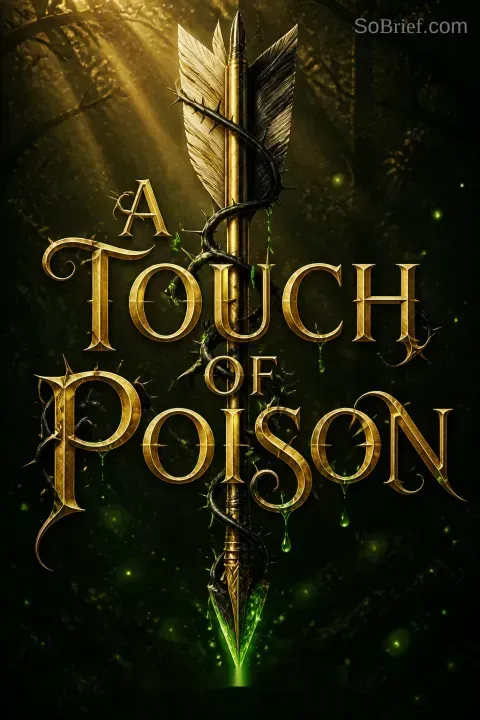
Clare Sager's 'A Touch of Poison' weaponizes the romantasy genre to explore consent, bodily autonomy, and the long arc of recovering selfhood after systemic abuse. Kat1's poison is a brilliant central metaphor: what was forced into her body becomes, through excruciating effort, a tool of agency. She is not a warrior in the traditional sense; her strength lies in enduring, in learning that survival is not the same as living, and in the radical act of choosing pleasure and love on her own terms. Bastian2's arc is the mirror image: a man so defined by control and loyalty to institutions that he cannot touch what he wants. His oath on his magic is the book's sacramental moment, a redefinition of contract not as obligation but as freely chosen devotion. The political plot, with its layers of deception and false-flag attacks, reinforces the personal theme that the systems we inherit, marriage laws, succession rites, the Sleep itself, are often complicit in the violence done to individuals. The book refuses easy answers: Sura4 is a rebel with legitimate grievances but brutal methods; Braea3 is a mother who killed her daughter and a queen who sacrificed her son-figure; Kat1 walks into Dawn at the end not as a rescued damsel but as a spy carrying evidence that could topple a throne. The serpent myth, threaded throughout, insists that destruction and creation are not opposites but partners in the same dance. To become whole, Kat1 had to let part of herself die, and from those ashes, she is forging a crown.
Review Summary
A Touch of Poison is a highly anticipated sequel that delivers intense romance, political intrigue, and character growth. Readers praise Kat's development and Bastian's complexity, enjoying their slow-burn relationship and steamy encounters. The book's pacing and length receive mixed reactions, with some finding it too long. Many applaud the world-building, plot twists, and emotional depth. While opinions vary on certain aspects, most reviewers eagerly anticipate the next installment, considering this a standout in the romantasy genre.
Characters
Kat (Katherine Ferrers)
Poisonous human turned weaponA human noblewoman trapped for a decade in an abusive marriage to pay her husband12's debts. Recruited as a spy in the previous book, she ingested aconite to save Bastian2 and now lives with poison seeping from her skin. Pragmatic and guarded, she has been conditioned since childhood to suppress pain and desire for the comfort of others. Her arc in this volume moves from devastating isolation to the discovery that her curse can be a gift. She learns to channel her power, kills her husband12, and embraces both her sexuality and her rage. By the end, she has traded survival for living, only to be handed as a hostage to the very court that tried to destroy her.
Bastian Marwood
Night Queen's Shadow, oathbreakerFae spymaster with unseelie shadow magic. As a teenager, he beheaded Princess Sura4 to stop a coup and killed his own father in the process, earning the epithet 'Serpent.' He masks profound guilt and a terror of losing control behind bored arrogance and ruthless efficiency. His love for Kat1 initially terrifies him because it threatens his last remaining point of honor: he has never broken a contract. His emotional journey entails dismantling that block, swearing his magic to her, and ultimately being betrayed by the queen3 he sacrificed everything for. His shadow-doubling ability allows him to exist in two places, a literalization of his fractured self.
Queen Braea
Night Queen, ancient manipulatorRuler of Dusk Court for over a millennium. She presents herself as a mother figure to Bastian2 while using him as her weapon. Sura4's story reveals she murdered her own pregnant daughter Nyx with three arrows rather than allow an unseelie heir. Her actions throughout the book, from forbidding Bastian2 to investigate Hydra Ascendant to sending Kat1 as a hostage to Dawn, demonstrate that her primary loyalty is to her own power. She envies Dawn's growing family while she has no heirs, a vulnerability that Sura4 exploits. Her betrayal of Bastian2 in the final chapter is the culmination of a pattern of using people as disposable assets.
Sura
Rebel princess, survivorThe younger daughter of Queen Braea3, believed beheaded by Bastian2 fifteen years ago. A loyal changeling died in her place. She leads Hydra Ascendant from the ruins of Ashara, seeking to unite the fractured courts under a single ruler without the Sleep. She reveals the truth about her sister Nyx's death to Kat1, challenging the official narrative. Her methods are brutal (the attack on Kat1 and Bastian2's convoy) but her goal, to dismantle a system that enabled her mother's crimes, has a certain moral weight. Her bargain with Kat1 suggests she can be reasoned with, unlike Braea3.
Elthea
Healer without mercyDawn Court's most powerful healer, saved Kat1's life initially but treats her subsequent condition as a scientific puzzle, not a patient's suffering. She cuts Kat1 open without anesthetic, injects manticore venom, and observes her agony with clinical detachment. Her favor to Bastian2 (saving Kat1's life) she repays by making him retrieve a music box from Horror territory, revealing a sentimental core beneath her coldness. She eventually perfects a cure, using an acorn from the Great Oak, and respects Kat1's choice to keep her magic. Her arc suggests even rigid people can bend, though never warmly.
King Lucius
Day King, conspiratorRuler of Dawn Court, father of Cyrus7 and Sepher. He orchestrated the plot involving the changeling unCavendish to ruin the alliance with Albion and poison Bastian2. Obsessed with obtaining the Crown of Ashes to break the Sleep and dominate both courts. His oily charm masks cold calculation; his first encounter with Kat1 in the city street is a velvet threat. He is murdered in the throne room during the climax, his throat cut by a traitor. His death leaves Cyrus7 on the throne, but the evidence Kat1 finds suggests the coup was an inside job, perhaps even orchestrated by Lucius himself or his heir.
Cyrus
New Day King, possible villainLucius6's eldest son, a preening, hedonistic prince who treats people as amusements. He flirts with Kat1, insults Bastian2, and takes credit for killing Horrors he barely helped defeat. His survival of the throne room massacre seems fortunate, and the thread on his cuff matching the attackers' insignias raises the strong possibility that he orchestrated the coup to accelerate his own ascension. Despite his surface shallowness, he proves capable of political maneuvering when he negotiates the hostage exchange with Braea3. His true motivations remain opaque, a major loose end driving into the next book.
Kaliban
Mind-reading teacherAn older fae whose gift allows him to hear others' thoughts so acutely that crowds become agony. He lives as a recluse, sustained by Kat1's grocery deliveries. In exchange, he erases the memories of Elthea5's tortures. He later refuses to erase more when he discovers Sura4's mind-mage has left Kat1's mind unstable. He teaches Kat1 the serpent creation myth and the principle of balance: control through release. His gruff exterior hides deep loneliness and grief over a lost partner, hinted at by the second pair of slippers by his fire. He becomes an unlikely father figure.
Rose
Werewolf bodyguard, friendA human woman turned into a werewolf by her husband Faolán11. She serves as Kat1's escort and de facto bodyguard in the city, introducing her to fae culture with humor and irreverence. Her own experience of being shunned as a shapechanger gives her empathy for Kat1's isolation. She is warm, loyal, and fiercely protective of her found family. Her relationship with Faolán11 models a healthy, chosen partnership that implicitly critiques the forced contract of Kat1's marriage.
Ella
Kat's best friend, conscienceA widow from Albion who followed Kat1 to Elfhame out of friendship and concern. Witty and observant, she provides emotional support and practical humor. She is the one who confronts Kat1 about her escalating drinking, revealing her own mother's fatal alcoholism. Her near-death from Kat1's accidental poison touch becomes a major catalyst. She represents the life Kat1 wants to preserve, the warmth that makes survival worth the cost.
Faolán
Bastian's right hand, shapechangerA massive wolf-shapechanger, Bastian2's oldest friend and second-in-command. Initially judgmental about Kat1's marital status because fae law sanctifies contracts. His own experience of discrimination as a shapechanger makes his rigidity ironic, a point Kat1 eventually forces him to confront after she kills Robin12. He loves Rose9 deeply and trains Kat1 in self-defense with gruff practicality. His arc moves from blind traditionalism to acknowledging that laws can perpetuate harm.
Robin
Kat's abusive husbandA human viscount who married Kat1 for her dowry, which he squandered. He views her as property, resents her independence, and becomes violent when she refuses to bear him an heir. He follows her to Elfhame as part of a diplomatic mission. His attack on Kat1 in her rooms (breaking her arm, strangling her) forces her to kill him in self-defense. His death is the book's most cathartic moment.
Uncle Rufus
Kat's manipulative uncleThe man who orchestrated Kat1's marriage to Robin12, buried her alive as a child (the 'grave' incident), and attempted to force her into Caelus's bed. He arrives in Elfhame as part of Queen Elizabeth's diplomatic delegation, immediately seeking to exploit Kat1's connection to Bastian2. His presence is a constant trigger for Kat1's trauma. Bastian2 has sworn not to kill him at Kat1's request, a promise that feels increasingly untenable.
Plot Devices
The Poison/Antidote Bond
Forces daily intimacy and dependenceKat1's body contains aconite fused with magic, making her touch lethal. Only Bastian2's skin provides the antidote, requiring them to touch before each sunset. This bond keeps them in enforced proximity after their mutual betrayal, forcing conversations they would otherwise avoid. The painful-then-pleasurable sensation of their touch becomes a physical metaphor for their relationship. When Elthea5 eventually cures the poison in Kat1's bloodstream, Kat1 chooses to keep the magical gift (the poisonous touch) but no longer needs daily contact. The bond shifts from necessity to choice, mirroring Kat1's emotional journey from captive to agent.
Crown of Ashes
Relic that drives the plotInitially mistranslated as 'Circle of Ash,' this artifact can break the enchanted Sleep that binds the monarchs to their respective halves of the day. Both Dusk and Dawn seek it to gain permanent power. Kat1 discovers the correct translation in an ancient text, revealing it is a crown made of ashes. The search for it sends them to the Lady of the Lake and ultimately to Ashara. Its existence raises the stakes from personal drama to realm-wide catastrophe, as whoever controls it can end the thousand-year balance between the courts.
Hydra Ascendant Insignias
Evidence of conspiracy and identity theftThe rebel group Hydra Ascendant uses an embroidered hydra badge with gold eyes on crimson thread. Kat1 obtains one from Sura4's genuine followers. When the Solstice Horror attack occurs, the captured operative wears an insignia with scarlet-and-gold two-ply thread. Kat1's seamstress friend Ariadne identifies the difference: the attackers' patches are not from Sura4's group. Kat1 later spots the same scarlet-and-gold thread on King Cyrus7's cuff at the climax, implicating Dawn's own royalty in the massacre they blamed on rebels.
The Great Yew and Great Oak
Source of magical poison and cureThe Great Yew of Dusk and the Great Oak of Dawn are the twin trees at the heart of the fae bargain with the land, granting them long life and magic. The changeling used a berry from the Great Yew to make the poison incurable by normal means. Elthea5 steals an acorn from the Great Oak to create the antidote, its equal and opposite. The trees represent the duality that runs through the entire book: Dusk and Dawn, creation and destruction, control and surrender. Kat1's bow, made from lightning-struck yew wood, symbolizes her attunement to these ancient forces.
The Iron Ring
Suppresses Kat's magic at a costKat1 bargains with Sura4 for an iron ring encased in silver, which nullifies her poisonous magic. While it allows her to touch people safely (she hugs Vespera and her friends), prolonged wear makes her sick and blocks all incoming magic, including healing. It represents the false solution of amputating a part of herself rather than learning to wield it. She eventually abandons the ring after mastering her control, choosing integration over suppression. The ring echoes the broader theme of whether safety is worth the price of self-diminishment.
Shadows of the Tenebris Court Series
About the Author
Other books by Clare Sager


Download PDF
Download EPUB
.epub digital book format is ideal for reading ebooks on phones, tablets, and e-readers.








































