
Key Takeaways
1. Suffering's True Nature: A Wilderness of Internal Strangers
Mind and body, once our home, once our own, break loose and become terrifying Strangers.
Internal chaos. The author vividly describes severe mental illness (OCD, termed "the Siren") and trauma ("a Body That Expects the World to End") as forces that transform one's inner world into a "Wilderness." This internal landscape is characterized by intrusive thoughts, overwhelming feelings of shame, dread, and fear, and a constant sense of impending catastrophe. The mind, body, and soul, once familiar, become alien and terrifying, screaming at the individual in "uninterpretable hieroglyphics."
Loss of self. Suffering, whether from "History or Affliction," is primarily about what is taken: honor, health, safety, will, and control. The individual feels dispossessed of their own faculties, as if their mind and body are no longer truly theirs. This profound sense of vulnerability and loss is exacerbated by the "Siren's" relentless warnings and commands, which present themselves as "What Has to Happen," creating an intense, painful intimidation that dictates one's reality.
Unbearable anguish. The culmination of this internal battle is the "Howling Boy," a metaphor for the soul's anguish, despair, and unbearable dissatisfaction. This deep-seated pain arises from the constant intimidation of the mind and the cringing anticipation of the body. The author emphasizes that this suffering is not a character flaw but an "Affliction," an experience provided by a misfiring brain, which, left unchecked, threatens to devour the individual entirely.
2. The Deceptive Comfort of Self-Dependence: The Haunted House of Cognition
The Realm of Ceaseless Cognition has been the country I have lived in all my life, the world I’ve been in instead of being in the world.
Compulsive coping. Faced with the "Siren's" relentless assaults, the natural human response is to seek control and safety. For the author, this manifested as obsessive compulsions: "figure out, know for sure, defend myself, and make things right." This excessive rumination, a "tangled nest of circuits," became his primary coping mechanism, a mental fortress he called the "Realm of Ceaseless Cognition" or the "Haunted House."
Addiction to self. This "Haunted House" represents an addiction to self-dependence, a place where the author cultivated his reliance on his own intellect and efforts to mitigate distress. He believed that by thinking more and better, he could escape the horrors his brain presented. This self-reliance, however, only deepened his enslavement, making his life lonely and misshapen. The psychiatric community's insight is echoed: "it’s not the obsessions that kill us, it’s the compulsions."
Blindness of the heart. This self-dependence is equated with the "Hardness of the Heart" or "original sin" in Christian terms—a blindness to one's own rebellion and unwillingness to trust God. The author realizes that his attempts to "clothe his own shame, cast out his own fear, overturn his own dread" through mental compulsions only created a "shrine to myself." This profound self-deception is something he couldn't see or end on his own.
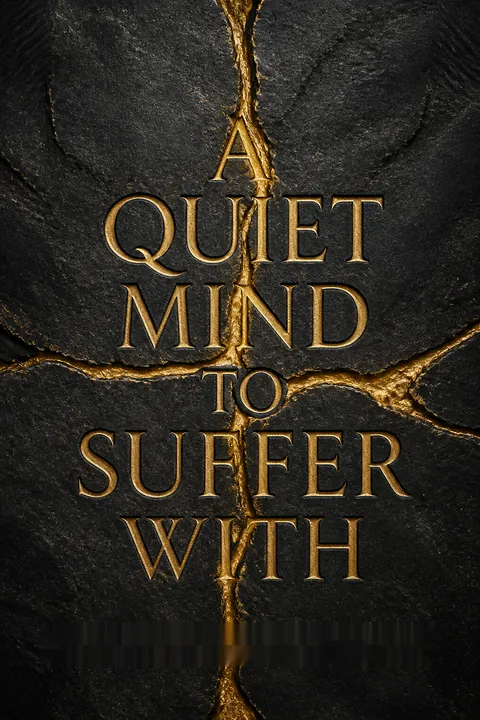
3. The Cross: A Quiet Mind to Suffer With
That understanding has been a great gift. It has been a quiet mind to suffer with.
Shift in relationship. The author's recovery is not about the removal of his mental illness or its symptoms, but a fundamental change in his relationship to them. The "Siren" still wails, but it is no longer a god he worships; it is a "Wilderness" he walks through. This shift is enabled by a "patient, quiet understanding"—a profound humility and trust in Christ that allows him to endure the horrors his brain presents without being devoured.
Understanding over feeling. This understanding means knowing "I’m okay when I don’t feel okay." It's a realization that what he understands about Christ and himself will determine the course of his life more than what his faulty brain makes him think and feel. This "hard kernel of patient, quiet trust" is more precious than better thoughts or feelings, acting as an "unsinkable boat in a great storm" that no one else can see.
Christ as Mercy. This "patient, quiet understanding" is rooted in Christ, who is "the Mercy that has been offered." It's the capacity to quietly hand himself over to who Christ is, knowing he is already okay. This understanding provides:
- Honor in shame
- Courage in fear
- Obedience in dread
- Endurance in Affliction
- Deliverance from the hardness of his own heart
It allows him to "stare down the Siren" and leave the "Realm of Ceaseless Cognition," heading towards dependence on Christ and a future provided by Mercy.
4. The Gospel as Forgiveness and Revelation
It is only by that Word that I can be miserable and upset and still understand that I am okay.
The Word's power. The "patient, quiet understanding" that underpins recovery is not self-generated but a gift born from "the Word"—the gospel that "Christ has died, Christ is risen, Christ will come again." This Word is not mere information but an event that involves the believer in the power, promise, and peril of the cross. It is the only thing that can create, deepen, and maintain the trust needed to navigate suffering.
Burial of self-reliance. The gospel's "near cruelty" lies in its destruction of "something very precious to us, something we cling to so closely we think it is us, our very heart and soul, our dependence on ourselves." This "Hardness of the Heart" is a blindness that cannot be seen or ended by human effort. Christ's death becomes the burial of this self-dependence, allowing Him to be:
- The clothing of our shame
- The casting out of our fear
- The overturning of accusation
- The enduring of our Affliction
Forgiveness as freedom. The author's psych ward experience, a "personally catastrophic" breakdown, becomes a "Word of God" to him, a way Christ gave Himself. He realizes that "the forgiveness of sins is not for people who have done something wrong. It is for people who are bound." This forgiveness is a revelation of Christ's character and the only way to untangle one's pain from idolatrous self-management. It means "to be seen, to be safe, to be fed," and to be "changed, and to finally understand."
5. The "Rhythm" of an Ordinary Life: Hearing, Prayer, and Offering
His Spirit means He is willing to become our simple life with His gospel, to return us to What We’ve Been Given and lead us toward What’s Been Promised.
Christ as the Way. In the "Wilderness of History and Affliction," where mind, body, and soul become "screaming Strangers," the author discovers that Christ is not only the "Word" (what's been given) and the "Amen" (what's been promised), but also the "Way." This "Way" is a return to the given and a leading toward the promised, facilitated by the Holy Spirit. It's a daily process of rescuing, leading, and fulfilling trust.
The Daily Procession. This "Way" manifests as a "Rhythm," an "Ordinary Life of Regular Worship" comprising three simple intentions: hearing, prayer, and offering. These are not desires or abilities, but the fundamental directions of a heart depending on Christ. Even when thoughts and feelings riot, the individual is "always headed toward hearing, headed toward prayer, headed toward offering," a path secured by involvement in Christ's death, resurrection, and return.
Intentional dependence. This "Rhythm" becomes the author's "friendship with Him," a pattern that leads him out of self-regard and the "Realm of Ceaseless Cognition." It's how he learns to live simply and vulnerably with Christ, resisting the "Siren" and reconciling with the "Howling Boy." This intentional dependence on Christ, even when difficult, is the "only thing that couldn’t be taken" from him, offering a profound freedom in the midst of suffering.
6. Reconciling with the "Howling Boy": Embracing Anguish
The most difficult and painful and mysterious thing I’ve had to do is trust Christ with the one who was afflicted, the one who was abandoned, the one everything was taken from, the one the worst has already happened to, the one who was made to see and feel horrors.
Facing the past self. The author grapples with the profound challenge of confronting his past self, the "Howling Boy"—the wounded, selfish, alienated person he was and still is. This figure embodies the soul's anguish, despair, and unbearable dissatisfaction, a direct result of the mind's intimidation and the body's anticipation. Remembering the "Howling Boy" is painful, threatening to re-humiliate and re-violate, making it tempting to hate or abandon this past self.
Forgiveness for self-hatred. The author realizes that "we depend on ourselves by hating ourselves," a desperate attempt to clothe shame and make things right. This self-hatred is an addiction, a blindness that only dependence on Christ can heal. By offering the "Howling Boy" the gospel of forgiveness, the author seeks to declare peace, ending the internal hostility and recognizing that this vulnerable self is precisely "the John to whom Mercy was offered."
Presence over fixing. Standing with the "Howling Boy" means accepting his grief, anger, and agony without trying to fix him or make things okay. It's an act of patient, quiet understanding, bearing witness that his suffering is "not unbearable" because Christ is present. This reconciliation allows the author to welcome his past self into his life, understanding that Christ is "our reconciliation," the end of internal warfare, and the provision for the soul's deepest anguish.
7. Suffering as a Path to Deeper Dependence on Christ
The reason so few of us grow in our life in Christ is because it is so painful. There is no growth to our dependence on Christ that is not also a wound to our dependence on self.
Unmet expectations. After leaving the psych ward, the author faced the "wrong expectation" that Christ's death and resurrection would immediately remove his suffering, make him "sane and honored," or restore "Life as I Would Have It." Christ's "utterly, transfixingly silent" response to these pleas was a profound challenge, foregrounding the cross as the only answer, rather than providing the desired relief or solutions.
Crucifixion of self-reliance. This "silence" and the ongoing suffering revealed a deeper truth: Christ had come to do "irreparable damage to Life as I Would Have It." This "hardness of heart," the lie that his life was his own to control, was the "vicious regime that was killing" him. The painful process of letting go of this lie, of accepting that he didn't need "the right thoughts and the right feelings to be okay," was a "crucifixion" of his self-dependence.
Trusting with the unfixable. Through practices like coloring images of the crucified Christ and drawing scarred hands, the author learned to trust Christ with his "lack of a story," his inability to fix or understand his suffering. This meant accepting that Mercy was not about things "getting better" in the way he expected, but about Christ's "gracious offer of Himself" in the midst of his misery. This painful process deepened his "patient, quiet understanding" that Christ could be depended on, even with the "big, scary things" of his internal world.
8. Intention Over Feeling: Choosing Christ Amidst Chaos
It’s not our experiences that are killing us; it’s our consolations.
The true enemy. The author's journey revealed that the real threat was not the intrusive thoughts or perilous feelings themselves, but his "desire to control them," his "consolations"—the compulsive attempts to "make sure, make right, defend myself, know for sure." These self-dependent actions, born from an inability to bear uncertainty or pain, were the true "power of sin" that disfigured him.
The agonizing delay. Prayer, particularly the Jesus Prayer ("Lord, Jesus Christ, Have Mercy on Me, a sinner"), became the "crucial, agonizing, terrifying delay between how things feel and what things are." It was a space to endure intense experiences without immediately applying meaning or resorting to compulsions. This practice allowed him to distinguish between powerful feelings and their actual significance, learning that "something can be very powerful without being at all meaningful."
Withstanding the Strangers. Through prayer, the author learned to "stand with Christ and patiently endure" the "Siren's" relentless pronouncements and the "Body That Expected the World to End." He discovered that he could experience fear, dread, and confusion without surrendering his faithfulness to Christ. This intentional choice to "not fix it" and to "choose to feel bad" with Christ, rather than seeking self-consolation, allowed him to gently lead the "Strangers" of his mind, body, and soul, understanding them as experiences, not verdicts.
9. Holiness in the Mundane: Offering Our Small Lives
Holiness was ordinary things set aside for God by trust in Him, a holy life was an ordinary life with ordinary things that have been offered to Christ.
The smallness of faith. The author's recovery led him to embrace a "smaller" life, one not defined by grand achievements or the absence of mental illness, but by "simple devotion, simple hearing, simple tasks." This "Pentecost of small obediences" involved making prayer books, writing letters, or simply being quiet. These mundane acts, performed with intention and dependence on Christ, became his "resistance to the Siren" and his "reconciliation with the Howling Boy."
Sacraments of the ordinary. The "Rhythm" of hearing, prayer, and offering transformed his ordinary life into a "sacrament." His part-time job, his borrowed bike, even his mental illness, when offered to Christ, became "sacred." This perspective allowed him to find joy in the difference between an "extraordinary" life (as he once conceived it) and a "sacred" one, understanding that Christ's presence consecrates the mundane.
Trust in the unseen. This "ordinary life of regular worship" provided a way forward when there seemed to be none, a "Thread" through every "beautiful, dull, horrible moment." It taught him that even when he couldn't think or feel, he could hear, speak, and act with intention. The "great holiness" lay in the realization that "when we cannot think, we can hear. When we cannot feel, we can speak. When we cannot imagine a future, we can look down and see we are still making books."
10. Christ's Return: The Ultimate Hope and Fulfillment
When Christ who is your life appears, you will appear with Him in glory.
Glimpse of fulfillment. During a moment of profound peace and clarity, the author experienced a "briefly, suddenly" restored sense of self—a "John in Whom Mercy Was Fulfilled." This experience, though fleeting, offered a powerful glimpse of the future promised by Christ's return. It was a moment where his heart understood, his soul rested, his mind paid attention, and his body expected joy, revealing the person he was "headed toward."
Future provided by Mercy. This vision solidified the understanding that his ultimate "fix" would not come from effort or sorrow, but from "glory, when Christ comes to say Amen to His own death and resurrection." Even as he returned to "an acceptable level of misery," the memory of this glimpse sustained him. It affirmed that "History and Affliction, What’s Wrong and What Happened, would not swallow me up entirely," because he still had the "Word of the cross," the "way of the cross," and the "expectation of joy."
The final Amen. The author concludes by emphasizing that the "Amen" is the ultimate fulfillment of Christ's promises. It is the gathering of His people to His Table, where all darkness will be cast out. This future, provided by Mercy, means that even the "surprising pain of being human" will be consecrated and transformed. Until then, the "irrevocable privileges of an ordinary life with Christ"—understanding and intention, Word and Spirit—allow him to "return to What’s Been Given and head toward What’s Been Promised."
People Also Read







Download PDF
Download EPUB
.epub digital book format is ideal for reading ebooks on phones, tablets, and e-readers.








































