
Key Takeaways
1. A Living Language of Patterns
Each pattern describes a problem which occurs over and over again in our environment, and then describes the core of the solution to that problem, in such a way that you can use this solution a million times over, without ever doing it the same way twice.
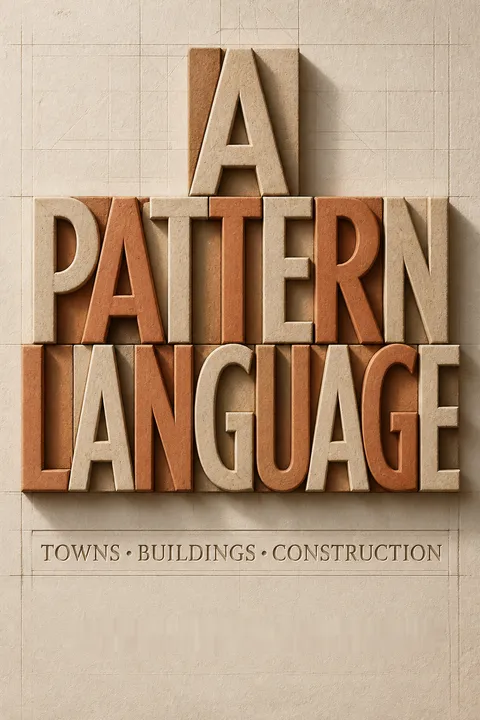
A new attitude. "A Pattern Language" introduces a revolutionary approach to architecture and planning, proposing a "living language" of interconnected patterns. This language offers a complete alternative to conventional methods, aiming to replace current ideas and practices with a more human-centered and organic way of building. It is presented as a practical guide, distilled from years of building and planning efforts, enabling individuals and communities to shape their own environments.
Problems and solutions. At its heart, each pattern identifies a recurring problem in our surroundings and offers a "core of the solution." These solutions are not rigid blueprints but flexible instructions, allowing for infinite variations while preserving the essential property that resolves the problem. The patterns are dynamic hypotheses, marked by asterisks to indicate the authors' confidence in their invariant truth, inviting users to test, improve, and evolve the language over time.
Interconnected network. The patterns are organized hierarchically, from large-scale regional planning to minute construction details, forming a vast, interconnected network. Each pattern supports "larger" patterns above it and is completed by "smaller" patterns below it. This interconnectedness ensures that no design element exists in isolation; every act of building contributes to a more coherent and whole environment, integrating individual creations into the larger web of nature.
2. Piecemeal Growth, Not Master Plans
These patterns can never be “designed” or “built” in one fell swoop—but patient piecemeal growth, designed in such a way that every individual act is always helping to create or generate these larger global patterns, will, slowly and surely, over the years, make a community that has these global patterns in it.
Organic development. The book advocates for a bottom-up, organic approach to urban development, contrasting it with centralized authority and rigid master plans. It posits that true community emerges from "patient piecemeal growth," where countless individual acts of building and planning, guided by shared patterns, gradually coalesce into larger, coherent structures over time. This process empowers local groups and individuals to shape their immediate surroundings.
Community control. The proposed planning process is rooted in a hierarchy of self-governing social and political groups, from families to regions. Each group takes responsibility for patterns relevant to its internal structure and common land. Higher-level groups do not dictate but rather encourage implementation through incentives, fostering a loose, voluntary system based on social responsibility rather than legislation or coercion.
Grassroots action. Even without formal structures, individual building acts can initiate this piecemeal transformation. A group might convert a noisy street into a "Green Street" or argue for a local workshop based on patterns like "Scattered Work." This approach, partially tested in "The Oregon Experiment," emphasizes that large-scale patterns can emerge organically if every small act of building contributes to shaping its corner of the world.
3. Human Scale in All Things
We believe the limits are reached when the population of a region reaches some 2 to 10 million. Beyond this size, people become remote from the large-scale processes of government.
Natural limits. The concept of human scale is fundamental, arguing that there are natural limits to the size of self-governing groups. Beyond 2-10 million people, governments become unmanageable, communication channels clog, and bureaucracy overwhelms human processes, leading to citizen remoteness and a loss of democratic access. This applies from regional governance down to neighborhood units.
Identifiable units. To counteract this, the city must be broken into a "Mosaic of Subcultures" and "Identifiable Neighborhoods," each small enough for individuals to have an effective voice and a strong sense of belonging. Neighborhoods should be no more than 300 yards across, with 400-500 inhabitants, protected from heavy traffic to maintain their identity and foster face-to-face interaction.
Personal connection. This human scale extends to buildings, which should never be monolithic but rather "Building Complexes" reflecting their internal social facts. Even individual rooms are designed with human comfort in mind, considering factors like ceiling height, light, and the ability to personalize space. The goal is to create environments where people feel connected, not alienated, by their surroundings.
4. The Interwoven City & Countryside
Continuous sprawling urbanization destroys life, and makes cities unbearable. But the sheer size of cities is also valuable and potent.
Balancing urban and rural. The book addresses the critical balance between urban development and open countryside. It argues against continuous sprawl, which destroys natural habitats and alienates city dwellers from nature. Instead, it proposes "City Country Fingers" – urban areas extending into farmland in narrow bands, ensuring everyone is within a 10-minute walk of true rural land.
Ecological necessity. This interweaving is not just aesthetic but a "biological necessity." Over-concentrated populations burden ecosystems, leading to pollution, congestion, and resource shortages. A more evenly spread population, with protected "Agricultural Valleys" and "Lace of Country Streets," minimizes environmental impact and fosters prudent land stewardship, allowing communities to maintain self-sufficiency.
Public access to nature. Crucially, all countryside, whether farmland or wild, should be accessible to the public, fostering a sense of collective ownership and responsibility. "The Countryside" pattern defines farms as parks where people have a right to be, and parks as working farms, blurring the lines between production and recreation, and deepening human connection to the land that sustains them.
5. Community & Identity Through Place
People need an identifiable spatial unit to belong to.
Defining belonging. Human beings inherently need to identify with the places they inhabit. This sense of belonging is fostered by clearly defined "Identifiable Neighborhoods" and "Community of 7000" units, each with distinct physical boundaries and a unique character. These units provide the social cohesion necessary for self-governance and mutual support.
Boundaries as opportunities. Boundaries are not just lines but active zones. "Subculture Boundary" and "Neighborhood Boundary" suggest creating substantial areas of non-residential land (parks, workplaces, roads) between communities. These boundaries protect unique lifestyles from encroachment while also serving as shared meeting grounds and centers for common functions, fostering interaction between adjacent groups.
Local centers and gateways. Within these identifiable units, "Activity Nodes" and "Small Public Squares" act as focal points for social life, drawing people together. "Main Gateways" physically mark the entry into these precincts, reinforcing their distinctness and creating a sense of arrival. These elements, from the largest community to the smallest house cluster, contribute to a rich "Mosaic of Subcultures" where diverse ways of life can flourish.
6. Spaces for Life's Full Cycle
To live life to the fullest, in each of the seven ages, each age must be clearly marked, by the community, as a distinct well-marked time.
Holistic community design. A truly "alive" community must accommodate the entire "Life Cycle" of its inhabitants, from infancy to old age. This means providing a balanced mix of people at every stage and the full range of settings needed for their development and transitions. Without this balance, individuals struggle to fulfill themselves and pass successfully through life's phases.
Intergenerational support. The "Household Mix" pattern encourages diverse household types—singles, couples, families, and group households—to live side-by-side, fostering intergenerational contact and mutual support. "Old People Everywhere" specifically addresses the need to integrate the elderly into neighborhoods, providing both communal living options and independent cottages close to social life, preventing isolation and leveraging their wisdom.
Rites and institutions. Beyond housing, communities must offer institutions that support life's transitions. "Birth Places" reimagines childbirth as a natural family event, not a medical procedure. "Teenage Society" proposes alternatives to high schools, creating miniature adult societies for adolescents to develop responsibility. "Grave Sites" advocates for small, local burial grounds integrated into neighborhoods, allowing the living to maintain connection with the dead and confront mortality.
7. Light, Comfort, and Connection
When they have a choice, people will always gravitate to those rooms which have light on two sides, and leave the rooms which are lit only from one side unused and empty.
The power of natural light. Natural light is paramount for human comfort and well-being in buildings. "Light on Two Sides of Every Room" is a fundamental pattern, asserting that rooms lit from multiple directions reduce glare, enhance visual clarity, and foster better social interaction. This principle dictates building shapes, favoring "Wings of Light" that are narrow enough to allow deep penetration of daylight.
Beyond mere function. Windows are not just for light; they are vital connections to the outside world. "Windows Overlooking Life" emphasizes the need for meaningful views of activity or nature, preventing rooms from feeling like prisons. "Deep Reveals" and "Filtered Light" further refine window design, softening harsh light and creating a gentle transition between the bright outdoors and the interior, enhancing comfort.
Edges as places. The "Building Edge" itself is conceived as a "place" with depth and volume, not a mere line. Features like "Arcades," "Gallery Surround," and "Six-Foot Balcony" create ambiguous zones between inside and outside, inviting people to linger, observe, and interact. These elements foster a sense of connection to the surrounding public world, making buildings more friendly and integrated into their environment.
8. Structure Serves Social Space
A first principle of construction: on no account allow the engineering to dictate the building’s form. Place the load bearing elements—the columns and the walls and floors—according to the social spaces of the building; never modify the social spaces to conform to the engineering structure of the building.
Congruence is key. This pattern challenges conventional construction, which often forces social spaces into rigid engineering frameworks. It asserts that buildings feel "right" only when their physical structure—columns, walls, floors—is congruent with the social spaces defined by human activities and groups. This means the structure must adapt to the plan, not the other way around, preserving the subtle arrangements that support human life.
Beyond rigidity and neutrality. Both overly demanding structural forms (like domes) and overly neutral "flexible" spaces (like open-plan offices) are deemed damaging. The former constrains social needs, while the latter creates an incoherent, depersonalized environment where flimsy partitions fail to define real spaces. A building's most solid elements should define its most critical social spaces, making them feel substantial and real.
Clarity and intuition. The structure should be intuitively understandable, revealing how the building is put together. "Columns at the Corners" proposes placing load-bearing elements at the psychological corners of social spaces, guiding construction and making the building's organization clear. This approach integrates gravity with social forces, creating a sense of wholeness and rest, much like natural forms.
9. Materials for Adaptability & Sustainability
Use only biodegradable, low energy consuming materials, which are easy to cut and modify on site.
Rethinking materials. The book critiques modern building materials—large, identical, unmodifiable, and energy-intensive—for destroying the organic quality of natural buildings. It advocates for "Good Materials" that are small-scale, easy to cut and work on-site without heavy machinery, adaptable, solid, long-lasting, and universally obtainable. This includes a focus on ecologically sound options.
Ultra-lightweight concrete. A key recommendation is ultra-lightweight concrete (40-60 lbs/cu ft, 600-1000 psi), which has the density of wood but is strong, light, easy to cut, nail, and repair. This material, often overlooked in conventional construction, offers a versatile bulk material that can be poured into sheet material forms, which then remain as finishes, integrating structure and surface.
Gradual stiffening. The construction process itself should be one of "Gradual Stiffening," starting with a flimsy framework that is progressively strengthened. This allows for on-site adaptation and fine-tuning, accommodating the subtleties of a design that cannot be fully captured on paper. Sheet materials (gypsum, wood planks, burlap) form the initial shell, which is then filled with compressive materials, creating a robust yet adaptable structure.
10. The Poetry of Compressed Patterns
Every building, every room, every garden is better, when all the patterns which it needs are compressed as far as it is possible for them to be. The building will be cheaper; and the meanings in it will be denser.
Beyond mere assembly. A building designed by simply stringing together patterns can be functional but lacks depth. The true artistry lies in "compressing" multiple patterns into the same physical space, creating a "dense" and profound environment. This is akin to poetry, where words carry multiple meanings, illuminating the whole through interlocking connections.
Density of meaning. Just as a poem reveals deeper truths through unexpected connections, a building can achieve richness when patterns overlap. For example, a "Bathing Room" merging with "Still Water" creates a space that is both private and communal, functional and contemplative. This compression not only makes the building more meaningful but also more economical, as less space is needed to fulfill multiple needs.
An everyday art. This compression is not reserved for exotic "works of art" but is an "ordinary economy of space" applicable to every design. Even a simple one-room cabin can embody numerous overlapping patterns, making it cheaper and richer in meaning. The ultimate goal is to use the pattern language to create buildings that are not just functional, but deeply resonant and poetic, reflecting the intricate web of human needs and natural forces.
Review Summary
A Pattern Language receives overwhelmingly positive reviews (4.42/5) for its comprehensive 253 design patterns covering everything from city planning to interior details. Readers appreciate its democratic approach to architecture and timeless insights about human-centered spaces. Many find it inspirational for home design, valuing patterns like natural light from two sides and window seats. Critics note it's dated, overly idealistic, sometimes pseudoscientific, and prescriptive. The 1,171-page book influenced fields beyond architecture, including software design. While some find it dense or frustrating, most consider it essential reading that fundamentally changes how people view their built environment.
People Also Read

Download PDF
Download EPUB
.epub digital book format is ideal for reading ebooks on phones, tablets, and e-readers.








































