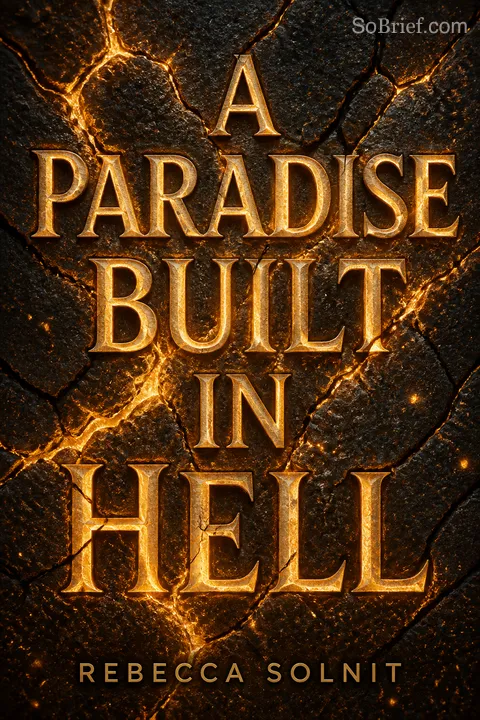
Key Takeaways
1. Disasters Unveil Human Altruism and Cooperation
In the wake of an earthquake, a bombing, or a major storm, most people are altruistic, urgently engaged in caring for themselves and those around them, strangers and neighbors as well as friends and loved ones.
Humanity's true nature. Contrary to popular belief and media portrayals, disasters consistently reveal a profound human capacity for altruism, resourcefulness, and cooperation. Decades of sociological research, from World War II bombings to modern storms, demonstrate that people primarily respond with mutual aid and care for others, rather than descending into panic or savagery. This inherent goodness often surfaces when ordinary societal structures are disrupted.
Spontaneous generosity. In the 1906 San Francisco earthquake, ordinary citizens like Anna Amelia Holshouser and Officer H.C. Schmitt spontaneously set up community kitchens, feeding hundreds daily with salvaged supplies. Similarly, Thomas A. Burns distributed fifty boxes of oranges and housed dozens of strangers, while the plumbers' union volunteered their services for a week. These acts of generosity were widespread, with people sharing food, water, and shelter without expectation of payment or formal organization.
- Anna Holshouser: Started a soup kitchen feeding 200-300 daily.
- Officer Schmitt: Family cooked for neighbors and strangers.
- Thomas Burns: Gave away oranges, housed dozens of refugees.
- Plumbers' Union: Volunteered services for a week.
Shared experience. The shared ordeal of disaster often fosters a deep sense of solidarity and empathy, breaking down everyday social divides. People who might otherwise be strangers connect, finding common ground in their vulnerability and collective effort to survive. This temporary unity highlights a latent human desire for connection and purpose, often leading to a surprising sense of joy amidst the devastation.
2. "Elite Panic" Exacerbates Crises
But belief lags behind, and often the worst behavior in the wake of a calamity is on the part of those who believe that others will behave savagely and that they themselves are taking defensive measures against barbarism.
Fear-driven overreaction. "Elite panic" describes the phenomenon where authorities, fearing public disorder, react with repressive measures that often worsen the disaster. This fear is rooted in a Hobbesian view of human nature, assuming that without strict control, the public will descend into chaos, looting, and violence. Such beliefs lead to actions that prioritize property over lives and treat victims as potential enemies.
San Francisco's tragic example. In 1906 San Francisco, Brigadier General Frederick Funston, with Mayor Eugene Schmitz's support, issued a "shoot to kill" order for looters. Troops were deployed, not primarily for rescue, but to control a perceived "unlicked mob." This led to:
- Soldiers destroying alcohol supplies, causing fear and property damage.
- Citizens being shot for alleged looting, sometimes while trying to rescue others or retrieve their own property.
- Firefighting efforts being hampered by military interference, leading to more destruction.
- The military's reckless use of explosives to create firebreaks, often spreading fires.
Katrina's devastating impact. Nearly a century later, Hurricane Katrina saw similar elite panic. New Orleans Mayor Ray Nagin and Police Chief Eddie Compass spread unsubstantiated rumors of mass rapes and murders in the Superdome and Convention Center. Governor Kathleen Blanco declared troops were "locked and loaded" and "more than willing to shoot and kill." This narrative:
- Diverted emergency responders from search and rescue to "anti-looting" efforts.
- Led to the closure of the Crescent City Connection bridge, trapping thousands of evacuees.
- Resulted in vigilante violence and documented murders of African American men by police and armed citizens.
3. Disasters Forge Temporary Social Utopias
Horrible in itself, disaster is sometimes a door back into paradise, the paradise at least in which we are who we hope to be, do the work we desire, and are each our sister’s and brother’s keeper.
Liberation from routine. Disasters, by shattering ordinary routines and social structures, can create temporary "social utopias." These are fleeting moments where people experience profound connection, purpose, and a sense of liberation from the alienations of everyday life. The urgency of survival often brings out the best in people, fostering a collective spirit.
Joy amidst devastation. Survivors often recall a surprising sense of joy or exhilaration during these times. Pauline Jacobson, a journalist during the 1906 San Francisco earthquake, described a "millennial good fellowship" where class divides vanished and strangers became friends. William James, the philosopher, noted the "universal equanimity" and "pure delight" he felt, observing that the "cutting edge of all our usual misfortunes comes from their character of loneliness."
- Pauline Jacobson: Celebrated the "reign of inclusiveness" and "joy in the other fellow."
- William James: Felt "glee and admiration," noting "universal equanimity."
- London Blitz survivors: Reported "pure and flawless happiness" amidst bombings.
Shared purpose and belonging. In these moments, money often becomes irrelevant, and people engage in meaningful work for the collective good. This shared purpose provides a deep sense of belonging and agency, fulfilling fundamental human needs for community identity that are often unmet in modern society. The temporary nature of these utopias highlights what is possible when people are freed from conventional constraints.
4. Media Perpetuates Harmful Disaster Myths
The astonishing gap between common beliefs and actualities about disaster behavior limits the possibilities, and changing beliefs could fundamentally change much more.
Reinforcing stereotypes. The media frequently perpetuates myths of public panic, chaos, and savagery during disasters, often ignoring or downplaying the widespread altruism and cooperation. This misrepresentation reinforces a pessimistic view of human nature and justifies authoritarian responses, as seen in Hollywood disaster movies and news coverage. The focus on sensationalism often overshadows the nuanced reality of human behavior.
Katrina's distorted narrative. During Hurricane Katrina, media outlets, echoing official statements, spread unverified rumors of mass rapes, murders, and widespread looting. This narrative:
- Labeled African Americans gathering necessities as "looters," while whites doing the same were "gathering supplies."
- Contributed to the demonization of victims and justified the militarization of the disaster response.
- Ignored the actual heroism and mutual aid efforts of New Orleans residents.
- Later retractions were often quiet and failed to undo the initial damage to public perception.
The "panic myth." Disaster sociologists, like Enrico Quarantelli, have conducted hundreds of studies demonstrating that panic is a "vanishingly rare phenomenon." What appears as chaotic flight is often a rational response to danger. However, the myth persists because it serves political and institutional interests, reinforcing the idea that the public needs to be controlled rather than empowered. This "intellectual pollution" hinders effective disaster planning and response.
5. Civil Society and Mutual Aid Drive True Recovery
The effectiveness of disaster response is thus diminished to the degree that we overrely on command and control. This is another case where political ideology trumps good scientific knowledge about how the world works.
Grassroots resilience. When formal institutions fail or are overwhelmed, civil society—the network of citizens, communities, and voluntary organizations—steps in to provide essential services and support. This grassroots response, characterized by mutual aid and improvisation, is often more effective and adaptable than top-down, bureaucratic approaches. It highlights the inherent capacity of people to self-organize and care for one another.
New Orleans's emergent groups. In the aftermath of Katrina, while FEMA and other government agencies struggled, numerous emergent groups and volunteers filled critical gaps:
- An "armada of boats" (civilian, Coast Guard, Fish and Wildlife) rescued thousands from flooded areas.
- Common Ground Relief, founded by former Black Panther Malik Rahim, provided medical care, food, and housing assistance, often bridging racial divides.
- Emergency Communities, a volunteer-run organization, set up kitchens and supply centers, distributing thousands of meals and essential goods daily.
- Churches and neighborhood associations like the Holy Cross Neighborhood Association became hubs for rebuilding and advocacy.
Beyond charity. Mutual aid differs from charity in its reciprocity and horizontal structure, where everyone is both a giver and a receiver. This fosters solidarity and a sense of shared agency, rather than creating dependency. The success of these emergent groups demonstrates that trust in citizens' capacity for self-governance is a more effective strategy than rigid command-and-control.
6. Disasters Act as Catalysts for Social Change
The earthquake was a force of nature, but the disaster was not a natural disaster. The devastation was terrible, but the response was remarkable.
Revealing systemic flaws. Disasters often act as "critical junctures," exposing pre-existing social, economic, and political vulnerabilities and accelerating calls for change. They can strip away the facade of governance, revealing corruption, incompetence, or indifference, and empowering citizens to demand accountability and reform. The devastation itself is often man-made, a consequence of poor planning, infrastructure, or social inequality.
Mexico City's political earthquake. The 1985 Mexico City earthquake, which killed thousands due to poorly constructed buildings under a corrupt regime, became a catalyst for profound political change. The government's slow and inadequate response, coupled with its attempts to suppress citizen-led rescue efforts, led to:
- The birth of independent women-led unions among garment workers.
- A citywide housing-rights movement (Coordinadora única de Damnificados) that secured housing for thousands.
- A rebirth of "civil society," with citizens organizing outside government control.
- The eventual weakening of the ruling Institutional Revolutionary Party (PRI) and the rise of multiparty democracy.
Nicaragua's revolution. The 1972 Managua earthquake, exacerbated by dictator Anastasio Somoza's corrupt handling of aid and his attempts to consolidate power, fueled widespread disaffection. Poet Gioconda Belli noted how the disaster fostered a collective sense of agency and a realization that "life has to be lived well or is not worth living." This contributed to the Sandinista Revolution seven years later.
7. The "Other Loves" Fulfill Deep Human Needs
The joy in disaster comes, when it comes, from that purposefulness, the immersion in service and survival, and from an affection that is not private and personal but civic: the love of strangers for each other, of a citizen for his or her city, of belonging to a greater whole, of doing the work that matters.
Beyond personal fulfillment. Human beings possess "other loves" beyond romantic or familial affections—a deep yearning for connection, purpose, and public engagement. Modern society, often emphasizing private life and consumerism, frequently leaves these needs unfulfilled, leading to alienation and meaninglessness. Disasters, by demanding collective action and shared purpose, can temporarily satisfy these profound desires.
The joy of civic engagement. The "startling joy" experienced in disasters arises from this immersion in service and survival, and from a civic affection for strangers and community. This is the "civic temper" William James sought as a "moral equivalent of war," a way to channel human energy and idealism into constructive collective action. It's a sense of mattering, of being part of something larger than oneself.
- Dorothy Day: Found "millennial good fellowship" in the 1906 earthquake, dedicating her life to realizing this "love in practice" through the Catholic Worker movement.
- New York after 9/11: Union Square became a vibrant public forum, with strangers connecting, discussing, and creating collective art.
- Camp Casey: Anti-war protestors found deep community and purpose outside President Bush's ranch.
Meaning in crisis. As psychiatrist Viktor Frankl observed after Auschwitz, finding and holding meaning is crucial for survival. Disasters, by stripping life to its essentials, can provide this clarity, forcing people to confront mortality and reprioritize their lives. This "post-traumatic growth" can lead to a renewed appreciation for life, community, and one's own capacity for resilience.
8. Bureaucracy Fails, Improvisation Succeeds
Bureaucracy depends on routine and schedules and paperwork and etc. If done right—in fact, the modern world could not exist without bureaucracy. The only trouble with that is that the bureaucratic framework is one of the worst things to have at the time of disasters when you need innovations and doing things differently.
Rigidity versus adaptability. Bureaucratic institutions, designed for routine and predictability, often struggle in the face of disaster's inherent chaos and novelty. Their reliance on established procedures, hierarchies, and paperwork hinders the rapid improvisation and flexible decision-making required in emergencies. In contrast, emergent, grassroots groups often excel precisely because they are unburdened by such constraints.
9/11's contrasting responses. The 9/11 attacks highlighted this institutional failure versus citizen success:
- Official failures:
- Port Authority initially advised people to stay in the South Tower, leading to more casualties.
- Fire and police departments suffered from lack of coordinated communication and shared technology.
- The city's Emergency Operations Center was located in a vulnerable building, quickly evacuated.
- FEMA and other federal agencies were slow, bureaucratic, and often turned away volunteers and supplies.
- Citizen successes:
- Thousands evacuated the towers calmly, helping each other down stairs.
- A spontaneous "armada of boats" evacuated hundreds of thousands from lower Manhattan.
- Volunteer-run commissaries like Tobin James Mueller's on Chelsea Piers rapidly organized food, supplies, and housing for rescue workers, often bypassing official channels.
The "rebel food" phenomenon. Convergent volunteers and emergent groups often irk officials because their effectiveness highlights the inadequacy of official responses. Their "rebel food" and "renegade supplies" demonstrate that decentralized, flexible networks can often respond more swiftly and appropriately to immediate needs than large, established organizations.
9. Memory of Utopia Inspires Lasting Transformation
The possibility of paradise is already within us as a default setting.
Seeds of change. While disaster utopias are often ephemeral, their memory can inspire lasting personal and social transformation. The experience of profound connection, purpose, and collective agency can reshape individuals' worldviews and motivate them to seek similar conditions in everyday life. This memory becomes a resource for future action and a blueprint for a better society.
Dorothy Day's lifelong quest. Dorothy Day's childhood experience of community after the 1906 San Francisco earthquake profoundly shaped her life. She dedicated herself to realizing that "love in practice" through the Catholic Worker movement, creating "houses of hospitality" and advocating for mutual aid and social justice. Her work was a direct attempt to make the fleeting utopia of disaster a permanent reality.
Mexico's enduring civil society. The 1985 Mexico City earthquake not only catalyzed immediate social change but also fostered a lasting "rebirth of civil society." The memory of collective action and government failure empowered citizens to:
- Form enduring housing rights movements.
- Create independent unions.
- Develop new forms of political engagement, including masked figures like Super Barrio who challenged authority with humor and direct action.
- This led to a more robust and participatory public life, influencing national politics for decades.
10. A Strong Civil Society is the Best Preparedness
Surviving and maybe even turning back the tide of this pervasive ongoing disaster will require more ability to improvise together, stronger societies, more confidence in each other.
Beyond material stockpiles. True disaster preparedness extends beyond stockpiling supplies and developing emergency plans; it requires fostering a strong, trusting, and interconnected civil society. Communities rich in "social capital"—networks of relationships, mutual trust, and shared norms—are inherently more resilient and better equipped to respond effectively to crises.
Lessons from Cuba and Chicago.
- Cuba's hurricane response: Despite economic scarcity, Cuba boasts an exceptionally effective civil defense system for hurricanes, with near-zero fatalities. This success is attributed to:
- Comprehensive disaster education and early-warning systems.
- Mandatory, well-organized evacuations of entire populations.
- Strong community networks (Committees for the Defence of the Revolution) that ensure everyone is checked on and evacuated.
- Chicago heat wave (1995): Over 700 died, primarily isolated, impoverished seniors. Neighborhoods with strong social ties and public life had significantly lower mortality rates, demonstrating that social connection acts as a vital safety net.
Empowering citizens. The San Francisco Fire Department's NERT (Neighborhood Emergency Response Team) program, training over 17,000 citizens in basic rescue and first aid, exemplifies a shift towards empowering civil society. This acknowledges that in major disasters, neighbors are the first and most crucial responders. Building confidence in each other and fostering a culture of mutual aid are essential for navigating an era of increasing and intensifying disasters.
Review Summary
Reviews of A Paradise Built in Hell are generally positive, averaging 3.95/5. Many praise Solnit's compelling thesis that disasters bring out humanity's best rather than worst, with people forming altruistic communities rather than descending into chaos. Readers found the case studies engaging and thought-provoking, particularly around "elite panic." Common criticisms include repetitive structure, political bias, dense prose, and weak organization. Several noted the final chapters on 9/11 and Katrina as less effective than earlier sections.
People Also Read




About the Author
Other books by Rebecca Solnit



Download PDF
Download EPUB
.epub digital book format is ideal for reading ebooks on phones, tablets, and e-readers.








































