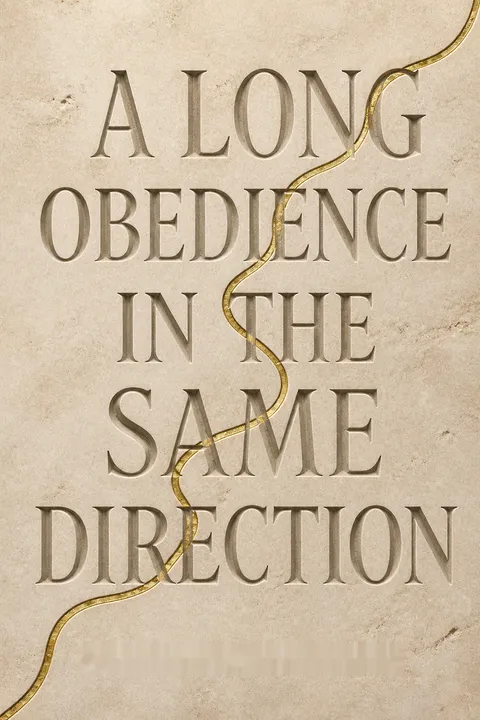

Key Takeaways
1. Discipleship Demands a Long Obedience, Not Instant Gratification
The essential thing “in heaven and earth” is . . . that there should be long obedience in the same direction; there thereby results, and has always resulted in the long run, something which has made life worth living.
Instant society. We live in a culture conditioned by thirty-second commercials and thirty-page abridgments, fostering an expectation that anything worthwhile can be acquired at once. This "tourist mindset" views religion as a quick visit to an attractive site, seeking new experiences or shortcuts to spiritual credit, rather than a sustained journey. This approach leads to a dreadful attrition rate among those who make decisions for Christ, as novelty quickly gives way to the garbage heap.
Pilgrims, not tourists. True Christian life is not about instant gratification but about a "long obedience in the same direction." We are called to be disciples, apprenticed to Jesus Christ, acquiring skills in faith at the work site, not just information in a classroom. We are pilgrims, constantly moving towards God, understanding that "this world is not my home" and setting out for "the Father's house."
The Songs of Ascents. The Psalms 120-134, known as the Songs of Ascents, serve as an ancient "dog-eared songbook" for this journey. These fifteen psalms, likely sung by Hebrew pilgrims ascending to Jerusalem, provide continuity and direction for developing maturity in Christ. They offer courage, support, and inner direction for navigating the transition from the world's environment to the Spirit's assembly, from sin to holiness, and from doubt to faith.
2. Repentance: The Essential Turn from Lies to God's Truth
A person has to get fed up with the ways of the world before he, before she, acquires an appetite for the world of grace.
Sick with lies. Christian consciousness begins with the painful realization that what we assumed was truth is, in fact, a lie. We are "doomed to live in Meshech, cursed with a home in Kedar," surrounded by deceit and hostility, where peace is elusive. This deep dissatisfaction with the world's falsehoods—from advertisers to politicians—is the prod that gets us going on the Christian way.
Deliverance from liars. The psalmist's immediate prayer is "Deliver me from the liars, God! They smile so sweetly but lie through their teeth." These lies are often impeccably factual but omit our origin and destiny in God, presenting a world without its Creator, bodies without the Holy Spirit, and love without the God who loves us. The word "God" illuminates this crossroads, exposing the world's falsehood and revealing the truth of our being.
A "no" that is a "yes." Repentance is not an emotion or feeling sorry for sins; it is a decisive act of turning. It's deciding that we were wrong to manage our own lives and be our own gods, and choosing to believe God's truth in Jesus Christ. This "piercing virtue" is the most practical of all acts, a "feet-on-the-ground" decision to follow Jesus, transforming dismay into gospel and setting us on a path of peace.
3. God's Unwavering Providence is Our Constant Security and Help
The promise of the psalm—and both Hebrews and Christians have always read it this way—is not that we shall never stub our toes but that no injury, no illness, no accident, no distress will have evil power over us, that is, will be able to separate us from God’s purposes in us.
Help from God, not mountains. When troubles arise, we often look for quick fixes or human solutions, like looking to "mountains" for strength, which in ancient times represented pagan shrines and false promises. Psalm 121 gently corrects this, reminding us that our strength comes from "God, who made heaven, and earth, and mountains." He is our Guardian, always awake, shielding us from every evil, not by preventing all harm, but by preserving us from the evil in them.
God is for us. Psalm 124 vividly describes life's hazards—being "swallowed alive by their violent anger" or "drowned in the torrent"—but counters this with the resounding declaration: "Oh, blessed be GOD! He didn’t go off and leave us." This is not an argument for God's help, but a testimony, a vigorous song of corporate reality. Our hazardous work of discipleship, where we put faith, hope, and love on the line daily, is sustained by God's constant presence and deliverance.
Encircling security. Our security is not based on our feelings or performance, but on God's steadfastness. "Those who trust in GOD are like Zion Mountain: Nothing can move it, a rock-solid mountain you can always depend on." Just as mountains encircle Jerusalem, "GOD encircles his people—always has and always will." This means that no depression, suffering, or even the possibility of defection can ultimately separate us from God's purposes.
4. Worship: The Foundation for a Structured Life in Relationship with God
Worship is an act that develops feelings for God, not a feeling for God that is expressed in an act of worship.
Voluntary and popular. Unlike many Christian behaviors that are socially enforced, worship is largely voluntary, making it one of the most popular acts among Christians. The psalmist's cry, "When they said, 'Let’s go to the house of GOD,' my heart leaped for joy," reflects a typical, not exceptional, Christian experience. This eagerness stems from deep needs met through worship.
A compact framework. Worship provides a workable structure for life, like Jerusalem, a "well-built city, built as a place for worship," where all the pieces fit compactly. In worship, diverse "tribes" gather into a single, harmonious people, finding unity amidst differences. It's where we "get our heads together," receiving a working definition for life and knowing where we stand in God's creation and redemption.
Nurturing relationship and divine decisions. Worship nurtures our relationship with God by commanding us to praise Him, even when we don't "feel like it." Feelings are unreliable in faith; acting ourselves into a new way of feeling is often more effective. Furthermore, worship centers our attention on God's "righteous judgment"—His decisive words that straighten things out, putting love in motion and ordering goodness. This continuous immersion in God's word informs our minds and refreshes our memories, extending peace and prosperity into our daily lives.
5. Service: An Urgent, Merciful Response to God's Lordship
Too often we think of religion as a far-off, mysteriously run bureaucracy to which we apply for assistance when we feel the need.
Upward look to God. Service begins with an upward look to God, acknowledging Him as "heaven-dwelling God," not a functional deity to be called upon at our convenience. If God is truly God, He knows our needs better, has a more comprehensive grasp of reality, and must be approached on His terms, through Scripture and Jesus Christ. This posture of looking up immediately places us in servitude.
Expectation of mercy. When we look up to God in faith, our expectation is mercy. "Mercy, GOD, mercy!" is not an attempt to manipulate God, but a confident reaching out to what we know He does—entering our condition to accomplish redemption. This conviction means God does not treat us according to our deserts but according to His plan, guiding us as children whose destinies He carries in His heart.
Urgency and reasonable service. The experience of being "kicked around long enough" by the world's oppression creates an urgency for God's mastery. Christian service is not casual but an urgent need to live under God's lordship, recognizing that relationships excluding God become oppressive. This "reasonable service" extends from worship into specific acts of serving others, transforming us from consumers into people who respond to God and develop relationships, finding freedom in His merciful rule.
6. Joy and Happiness: Consequences of God's Abundance and Blessing
Joy is not a requirement of Christian discipleship, it is a consequence.
Authentic Christian note. "We laughed, we sang, we couldn’t believe our good fortune." Joy is a characteristic of Christian pilgrimage, not a moral requirement, but a consequence of walking in faith and obedience. It's a product of God's abundance, an overflow of vitality that cannot be commanded or purchased through entertainment, but comes from living in response to God's generosity.
Rooted in history and hope. Christian joy is not ephemeral; it has a past and a future. It builds on the "wonderful" acts of God in history—like Israel's deliverance from Egyptian servitude or Babylonian captivity—and anticipates future grace, like "rains to our drought-stricken lives" and "hurrahs at the harvest." This means joy is actual even amidst pain and suffering, as God knows how to wipe away tears and create the smile of new life.
Blessing: The power to increase. Happiness, or blessing, is an inner strength and vital power that fills and surrounds the person of faith. It's not about ease or wealth, but about the power to live in its deepest sense, characterized by sharing and delight in life. Christian blessing multiplies as we give and share, increasing our vitality and making those around us fruitful. This "smooth straight road" of fearing God and walking in His ways leads to a life overflowing with goodness and peace.
7. Work: Participating in God's Creative Relationships, Not Anxious Striving
The curse of some people’s lives is not work, as such, but senseless work, vain work, futile work, work that takes place apart from God, work that ignores the if.
God works. The premise for all work is that God works; He builds and guards. Our work goes wrong when we lose touch with this reality, becoming either frantically compulsive (like Babel) or indolent (like Thessalonica). Christian discipleship frees us from the compulsiveness of work by orienting us in God's work, allowing us to participate in what He is already doing, rather than blasphemously trying to do God's work for Him.
Effortless procreation. Psalm 127 contrasts anxious labor with the "effortless work of making children." This metaphor highlights that true Christian work is not about acquiring things or amassing possessions through strenuous effort, but about responding to God and developing relationships. We invest our energy in people, fostering "sons and daughters, sisters and brothers," much like Jesus did.
People at the center. The character of our work is shaped by relationships, not accomplishments. While our society rewards relentless, compulsive work habits, the psalmist sees this as a sign of weak faith. Christian work, done within any job or profession, involves paying attention to and practicing what God is doing in love, justice, helping, healing, liberating, and cheering. It's about seeing God's work at the center, not our own efforts.
8. Perseverance: Sustained by God's Faithfulness, Not Our Own Strength
Perseverance is not the result of our determination, it is the result of God’s faithfulness.
Tough faith. The people of God are tough; they have been "kicked around ever since I was young, but they never could keep me down." Christian faith is not fragile, flourishing only in ideal conditions, but a resilient perennial that endures storms, droughts, and attacks. This is evident in the lives of Jesus and Paul, who faced relentless opposition yet never wavered from their path.
God rips the harnesses. Opposition to faith is often futile, like "plowmen plowed long furrows up and down my back" only for God to "rip the harnesses... to shreds." The enemies of God's people may bluster and persecute, but their efforts are ultimately worthless, like "grass in shallow ground that withers before the harvest." This imagery provides a cartoon-like reassurance that the world's God-defying purposes are unharnessed from eternity and therefore barren.
God sticks with us. The cornerstone of perseverance is "God wouldn’t put up with it, he sticks with us." Our survival in faith is not due to our stamina but to God's unwavering commitment. Christian discipleship is about paying more attention to God's righteousness than our own, charting His faithfulness rather than our fluctuating enthusiasms. This unalterable commitment from God enables us to persevere, even when we stumble, knowing that "purposes last."
9. Hope: Actively Waiting and Watching for God's Redemptive Work
Hoping does not mean doing nothing. It is not fatalistic resignation. It means going about our assigned tasks, confident that God will provide the meaning and the conclusions.
Dignity in suffering. To be human is to be in trouble, to suffer pain that threatens our worth and destiny. Psalm 130 begins with anguished prayer, "Help, GOD—the bottom has fallen out of my life!" By voicing this suffering openly before God, the psalm gives it dignity, refusing to treat it as an embarrassment or a puzzle to be explained away. It acknowledges suffering as reality, not illusion, and immerses it in God's personal and concerned presence.
Forgiveness is God's habit. The psalm's profound insight into God's character is that "forgiveness is your habit, and that’s why you’re worshiped." If God kept records of wrongdoing, no one would stand a chance. This truth means that suffering can never be ultimate; God is at the foundation and boundaries of our lives, actively involved in creation and redemption. This conviction allows us to face suffering, knowing it cannot separate us from God's purposes.
Wait and watch. The procedure for participating in this reality is to "wait and watch," which adds up to hope. Like a watchman waiting for the dawn, we go about our assigned tasks, confident that God will provide meaning and conclusions. Hoping is not dreaming or passive resignation; it's a "confident, alert expectation that God will do what he said he will do," an imagination harnessed by faith, willing to let God work in His way and time.
10. Humility and Obedience: Cultivating Childlike Trust and Responding to God's Call
Humility is the obverse side of confidence in God, whereas pride is the obverse side of confidence in self.
Pruning ambition. Psalm 131 is a "maintenance psalm" that prunes away unruly ambition, a temptation often glorified in our culture. The psalmist declares, "God, I’m not trying to rule the roost, I don’t want to be king of the mountain." This rejects the Faustian pursuit of godlike control and self-aggrandizement, which, despite superficial rewards, leads to damnation. True life is lived on God's terms, delighting in being made in His image, not awkwardly imitating Him.
Childlike trust, not infantile dependency. Having rejected pride, we must also avoid the mistake of thinking too little of ourselves, becoming "doormat Christians." Instead, the psalm calls for childlike trust: "Like a baby content in its mother’s arms, my soul is a baby content." This is not neurotic dependency but a willing trust in God, like a weaned child who loves the mother for her own sake, not just for comfort. It's a mature faith that freely chooses God's presence.
Obedience with history and hope. Psalm 132 roots obedience in historical fact, remembering David's vow to find a home for God's ark, and extends it into a daring leap of hope. Obedience is not a "stodgy plodding" but a "lively, adventurous response of faith" that draws on a rich biblical memory to inform present decisions and envision future promises. This fusion of memory and hope gives obedience ballast, breadth, direction, and goal, protecting us from a religion of whims or fantasies.
11. Community: The Essential Family of Faith, Marked by Mutual Priesthood and Fresh Expectancy
Our community with one another consists solely in what Christ has done to both of us.
No solitary Christians. Membership in the Christian church is a basic spiritual fact, a corollary of faith in Christ, not an option. "No Christian is an only child." While brothers and sisters in faith are not always "one big happy family" and can be challenging, community is essential and desirable. It's where we visibly gather in worship and remain in relationship through the week, fulfilling the command to "Love others as well as you love yourself."
Each other's priest. Community is like "costly anointing oil flowing down head and beard," symbolizing God's presence and anointing. This image from Aaron's ordination means we see each other as God's anointed, mediating God's mysteries and representing His address to one another. Our brotherhood is determined by what Christ has done to both of us, setting us apart for mutual service and speaking God's Word to each other, especially when we are uncertain or discouraged.
Fresh expectancy. Community is also "like the dew on Mount Hermon flowing down the slopes of Zion," signifying morning freshness, fertility, and growth. This encourages an ever-renewed expectation in what God is doing in each brother and sister, refusing to label or predict their growth. In such a community, where relationships are warm and expectancies fresh, "GOD commands the blessing, ordains eternal life," offering a hint of heaven's "rousing good fellowship."
Review Summary
A Long Obedience in the Same Direction is highly praised for its profound, accessible wisdom about Christian discipleship through the Psalms of Ascent (120-134). Readers appreciate Peterson's emphasis on slow, patient spiritual growth over instant results, his honest portrayal of faith's challenges, and his beautiful writing style. Many consider it a masterpiece deserving repeated readings. Some critics found Peterson's interpretations occasionally stretched beyond the text or his theology imperfect. The book resonates particularly with those experiencing spiritual fatigue, offering encouragement for the "long haul" of faith through practical, scripture-saturated insights without quick fixes or gimmicks.
People Also Read





About the Author


Download PDF
Download EPUB
.epub digital book format is ideal for reading ebooks on phones, tablets, and e-readers.








































