
Key Takeaways
1. History's Hidden Narratives: Through the Human Body
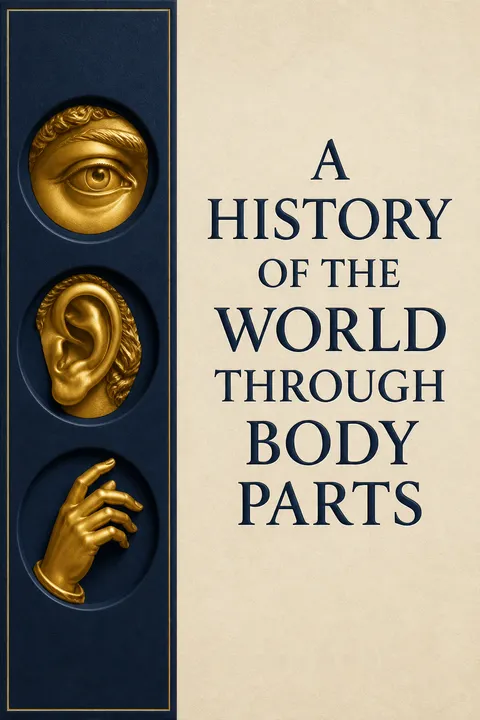
In short, we found that one can learn a great deal by focusing, as did Caesar and Antony, allegedly, on an individual body part.
A unique lens. History is often told through grand narratives of wars, empires, and ideologies, but a deeper, more human story emerges when viewed through the lens of individual body parts. From ancient hands stenciled on cave walls to a space-age bladder, these discrete pieces of the human form offer surprising insights into the cultures, beliefs, and daily lives of people across millennia. The authors' journey began with Cleopatra's nose, pondering its historical impact and the Roman perception of such a feature.
Beyond the obvious. This approach moves beyond mere historical events to explore the human condition itself, revealing how physical attributes, ailments, or even the symbolic representation of body parts shaped societies. It delves into questions like:
- What did people feel about their bodies?
- How did they interact with them?
- What role did the body play in major historical shifts?
A human perspective. By focusing on specific body parts, the book aims to make history more relatable and "truly human," highlighting the universal experiences of embodiment, with all its "warts, bowels, noses, and all." This perspective uncovers fresh and often surprising insights into ideology, power dynamics, and the everyday realities that traditional histories might overlook.
2. Power & Patriarchy: The Body as a Political Canvas
Wearing one exemplified her political power and legitimacy, which typically were vested in male bodies.
Masculinity as power. For Queen Hatshepsut, a female pharaoh in ancient Egypt, adopting the ceremonial false beard was a crucial political act. This symbol of monumental masculinity, usually reserved for male rulers and linked to the divine Osiris, underscored her legitimacy in a patriarchal society that struggled to accept a woman on the throne. Her image evolved from subtly masculine to fully male in statuary, a deliberate gender-bending campaign to secure her rule.
Challenging norms. Similarly, the exaggerated, 3-foot-long breasts of Vietnamese warrior Triệu Thị Trinh, often depicted topless on her war elephant, served as a powerful, albeit ambiguous, symbol. While some interpret them as a defiant rejection of Chinese-influenced Confucian norms that favored small, bound breasts and subservient women, others suggest they were a patriarchal attempt to diminish her by portraying her as a superhuman beast rather than a relatable female leader.
The struggle for legitimacy. Both Hatshepsut and Triệu Thị Trinh illustrate the immense pressure faced by powerful women in ancient times to conform to or subvert male-dominated ideals. Their physical representations, whether adopted or exaggerated, became central to their political narratives, highlighting the enduring struggle against patriarchal structures and the ways in which female bodies were interpreted and controlled.
3. Classical Ideals: The Aesthetics of the Human Form
Yes, Aristophanes and his fellow Greeks believed a “small prick” was a characteristic of the perfect male.
Sophrosyne and proportion. Ancient Greek aesthetics, particularly concerning the male form, were deeply intertwined with their philosophical ideal of sophrosyne—excellence of character, embodying temperance and self-control. This ideal manifested in art as small, flaccid penises on statues of gods and heroes, contrasting sharply with the large, erect phalluses associated with grotesque, out-of-control figures like Pan or Priapus. A large penis was seen as "too out there," lacking the desired moderation.
Noses and empires. Cleopatra's nose, famously speculated by Blaise Pascal to have altered world history if shorter, highlights another aspect of classical aesthetics and power. While the actual length of her nose is debated due to conflicting depictions, Roman leaders often sported long, aquiline noses, associating them with dominant personalities. Cleopatra, a Greek queen ruling Egypt, strategically manipulated her portraits, sometimes enlarging her features to project equivalence with powerful Romans like Marc Antony, demonstrating how physical traits were woven into political image-making.
Gendered representation. The Greek obsession with male genitalia extended to its absence in female statuary. Classical Greek goddesses were depicted without any visible genitals, a stark contrast to the ubiquitous male forms. This omission is seen by many scholars as a misogynistic extension of the small penis ideal, denying women even the opportunity to embody sexual control, reflecting a society that viewed women as inherently lustful and inferior.
4. Disability's Impact: Shaping Leaders and Legends
His self-styled “cloven hoof” served as a creative goad—and as a source of deep distress throughout his life.
A conqueror's limp. Timur (Tamerlane), one of history's most notorious conquerors, was known as "Timur-the-Lame" due to a severe leg injury. While some accounts attribute it to sheep rustling and others to battle, his limp became part of his complex image. Soviet exhumation later confirmed his injuries, revealing a stiff right arm and a shuffling gait. Timur, a master of public relations, may have even used his disability to craft a narrative of a humble man overcoming adversity, blending it with his ruthless tactics to inspire fear and submission.
Byron's tormented foot. Lord Byron, the Romantic poet and celebrity heartthrob, suffered from a congenital foot disability, likely a form of dysplasia, which caused him immense embarrassment and lifelong distress. He meticulously concealed his "cloven hoof," which he believed made him a "lame brat." This physical imperfection, however, also served as a "creative goad," driving him to produce masterpieces like Don Juan and shaping his iconic Byronic hero persona—talented, tormented, and brooding.
Beyond physical limitations. Both Timur and Byron demonstrate how physical disabilities, whether real or perceived, can profoundly influence an individual's personality, public image, and historical trajectory. For Timur, it was a tool in his conquest; for Byron, a source of internal agony that fueled his artistic genius and contributed to his carefully curated celebrity.
5. Propaganda's Canvas: Bodies as Tools for Control
From then on, there was really no going back where Richardʼs public image was concerned.
The villain's back. King Richard III's "hunchback" is a prime example of how physical characteristics can be weaponized for political propaganda. Though modern archaeological findings revealed he had adolescent-onset scoliosis, not a severe hunchback, the victorious Tudors, aided by chroniclers like John Rous and later by Shakespeare, exaggerated his spinal curvature into a monstrous deformity. This "crookback" image served to demonize Richard, justifying the Tudor usurpation and cementing their own legitimacy.
Martyrdom in the tub. Jean-Paul Marat, a radical journalist of the French Revolution, suffered from a debilitating skin condition that forced him to work from his bathtub. His assassination there by Charlotte Corday, a Girondist sympathizer, was swiftly exploited by the Jacobins. Jacques-Louis David's painting, The Death of Marat, transformed the middle-aged, diseased man into a Christ-like martyr with glowing skin, making him a central figure in the revolutionary cult and a powerful symbol for their cause.
Heads of state, severed. The beheadings of Charles I and the post-mortem decapitation of Oliver Cromwell illustrate the symbolic power of severed heads in 17th-century England. Charles I, executed for treason, used his trial and death to craft an image of a dignified martyr, which ultimately helped restore the monarchy. Cromwell's head, later impaled on a stake, served as a stark warning against challenging royal authority. These acts were not just executions but potent political statements, literally separating the ruler from the body politic.
6. Unsung Drivers: How Bodily Functions Alter History
The Protestant Reformation of the 16th century was one of Christianityʼs most important and controversial movements with far-reaching repercussions.
Luther's cloacal epiphany. Martin Luther, the architect of the Protestant Reformation, famously attributed his theological breakthrough—that salvation comes by God's grace alone—to an epiphany experienced in the "cloaca," Latin for sewer or latrine. Plagued by chronic constipation, Luther's physical discomfort and the relief he found in this "not-so-spiritual place" may have influenced his rejection of Catholic doctrines and his embrace of a more "earthy" Christianity, often expressed through scatological rhetoric.
Washington's dental dilemma. George Washington's lifelong struggle with dental problems, culminating in his famous (and fake) wooden dentures, reveals a hidden aspect of his leadership. His dentures, made of carved ivory and human teeth (possibly from enslaved people), highlight the crude and unethical practices of 18th-century dentistry. Ironically, an intercepted letter about his dental tools even misled the British, contributing to a crucial American victory at Yorktown.
Shepard's space-age pee. Alan Shepard, the first American in space, faced an unexpected challenge: an urgent need to urinate during an 8-hour launch delay. His decision to "go" in his suit, shorting out medical sensors, underscored the prosaic yet critical problem of bodily waste management in extreme environments. This incident spurred innovations in space suit design and highlighted the human body's unexpected adaptations to zero gravity, where the urge to urinate is diminished.
7. Sacred Fragments: The Enduring Power of Relics
Relics were big business in the Catholic Church.
The wonder-worker's nails. St. Cuthbert, a 7th-century monk, became Northern England's most popular saint, whose body was miraculously "uncorrupted" after death. His fingernails and hair, believed to continue growing, were regularly clipped by a sacristan and distributed as relics. This practice exemplifies the Catholic Church's strategic use of saintly fragments to spread influence and generate revenue, as relics became highly sought-after objects for veneration, protection, and miracle-working.
Dispersed burials. The medieval practice of "dispersed burial," where body parts like hearts, bones, or entrails were interred in multiple locations, became a significant status symbol, particularly among the aristocracy.
- Initially popularized during the Crusades to transport fallen nobles home.
- Richard the Lionheart famously requested a tripartite burial for his heart, brain, and body.
- Despite papal bans, obtaining dispensation for dispersed burial became the ultimate 14th-century status symbol.
Anne Boleyn's heart. The fate of Anne Boleyn's heart, rumored to have been removed and buried separately after her execution, reflects this fading but persistent custom in England. While its exact fate remains uncertain, the discovery of a heart-shaped casket in a church in Erwarton, Suffolk, now marked as her probable burial place, continues to draw tourists, illustrating the lasting allure and commercial potential of these sacred (or semi-sacred) fragments.
8. The Genius Within: Brains, Trauma, and Revelation
Einstein was a world-famous genius and people I knew used to remark, ʻYou spend a good deal of time with Einstein. He has a perfect brain, doesnʼt he?ʼ”
Einstein's seized brain. Upon Albert Einstein's death, pathologist Thomas Harvey controversially removed his brain for scientific study, driven by a historical "brain fever" to understand the biological basis of genius. Despite initial family objections and a lack of immediate scientific interest, later studies revealed that Einstein's brain, though smaller than average, had larger parietal lobes and a higher ratio of glial cells to neurons, hinting at enhanced cognitive ability and creative leaps.
Tubman's visionary brain. Harriet Tubman, the legendary conductor of the Underground Railroad, developed emotionally mediated synesthesia after a severe skull fracture in her youth. This traumatic brain injury caused crushing headaches, narcolepsy, and "absence epilepsy," but also vivid dreams and visions she interpreted as divine guidance. These experiences intensified her faith and convinced her of supernatural powers, which she credited for her remarkable success in guiding enslaved people to freedom.
Trauma and talent. Both Einstein and Tubman, though vastly different figures, highlight the profound and sometimes unexpected ways the brain shapes human experience and potential. Whether through inherent structure or traumatic alteration, the brain can be a source of extraordinary abilities, driving individuals to reshape scientific understanding or lead movements for liberation.
9. Rebellion on Foot: Women Challenging Tradition
This is a story of how two feet ignited one of the most courageous feminist movements in history.
The agony of lotus feet. For over a millennium in Imperial China, foot-binding was a pervasive and excruciating practice, forcing girls' feet into tiny "golden lilies" of less than four inches. This painful custom, which involved breaking toes and bending arches, was a symbol of status, economic stability, and erotic attractiveness, dictating a woman's social standing and marriage prospects. The resulting "teetering" gait was considered sensual by men, while women endured chronic pain and infection.
Qiu Jin's defiant steps. Qiu Jin, a Chinese feminist revolutionary of the late 19th century, vehemently denounced foot-binding, which she herself endured. She secretly unbound her feet and became a vocal advocate for women's independence, arguing that bound feet rendered women economically unproductive and subservient. Her polemic, "A Respectful Proclamation to China's 200 Million Women Comrades," directly linked women's subjugation to their lack of mobility.
A legacy of freedom. Despite facing opposition and ultimately being executed for her revolutionary activities, Qiu Jin's legacy as a national hero endured. Foot-binding was officially outlawed in 1912, and though it lingered in remote areas, it lost its prestige. Qiu Jin's courageous challenge to this deeply entrenched tradition, symbolized by her unbound feet, became a powerful catalyst for women's liberation and a testament to the transformative power of individual resistance.
10. Genetic Echoes: Royal Bloodlines and Their Costs
But he also inherited the family jaw, one that made him famous for all the wrong reasons.
The Habsburg jaw. Charles II of Spain, the last Habsburg ruler of Spain, suffered from a severely disfiguring "Habsburg jaw"—mandibular prognathism coupled with maxillary retrognathism. This jutting lower jaw, thick lip, and underdeveloped upper jaw made it impossible for him to close his mouth fully, causing copious drooling and unintelligible speech. This debilitating condition was a direct consequence of centuries of extreme inbreeding within the Habsburg dynasty, who married close relatives to maintain power.
A family's obsession with sound. The Bell family, particularly Alexander Graham Bell, was driven by a multi-generational obsession with sound and hearing. His grandfather and father were pioneers in phonetics and elocution, developing "Visible Speech" to help the deaf. Bell's mother's profound hearing loss directly inspired his quest to help her hear more clearly, leading him to experiment with sound and eventually invent the telephone. This family legacy, while not a genetic defect, highlights how inherited interests and environmental factors can shape groundbreaking innovations.
The price of power. Charles II's physical and mental infirmities, exacerbated by his lack of education and overprotective upbringing, earned him the nickname "El Hechizado" (the Hexed). His inability to produce an heir, a direct result of the dynasty's inbreeding, ultimately led to the extinction of the Spanish Habsburg line and triggered the War of the Spanish Succession. Both the Habsburg jaw and the Bell family's auditory focus demonstrate how genetic traits or deeply ingrained family pursuits can have profound, often unintended, consequences on individuals and the course of history.
People Also Read


Download PDF
Download EPUB
.epub digital book format is ideal for reading ebooks on phones, tablets, and e-readers.








































