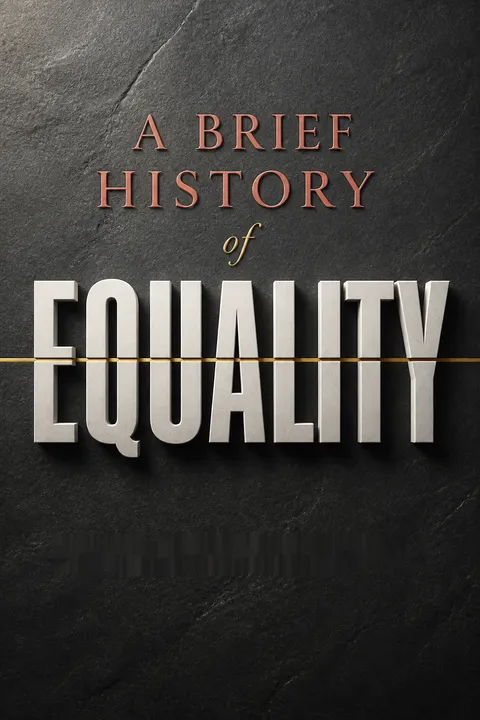

Key Takeaways
1. Equality's Long, Uneven March
The advance toward equality is a battle that began long ago and needs only to be continued in the twenty-first century, provided that we all participate in it and that we break with the divisions based on racial or cultural identity and on disciplines that too often prevent us from moving forward.
Human progress exists. Over the past two centuries, humanity has made significant strides in health and education. Global life expectancy at birth rose from 26 years in 1820 to 72 in 2020, while literacy rates for those over 15 climbed from 10% to over 85%. This progress, however, is not linear or natural; it is the hard-won result of historical processes and specific social battles, often accelerating during periods of intense political struggle and the expansion of the welfare state.
Growth's complex interpretation. While global population and average income have multiplied tenfold since the 18th century, interpreting this as unmitigated progress is complex. Exponential population growth is unsustainable, and average income increases mask profound inequalities. A truly meaningful assessment requires a multidimensional approach, moving beyond simple GDP figures to include:
- Real distribution of wealth among social classes.
- Environmental impact and sustainability.
- Access to concrete goods like education, healthcare, and housing.
Indicators are political. The choice of socioeconomic indicators is inherently political, shaping public debate and policy. Relying solely on averages or GDP obscures critical realities, such as the disproportionate carbon emissions of the wealthiest or the vast disparities in income and property. To genuinely advance equality, we must embrace transparent, multidimensional indicators that reveal injustices and guide collective action, rather than allowing economic elites to dictate the narrative.
2. Property's Enduring Concentration
The richest 1 percent’s share of total private property is currently two times smaller than it was a century ago, but it still remains on the order of five times larger than the share held by the poorest 50 percent, who today own scarcely more than 5 percent of the total (despite the fact that they are by definition fifty times more numerous than the richest 1 percent).
Hyperconcentration persists. Despite a long-term trend toward less concentrated wealth since the early 20th century, property ownership remains astronomically skewed. In France, the richest 1% held 55% of total private property in 1910, falling to 24% by 2020. However, the poorest 50% saw their share rise only marginally from 2% to 6% in the same period, indicating that the deconcentration primarily benefited the "patrimonial middle class."
Property as power. Property is not an absolute right but a "bundle of rights" defined by socio-historical context, conferring power and opportunity. Historically, this power extended beyond monetary value to include fiscal, political, and jurisdictional privileges for the aristocracy. While legal reforms have granted more rights to non-property owners (employees, renters, women), the fundamental power imbalance inherent in wealth concentration persists, making the poorest 50% vulnerable.
Fragile middle class. The emergence of a patrimonial middle class (the 40% between the poorest 50% and richest 10%) is a significant shift, with their share of total wealth tripling between 1914 and 1980 in France. However, this gain is fragile, and in the United States, this group's share has declined significantly since 1980. This demonstrates that without sustained institutional support, the gains in wealth distribution can be easily reversed, leaving the majority with little to no tangible assets.
3. Colonialism's Deep Scars
All the research at our disposal demonstrates that the development of Western industrial capitalism is closely linked to the international division of labor, the unrestrained exploitation of natural resources, and the military and colonial domination that developed gradually between the European powers and the rest of the planet starting in the fifteenth and sixteenth centuries and accelerating during the eighteenth and nineteenth centuries.
Western wealth's true origins. The "Great Divergence" between Europe and Asia, leading to Western industrial capitalism, was not solely due to internal European virtues. It was fundamentally fueled by:
- Global resource exploitation: Large-scale extraction of raw materials (cotton, wood) and energy from colonized territories.
- Coercive labor systems: Slavery and forced labor in plantations (e.g., US South, Saint-Domingue) provided cheap inputs.
- Military and fiscal dominance: European states, strengthened by interstate rivalries, developed superior military and financial capacities to impose their will globally.
Protectionism's hypocrisy. European powers, particularly Britain, aggressively used protectionist policies (tariffs, import bans) to dismantle rival industries like India's textile sector, securing their own industrial supremacy. Once dominant, they then championed "free trade" to maintain their advantage, effectively preventing less developed nations from replicating their path to industrialization. This historical pattern highlights the strategic, rather than natural, application of economic doctrines.
Extreme global inequality. Colonialism created profoundly hierarchical "center-periphery" relations, relegating much of the world to a subordinate position. This legacy is evident in the extreme income inequalities observed in historical slaveholding societies (e.g., Saint-Domingue, where the top 10% appropriated 80% of production) and colonial regimes (e.g., French Algeria, South Africa). These systems represent some of the most unequal societies in human history, demonstrating how political and military power can be leveraged to create and sustain vast disparities.
4. Reparations: Unaddressed Injustice
By rejecting any discussion of a debt that Haiti had to pay to France for ending slavery, even though the payments made from 1825 to 1950 are well documented and are not contested by anyone, we risk giving the impression that some injustices are more important than others.
Slaveholders, not slaves, compensated. The abolition of slavery in the 19th century, particularly by France and Britain, was often accompanied by massive financial compensation paid to slaveholders, not to the enslaved. Haiti, after its victorious slave revolt and declaration of independence in 1804, was forced by France to pay an indemnity of 150 million gold francs (over 300% of its national income) to former slaveholders, a debt that crippled its development for over a century.
A persistent double standard. The refusal to discuss reparations for historical injustices like Haiti's debt stands in stark contrast to ongoing compensation processes for other historical expropriations (e.g., Jewish property after WWII, Hohenzollern claims). This selective approach undermines the development of universal principles of justice and fuels resentment. A transparent, democratic debate on reparations, such as France reimbursing Haiti's debt (estimated at 30 billion euros), is essential to rectify past wrongs and foster reconciliation.
Postslavery's new forms of control. Even after formal abolition, colonialism continued through discriminatory legal systems and forced labor. In French colonies, "natives" faced systematic deprivation of rights, and systems like "engagés" (indentured workers) or "corvées" (forced labor) perpetuated exploitation. Educational systems were deeply segregated, with vastly unequal public spending favoring colonists. This demonstrates a continuum of control, where legal and social structures replaced overt slavery to maintain dominance and extract resources.
5. The State's Transformative Power
Historically, it is the battle for equality and education that has made economic development and human progress possible, and not the veneration of property, stability, and inequality.
Welfare state's rise. Between 1914 and 1980, Western countries witnessed an unprecedented expansion of the fiscal and social state. Tax receipts quadrupled in Europe, funding massive investments in:
- Education: From elitist to near-universal secondary access, significantly boosting productivity.
- Healthcare: Establishment of universal systems (e.g., NHS in the UK).
- Social Security: Pensions, unemployment benefits, and other transfers stabilizing society.
This transformation, driven by social movements and accelerated by world wars and economic crises, proved that large sectors of the economy could be organized outside purely commercial logic, often more efficiently.
Progressive taxation's impact. The invention and widespread implementation of highly progressive income and inheritance taxes (e.g., US top income tax rates averaging 81% from 1932-1980) were crucial. These taxes not only redistributed wealth after taxes but also significantly reduced inequalities before taxes (predistribution). High rates on top incomes discouraged extravagant remunerations, freeing up funds for lower salaries and broader investments, without hindering economic growth or innovation.
Anthropological revolution. This "second leap forward" for the state represented an anthropological shift: for the first time, the state largely escaped the exclusive control of dominant classes. Universal suffrage, parliamentary democracy, and strong labor movements empowered lower and middle classes to shape state policy. This demonstrated that a state, when democratically controlled, could be a powerful engine for equality, decommodification, and collective well-being, challenging the notion that capitalism is the only viable economic system.
6. Beyond Formal Equality
To attain real equality, we must develop indicators and procedures that will allow us to fight gendered, social, and ethno-racial discrimination, which is in practice endemic nearly everywhere, in the global North as well as in the South.
Educational hypocrisy persists. Despite formal declarations of equal opportunity, deep educational inequalities persist. In the US, parental income strongly predicts university access, with the wealthiest often benefiting from opaque admissions processes and "legacy" preferences. In France, public resources are disproportionately allocated to privileged students in selective institutions, while disadvantaged schools receive fewer experienced teachers. This systemic bias undermines the very foundation of meritocracy.
Patriarchy's slow decline. Women have historically faced massive, systematic discrimination across all societies. While formal legal equality has advanced, the pace of change in economic power remains glacial. In France, women's share of top remunerations rose from 10% in 1995 to only 19% in 2020, projecting parity centuries away. Quotas for political office and corporate boards have shown some efficacy, but a true exit from patriarchy requires a fundamental rebalancing of work, family, and social reproduction, challenging the "productivist" lifestyle that disproportionately burdens women.
Fighting discrimination without rigidifying identities. Combating social, ethno-racial, and religious discrimination requires explicit, verifiable measures. While quotas (e.g., India's "reservations" for castes) can be effective in opening opportunities and reducing prejudice, they risk rigidifying identities. A more universalist approach involves:
- Transparency: Publicly tracking educational expenditures and outcomes by social origin.
- Targeted policies: Affirmative action based on social criteria (income, neighborhood) rather than ethno-racial categories.
- Anti-discrimination testing: Large-scale, repeated testing to identify and prosecute discriminatory practices in employment and public services.
- Rethinking religious neutrality: Addressing hypocrisies in state funding and tax deductions that favor certain religions.
7. Neocolonialism's Modern Chains
The current economic system, based on the uncontrolled circulation of capital, goods, and services, without social or environmental objectives, is akin to a neocolonialism that benefits the wealthiest.
Global inequality's enduring legacy. While inequalities between countries have slightly decreased since 1980 (driven by China's growth), they remain vast and deeply rooted in the colonial past. The "national welfare state" of the Global North, developed during the Trente Glorieuses, largely ignored the South's development needs, perpetuating a hierarchical world-economy where poorer nations struggle to establish legitimate state power and autonomous development.
Washington Consensus's damage. The "Washington Consensus" of the 1980s and 90s imposed rapid deregulation, budget austerity, and trade liberalization on poor countries. This policy:
- Weakened states: Led to a decline in tax revenues (especially customs duties) without viable alternatives, crippling public services.
- Fueled capital flight: Exacerbated by tax havens, massive capital outflows from the South often dwarfed incoming international aid.
This effectively created a new form of neocolonialism, where rich countries benefited from open markets and capital inflows, while poor countries were denied the fiscal capacity for self-development.
Beyond "aid" to "rights." The current system of international aid is insufficient and often hypocritical, with outflows of profits and capital from the South frequently exceeding aid inflows. To exit neocolonialism, poor countries need:
- Right to development: Automatic fiscal receipts, such as a share of global taxes on multinationals and billionaires (e.g., a 2% global wealth tax on fortunes over €10 million could yield €1 trillion annually).
- Codevelopment treaties: Replacing purely commercial treaties with agreements that set explicit, binding social and environmental goals, subordinating trade to these objectives.
- Transnational democracy: Creating assemblies (e.g., Euro-African Union) to democratically oversee global public goods and fiscal justice, moving beyond national-social states to a federal-social model.
8. Democratic Socialism: The Future's Blueprint
The democratic socialism described here is only an outline. It includes many weaknesses and limitations. For example, some readers may think that by allowing the continued existence of a limited form of private ownership of the means of production (at the level of small businesses) and housing, we are taking the risk that these changes will be ephemeral, and that the strict limitation of differences in wealth will not last, given the considerable efforts that some people will deploy to ensure that the tax scales are modified and to reject all limits.
Systemic transformation, not mere reform. Democratic socialism, as envisioned, is not a mild adjustment to capitalism but a systemic transformation building on the welfare state and progressive taxation. It aims for a decentralized, self-managing, ecological, and multicultural society, fundamentally different from 20th-century authoritarian state socialism. This involves:
- Deepened welfare state: Expanding decommodified sectors like healthcare, education, and energy, potentially reaching 60-70% of national income.
- Radical progressive taxation: Implementing near-confiscatory rates (80-90%) on the highest incomes and wealth, including an annual wealth tax, to ensure predistribution and limit accumulation.
- Participatory governance: Power-sharing in firms (e.g., 50/50 employee-stockholder voting rights) and public institutions.
Property for all, not just a few. To address hyperconcentration of wealth, a "universal inheritance" system is proposed: a minimal capital endowment (e.g., 60% of average wealth, or €120,000 in France) paid to every young adult, financed by progressive wealth and inheritance taxes. This aims to:
- Increase negotiating power: Empowering individuals to reject exploitative jobs or pursue personal projects.
- Foster social property: Redefining small private property as social and temporary, embedded within a framework of shared power and strict limits on accumulation.
This approach seeks to democratize access to capital without falling into the bureaucratic excesses of state-owned production.
Beyond market and state. This vision of democratic socialism seeks to transcend the traditional dichotomy of market vs. state by fostering a vibrant, diverse ecosystem of public, municipal, cooperative, and non-profit structures. It recognizes that while some private ownership (housing, small businesses) can play a role, it must operate within a legal and fiscal framework that prioritizes collective well-being, ecological sustainability, and the continuous circulation of power and property, rather than unlimited accumulation.
9. Universalist Sovereignism
Each political community must be able to set the conditions for the pursuit of trade with the rest of the world, without waiting until it has reached agreement with all its partners.
Reclaiming national autonomy. The free circulation of capital, without common regulation or taxation, has created a new "censitary power," allowing the wealthiest to evade national tax systems and undermining democratic choices. To counter this, nations must adopt "universalist sovereignism": the right to unilaterally set conditions for trade and capital flows based on explicit, universal criteria of social, fiscal, and environmental justice, rather than waiting for elusive global consensus.
A new global framework. This approach requires replacing purely commercial treaties with "codevelopment treaties" that prioritize binding social and environmental goals. These treaties would:
- Set targets: Quantified, verifiable targets for multinational tax rates, wealth distribution, carbon emissions, and biodiversity.
- Subordinate trade: Make trade conditional on achieving these objectives, rather than an end in itself.
- Empower transnational assemblies: Create democratic bodies (e.g., European Assembly, Euro-African Union) with real budgetary, fiscal, and social decision-making powers, moving beyond the limitations of national parliaments and intergovernmental councils.
Money as a democratic tool. The increasing power of central banks and monetary creation, especially since 2008, highlights the malleability of economic institutions. This tool must be democratized and put under parliamentary supervision to serve:
- Full employment and guaranteed jobs.
- Ecological transition and public investments.
- Debt reduction through wealth levies.
This requires transparency, public deliberation, and a shift from saving banks to saving the planet and reducing inequalities, challenging the conservative schema that currently governs monetary policy.
Review Summary
A Brief History of Equality by Thomas Piketty receives mixed reviews averaging 3.97/5. Readers appreciate Piketty's data-driven analysis of inequality spanning 300 years, though many find it dry and academic. Supporters praise his accessible condensation of previous works, documenting progress toward equality while warning of reversals since the 1980s. He proposes "democratic socialism" with progressive taxation, welfare expansion, and wealth redistribution. Critics argue the book is ideologically biased, lacks depth across disciplines, presents contentious claims as fact, and focuses heavily on French/European contexts. Most agree it's thought-provoking despite density issues.
People Also Read








About the Author

Download PDF
Download EPUB
.epub digital book format is ideal for reading ebooks on phones, tablets, and e-readers.








































