


Key Takeaways
Structure the days, surrender the nights, and skip the crying entirely
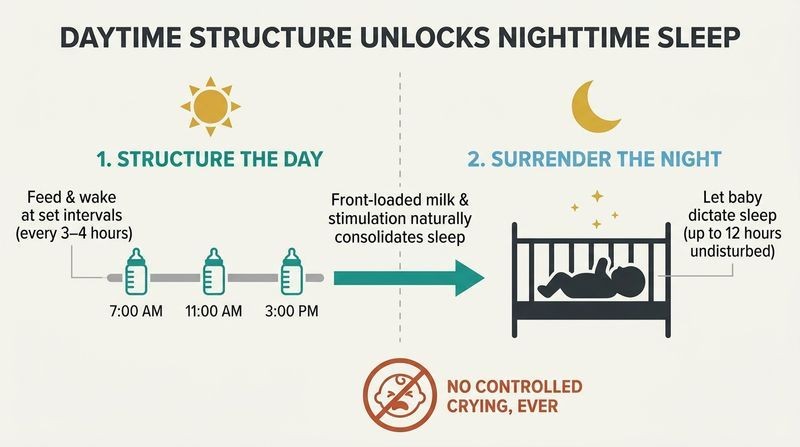
Charmian Mead's core promise splits the difference between two warring camps: rigid scheduling with controlled crying on one side, and feed-on-demand co-sleeping on the other. Her middle path is deceptively simple.
1. Structured days: wake and feed the baby at set intervals, roughly every 3 to 4 hours.
2. Baby-led nights: never wake a baby for a feed; let hunger dictate.
3. No controlled crying, ever.
By front-loading milk and stimulation into daylight hours, the baby learns night from day and naturally consolidates sleep. Mead claims babies can sleep twelve-hour stretches as early as six to eight weeks. The day is engineered; the night is trusted to follow. The whole system pivots on one idea: get daytime right and nighttime fixes itself.
What's compelling here is the reframe: most sleep debates fixate on the night, but Mead relocates the lever to the day. This echoes circadian science, where light exposure, feeding timing, and activity are well-documented zeitgebers (time cues) that entrain an infant's immature body clock. The claim of twelve hours by six weeks is aggressive, and readers should note it reflects one consultant's clinical observation, not randomized trials. Skeptics of early scheduling point to responsive-feeding research linking on-demand access to breastfeeding success. Mead's rebuttal, that unstructured feeding often masks low supply and exhaustion, is a genuinely underexplored angle worth weighing.
Trapped wind fakes fullness, so burp every ounce religiously

Mead's obsession is the gut. A newborn cannot burp itself until roughly 8 to 12 weeks, so swallowed air accumulates and creates a false sense of fullness. The baby drifts off mid-feed, takes too little milk, then wakes hungry an hour later. Trapped air also causes pain as it travels the digestive tract, and can trigger projectile vomiting when milk sits atop an air bubble.
Her prescription: wind every 5 to 10 minutes on the breast, or every 15 to 30ml on the bottle. Sit the baby upright with a straight back, support the stomach and chin, and rub firmly in upward circles beside the spine (not patting it to sleep). She insists breastfed babies need winding too, sometimes more, because foremilk is especially wind-forming.
Mead elevates winding from afterthought to keystone, and the physiological logic is sound: infant lower-esophageal sphincters are immature, and aerophagia (air swallowing) is real. Her sharpest contrarian move is dismissing colic as a non-diagnosis, a catchall for undiagnosed gut discomfort. Pediatric medicine still defines colic by the rule of threes (crying three hours a day, three days a week, three weeks), and its causes remain debated, so her confidence that every case has a pinpointable cause overstates certainty. Still, the emphasis on posture and digestion aligns with reflux-management guidance, and treating feeding, winding, and comfort as one system is genuinely useful.
Split the bedtime feed with a bath to build the biggest meal
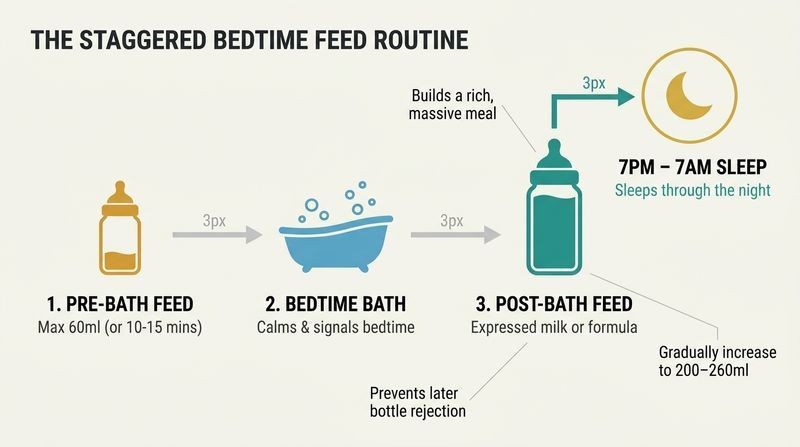
The linchpin of the whole routine is what Mead calls the staggered feed. A mother's milk supply is richest in the morning and lowest by evening, precisely when the baby needs its largest meal to last the night. Her fix: give a small pre-bath feed (a maximum of 60ml or 10 to 15 minutes per breast), bathe the baby, then deliver a large post-bath bottle of expressed milk or formula.
This bottle becomes the day's biggest feed, gradually increased by 15 to 30ml at a time until the baby reaches its personal magic number, usually 200 to 260ml, that unlocks sleeping through. The bath both calms the baby and signals bedtime. Introducing this bottle by week two also prevents later bottle rejection.
This is Mead's most original mechanical insight, and it cleverly exploits a real physiological asymmetry: circadian variation in milk composition and volume, with evening supply genuinely lower for many mothers. Introducing a bottle early to preempt refusal is shrewd behavioral conditioning, exploiting the narrow window before bottle aversion sets in around weeks five to eight. The tension worth flagging: lactation orthodoxy warns that supplementing the evening feed can suppress the very stimulation that builds supply. Mead counters that a well-rested, well-slept mother produces more milk overall, a plausible trade-off, though it converts exclusive breastfeeding into mixed feeding, which not every parent wants.
Keep newborns awake and playing by day to earn quiet nights
Contrary to the belief that newborns only eat and sleep, Mead argues many one-week-olds can stay awake up to two hours per feed cycle. Structured awake time after each daytime feed serves triple duty: it aids digestion, teaches day from night, and lets parents gauge whether the baby actually got enough milk.
Create the right environment, because newborns are hypersensitive to heat, light, noise, and motion:
1. Keep the room at 19 to 20 degrees Celsius, baby stripped to a vest.
2. Dim the lights, since bright light shuts newborn eyes.
3. Kill background noise like TV or washing machines, which lull babies to sleep.
4. Use static black-and-white images, all a newborn can focus on at first.
5. Never do playtime in a moving pram, which forces sleep.
The counterintuitive claim, that background noise sedates rather than stimulates newborns, cuts against the popular white-noise industry. Both can be true: constant broadband noise mimics the womb and promotes sleep, which is exactly why Mead wants it absent during intended wake windows. Her insistence on black-and-white imagery tracks established developmental science; newborn visual acuity is poor and contrast sensitivity develops first. The deeper principle, using daytime alertness to consolidate nighttime sleep, mirrors adult sleep hygiene, where daytime light and activity deepen night sleep. Parents anxious about overtiredness should note Mead's claim that this concern only applies after roughly three months.
Pause two minutes before every night waking to protect self-settling
Mead's two-minute rule is the gentle heart of her no-cry method. Babies cycle through many light sleep phases and routinely grunt, twitch, stretch, and even cry briefly before resettling on their own. Rush in at the first squeak and you interrupt that process, potentially starting a feed the baby didn't need, only for it to wake genuinely hungry hours later.
So you wait two minutes. If the baby truly needs you, it escalates; if not, it drifts back to sleep and learns self-settling. The one exception is right after the bedtime feed, the only time the baby sleeps on a full stomach, where crying likely signals missed wind. Mead distinguishes this sharply from controlled crying: it is a brief pause to read the baby, not a training protocol of timed abandonment.
The two-minute rule is essentially a low-dose version of the graduated-extinction debate, sidestepping its ethical controversy by capping the wait so short that it reads as observation rather than training. This is psychologically astute: infant sleep architecture involves frequent partial arousals, and adult intervention can convert a self-resolving micro-waking into a full one. Attachment-oriented critics may still bristle at any deliberate pause, while cry-it-out proponents may find two minutes toothless. Mead threads the needle. The framework's real value is diagnostic: it forces parents to distinguish sleep noise from distress, a skill that reduces both unnecessary feeds and parental anxiety over time.
Rest is the real milk booster, not endless night feeding
Mead reorders the body's energy priorities: it spends energy first on recovering from birth, second on daily activity, and last on making milk. The implication is radical for exhausted mothers, since sleep and rest do more for supply than round-the-clock stimulation. Milk is most plentiful in the morning after a night's sleep and depletes through the day.
Her supply toolkit:
1. Take a 90-minute to 2-hour daytime rest, ideally a skin-on-skin nap that releases milk-making hormones.
2. Go to bed by 9pm until the baby sleeps through.
3. Express after the first two morning feeds to trick breasts into producing more.
4. Drink 2 to 3 litres of water plus fennel tea.
5. Eat well, never diet, and never skip meals while nursing.
This reframing is both humane and biologically defensible. Chronic sleep deprivation elevates cortisol and can blunt oxytocin-driven letdown, so the mother running on fumes may indeed undermine her own supply, a vicious cycle Mead names precisely. Her claim that long night sleep benefits supply as much as night stimulation runs against the prolactin-surge rationale for night feeds (nocturnal prolactin peaks are real). The likely truth is individual: some mothers need night stimulation to protect supply, others are sabotaged by exhaustion. Her advice to express after morning feeds cleverly harnesses supply-and-demand without robbing the baby, a genuinely practical maneuver.
Feed meals not snacks so the stomach fully empties between
Frequent snacking is Mead's villain. A baby that feeds every one to two hours never empties its stomach, so fresh milk piles on undigested milk, breeding gas and pain. On the breast, snacking means the baby gets thin, wind-forming foremilk but never reaches the rich, satisfying hindmilk, so it stays hungry and catnaps.
The fix is to make each feed a proper meal: both breasts, active sucking, full winding, spaced 3 to 4 hours apart. Mead teaches parents to distinguish active feeding (a wide, circular jaw motion with visible swallowing) from comfort sucking (a shallow nibble-nibble-pause with a shuddery jaw that delivers almost no milk). Spacing feeds lets the stomach empty, builds a genuine appetite, and aids digestion, the opposite of the constant topping-up that leaves babies gassy and unsatisfied.
The foremilk-hindmilk distinction is real, though modern lactation science has softened the old rigid framing; total milk transfer matters more than obsessing over hindmilk ratios. Still, Mead's behavioral observation is sharp and immediately useful: teaching parents to read active versus comfort sucking gives them a real-time feedback signal most guides omit. The meals-not-snacks principle also has an elegant systems logic, since digestion, appetite, and sleep are coupled. The caveat is that cluster feeding in the evening is often normal and supply-protective in early weeks, so parents should not pathologize all frequent feeding, especially during growth spurts Mead herself acknowledges.
Swaddle and tuck tightly, because a startle reflex steals sleep
Between three and six weeks, the Moro (startle) reflex kicks in, sending a baby's arms flailing and jolting it awake mid-sleep. Mead treats swaddling as the single legitimate sleep prop, because it makes a baby feel cuddled and secure while preventing self-waking. She swaddles for night sleep to reinforce day-night distinction, adding daytime swaddling only if naps are unsettled, which she says applies to about 75 percent of babies in her care.
Use thin, stretchy cotton, firm around the chest and arms, looser at the hips. Beyond swaddling, tuck blankets tightly at shoulder height with no loose fabric near the face. The security of being wrapped and tucked mimics the womb. She weans the swaddle gradually once the baby sleeps through for two solid weeks, one arm at a time.
The Moro reflex explanation is textbook accurate and often overlooked by frazzled parents who misread self-startling as hunger. Swaddling's calming effect is well-supported, reducing crying and improving sleep continuity. The important safety caveat, which readers must weigh independently, is that swaddling interacts with SIDS guidance: swaddled babies must be placed on their backs, and swaddling should stop once a baby shows signs of rolling. Mead's separate advocacy for tilted side-sleeping with roll pillows departs from official back-only guidance and should be approached cautiously and with professional consultation. The core insight, that physical security engineering beats sedation, is nonetheless the right instinct.
Skip the dummy, since sucking for comfort is a learned trap
Mead is openly hostile to pacifiers. Her argument is developmental: a newborn is not born wanting to suck for comfort. That behavior only emerges around three months with teething and hand control. So a newborn soothed by a dummy is really having a problem masked, whether hunger, wind, or too little awake time, while being taught the wrong association between sucking and sleep.
Dummies also generate wind, worsen reflux by stimulating gastric acid, and create a settling dependency where parents are up all night reinserting a fallen dummy. Her alternative is the three-point checklist: is the baby fed until full, winded thoroughly, and given enough structured awake time? Meet all three and the baby has no need to suck for comfort. The only exception is temporary, tactical dummy use with twins near the finish line of sleep training.
This is one of Mead's most contrarian stances, and it collides directly with major pediatric bodies that associate pacifier use at sleep onset with reduced SIDS risk, a significant countervailing benefit she does not engage. Her behavioral critique, that dummies can mask underlying needs and create a reinsertion cycle, is legitimate and familiar to any sleep-deprived parent. But framing comfort sucking as purely learned understates the non-nutritive sucking reflex present from birth, which is a genuine self-regulation mechanism. The honest synthesis: dummies carry real trade-offs, and Mead's checklist-first approach is valuable, but her blanket dismissal skips evidence parents deserve to see.
Twins thrive on the same routine, fed tandem to stay in sync
Mead built her career on twins, and her counterintuitive claim is that they are often easier to routine than singletons. Born smaller, twins need more sleep to grow, so they naturally sleep longer at night. The key is doing everything together: wake both, feed both, nap both, even if one twin isn't the one who woke.
Tandem feeding, nursing both simultaneously with a breast each, is essential to keep them synchronized and give parents singleton-sized downtime. Because two breasts rarely supply two full appetites, the twin routine is inherently a mixed-feeding one: breast first, then top up with expressed milk or formula. Save formula for the bedtime bottle where its heavier composition sustains longer, and use lighter breast milk for night and afternoon feeds. In one case, twin boys slept through within 48 hours.
The insight that twins are easier to schedule inverts common dread, and the logic holds: lower birth weight and higher sleep need are real, and synchronization converts two chaotic schedules into one. This is essentially operations management applied to infants, minimizing parental context-switching, the same principle behind batching tasks. The 48-hour turnaround is a single anecdote and should be read as illustrative, not typical. The strategic sequencing of milk types (heavier formula at night, lighter breast milk when lighter feeds are wanted) is a genuinely clever exploitation of digestion rates. Parents of multiples, often underserved by singleton-centric advice, get rare tailored guidance here.
Treat the plan as a dial, not a switch you flip
For all its precise timings, Mead insists the routine bends. Babies are not robots to be programmed. Every routine variation she offers ends the day at the same bath and bedtime, so consistency lives in the evening anchor while the daytime slides to accommodate early wakings, appointments, or growth spurts.
When things go sideways, she prescribes troubleshooting by elimination rather than despair: check milk intake, then winding, then awake time, then sleep position. Change only one variable at a time and give it three days before judging. Growth spurts at three weeks, six weeks, and three months will disrupt everything temporarily. Progress is not linear, and backtracking is normal, especially for babies who slept through early. The mantra: tomorrow is another day, and partial application still yields partial benefit.
This meta-principle rescues the book from the rigidity its detailed timetables might suggest, and it reflects sound systems thinking: hold one variable fixed (bedtime) as an anchor while letting others flex. The change-one-thing, wait-three-days protocol is essentially single-variable experimentation, the same discipline that makes debugging or A/B testing work, and it protects anxious parents from thrashing between methods. The three-day window matters because infant behavior has enough day-to-day noise that shorter evaluation misleads. The candid acknowledgment that early sleepers often regress inoculates parents against the crushing disappointment that derails many routines. It is the difference between a recipe and a mental model.
Analysis
This is a practitioner's manual, not a research monograph. Charmian Mead writes from 25-plus years as a hands-on newborn and breastfeeding consultant, and the book's authority is experiential, hundreds of families, a twin specialism, one endorsing gastroenterologist, rather than trial-based. That shapes both its strengths and its blind spots. The strength is granular, clock-by-clock practicality: exact volumes, temperatures, timings, and troubleshooting decision trees that a desperate 3am parent can actually follow. The weakness is that several signature positions (twelve-hour sleep by six weeks, early formula supplementation, side-sleeping with roll pillows, blanket anti-dummy stance) diverge from official UK guidance, which Mead flags honestly but resolves in her own favor.
Structurally, the book is a hub-and-spoke design. The hub is a unified theory: digestion drives everything, and a well-fed, well-winded, well-stimulated daytime baby sleeps at night. The spokes are feeding-modality chapters (breast, bottle, mixed, twins) that repeat the same principles with modality-specific tweaks, plus the distilled 12 Steps and an extensive troubleshooting section. This repetition aids reference use but makes for redundant reading.
Intellectually, Mead's most valuable contribution is relocating the sleep problem from night to day and from behavior to physiology. Where much of the sleep-training literature fights over cry tolerance, she largely dissolves the question by engineering feeds and comfort so the baby has less reason to wake. That is a genuine reframe with real circadian and digestive logic behind it.
The reader should hold two things at once: the operational advice is unusually actionable and often shrewd, while the bolder medical claims warrant cross-checking against current pediatric guidance, particularly on safe sleep and SIDS. Read as an experienced mentor's opinionated system, calibrated against a healthcare professional's input, it delivers substantial value to exhausted new parents seeking structure without controlled crying.
Review Summary
The 7pm to 7am sleeping baby routine receives mixed reviews, with an average rating of 3.15 out of 5. Some readers praise the book for helping establish effective sleep routines and improving their babies' sleep patterns. However, many criticize it for providing potentially dangerous advice contradicting medical guidelines, especially for newborns. Critics argue the book lacks scientific basis and offers rigid, contradictory information. Positive reviewers claim it helped their babies sleep through the night early on, while detractors warn against following its recommendations, citing concerns about infant safety and breastfeeding misinformation.
People Also Read









Glossary
Staggered feed (split feed)
Bedtime feed divided by bathMead's technique of splitting the final feed of the day into two parts: a small feed before the bath (max 60ml or 10 to 15 minutes per breast) and a large bottle after the bath. This works around the evening dip in milk supply and makes the post-bath feed the largest of the day, the key to long night sleep.
Baby-led nights
Never wake baby overnightThe principle that daytime feeds are scheduled and structured, but at night the baby is allowed to wake naturally when hungry rather than being woken for feeds. Contrasts with routines that use a scheduled dream feed. Combined with structured days, it teaches day-night distinction and lets night sleep lengthen at the baby's own pace.
Two-minute rule
Pause before responding to wakingWait two minutes when a baby cries or stirs, day or night, to see if it resettles on its own before intervening or feeding. Distinguishes genuine waking from normal light-sleep noise, encourages self-settling, and prevents starting unnecessary feeds. Not controlled crying; a brief observational pause. The one exception is right after the bedtime feed.
Shush and hold
Calming settling techniqueA settling method: after waiting two minutes, place a hand on the baby's body, press cheek to cheek, and shush louder than the cry until breathing calms, then gradually withdraw. If unsuccessful, hold the swaddled baby upright over the shoulder, patting rhythmically while breathing deeply. Used only after feeding, winding, and awake-time needs are confirmed met.
Active feeding vs comfort sucking
Reading the baby's suckActive feeding is a wide, circular jaw motion with visible swallowing that transfers real milk. Comfort sucking is a shallow up-and-down nibble with a shuddery jaw and pauses that delivers little or no milk, using the breast or teat like a dummy. Mead teaches parents to read the difference to ensure full feeds.
45-minute bed break
Temporary trick for sleepy feederA short-term technique when a baby cannot stay awake for the bedtime bottle: put the baby to bed swaddled as if for the night, then wake it 45 minutes later to take more milk. Allows partial digestion and a brief sleep so the baby can rouse for a top-up. Not for long-term use.
Three-point checklist
Diagnose baby's unmet needsMead's diagnostic tool for an unsettled baby: confirm the baby is (1) fed until full, (2) winded regularly during and after feeds, and (3) given structured awake time to digest before sleep. If all three are met, the baby should be content and sleep well; if not, the failing element points to the cause.
FAQ
What's 7pm to 7am Sleeping Baby Routine about?
- Focus on Sleep Routine: The book provides a structured plan to help babies sleep through the night, aiming for 12-hour stretches by six weeks old. It emphasizes a no-cry approach, making it suitable for parents seeking gentle methods.
- Comprehensive Guidance: It covers both breastfeeding and bottle-feeding, offering practical advice for each method. The author, Charmian Mead, shares insights based on her extensive experience with families.
- Digestive Comfort: The routine emphasizes the importance of a baby's digestive comfort, which impacts their ability to sleep well. It outlines how to manage feeding and settling to promote better sleep.
- Holistic Approach: The book incorporates feeding, winding, and playtime, ensuring that all aspects of a baby's day contribute to better sleep.
Why should I read 7pm to 7am Sleeping Baby Routine?
- Expert Advice: Written by Charmian Mead, a seasoned newborn sleep consultant with over 26 years of experience, the book offers reliable and tested strategies. Her methods have helped numerous families achieve better sleep for their babies.
- No-Cry Approach: The book provides a gentle, no-cry method for establishing a sleep routine, making it appealing for parents who want to avoid controlled crying techniques.
- Comprehensive Coverage: It addresses common issues like wind and digestive problems, offering solutions that can lead to happier, more content babies.
- Support for New Parents: The routine is designed to alleviate the stress of sleep deprivation, helping parents regain their energy and well-being.
What are the key takeaways of 7pm to 7am Sleeping Baby Routine?
- Establishing a Routine: The book emphasizes the importance of establishing a consistent routine from birth or shortly after. This helps babies learn the difference between day and night, promoting better sleep patterns.
- Feeding Strategies: It provides detailed advice on effective feeding techniques, including how to wind babies properly to reduce discomfort.
- Flexibility in Approach: While the routine is structured, it allows for flexibility to adapt to individual baby needs and family lifestyles.
- Consistency is Crucial: Establishing a consistent routine for feeding, playtime, and sleep is essential for helping babies learn to self-settle.
What specific method does 7pm to 7am Sleeping Baby Routine recommend for feeding?
- Active Feeding Technique: The book advocates for active feeding, where parents encourage babies to suck efficiently rather than comfort suck.
- Winding Frequency: Charmian Mead recommends winding babies every 5-10 minutes during feeds to alleviate trapped wind.
- Structured Awake Time: The routine includes structured awake time after feeds to aid digestion and help babies learn to self-settle.
- Mixed Feeding Approach: Combining breastfeeding with formula or expressed milk ensures babies are adequately fed.
How does 7pm to 7am Sleeping Baby Routine address digestive issues?
- Focus on Gut Health: The book highlights the significance of a baby's digestive comfort in relation to their sleep quality.
- Winding Techniques: Mead emphasizes effective winding techniques to help release trapped air, which can cause discomfort and disrupt sleep.
- Dietary Considerations: The author discusses how a breastfeeding mother's diet can impact her baby's digestion, advising on foods to avoid.
- Wind and Digestion: Regular winding and a focus on digestion are key components of the routine.
What are the best quotes from 7pm to 7am Sleeping Baby Routine and what do they mean?
- “A baby is always happy and sleeps well if these three needs are met.” This quote encapsulates the book's core philosophy that meeting a baby's feeding, winding, and awake time needs leads to better sleep and overall happiness.
- “The idea is to encourage, not to enforce, a routine.” This emphasizes the importance of a gentle approach to establishing a routine, allowing babies to adapt at their own pace.
- “Your baby’s digestive comfort has an impact on how settled and relaxed she is.” This highlights the book's focus on the connection between digestion and sleep.
- "Winding your baby frequently is very important as air in the tummy can swell up, giving a false sense of fullness." This highlights the critical role of winding in preventing discomfort.
How can I implement the 7pm to 7am Sleeping Baby Routine if my baby is already a few weeks old?
- Start with a Three-Hour Routine: If your baby is older, begin with a three-hour feeding routine to help establish a consistent schedule.
- Increase Milk Intake: Focus on increasing your baby's milk intake during the day to reduce night wakings.
- Be Flexible and Patient: Understand that it may take time for your baby to adapt to the new routine.
- Gradual Transition: Gradually transition to the 7pm to 7am routine as your baby adjusts.
What are the recommended feeding intervals in 7pm to 7am Sleeping Baby Routine?
- Daytime Feeding Schedule: The book suggests feeding every 3-4 hours during the day, with the goal of encouraging larger feeds to promote longer sleep at night.
- Nighttime Feeding Guidelines: At night, the routine recommends allowing babies to wake naturally for feeds, with intervals gradually increasing as they grow.
- Staggered Bedtime Feed: The bedtime feed is emphasized as the largest feed of the day, which helps set babies up for a good night's sleep.
- Pre-Bath and Post-Bath Feeding: A pre-bath feed to calm the baby, followed by a larger post-bath bottle feed, ensures the baby is full.
How does 7pm to 7am Sleeping Baby Routine differ from other sleep training methods?
- No-Cry Approach: Unlike many sleep training methods that involve controlled crying, this book promotes a gentle, no-cry approach.
- Focus on Digestive Health: The routine places a strong emphasis on the importance of a baby's digestive comfort.
- Flexibility and Individualization: The book encourages parents to adapt the routine to fit their family's lifestyle and their baby's unique needs.
- Holistic View: This holistic view helps address underlying issues that may affect sleep.
What troubleshooting advice does 7pm to 7am Sleeping Baby Routine offer for common sleep issues?
- Identifying Wind Issues: The book provides guidance on recognizing signs of trapped wind and offers effective winding techniques.
- Adjusting Feeding Techniques: If a baby is not settling well, the author suggests reviewing feeding techniques to ensure babies are actively feeding.
- Monitoring Awake Time: Mead advises parents to monitor and gradually increase their baby's awake time to promote better sleep patterns.
- Using the Two-Minute Rule: The "two-minute rule" encourages parents to wait before responding to a baby's cries.
How does 7pm to 7am Sleeping Baby Routine suggest managing feeding and playtime?
- Structured Awake Time: The book recommends keeping babies awake for structured playtime after feeds, which aids digestion.
- Engaging Activities: Parents are encouraged to engage their babies with black-and-white images and toys during playtime.
- Nappy Changes as Stimulus: Changing a baby's nappy after a feed is suggested as a way to help wake them up for playtime.
- Gradual Increase: Awake time should gradually increase to two hours for optimal results.
How does 7pm to 7am Sleeping Baby Routine help with postnatal recovery for mothers?
- Emphasis on Self-Care: The book stresses the importance of mothers taking care of themselves physically and mentally during the postpartum period.
- Structured Routine Benefits: By following the routine, mothers can experience longer periods of sleep, aiding in recovery from childbirth.
- Support for Emotional Health: The author acknowledges the emotional challenges new mothers face and encourages open communication about feelings.
- Regaining Energy: This structure allows mothers to regain energy and focus on their well-being.
Download PDF
Download EPUB
.epub digital book format is ideal for reading ebooks on phones, tablets, and e-readers.








































