


Plot Summary
Prologue
Bram Whitlock,2 inheritor of the underground fortress Whitlock, confesses his obsessive love for a slave he has watched since she was a fourteen-year-old suicide survivor.1 He knows his feelings are dark and possessive, and he fears his own capacity for violence.
He describes Whitlock as a place where the wealthy enact their worst desires, and he admits that his love has killed for her before. He believes she is safer with the other monsters than with the devil he knows himself to be, yet he cannot stop watching her. This internal war between love and predation frames the entire story.
The prologue establishes the novel's gothic heart: love as ownership, protection as threat. Bram's self-awareness does not redeem him; it deepens the horror. His confession transforms the reader into a silent witness, implicating us in his voyeurism. The language of heaven and hell creates a moral inversion where the most honest monster is the one most dangerous.
Waking to a Knife in His Eye
Everleigh,1 known as Slave Vicolette,1 wakes beside her master's9 corpse, a knife lodged in his eye. Guards arrive and, despite her pleas of innocence, attempt to rape her in the bathroom. Bram Whitlock, the Main Master,2 bursts in and slaughters the guards, including his cousin Torrance.
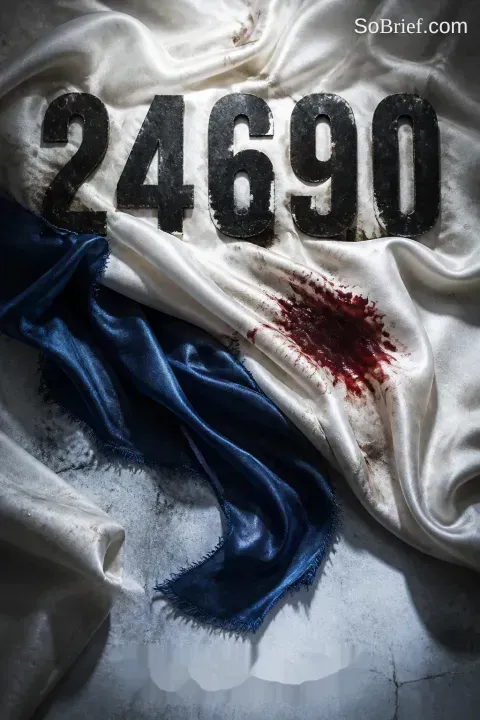
He then strips her of her slave name, renumbers her as 24690,1 and sends her to Slave Row. He orders a guard's hand10 cut off as punishment for touching her. Terrified and newly branded, Everleigh1 begins her existence directly under Bram2's threatening observation, her nominal protection now a perilous spotlight.
The murder shatters Everleigh's sheltered life within horror, placing her in the crosshairs of the story's central power struggle. Bram's lethal intervention and the amputation serve as a proclamation: she is his investment, and any violation is an attack on his property. The scene initiates the central theme of protection through possession, where safety is indistinguishable from bondage.
A Kiss Without Apology
While escorting her to Medical, Bram2 reveals that her master9 had her kidnapped at age ten and her parents murdered, and that he himself stopped the rapes after her suicide attempt. Overwhelmed by the disclosure, Everleigh1 kisses him. He recoils, ordering her never to repeat it, but she refuses to apologize.
His anger melts into confusion, and for a moment the fearsome Main Master2 appears lost. The kiss cracks their master-slave dynamic, exposing a mutual attraction that terrifies Bram2 as much as it empowers her. From this point, Everleigh1 glimpses a fragile leverage over the man2 who controls her fate.
The kiss is a reversal of power through intimacy. Everleigh weaponizes gratitude into a challenge, testing the boundaries of Bram's cruelty. His unmasked reaction reveals a vulnerability he has suppressed for years. This moment plants the seed of Everleigh's eventual strategy: to survive, she must learn to manipulate the emotions of those who own her.
Ruined for Any Other Master
Unable to resist, Bram2 brings Everleigh1 to his bed repeatedly. Their sex mixes choking, slapping, and surprising tenderness. He tells her he will ruin her for whoever buys her, and she responds with growing boldness, even mounting him when permitted. She spends a night in his arms, feeling protected and loved.
By morning, however, he reverts to coldness, insisting she will go to his friend West Harper.3 Feeling betrayed, Everleigh1 declares she will never kneel to another master. She takes a scalpel and cuts her own chest to show she can accept his darkness, but he leaves her weeping, calling himself a coward.
The affair is a crucible where abuse and affection fuse. Everleigh's orgasmic response to violence is a survival adaptation, but also a genuine bond. Bram's retreat is a twisted form of care: he believes proximity will lead to her death at his hands. Her self-mutilation is a desperate bid to prove she can survive him, a foreshadowing of the lengths she will go to reclaim agency.
Fifty Million for a Name
At the auction, Everleigh,1 sedated and displayed like merchandise, endures dozens of masters groping her body. Bidding rises into the tens of millions. When it becomes clear the masters are battling for the hidden fortune attached to her, she screams a bid of fifty million dollars for her own freedom, using her dead master's inheritance.
Bram2 rules that she may choose her own master instead; she chooses herself, becoming Mistress Davenport.1 She is installed in an apartment near Bram2 and West,3 free in title but still imprisoned. West,3 who planned to win her, is enraged. Her public victory isolates her further among the resentful masters.
The auction scene literalizes the commodification of women, but Everleigh's self-purchase disrupts the transaction. Her act is a fleeting triumph in a system designed to deny agency. The masters' shock reveals how deeply they rely on the slave's complicity. Her new status as Mistress is an oxymoron: a gilded cage that grants respect but no escape, setting the stage for West's brutal reclamation of control.
Stabbed in the Dark Theater
During a theater excursion meant to ease the tension between them, West3 feigns sudden illness. Bram2 helps him to the restroom, where the disgraced guard Billy,10 still bearing his severed hand's stump, ambushes and stabs Bram2 three times in the chest. West3 stands watching, having orchestrated the attack, then kills Billy10 to erase his involvement.
Everleigh1 sees Bram2 bleeding out, and Lyle,4 the loyal high leader, airlifts him to a secret hospital per Bram2's standing contingency. West3 instantly assumes command, his first act being to hunt Everleigh.1 The mask of friendship falls, and West3's long-suppressed ambition surfaces.
The theater, a space of illusion, is the perfect setting for West's performance. His betrayal weaponizes Bram's compassion, turning a moment of care into a death trap. The stabbing fulfills Bram's fear that love makes him vulnerable, but it also executes West's lifelong envy: he literally takes Bram's place. The secret hospital and Lyle's loyalty introduce the novel's ghost thread: that Bram may yet survive.
The Main Master's Wife
With Bram2 assumed dead, West3 declares himself Main Master3 and takes Everleigh1 as his slave. He drugs and rapes her, then forces her to sign marriage papers transferring her inheritance to him. In Chicago for Bram2's funeral, she touches his casket, whispers her grief, and receives Bram's book of poems from Lyle4 with instructions to read a marked page.
West3 parades her as his wife, purchasing a diamond ring. Back at Whitlock, his sexual violence continues, alternating with needy tenderness that confuses her mind. Everleigh1's psyche begins to fracture, but she starts constructing a long-game plan for survival and revenge.
The marriage is the ultimate act of erasure: West overwrites Bram's name and possession onto Everleigh's body and legal identity. The funeral provides a brief, sacred space for her grief, while the poem book becomes a dormant weapon. West's oscillation between rapist and lover destabilizes Everleigh's identity, forcing her to develop a split self: a compliant wife on the surface, a calculating avenger beneath.
The Skinning of a Friend
West3 takes Everleigh1 to Master Kunken7's quarters. There, Kunken7 has murdered his slave and niece, Julie,6 and hung her body for butchering. West3 orders Everleigh1 to assist. She holds the knife as Kunken7 guides her hands, peeling skin from muscle and helping remove the head. She disassociates entirely, functioning as an automaton while internally she splinters.
The ordeal proves to West3 that she can stomach the fortress's depravity. He praises her, believing she has been hardened into a true consort. For Everleigh,1 the experience extinguishes any remaining naivety and sharpens her resolve to destroy the system that made her complicit in such horror.
Forced cannibalistic butchery of her only friend is the story's moral nadir. Everleigh's dissociation is both a trauma response and a tactical retreat into a mental safe room. West misreads her catatonia as strength, granting her more freedom and trust. The scene demonstrates how systemic violence corrupts victims into perpetrators, leaving Everleigh to wrestle with guilt that will fuel her eventual rampage.
Escape through the Dark Tunnels
Everleigh1 and Eli,5 the guard who helped kill Bram,2 execute a plan to free the fourteen children held in The Cradle. She kills a pedophile guard, then leads the children through disused tunnels to a waiting van. After the van departs, Eli5 thanks her. She promptly stabs him in the back and slits his throat, avenging Bram2 and Lyle4 (whom Eli5 also killed).
She cuts her own shoulder, then staggers back to West,3 claiming Eli5 tried to abduct her and she killed him in self-defense. West3 believes her, impressed by her ferocity. The children are gone; one of Bram2's murderers is dead; Everleigh1's stock with West3 rises.
The escape is a masterful triple-layered move: liberation for the children, revenge for Bram, and strengthened position with West. Her murder of Eli is cold and premeditated, marking her full transformation from victim to executioner. The self-inflicted wound is a sacrificial offering, binding West closer while she positions herself as his most trusted ally. Her moral calculus is now indistinguishable from the fortress's violent logic.
The Mask of a Devoted Wife
In the weeks after Eli5's death, Everleigh1 perfects her role as West3's fierce, loyal wife. She manages his moods, initiates sex, and endures his violence with apparent passion. Her reward is a firearm, a symbol that West3 believes she is his true partner.
When a deranged master threatens West,3 she shoots the man dead without hesitation, publicly affirming her loyalty. Internally, she battles hallucinations of Bram2's ghost and dizzy spells, signs of a fracturing psyche. West,3 who trusts no one, lowers his guard around her, believing he has finally won her love. She has, in fact, been sharpening her weapon.
The gun is a perfect symbol of inverted trust. Everleigh's performance of devotion is so seamless it becomes indistinguishable from reality, even to herself. Her hallucinations of Bram suggest that her love for him is the last thread tethering her to a moral universe. West's need to be loved blinds him to the danger; he has created a monster he can no longer read, setting the stage for his own destruction.
The Desk and the Paperweight
After a period of relative calm, West3 erupts in jealous rage over Everleigh1's request to read Bram's book. He drags her to his library, bends her over the desk, and anally rapes her while she screams. This time, she does not dissociate but fights. When he loosens his grip, she seizes a heavy paperweight and strikes his skull, knocking him unconscious.
She had hidden rope prior; she ties him to the desk. Her revenge has been years in the waiting, and now, with him helpless, she retrieves the tools of his own torture. The library, symbol of his stolen authority, becomes the stage for his reckoning.
The library rape is the final trigger that converts decades of survival instinct into pure action. The paperweight, a mundane object, becomes the pivot from victimhood to agency. Everleigh's preparedness with rope reveals that she has been waiting for this moment all along. The scene inverts the novel's central power dynamic: the master is now the captive, and the slave wields the knife.
Peeling Back the Monster's Face
Everleigh1 gags West3 and systematically tortures him. She stabs his shoulder, inserts scissors into his rectum, and begins to skin his face while narrating his crimes: the murder of Bram,2 the rapes, the forced marriage. In the midst of this butchery, she opens Bram's book of poems and reads a handwritten passage aloud.
The poem speaks of love surviving death, of a heartbeat watching from the shadows, of Bram2 still being there. Guards burst in to find the scene of carnage. The revelation that Bram2 may not be dead hangs in the air as Everleigh1 reads the final lines, and the story ends on a cliffhanger.
The torture scene is a grotesque mirroring of the novel's themes: the victim becomes the perpetrator, using the master's own instruments. Her reading of Bram's poem transforms revenge into a ritual of potential resurrection. The cliffhanger asks whether Everleigh's violence has damned her or redeemed her, and whether Bram's survival offers hope or a deeper entrapment. The poem's heartbeat becomes the sound of the narrative itself, refusing to die.
Analysis
246901 operates as a gothic case study in the destruction and rebirth of identity within a totalitarian system. Whitlock is not merely a setting but a laboratory of extreme power, where the traditional romance plot is inverted: love is possession, protection is predation, and the happy ending is a corpse or a cliffhanger. The novel draws on the traditions of de Sade and contemporary dark romance to explore the erotics of submission and violence, but it refuses to romanticize without cost. Everleigh1's arc from broken slave to avenging torturer is a psychological autopsy of how trauma, when coupled with absolute powerlessness, can produce a perpetrator perfectly mirroring the original oppressor. The story asks whether agency can be reclaimed once it has been stolen, and at what price. Bram2's ambiguous survival introduces a gothic ghost: the possibility that love can endure beyond brutality, but also that it might be yet another form of surveillance and control. The cliffhanger ending leaves the reader suspended in the same uncertainty as Everleigh1 herself, forced to interpret whether the heartbeat in the poem signals hope or another layer of entrapment. The novel ultimately argues that in a world without law, the only escape is to become the law oneself, a transformation that may damn the survivor even as it saves her.
Review Summary
24690 is a dark, disturbing novel that deeply polarizes readers. Many praise its shocking twists, graphic violence, and exploration of human depravity. Critics cite poor editing, implausible plot elements, and excessive gore. The story follows a sex slave in a secret underground facility, entangled with the facility's sadistic masters. Readers warn of extreme content and triggers, noting it pushes boundaries even for dark romance. While some found it addictively thrilling, others felt it went too far or lacked depth. The cliffhanger ending left many eager for the sequel.
People Also Read


Characters
Everleigh Davenport / Slave 24690
Captive turned master's wife and avengerStolen at age ten and enslaved for fourteen years, Everleigh survives through adaptability and intelligence. Her love for Bram2 is the emotional core of her existence; after his murder, she channels grief into a long-term strategy of manipulation and revenge. Initially conditioned to obedience, she learns to leverage her sexuality, her victimhood, and her performance of submission as weapons. Her psyche fractures under prolonged trauma, producing hallucinations and dissociative episodes, but also a cold, calculating persona capable of extreme violence. She is both the novel's moral center and its most terrifying creation, asking whether survival in hell requires becoming a demon.
Bram Whitlock
Main Master of Whitlock, tortured loverHeir to a legacy of depravity, Bram rules Whitlock with absolute authority but is warped by his love for Everleigh1. He has protected her from afar for years, yet fears his innate sadism will destroy her. His public persona is that of a ruthless master; in private, he writes dark poetry and yearns for connection. His contradictory actions (killing for her, then pushing her away) stem from a belief that love is a fatal weakness. His contingency planning hints that he knows he is a target. His possible survival after the stabbing becomes the story's ghostly hope.
West Harper
Envious best friend turned usurperRaised alongside Bram2 but always in his shadow, West nurses a deep envy that curdles into hatred. He orchestrates Bram2's murder to claim Everleigh1 and Whitlock for himself. Beneath a veneer of charm, he is a sadist who rapes and brutalizes Everleigh1 under the guise of love. His need for validation makes him susceptible to her manipulation; he longs to be the man Bram2 was, but his cruelty is erratic and insecure. His relationship with Everleigh1 cycles between violent possession and desperate affection, revealing a man who destroys what he covets because he cannot believe he deserves it.
Lyle
Loyal high leader and protectorThe chief guard, fiercely loyal to Bram2. He follows Bram2's secret instructions after the stabbing: he airlifts him to a hidden hospital, protects Everleigh1, and delivers the crucial book of poems. He represents the last vestige of honor and order in Whitlock. His death at Eli5's hands deepens Everleigh1's resolve for revenge, and his final words to her (hope, stay strong) echo throughout her journey.
Eli
Guard turned co-conspiratorA former pro football player turned Whitlock guard, Eli becomes West3's ally and helps arrange Bram2's murder. Despite his criminality, he draws the line at harming children, which Everleigh1 exploits. He assists her in freeing the children from The Cradle, not knowing she is aware of his role in Bram2's death. She kills him as an act of vengeance, making him a sacrificial piece in her long game.
Julie (Slave 26975)
Naive cellmate and tragic victimA young redhead brought to Whitlock, she shares a cell with Everleigh1 and clings to her for guidance. She is purchased by her uncle, Master Kunken7, who later kills and butchers her. Her death, and Everleigh1's forced participation in the skinning, serve as the ultimate loss of innocence. She symbolizes the complete vulnerability of the enslaved and the absence of hope.
Master Kunken
Cannibalistic main masterA politically connected member of Whitlock's ruling council, Kunken eats his slaves. He buys his own niece, Julie6, only to slaughter and prepare her as a meal. He forces Everleigh1 to assist in the butchering, an act that crystallizes her realization that the masters are irredeemable. His domestic approach to atrocity illustrates how routine evil has become.
Dr. Cortez
Compassionate surgeon turned slaveA talented surgeon kidnapped to serve Whitlock. She secretly gives Everleigh1 a scalpel for protection and is caught. West3 has her raped and demoted to a slave; she dies shortly after. Her fate proves that any display of mercy inside Whitlock is fatal, and her scalpel becomes a symbolic tool that Everleigh1 later uses to carve her own path.
Master Vicolette
Everleigh's original predatory masterThe man who had Everleigh1 kidnapped at ten and her parents murdered. He was both cruel and doting, representing the twisted father figure. His murder opens the story, and his hidden inheritance becomes the financial lever that allows Everleigh1 to briefly escape slavery. His legacy is the fortune that everyone fights over.
Billy
Disgraced guard turned assassinA blond guard whose hand Bram2 amputates for participating in Everleigh1's rape. Consumed by revenge, he becomes West3's pawn, stabbing Bram2 in the theater restroom. He is immediately killed by West3 to eliminate the witness. His arc demonstrates the circular violence of Whitlock: punishment breeds retaliation, which breeds more death.
Plot Devices
Whitlock Fortress
Underground prison and societyA vast subterranean complex built inside a mountain in Wyoming, Whitlock houses luxurious apartments, slave rows, an auction theater, torture chambers, and a city center. It operates as a separate world where wealthy men can indulge any depravity without legal consequence. The all-white corridors and stone walls create a claustrophobic atmosphere that warps everyone inside. The fortress is a character in itself: its rules, its history, and its architecture shape the power dynamics. Escape is considered impossible, making survival the only currency.
Bram's Book of Poems
Encrypted message from the dead (or not)A black leather volume containing Bram2's handwritten poetry, which Lyle4 gives to Everleigh1 at the funeral with instructions to read a marked page. The book serves as a tangible link to Bram2's inner life and, crucially, holds a handwritten poem suggesting he survived the stabbing and is watching over her. In the climax, Everleigh1 reads the poem aloud while torturing West3, transforming the book from a memento into a revelation that recontextualizes the entire story.
The Auction and the Blue Scarf
Mechanism of commodification and displayThe public auction is where slaves are sold to the highest bidder after being paraded, oiled, and groped. The blue scarf designates non-virgins, marking them as less valuable. The oil used on slaves contains a drug that renders them compliant and aroused, stripping them of consent. Everleigh1's self-purchase at the auction disrupts this entire system, using the masters' own financial logic against them. The auction becomes the site of her first major act of defiance.
The Inheritance
Financial lever and object of theftMaster Vicolette9 left Everleigh1 a hidden fortune, which she learns about at the auction. She uses fifty million of it to buy her freedom, becoming a Mistress. West3 later forces her to sign a marriage contract that transfers control of the money to him, believing he has secured both her body and her wealth. The inheritance is a symbol of her lost identity as Everleigh Davenport1, heiress, and her struggle to reclaim it mirrors her fight for personhood.
The Children of The Cradle
Moral stakes and hope for redemptionFourteen children, taken as infants or young children, are held in a nursery called The Cradle. Bram2's reforms had kept them off-limits, but West3 plans to auction them. Everleigh1's determination to free them becomes her redemptive mission. Their successful escape via a van through secret tunnels is one of the few victories in the novel, and it serves as a test for Everleigh1's humanity. Their fate provides a counterweight to the relentless darkness, suggesting that even within hell, some innocence can be saved.
Download PDF
Download EPUB
.epub digital book format is ideal for reading ebooks on phones, tablets, and e-readers.








































