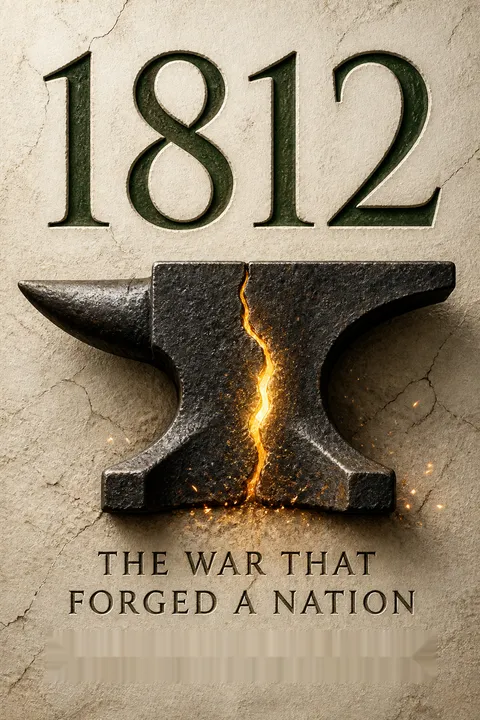
Key Takeaways
1. The War's True Purpose: Forging a Nation
In the retrospect of two centuries of American history, however, the War of 1812 stands out as the coming of age of a nation.
Beyond grievances. The War of 1812, often seen as a conflict over impressment and trade, was fundamentally about the United States asserting its identity and sovereignty on the world stage. Despite initial reluctance and internal divisions, the war forced the young republic to confront its vulnerabilities and define its place among global powers. It was a crucible that tested the very idea of a unified American nation.
Testing the Union. The early American union was tenuous, with intense regional loyalties and even whispers of secession, as exemplified by Aaron Burr's conspiracy to carve out a western empire. The war, initially dreaded by many, became an unexpected catalyst for national cohesion, pushing disparate states and factions towards a shared sense of purpose. This internal struggle for unity was as significant as the external conflict with Great Britain.
A new identity. By its conclusion, the war transformed the perception of the United States from a collection of loosely joined states to a singular, unified nation. This newfound national identity, forged through shared sacrifice and unexpected victories, laid the groundwork for future westward expansion and a more confident stance in international affairs. The war, with all its "vicissitudes," ultimately illustrated America's capacity and destiny as a powerful nation.
2. Early Land Campaigns: A Series of Disasters
On land, the American campaigns of 1812 had been unmitigated disasters.
Poor leadership. The initial American land campaigns were plagued by incompetent leadership, disorganization, and a lack of coordination. Generals like William Hull at Detroit and Henry Dearborn on the Niagara and Montreal fronts proved timid and ineffective, leading to humiliating defeats and surrenders. This starkly contrasted with the bold rhetoric of "war hawks" like Henry Clay, who boasted of easily conquering Canada.
Militia failures. A significant problem was the reliance on state militias, many of whom refused to fight outside their home states or lacked the discipline of regular troops.
- Hull's Ohio militiamen refused to cross into Canada.
- New York militia under Van Rensselaer refused to reinforce Winfield Scott at Queenston Heights.
- Dearborn's Montreal assault stalled when militia wouldn't cross the border.
This provincialism severely hampered offensive operations and exposed the fragility of national military command.
Strategic blunders. The three-pronged invasion of Canada in 1812, though theoretically sound, was executed disastrously. The loss of Detroit, the surrender of Mackinac Island, and the massacre at Fort Dearborn left the entire Northwest frontier vulnerable. These early failures underscored America's military unpreparedness and the deep chasm between ambitious political rhetoric and battlefield reality.
3. Naval Triumphs: A Beacon of National Pride
Never before, in the history of the world, did an English frigate strike to an American.
Unexpected victories. While land campaigns faltered, the small American navy delivered a series of stunning victories that electrified the nation and boosted morale. The USS Constitution, nicknamed "Old Ironsides," became an icon after defeating HMS Guerrière and HMS Java. These single-ship engagements, though not strategically decisive, had immense psychological impact.
Skilled captains. American captains like Isaac Hull, Stephen Decatur, and William Bainbridge proved adept at naval tactics and gunnery, often outmaneuvering and outgunning their British counterparts.
- Hull's escape from a British squadron off New York.
- Decatur's capture of HMS Macedonian, the only British frigate brought into an American harbor as a prize.
- Bainbridge's destruction of HMS Java.
These triumphs challenged British naval supremacy and instilled a new sense of pride in the young American fleet.
Shifting perceptions. The naval successes, particularly the Constitution's, helped galvanize public opinion, especially in the trade-oriented New England states that had initially opposed "Mr. Madison's War." They provided a much-needed counterpoint to the land defeats and contributed to Madison's re-election, demonstrating the power of military success to unite a divided populace.
4. The Great Lakes: A Pivotal Strategic Theater
The loss of the fleet is a most calamitous circumstance.
Control is key. The Great Lakes, particularly Erie and Ontario, proved to be the strategic lifeline for Canada and a critical battleground for the war. Both American and British commanders recognized that naval superiority on these lakes was a "sine qua non of success" for any land operations along the frontier. This led to an intense shipbuilding race.
Perry's triumph. Master Commandant Oliver Hazard Perry's victory on Lake Erie in September 1813 was a turning point in the Northwest. Despite challenges in shipbuilding and manning his fleet, Perry's determination and tactical prowess led to the surrender of the entire British squadron. His famous dispatch, "We have met the enemy and they are ours," became a rallying cry.
Enabling land gains. Perry's victory immediately enabled William Henry Harrison to launch a successful offensive, leading to the recapture of Detroit and the decisive Battle of the Thames. Conversely, the British failure to secure Lake Champlain contributed significantly to Sir George Prevost's retreat from Plattsburgh, demonstrating how naval control dictated land campaign outcomes.
5. Indian Resistance: A Dream Crushed by Expansion
The war on the Wabash is purely British.
British instigation. American expansion into the Northwest Territory fueled constant conflict with Native American tribes, who were often supplied and encouraged by the British in Canada. This perceived British instigation of Indian unrest was a major grievance for western Americans and a key driver for the "war hawks" desire to conquer Canada.
Tecumseh's vision. The Shawnee chief Tecumseh emerged as a powerful leader, advocating for a unified Indian confederacy to halt white encroachment. His alliance with the British, particularly after William Henry Harrison's victory at Tippecanoe, made him a formidable foe. Tecumseh's dream, however, was ultimately tied to British fortunes.
Decisive defeats. The Battle of the Thames in October 1813, where Tecumseh was killed, effectively shattered the dream of an Indian confederacy in the Northwest. Similarly, Andrew Jackson's brutal campaign against the Creek Nation, culminating in the Battle of Horseshoe Bend, crushed Native American power in the South. These conflicts irrevocably cleared the path for American westward expansion, regardless of treaty stipulations.
6. New England's Dissent: A Threat to Unity
New Englanders did not take kindly to or go out of their way to support what they called “Mr. Madison’s war.”
Economic grievances. New England, heavily reliant on maritime trade, vehemently opposed the war, viewing it as detrimental to their economic interests. Jefferson's embargoes and the subsequent British blockade crippled their commerce, leading to widespread discontent and accusations that the war was being waged for western territorial gains rather than maritime rights.
Political opposition. Federalist-controlled New England states openly defied federal war efforts, refusing to provide militia for service outside their borders and even engaging in trade with the enemy. The John Henry affair, though a fabrication, highlighted Madison's paranoia about a British plot to encourage New England secession, reflecting the deep political chasm.
Hartford Convention. The culmination of this dissent was the Hartford Convention in December 1814, where delegates debated states' rights, nullification, and proposed constitutional amendments aimed at curbing southern and western influence. While moderates prevented an outright call for secession, the convention's secrecy and timing, coinciding with the end of the war, permanently tainted the Federalist Party with the stigma of disloyalty, leading to its eventual demise.
7. Washington's Burning: A Humiliating Retribution
The world was astonished to see a handful of seven or eight thousand Englishmen making their appearance in the midst of a state embracing ten millions of people, taking possession of its capital, and destroying all the public buildings—results unparalleled in history.
British vengeance. After Napoleon's defeat, Great Britain turned its full attention to America, seeking retribution for perceived American outrages, particularly the burning of York (Upper Canada's capital). Admiral Alexander Cochrane ordered his forces to "destroy and lay waste" coastal towns, leading to a campaign of escalating reprisals.
Capital's vulnerability. Washington D.C. was shockingly unprepared for attack, largely due to Secretary of War John Armstrong's ambivalence and General William Winder's ineffective command. Despite warnings, no serious defensive measures were taken, and the British advance from Benedict on the Patuxent River met little resistance.
The "Bladensburg Races". The Battle of Bladensburg on August 24, 1814, was a humiliating rout of American militia, allowing British forces under Major General Robert Ross and Admiral George Cockburn to march unopposed into the capital. They proceeded to burn the Capitol, the President's House, the Treasury, and other public buildings, a symbolic act of destruction that shocked the nation and the world.
8. Baltimore's Stand: A Symbol of Defiance
Fort McHenry had held.
A different response. Unlike Washington, Baltimore was prepared. Its citizens, led by Major General Samuel Smith, had actively fortified the city, digging earthworks and assembling a large militia force. This proactive defense, contrasting sharply with Washington's disarray, demonstrated a fierce determination to resist the British.
Ross's demise. The British land advance on Baltimore was met with stiff resistance at North Point, where Major General Robert Ross, the victor of Washington, was killed by an American sharpshooter. This loss demoralized the British land forces and slowed their progress, preventing a swift capture of the city.
Fort McHenry's resilience. The naval bombardment of Fort McHenry, the key to Baltimore's harbor, lasted for 25 hours but failed to break the fort's defenses. Major George Armistead's garrison, despite being outranged by British mortars, held firm. The sight of the massive American flag still flying at dawn inspired Francis Scott Key to pen "The Star-Spangled Banner," which became a powerful symbol of national defiance and resilience.
9. New Orleans: A Decisive, Post-Treaty Victory
We have met the enemy and they are ours: Two Ships, two Brigs, one Schooner, and one Sloop.
Jackson's leadership. Andrew Jackson, "Old Hickory," emerged as a national hero through his decisive victory at the Battle of New Orleans. Despite initial British secrecy leaks and his own strategic dilemmas, Jackson rallied a diverse force of regulars, militia, free men of color, and even pirates like Jean Lafitte, to defend the city. His leadership transformed a motley crew into a formidable fighting force.
Strategic defense. Jackson's defensive line along the Rodriguez Canal, fortified with earthworks and cotton bales, proved impenetrable to the British. His tactical brilliance, combined with the devastating accuracy of American artillery and riflemen, inflicted catastrophic casualties on the advancing British columns. The British, under Sir Edward Pakenham, underestimated the American resolve and the strength of their positions.
A post-treaty triumph. The Battle of New Orleans, fought on January 8, 1815, occurred two weeks after the Treaty of Ghent had been signed, but before news of peace reached America. This decisive victory, where British losses vastly outnumbered American casualties, cemented Jackson's legendary status and provided a powerful, unifying narrative for a nation weary of war. It was a psychological triumph that resonated deeply with the American public.
10. The Treaty of Ghent: A Return to Status Quo
The war has renewed and reinstated the national feelings and character which the Revolution had given, and which were daily lessened.
Negotiating under pressure. The American peace commission, a distinguished group including John Quincy Adams, Albert Gallatin, and Henry Clay, faced immense pressure. Initially, the British, buoyed by Napoleon's defeat, made expansive demands, including an Indian buffer state and territorial concessions. However, American resilience on the battlefield and Wellington's pragmatic advice led to a more favorable outcome.
Status ante bellum. The Treaty of Ghent, signed on Christmas Eve 1814, essentially restored the pre-war status quo. It made no mention of impressment, the initial casus belli, nor did it grant any territorial gains to either side. Boundaries were to be resolved by future commissions, and Indian rights were vaguely addressed.
A sigh of relief. Despite the lack of clear gains, the treaty was met with widespread relief in the United States. The war, which had crippled the economy and exposed national vulnerabilities, was finally over. The prompt ratification by the U.S. Senate, a unanimous 35-0 vote, underscored the nation's eagerness for peace and stability.
11. A Singular Nation: United by Conflict
The people now have more general objects of attachment with which their pride and political opinions are connected. They are more Americans; they feel and act more as a nation; and I hope that the permanency of the Union is thereby secured.
End of an era. The War of 1812 marked the end of the Federalist Party, discredited by its opposition to the war and the Hartford Convention. This paved the way for the "Era of Good Feelings" under James Monroe, characterized by a period of national unity and reduced partisan strife. The war had effectively purged the nation of its lingering colonial adolescence.
National identity solidified. The shared experience of war, despite its difficulties, fostered a stronger sense of national identity. Victories like Lake Erie and New Orleans, and even the defiant stand at Baltimore, became touchstones of American pride. The plural "United States" gradually gave way to the singular, reflecting a deeper sense of unity.
Global recognition. The war, though militarily inconclusive in terms of territorial gains, earned the United States newfound respect on the international stage. The Monroe Doctrine, articulated just a decade later, demonstrated a confident American stance against European intervention in the Western Hemisphere, a direct outgrowth of the nation's coming-of-age during the War of 1812.
Review Summary
1812: The War That Forged a Nation by Walter R. Borneman receives mostly positive reviews (3.91/5) for its accessible, reader-friendly narrative of America's "Forgotten War." Readers appreciate the book's concise 304-page format, smooth writing style, and coverage of naval battles, the Canadian front, and key figures like Andrew Jackson. However, critics note the weak development of its central thesis—that the war forged national unity—with some calling it contradictory given the regional divisions evident throughout. Several reviewers mention superficial analysis and colloquial writing, though most recommend it as a solid introductory overview.
People Also Read

Download PDF
Download EPUB
.epub digital book format is ideal for reading ebooks on phones, tablets, and e-readers.








































