

Key Takeaways
Chasing 10x forces simplicity; chasing 2x traps you in exhausting grind
The counterintuitive core thesis. Most people reach for incremental gains: a promotion, a little more revenue, a new personal best. Sullivan and Hardy call this the 2x mindset, doubling output by doubling effort, working harder and longer along the path you already walk. It feels safe but it is soul-draining. A 10x goal (aiming to multiply results tenfold) is so audacious that brute force cannot reach it, which forces you to abandon your current approach entirely.
Decision expert Alan Barnard illustrates it: ask how to grow profits 10% and there are infinite mediocre paths. Ask how to grow them 10x and only a few strategies could possibly work. The impossible goal becomes a filter that reveals the signal and discards the noise. Fewer viable paths mean less confusion, not more.
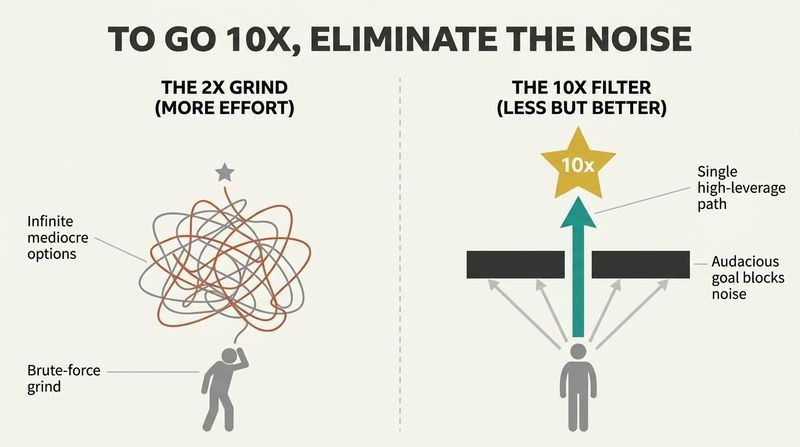
What's striking is how this inverts the intuition that bigger goals demand bigger sacrifice. The mechanism resembles constraint theory and satisficing research: too many options paralyze, while tight constraints channel creativity. Astro Teller of Google X made the same argument about moonshots being cheaper than 10% improvements because they bypass the smartness arms race. The claim deserves nuance, though. Survivorship bias lurks here; the authors profile people who achieved 10x, not the many who bet everything on an impossible goal and lost. The framework works best for those with slack to absorb failure, a caveat worth holding alongside the inspiration.
Every leap forward means keeping 20 percent and releasing 80 percent
The operating mechanism of transformation. Applying the Pareto principle ruthlessly, the authors argue that roughly 20 percent of your clients, activities, and relationships produce 80 percent of your results and joy. Going 2x lets you keep the comfortable 80 percent and tweak the edges. Going 10x requires cutting that 80 percent loose entirely and pouring everything into the vital 20 percent.
Carson Holmquist ran a freight company where routine clients were 95 percent of business but a race to the bottom on price. His high-stakes clients were 5 percent of clients yet 15 percent of profit. He stopped chasing routine work entirely. In under three years, with the same 40 employees, revenue grew from 22 to 36 million dollars and profit quadrupled. Less, but better.
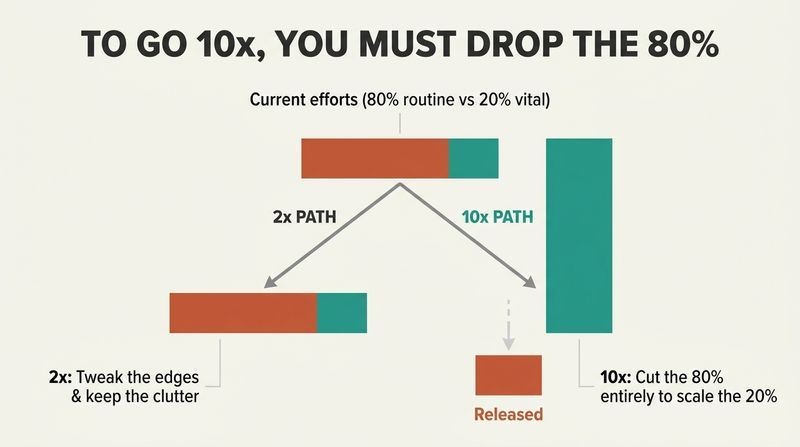
The 80/20 idea is well-trodden since Richard Koch popularized it, but the authors add a sharp wrinkle: only a big enough goal makes the split visible. With modest ambitions you never need to distinguish the vital few from the trivial many. This echoes Jim Collins on good being the enemy of great, and Greg McKeown's essentialism. The hard part is emotional, not analytical. Cutting 95 percent of your customer base triggers loss aversion so acute that most founders cannot do it, which is precisely why the returns exist for those who can stomach the discomfort.
Raise your minimum standard and become the person who meets it
Standards, not goals, reshape identity. Fresh from college, Chad Willardson declared he would only take wealth-management clients with 100,000 dollars to invest, an amount his manager called impossible for a young unknown. He held the line, endured six months of pure rejection, then landed a 600,000 dollar client. He kept raising his floor: 250,000, then a million, then higher, until he was managing over a billion for eight- and nine-figure entrepreneurs.
The authors define identity as the story you tell yourself plus the standards you commit to. Elevating a standard runs through Sullivan's 4 C's: Commitment comes first, then Courage to act without capability, which builds Capability through trial, which finally yields Confidence. Nothing happens until you commit; the skill follows the stand you take.
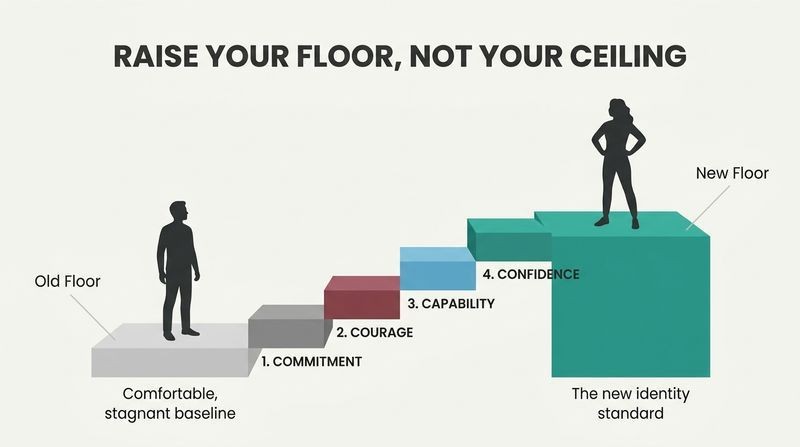
This lands squarely in the identity-based habit literature that James Clear popularized, but flips the emphasis toward the frightening front end. Behavioral economics explains the resistance: loss aversion, the endowment effect (overvaluing what you already have), and the consistency principle all conspire to keep people anchored to old standards. The 4 C's sequence is essentially a self-efficacy loop, which Albert Bandura showed is built by mastery experiences. One caution: raising a fee or standard only works when genuine value backs it. Standards without capability development becomes arrogance, and the market corrects it fast.
A 10-20% better product can capture 4-10x the reward
Quality is exponential, not linear. YouTuber Jimmy Donaldson, known as MrBeast, explained his method plainly: getting people to click 10 percent more and watch 10 percent longer does not yield 10 percent more views, it yields roughly four times the views. So he pours triple the effort into one video rather than spreading it across many. His three ingredients: think exponentially, obsess over quality over quantity, and build a team so specialists own the work you are mediocre at.
The authors argue results scale nonlinearly with quality. Seth Godin notes the number-one player often earns ten times the number-ten player and a hundred times number 100. You need not be 10x better than everyone; being 10-20% better and genuinely different can produce 10x outcomes.
The exponential-reward claim maps onto power-law distributions that dominate creative and networked markets, from app stores to book sales, where winners take almost everything. The authors take a useful swipe at Gladwell's 10,000-hour rule, siding with Naval Ravikant that it is 10,000 iterations, not hours, that matter; deliberate practice research by Anders Ericsson agrees that mindless repetition plateaus. The weak spot is attribution. MrBeast's success also rode platform algorithms, timing, and a tolerance for enormous upfront capital risk. Quality was necessary but the multiplier came from a system that rewards virality, which not every field offers.
Stop justifying needs; build the life you actually want
Wanting is abundance, needing is scarcity. On a single day in 1978 Sullivan went bankrupt and got divorced. He resolved to write down what he wanted every day, and did so for 25 years. The distinction he drew: needs must be justified because they compete for scarce resources, but wants require no justification because creativity generates new wealth without taking from anyone. Paul Graham's insight anchors this: wealth (things people actually want) is created and infinite, while money is merely a token for moving it. Restoring an old car creates wealth without making anyone poorer.
Coinbase CEO Brian Armstrong modeled want-driven courage when he offered severance to employees who disagreed with keeping the company mission-focused rather than politically activist. Five percent left, and he called it one of the best decisions he ever made.
The want-versus-need framing rhymes with Self-Determination Theory, where intrinsically motivated pursuits sustain energy far longer than externally pressured ones. Erich Fromm's distinction between freedom from and freedom to, which the authors cite, adds philosophical depth. The abundance claim is largely sound in knowledge and creative economies where value is genuinely generative. It strains, however, against genuinely rivalrous goods like land, attention, and time, where one person's gain can be another's loss. The framing also risks giving cover to unchecked acquisitiveness; the authors partly guard against this by tying wanting to unique contribution rather than mere consumption.
Master your Unique Ability, the value only you can create
Find the work that is play for you. Unique Ability is Sullivan's term for the handful of activities where you have superior skill, feel intrinsically energized, and see endless room to improve. It is not just what you do but the singular way you do it. Skateboarder Paul Rodriguez walked away from a Nike deal because it lacked the signature shoe he wanted, then earned ten of them, joining Kobe, Jordan, and LeBron in a rare club. His edge was uniqueness, not mere competence.
The authors distinguish expertise (doing something well) from mastery (doing something uniquely well, in a way no one can replicate). Peter Drucker refused to be called creative, saying his productivity came from a very big wastebasket for anything outside the work he was built to do.
Unique Ability overlaps with the Japanese concept of ikigai and with Cal Newport's argument that rare and valuable skills, not passion alone, produce fulfilling work. Robert Greene's Mastery, quoted heavily here, grounds it in the idea of an inborn inclination that must still be developed through thousands of hours. The tension worth flagging: the book insists Unique Ability comes easier to you than to others, yet also that developing it is the hardest thing you will do. Both are true but the framing can seduce readers into thinking ease signals their calling, when early difficulty is often just the cost of the climb.
Measure backward against where you started, never against the horizon
The Gap versus the Gain. When Sullivan asked an entrepreneur about his progress, the man insisted nothing good had happened, despite landing new clients, because he measured himself against an ideal of where he should be. That is the Gap: comparing what is against an imagined ideal, which recedes like a desert horizon no matter how far you walk. It corrodes confidence and, in that entrepreneur's case, contributed to divorce and lost ambition.
The Gain is measuring only backward, against who and where you were before. Actor Matthew Perry's memoir shows the Gap as addiction, chasing fame to fill a hole that reopens like Whac-A-Mole. Ideals are useful for direction but toxic as measuring sticks. Research links gratitude and positive emotion (dopamine, not cortisol) to better decisions and performance.
This is arguably the book's most psychologically robust tool. It aligns with research on the hedonic treadmill and with self-referenced versus other-referenced goal orientation, where comparing to your past self predicts persistence and well-being better than comparing to peers or ideals. The reframe of loss (letting go of the 80 percent) as gain is a clever application of prospect theory used in reverse. A fair critique: perpetual backward-measurement could breed complacency in domains where external benchmarks genuinely matter, like competitive markets or safety-critical work. The authors would counter that ideals still set direction; only the scorekeeping changes.
Set impossible goals because they attract the fewest competitors
Ambition is a competition filter. Tim Ferriss observed that most people aim for realistic goals, making the realistic tier the most crowded and paradoxically the hardest. David Schwartz's 1959 research found 50 to 250 times more applicants for lower-paying jobs than for top ones; First Class Avenue is a short, uncrowded street. It is easier to find one client who pays a million than a hundred who pay ten thousand, and easier to manage one ten-million-dollar property than twenty half-million ones.
Jim Carrey embodied specificity: broke in the late 1980s, he wrote himself a 10 million dollar check for acting services, dated it five years out, and carried it in his wallet. Just before that Thanksgiving he was paid exactly that for Dumb and Dumber.
The counterintuitive claim that big goals face less competition is empirically grounded in labor economics and matches venture logic, where contrarian bets avoid crowded consensus. It resonates with Peter Thiel's argument that competition destroys profits while monopoly (being radically different) preserves them. The Carrey anecdote is inspiring but should be read as illustration, not method; visualization alone has been shown in some studies to reduce motivation by letting the brain prematurely taste success. What actually drove Carrey was relentless craft development behind the visualization. The check clarified direction; the years of obsessive work cashed it.
Treat time like an entertainer: perform, rehearse, and fully recover
Escape factory time for kairos flow. The 9-to-5 model, the authors argue, descends from 19th-century factories and rewards busyness, not results. They borrow the Greek distinction between chronos (sequential clock time) and kairos (qualitative, opportune, transformative time). Drawing on Sullivan's Entrepreneurial Time System, they split days into three types:
1. Free Days for full rejuvenation and psychological detachment from work
2. Focus Days for high-value performance in your 20 percent
3. Buffer Days for preparation and organization
Sullivan's wife Babs blocks 180 Free Days per year on his calendar first, as non-negotiable. LeBron James, a self-described recovery obsessive who sleeps 8-12 hours nightly, has played over 50,000 minutes when most decline after 40,000. Bill Gates famously took solitary Think Weeks to generate Microsoft's biggest breakthroughs.
The chronos-versus-kairos frame gives poetic language to solid findings. Occupational psychology on psychological detachment (led by Sabine Sonnentag) links unplugging to less fatigue, better health, and stronger marriages. Paul Graham's maker-versus-manager schedule explains why fragmented calendars destroy deep work. The stretch is invoking Einstein's relativity as a productivity metaphor; time dilation is a physical phenomenon at relativistic speeds, not a description of subjective flow, so the analogy is evocative rather than literal. Still, the practical core, that recovery is a performance input rather than a reward for performance, is exactly what elite sports science now treats as gospel.
Build a company that runs without you by teaching self-governance
From micromanager to transformational leader. The authors chart four levels: rugged individualist who does everything, leader who applies Who Not How (getting the right people rather than figuring out every how yourself), owner of a Self-Managing Company where leaders run daily operations, and finally a self-multiplying team where everyone refines their own 20 percent. Garnet Morris's life-insurance firm was stuck until he hired Susan Kichuk as CEO to stabilize, optimize, grow, and transform it, freeing him to innovate. It became Canada's top seller by a factor of ten.
When a legislator asked how Joseph Smith governed 20,000 people in order, he replied that he taught correct principles and let them govern themselves. Transformational Leadership research shows trust in leader and emotional commitment expand what people voluntarily contribute.
The self-managing ideal is well supported by Self-Determination Theory's trio of autonomy, mastery, and relatedness as the engine of intrinsic motivation, and by Stephen M.R. Covey's point that trust is given before it is earned. The authors bravely embrace a risk most management books dodge: if you develop people into irreplaceable masters, they become attractive to competitors and their departure leaves real holes. That honesty is refreshing. The unspoken tension is that a compelling 10x vision is the retention mechanism, which places enormous weight on the founder's continued reinvention. Stop growing, and your best people leave.
You have already gone 10x many times; study your own leaps
Normalize transformation by connecting the dots backward. The authors argue that learning to walk, to read, to drive, and to earn ten times your former income were all 10x jumps, qualitative leaps after which you were a different person. Steve Jobs said you can only connect the dots looking backward, which builds the trust to follow your gut forward. Hardy maps his own leaps: a church mission, admission to a competitive university after barely finishing high school, a PhD, and a 220,000 dollar book deal from Hachette, each with its own vital 20 percent and released 80 percent.
The exercise: name five past 10x jumps, define the 20 percent you focused on and the 80 percent you dropped at each, and watch your Unique Ability compound across them.
This reframing tool has real cognitive utility. Recalling past mastery experiences is one of Bandura's core sources of self-efficacy, and narrative identity research by Dan McAdams shows that how people story their past strongly predicts future agency and resilience. Reinterpreting your history as a series of deliberate transformations, rather than luck or circumstance, is a form of adaptive meaning-making. The mild risk is hindsight bias, tidying messy, accidental paths into clean intentional arcs. But even a slightly rosy narrative that increases confidence and clarifies your pattern of growth is arguably more useful than a coldly accurate one that leaves you paralyzed.
Analysis
10x Is Easier Than 2x is a business and personal-development book built on a single deliberately provocative inversion: that aiming tenfold higher is simpler and less exhausting than aiming to merely double. Structurally it pairs Dan Sullivan's five decades of coaching intuition with Benjamin Hardy's organizational-psychology framing, then illustrates each principle through entrepreneur case studies (a freight company, a wealth manager, a real-estate mogul) and cultural exemplars (Michelangelo, MrBeast, Jim Carrey, LeBron James).
The book's genuine contribution is not the 80/20 rule, Pareto is ancient, but the argument that goal size determines whether the vital 20 percent even becomes visible. Small goals hide the difference between signal and noise; only an impossible goal forces the discernment that makes focus possible. This is a real and underappreciated insight about how constraints generate clarity, and it connects the dots between constraint theory, decision science, and essentialism.
The weaknesses are those of the genre. The evidence is a curated gallery of winners, wide open to survivorship bias; we never meet the entrepreneurs who bet everything on 10x and cratered. The psychology citations, while abundant, function more as rhetorical reinforcement than as rigorous grounding, and the Einstein relativity analogy strains credibility as anything but metaphor. The book also assumes a reader with substantial slack and autonomy; a middle manager, as one of Hardy's own friends admits, cannot simply delete 80 percent of a bureaucratic job.
What elevates the work above typical hustle literature is its insistence that 10x is qualitative and internal. Freedom, not money, is the stated endgame, and the Gap-and-Gain tool offers a durable antidote to achievement-driven misery. The prose occasionally lapses into repetition and near-cultish phrasing, but the central reframe is memorable, testable, and genuinely useful for anyone with the freedom to apply it.
Review Summary
10x Is Easier Than 2x receives mixed reviews, with an overall positive rating. Many readers find the core concept of focusing on high-impact activities and delegating the rest valuable, praising its potential to simplify life and increase productivity. Some appreciate the book's motivational aspects and practical advice for entrepreneurs. However, critics argue it's repetitive, lacks depth, and promotes an unrealistic or privileged perspective. Several reviewers note the book's religious and political undertones, which some find off-putting. Despite its flaws, many readers consider it a thought-provoking read for those seeking to improve their business and personal lives.
People Also Read










Glossary
10x vs. 2x
Tenfold leap versus doublingSullivan and Hardy's central framework. 2x means linear growth by doing more of the same with more effort, keeping 80 percent of your current life. 10x means a nonlinear, qualitative transformation that requires releasing 80 percent of your activities, clients, and identity to focus entirely on the vital 20 percent. The authors argue 10x is easier because it forces clarity and eliminates the many exhausting paths of 2x.
Unique Ability
Your irreplaceable core talentA trademarked Strategic Coach term for the small set of activities where you have superior skill, feel intrinsically energized, and see limitless room for improvement. It is not merely what you do but the singular, non-replicable way you do it. Developing and expressing it is framed as your life's central work and the source of both mastery and unique market value.
The Gap and The Gain
Two ways to measure progressThe Gap is measuring yourself against an ideal, an ever-receding horizon that breeds dissatisfaction regardless of achievement. The Gain is measuring backward against where you started, which builds gratitude, confidence, and momentum. The authors tie the Gap to cortisol and stress, the Gain to dopamine and motivation, and argue only the Gain makes pursuing 10x emotionally sustainable.
The 4 C's Formula
Commitment, courage, capability, confidenceSullivan's sequence for elevating standards and identity. You first Commit to a standard beyond your current ability, which demands Courage to act without knowing how, which through trial and error builds new Capability, which finally produces Confidence. The order matters: nothing happens until you commit, and confidence is the last step, not the first.
Who Not How
Find people, not methodsThe principle that instead of figuring out how to accomplish a goal yourself, you find the right person (a Who) who already can and wants to. Hiring capable people to own your 80 percent is framed as an investment that frees you for your Unique Ability, not a cost. Central to building teams that enable 10x growth.
Self-Managing Company
Business running without the founderAn organization where daily operations and management are handled entirely by the team, freeing the entrepreneur to focus on vision, innovation, and their Unique Ability. Achieved by teaching correct principles and granting autonomy rather than micromanaging, so people govern themselves. The authors present it as essential infrastructure for repeated 10x jumps.
Kairos vs. Chronos
Qualitative versus clock timeTwo Greek words for time the authors use to reframe productivity. Chronos is sequential clock time that passes whether or not you engage, associated with busyness. Kairos is qualitative, opportune, deeply present time in which transformation and flow occur. The book argues 10x growth happens in kairos, and that recovery and open blocks of time cultivate it.
Free Days, Focus Days, Buffer Days
Entertainer-style time segmentationSullivan's Entrepreneurial Time System, modeled on performers. Free Days are complete rejuvenation with no work contact. Focus Days are for high-value performance within your 20 percent. Buffer Days are for preparation, organization, and team meetings. Sullivan schedules 180 Free Days per year first, treating recovery as the foundation of sustained high performance rather than a reward.
Fitness Function
What you optimize yourself towardBorrowed from computer and evolutionary science, it means clarifying the specific qualities, standards, and developmental path you are optimizing for. Because whatever you focus on you become, defining your fitness function precisely determines who you turn into. The authors compare it to a plane's heading, where a few degrees off course compounds into arriving somewhere entirely different.
Dream Check
Imagined 10x future paymentA Sullivan visualization tool, exemplified by Jim Carrey writing himself a 10 million dollar check. You imagine being paid roughly ten times your largest prior payment for work that feels like play, then ask what value and Unique Ability you would need to develop so that sum becomes a no-brainer bargain for the payer. It clarifies your next 20 percent focus.
Always Be the Buyer
Negotiate from standards, not desperationSullivan's principle distinguishing Buyers from Sellers. A Buyer has clear self-chosen standards, knows what they want, and can walk away. A Seller is desperate to be accepted and lowers their standards to close a deal. Being the Buyer, illustrated by Paul Rodriguez nearly walking from Nike, enables transformational rather than transactional relationships.
FAQ
What's 10x Is Easier Than 2x about?
- Focus on Exponential Growth: The book argues that aiming for 10x growth is fundamentally easier and more rewarding than striving for 2x growth, as it encourages innovative and non-linear approaches.
- Mindset Shift: It emphasizes a shift from scarcity to abundance, encouraging readers to embrace their unique abilities and desires without needing to justify them.
- Practical Framework: The authors provide a framework for implementing 10x thinking in various aspects of life, including business, relationships, and personal development.
Why should I read 10x Is Easier Than 2x?
- Achieve More with Less: The book offers insights on simplifying focus and eliminating unnecessary tasks to increase productivity and satisfaction.
- Unique Perspective: It challenges conventional wisdom about growth and success, inspiring readers to rethink their goals and strategies.
- Personal Transformation: Readers learn to identify and leverage their unique abilities for greater success, making it relevant for anyone looking to improve their life.
What are the key takeaways of 10x Is Easier Than 2x?
- 10x vs. 2x Mindset: The book distinguishes between radical growth and incremental improvements, crucial for effective goal-setting.
- Unique Ability: Embracing and developing one's specific talents is essential for achieving 10x results.
- The Gain vs. The Gap: Focus on achievements rather than shortcomings to foster a positive and productive mindset.
What is the 10x process described in 10x Is Easier Than 2x?
- Commitment to Growth: Begin with a strong commitment to achieving seemingly impossible goals, essential for overcoming obstacles.
- Courage to Change: Let go of activities that do not contribute to your goals, often involving difficult decisions.
- Continuous Improvement: Emphasize refining your approach and adapting to new challenges for ongoing development.
What is the significance of Unique Ability in 10x Is Easier Than 2x?
- Core of Personal Value: Unique Ability is the specific talents and skills that set individuals apart, crucial for achieving 10x results.
- Focus on Strengths: Concentrate on Unique Ability rather than spreading thin across multiple tasks for greater satisfaction and effectiveness.
- Transformational Relationships: Embracing Unique Ability fosters relationships where all parties thrive, essential for growth and innovation.
How does 10x Is Easier Than 2x define the difference between wanting and needing?
- Abundance vs. Scarcity: Wanting is rooted in abundance, while needing is tied to scarcity, crucial for goal and desire approaches.
- No Justification Required: Wanting something doesn't require justification, allowing for greater creativity and innovation.
- Empowerment through Choice: A wanting mindset empowers individuals to make choices based on true desires, essential for 10x growth.
What are the 4 Freedoms mentioned in 10x Is Easier Than 2x?
- Freedom of Time: Control over time allows for greater flexibility and fulfillment, encouraging goal-aligned activities.
- Freedom of Money: Financial independence enables passion pursuit without constraints, highlighting wealth creation through value.
- Freedom of Relationship: Building meaningful connections with supportive individuals fosters growth and aligns with values.
- Freedom of Purpose: Pursuing unique purpose and passions aligns work with intrinsic desires and values.
What is the Gap and Gain concept in 10x Is Easier Than 2x?
- Measuring Progress: Distinguishes between measuring against ideals (the Gap) and achievements (the Gain), crucial for a positive mindset.
- Focus on Achievements: Appreciating progress and accomplishments leads to greater motivation and satisfaction.
- Encouraging Growth: The Gain perspective encourages continuous growth by recognizing past achievements' value.
What are Free Days, Focus Days, and Buffer Days in 10x Is Easier Than 2x?
- Free Days: Dedicated to recovery and rejuvenation, essential for maintaining high performance and creativity.
- Focus Days: Concentrate on important tasks and projects, engaging deeply with Unique Ability for high-quality results.
- Buffer Days: Used for preparation and organization, ensuring productive and efficient focus days.
What is the Dream Check concept in 10x Is Easier Than 2x?
- Definition of Dream Check: A visualization exercise where individuals write a check to themselves for a future goal amount.
- Clarity and Focus: Provides clarity on financial and personal aspirations, focusing efforts on achieving specific goals.
- Motivation and Accountability: Acts as a motivational tool, reminding individuals of ambitions and holding them accountable.
How can I apply the 10x principles in my life?
- Identify Your Unique Ability: Reflect on what you love and excel at, focusing efforts on these areas for maximum impact.
- Shift to a Gain Mindset: Measure progress based on personal growth rather than external ideals to appreciate achievements.
- Structure Your Time: Implement Free Days, Focus Days, and Buffer Days to balance recovery, productivity, and preparation.
What are the best quotes from 10x Is Easier Than 2x and what do they mean?
- “What got you here won’t get you there.”: Emphasizes the need for continuous growth and adaptation for future achievements.
- “10x is about quality, not quantity.”: Highlights focusing on impactful actions rather than doing more of the same.
- “You can defeat a thousand pounds with four ounces.”: Illustrates the power of leverage and focus in achieving extraordinary results with minimal effort.
About the Author
Other books by Dan Sullivan





Download PDF
Download EPUB
.epub digital book format is ideal for reading ebooks on phones, tablets, and e-readers.








































