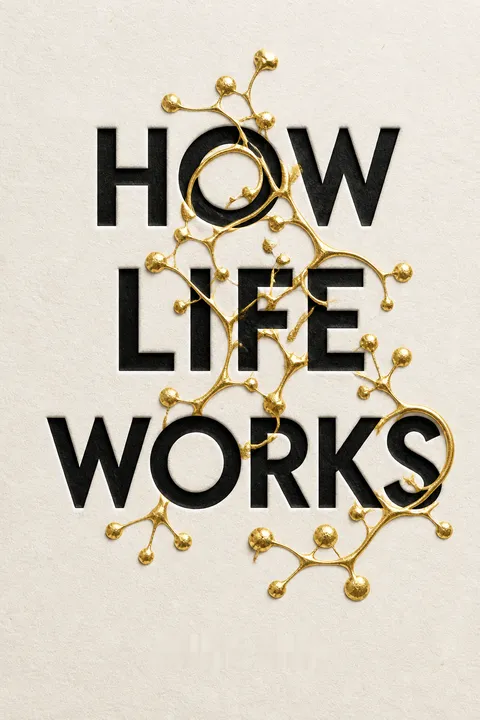

核心要点
1. 生命超越机械隐喻
人类从未制造出能像细胞那样运作的机器。
超越机器。 长期以来,将生命系统比作机器的类比虽有其历史价值,但终究不足以解释生命本质。细胞的运作逻辑根本不同于我们所设计的任何工程系统。这一视角促使我们不再将有机体视为固定功能部件的集合,而是理解为动态、自组织的整体。
分子尺度的差异。 分子世界的物理条件与宏观世界截然不同。粘度、摩擦力和附着力等概念在分子尺度下表现迥异,使得机械隐喻难以适用。这要求我们以全新思维看待生物过程,承认分子领域的独特性质。
拥抱复杂性。 机械隐喻的局限促使我们深入探索生命的真实本质,超越对技术的简单类比。这意味着认识到现有隐喻的不足,发展能够捕捉生命系统涌现性、多样性、适应性和稳健性的全新框架。
2. 基因是仆人,而非主宰
它们是仆人,不是主人。
基因作为资源。 传统将基因视为蓝图或说明书的观点并不准确。基因更应被理解为细胞在复杂自组织系统中利用的资源。这一视角将重点从遗传决定论转向基因与其他细胞成分及环境因素的相互作用。
超越基因控制。 虽然基因在遗传和进化中扮演关键角色,但它们并不具备真正的自主性或决策能力。基因受细胞过程和环境信号的影响,凸显了基因组之外因素在生命塑造中的重要性,挑战了基因作为自私独裁者的观念。
信任过程。 基因依赖于超出其直接控制的过程,使有机体得以生长、繁荣和进化。这种对自组织的“信任”是生物学中的反复主题,尤其体现在多细胞性和认知等复杂系统中,强调了生命体中涌现特性和去中心化控制的重要性。
3. DNA:资源,而非蓝图
本书旨在阐明为何这些隐喻不足,为什么必须替代它们,以及只有这样我们才能真正理解生命的运作。
超越蓝图。 将DNA比作蓝图或说明书具有误导性,因为这暗示了有机体的预定计划。实际上,DNA提供的是一套资源,细胞根据环境信号和内部过程利用这些资源构建自身。这挑战了遗传决定论,强调了环境语境在生命形成中的关键作用。
动态信息。 DNA并非静态的信息库,而是与其他细胞成分互动的动态分子。DNA的包装、转录和翻译受多种因素影响,包括表观遗传修饰和RNA调控。这种动态交互挑战了从DNA到蛋白质的线性信息流观念。
不断演进的理解。 DNA结构的发现开启了遗传时代,但也带来了持续数十年的误导性隐喻。用更细致的视角将DNA视为资源,对于推动我们对生命运作的理解至关重要。
4. RNA:细胞多才多艺的指挥者
这一图景有时显得极其复杂和难解,但最终它将控制的重担从基因组肩上卸下,转而依赖自组织的原则和过程,正因无需严格的基因指导,避免了脆弱性的产生。
超越信使。 RNA不仅是DNA与蛋白质之间的被动中介,而是具有多样调控功能的多才分子。尤其是非编码RNA,在基因表达、细胞分化等关键过程中发挥重要作用。这挑战了RNA仅为简单信使的传统观念,凸显其在生命塑造中的主动角色。
调控网络。 RNA参与复杂的调控网络,控制基因表达、细胞分化等关键过程。这些网络涉及与蛋白质、DNA及其他RNA分子的相互作用,形成动态互联的系统。此观点挑战了DNA到蛋白质的线性信息流,强调反馈回路和涌现特性的意义。
动态景观。 RNA调控功能的发现改变了我们对细胞运作的理解,焦点从静态蓝图转向基因表达的动态景观,RNA成为塑造细胞命运和行为的关键角色。新视角强调了环境语境、灵活性和自组织在生命系统中的重要性。
5. 蛋白质:从机器到动态网络
生命体是意义的创造者。
超越分子机器。 虽然部分蛋白质作为分子机器执行特定任务,但更多蛋白质参与动态交互网络。这些网络包含多重结合、结构无序和变构调节,构建出复杂且适应性强的系统。此观点挑战了蛋白质作为孤立、固定功能实体的简单看法。
结构无序。 许多调控相关蛋白质含有内在无序区,使其能与多种伙伴相互作用并适应不同细胞环境。结构无序非缺陷,而是蛋白质参与复杂网络、响应变化条件的关键特征,挑战了蛋白质功能仅由固定结构决定的观念。
有意义的交互。 蛋白质通过与环境及彼此的相互作用创造意义。这些交互非随机碰撞,而是受化学亲和力、电力等因素引导。由此形成的交互网络构建了动态互联系统,使细胞能响应刺激、做出决策并维持稳态。
6. 细胞:自主决策者
这一生物学新视角尚未完整,仍处于萌芽阶段,但其核心依赖于一种信任。
超越构建模块。 细胞不仅是被动的构建模块,而是具备自主决策、响应刺激和适应环境能力的实体。这一观点挑战了将有机体视为受中央控制的细胞集合的传统,强调细胞间通讯和自组织的重要性。
认知能力。 细胞展现出学习、记忆和解决问题等认知能力,使其能在复杂环境中导航并实现目标。这些能力不限于神经元,而存在于所有细胞类型,表明认知是生命的基本属性。此观点挑战了认知仅限于大脑的传统看法。
集体决策。 细胞命运决策非预先确定,而是通过与邻近细胞及环境信号的互动集体完成。去中心化的决策过程带来稳健性、适应性及复杂模式和结构的涌现,挑战了中央控制命运的观念,凸显发育中的自组织作用。
7. 组织:自组织系统
当生物首次成为多细胞体,能够通过视觉、嗅觉等感官充分感知并利用环境丰富性,其对环境的敏感性和接受性转化为真正的认知,生命似乎逐渐放弃了为每个刺激预设反应的策略,转而提供构建涌现、多样、适应且稳健生活解决方案的基本要素。
超越预编程组装。 组织非简单按预设计划组装的细胞集合,而是由细胞与环境相互作用中涌现的自组织系统。这一观点挑战了组织形成蓝图的观念,强调涌现特性和去中心化控制的重要性。
形态发生场。 组织由形态发生场塑造,即信号分子梯度为细胞提供位置资讯。梯度结合细胞间通讯和机械力,引导细胞分化、迁移和粘附,形成复杂组织结构。此观点挑战了组织形成纯基因驱动的看法,强调物理和化学信号的作用。
再生能力。 某些生物如涡虫展现出组织自我修复和维持形态的惊人能力。再生不仅是替换受损细胞,更是重建定义组织身份的复杂交互和信号通路。此观点挑战了组织结构固定不变的观念,凸显生命系统的动态和适应性。
8. 疾病:生命和谐的破坏
新兴的生命运作观念已促使医学反思——如药物设计方式,以及为何癌症等疾病难以预防或治愈。
超越单一靶点。 传统医学聚焦单一分子或基因靶点,常因忽视生物系统的复杂性和互联性而效果有限。此观点挑战“神奇子弹”理念,强调疾病治疗需更整体、系统化的方法。
疾病的渠道化。 许多疾病虽成因多样,却通过相同生理通路表现。疾病渠道化表明,针对多种疾病的策略可能相似,尤其涉及免疫系统。此观点挑战逐一研究和攻击疾病的传统,强调统一疾病管理方法的潜力。
医学研究再思考。 将生命视为自组织系统的新观念促使医学研究转向。研究焦点从单一疾病转向健康与疾病的基本原理,从靶向特定分子转向调节整体系统。此观点挑战还原论医学,强调更整体、整合的视角。
9. 意义:生命系统的本质
生命体是意义的创造者。
超越物理属性。 仅以复制、新陈代谢或进化等物理属性定义生命不足。生命体的关键特征在于其通过从环境中提取价值来创造意义。此观点挑战纯机械论生命观,强调目的性和目标导向的重要性。
赋予价值。 生命体为环境中的事物如水分、养分和温暖赋予价值。这种价值赋予非感情用事,而是生命系统运作的根本方面。此观点挑战无意义宇宙观,凸显生命内在的目的性。
进化的本质。 生命系统创造意义的能力是进化的产物。自然选择偏好能有效赋值并据此行动的实体。此观点挑战生物学中对目的性的否认,强调进化在形成目标导向中的作用。
读者评价
《生命如何运作》挑战了传统生物学观念,反对将DNA简单比作蓝图的过度简化隐喻。Ball强调了从基因到有机体的生物过程复杂且相互关联的本质。他深入探讨了生命系统中的能动性、目的性与意义等概念。评论者称赞本书视野宏大、发人深省,尽管部分读者认为其内容对非专业人士而言较为晦涩。许多人认可Ball对以基因为中心的生物学批判以及他对最新发现的探讨。总体来看,本书被视为理解生命复杂性的重大贡献,尽管其表达方式评价不一。
其他人还在读





常见问题
What is "How Life Works: A User’s Guide to the New Biology" by Philip Ball about?
- Comprehensive exploration of biology: The book provides a deep dive into modern biology, moving beyond gene-centric and mechanistic metaphors to explain how life operates from molecules to organisms.
- Integration of new scientific advances: Philip Ball synthesizes recent research in genetics, cell biology, evolution, immunology, and synthetic biology to present a unified, updated view of life’s complexity.
- Focus on emergent properties: The narrative emphasizes hierarchical organization, self-organization, and emergent properties, challenging the idea that genes alone dictate biological outcomes.
- Agency and meaning in biology: Ball explores how living systems generate meaning, purpose, and agency, making these concepts central to understanding life.
Why should I read "How Life Works: A User’s Guide to the New Biology" by Philip Ball?
- Clarifies complex biological concepts: The book breaks down intricate topics like gene regulation, protein dynamics, and epigenetics into accessible explanations without oversimplifying.
- Challenges outdated metaphors: Ball critiques traditional views such as the genome as a blueprint, helping readers avoid common misconceptions about genetics and life.
- Relevance to health and technology: The book connects biological principles to practical issues in medicine, biotechnology, and synthetic biology, showing their impact on disease treatment and innovation.
- Prepares for future advances: Readers gain insight into emerging fields and ethical considerations, equipping them for the ongoing biological revolution.
What are the key takeaways from "How Life Works: A User’s Guide to the New Biology" by Philip Ball?
- Genes are not blueprints: Genes provide resources, not deterministic instructions; life’s complexity arises from context-dependent interactions and regulation.
- Life is hierarchical and self-organizing: Biological systems operate across multiple levels, with feedback and emergent properties shaping outcomes.
- Agency and purpose emerge: Living systems exhibit agency, generating meaning and goal-directed behavior through complex, multi-level interactions.
- Networks and environment matter: Biological networks are dynamic and influenced by environmental and epigenetic factors, blurring the line between nature and nurture.
How does Philip Ball in "How Life Works" challenge the traditional genome-as-blueprint metaphor?
- Genome lacks prescriptive plan: Ball argues that the genome is not an instruction book or code; it does not contain a clear, step-by-step plan for building organisms.
- Genes as servants, not masters: Genes do not act independently or possess agency; they are regulated by cellular context and environmental factors.
- Complex regulation beyond DNA: The function of the genome depends on chromatin structure, noncoding RNAs, and epigenetic modifications, requiring new conceptual frameworks.
How does "How Life Works" by Philip Ball explain gene regulation and the role of RNA?
- RNA as a key regulator: RNA molecules, especially noncoding RNAs, play crucial roles in gene expression, chromatin structure, and cellular responses.
- Diverse RNA functions: The book highlights long noncoding RNAs, microRNAs, and other small RNAs that modulate transcription, translation, and epigenetic states.
- RNA enables adaptability: RNA-based regulation allows cells to rapidly adjust gene expression in response to environmental and developmental cues, providing flexibility.
What is the significance of epigenetics in "How Life Works: A User’s Guide to the New Biology" by Philip Ball?
- Epigenetic regulation of genes: Chemical modifications like DNA methylation and histone modification control gene activity without altering DNA sequences.
- Environmental influence and plasticity: Epigenetic marks are shaped by environmental factors, lifestyle, and experiences, contributing to differences even among genetically identical individuals.
- Inheritance and limitations: While some epigenetic changes can be inherited, most are reset in animals, so epigenetics complements but does not replace genetic inheritance.
How does Philip Ball describe proteins and their functions in "How Life Works"?
- Proteins as dynamic entities: Many proteins have intrinsically disordered regions, enabling flexible and promiscuous interactions essential for cellular signaling and regulation.
- Protein folding complexity: The book discusses the challenges of predicting protein structure and function, emphasizing that dynamic conformations often matter more than fixed shapes.
- Modularity and multifunctionality: Proteins often consist of modular domains, allowing for diverse functional variants and supporting evolutionary innovation.
What are biological networks and how are they described in "How Life Works" by Philip Ball?
- Networks over linear pathways: Biological processes involve complex, dynamic networks of interacting genes, proteins, and RNAs, rather than simple cause-and-effect chains.
- Three-dimensional genome organization: Gene regulation depends on chromatin folding and looping, bringing distant genetic elements into contact for coordinated expression.
- Fluid and ephemeral assemblies: Regulatory molecular complexes are dynamic, assembling and disassembling rapidly to allow flexible and robust control.
How does "How Life Works" by Philip Ball explain cell differentiation and the Waddington landscape?
- Epigenetic landscape metaphor: Ball uses Waddington’s model, visualizing cell differentiation as a ball rolling down a landscape of branching valleys, each representing a stable cell fate.
- Stable attractor states: Despite molecular complexity, cells settle into a limited number of stable gene expression states, corresponding to differentiated cell types.
- Role of noise and flexibility: Differentiation is gradual, reversible, and influenced by noise, allowing cells to explore and switch between fates as needed.
What is causal emergence and how does it shape biological systems in "How Life Works" by Philip Ball?
- Higher-level causation: Causal emergence means that primary causes of biological behaviors arise at higher organizational levels, not just from molecular interactions.
- Robustness against noise: Emergent causation helps systems function reliably despite molecular variability, ensuring stable outcomes.
- Evolutionary significance: The shift to higher-level causation was key in the evolution of complex multicellular organisms, promoting adaptability and resilience.
How does Philip Ball address agency, purpose, and meaning in biology in "How Life Works"?
- Agency as a defining feature: Living systems are agents with goals, capable of using meaningful information to manipulate themselves and their environment.
- Information and thermodynamics: Organisms use information to maintain order and evade equilibrium, linking agency to energy efficiency and prediction.
- Beyond genetic determinism: Purpose and meaning arise from higher-level regulatory networks, making life a process of goal-directed, adaptive behavior.
What are the implications of "How Life Works: A User’s Guide to the New Biology" by Philip Ball for medicine, disease, and biotechnology?
- Limits of genetic determinism: Many diseases are polygenic and influenced by complex networks and environmental factors, not just single genes.
- Integrative medical approaches: Effective treatments may target higher-level processes and network dynamics rather than focusing solely on genetic mutations.
- Future of health monitoring: The book envisions personalized medicine using digital twins and real-time data, raising ethical and social challenges for healthcare.
关于作者
下载 PDF
下载 EPUB
.epub digital book format is ideal for reading ebooks on phones, tablets, and e-readers.








































