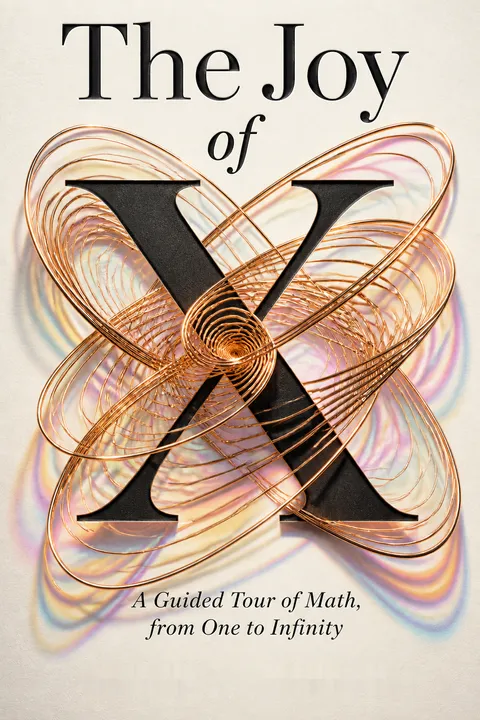

Principais Lições
1. Matemática: A Linguagem dos Padrões e das Relações
Os números são atalhos maravilhosos.
O código da natureza. A matemática é a linguagem universal que descreve padrões e relações no mundo que nos rodeia. Não se trata apenas de aritmética ou de resolver equações, mas de uma forma de pensar que nos permite compreender e prever fenómenos naturais. Desde as espirais num girassol até às órbitas dos planetas, a matemática oferece um quadro para descrever a ordem subjacente em sistemas aparentemente caóticos.
Abstração e aplicação. O poder da matemática reside na sua capacidade de abstrair situações complexas do mundo real em modelos mais simples e manejáveis. Essa abstração permite resolver problemas num domínio e aplicar essas soluções em áreas completamente diferentes. Por exemplo, os mesmos princípios matemáticos usados para descrever o fluxo da água podem ser aplicados para entender padrões de trânsito ou a propagação de doenças.
Conceitos matemáticos essenciais:
- Padrões e relações
- Abstração e modelagem
- Aplicabilidade universal
2. Do Contar ao Infinito: A Evolução dos Números
Os números primos são divisíveis apenas por 1 e por eles próprios.
A expansão dos sistemas numéricos. O conceito de número evoluiu dramaticamente ao longo da história, desde a contagem simples até aos complexos sistemas numéricos que usamos hoje. Essa evolução reflete a nossa crescente compreensão do mundo e a necessidade de descrever conceitos cada vez mais abstratos.
O infinito e o infinitesimal. Um dos desenvolvimentos mais profundos na matemática foi a incorporação do infinito e dos infinitesimais. Conceitos que antes pareciam paradoxais tornaram-se fundamentais para o cálculo e para a compreensão dos processos contínuos. A capacidade de trabalhar com o infinito permitiu aos matemáticos resolver problemas que antes se julgavam impossíveis.
Evolução dos sistemas numéricos:
- Números naturais (contagem)
- Números inteiros (incluindo negativos)
- Números racionais (frações)
- Números irracionais (ex.: π, √2)
- Números reais
- Números complexos
3. Álgebra: Resolver para X e Trabalhar com Fórmulas
Uma página é boa na medida em que páginas boas nela se ligam.
A linguagem das relações. A álgebra oferece um conjunto poderoso de ferramentas para descrever relações entre quantidades. Ao usar variáveis e equações, podemos expressar ideias complexas de forma concisa e manipulável. Essa abstração permite resolver problemas que seriam intratáveis apenas com aritmética.
Do antigo ao moderno. O pensamento algébrico evoluiu desde a resolução de problemas simples até sustentar tecnologias modernas. Os mesmos princípios que permitiram aos matemáticos antigos calcular heranças formam hoje a base de algoritmos que alimentam motores de busca e sistemas de recomendação.
Conceitos algébricos essenciais:
- Variáveis e equações
- Funções e relações
- Resolver incógnitas
- Modelar problemas do mundo real
4. Geometria: Lógica, Intuição e a Natureza do Espaço
A topologia destaca as propriedades mais profundas de uma forma — aquelas que permanecem inalteradas após uma distorção contínua.
Unindo intuição e lógica. A geometria oferece uma combinação única de intuição visual e lógica rigorosa. Permite-nos raciocinar sobre espaço e forma de maneiras intelectualmente satisfatórias e praticamente úteis. Do teorema de Pitágoras às geometrias não euclidianas, o pensamento geométrico influenciou profundamente a nossa compreensão do mundo físico.
Para além do plano. A geometria moderna vai muito além do estudo das formas num plano. A topologia, por exemplo, explora propriedades que permanecem invariantes sob deformações contínuas, levando a insights em áreas tão diversas como análise de dados e física teórica.
Conceitos e aplicações geométricas:
- Geometria euclidiana: linhas, ângulos, formas
- Geometrias não euclidianas: espaços curvos
- Topologia: propriedades invariantes sob deformação
- Aplicações: arquitetura, gráficos computacionais, cosmologia
5. Cálculo: A Matemática da Mudança e do Movimento
O cálculo é a matemática da mudança.
A linguagem da física. O cálculo fornece o quadro matemático para descrever mudança e movimento. Permite analisar e prever sistemas dinâmicos, desde a órbita dos planetas até à propagação de epidemias. Os conceitos fundamentais de derivadas e integrais são ferramentas poderosas para entender taxas de variação e acumulação.
O infinito domado. No seu cerne, o cálculo lida com processos envolvendo quantidades infinitamente pequenas ou somas infinitas. Ao desenvolver métodos rigorosos para trabalhar com esses conceitos, os matemáticos conseguiram resolver problemas que intrigaram pensadores durante séculos. Essa "domesticação" do infinito teve implicações profundas em ciência e engenharia.
Conceitos-chave do cálculo:
- Derivadas: taxas de variação
- Integrais: acumulação e área
- Limites: lidar com o infinito
- Aplicações: física, economia, otimização
6. Probabilidade e Estatística: Compreender a Aleatoriedade
Coisas que parecem desesperadamente aleatórias e imprevisíveis quando vistas isoladamente revelam-se regulares e previsíveis quando analisadas em conjunto.
Quantificar a incerteza. A probabilidade e a estatística oferecem ferramentas para entender e tomar decisões perante a incerteza. Estas áreas permitem analisar dados, testar hipóteses e fazer previsões sobre sistemas complexos onde os resultados individuais podem ser imprevisíveis.
Do jogo ao big data. Originalmente desenvolvidas para compreender jogos de azar, a probabilidade e a estatística desempenham hoje papéis cruciais em áreas que vão da investigação científica à análise empresarial. A capacidade de extrair padrões significativos de grandes conjuntos de dados tornou-se cada vez mais importante no nosso mundo orientado por dados.
Conceitos essenciais em probabilidade e estatística:
- Distribuições de probabilidade
- Inferência estatística
- Teste de hipóteses
- Análise e visualização de dados
7. O Poder do Pensamento Matemático no Mundo Real
A matemática é a ferramenta mais poderosa que a humanidade já criou para compreender o mundo material.
Mentalidade de resolução de problemas. O pensamento matemático vai muito além da resolução de equações. Proporciona uma abordagem estruturada para resolver problemas que pode ser aplicada em muitas áreas da vida. Ao decompor problemas complexos em componentes mais simples, identificar padrões e raciocinar logicamente, conseguimos enfrentar desafios com maior eficácia.
Impacto interdisciplinar. O poder da matemática reside na sua capacidade de descrever padrões fundamentais que aparecem em diversos campos. Desde a otimização de cadeias de abastecimento até à compreensão de redes sociais, os modelos matemáticos fornecem insights que impulsionam a inovação e a tomada de decisões em negócios, tecnologia e políticas públicas.
Aplicações práticas da matemática:
- Finanças e economia
- Ciência da computação e inteligência artificial
- Engenharia e tecnologia
- Ciências sociais e formulação de políticas
- Medicina e saúde
- Ciências ambientais e modelagem climática
Resumo das Resenhas
A Alegria do X é amplamente elogiado por tornar a matemática acessível e cativante. Os leitores destacam as explicações claras de Strogatz, os exemplos práticos e a capacidade de despertar interesse pela matemática. Muitos consideram a obra agradável e perspicaz, valorizando o contexto histórico e as ligações com o quotidiano. Alguns apontam que certas partes se tornam mais complexas, o que pode afastar quem não tem uma base sólida em matemática. No geral, o livro é recomendado para quem deseja redescobrir a beleza e a relevância da matemática, embora haja opiniões divergentes quanto à sua eficácia para iniciantes completos.
Outros Também Leram





Perguntas Frequentes
What's "The Joy of X" by Steven H. Strogatz about?
- Guided tour of math: The book is a guided tour through the elements of mathematics, from basic arithmetic to advanced concepts like calculus and complex numbers.
- Math's beauty and utility: It aims to show the beauty and utility of math, explaining why it is so enthralling to those who understand it.
- Real-world applications: The book connects mathematical concepts to real-world scenarios, such as Michael Jordan's dunks explaining calculus fundamentals.
- Accessible to all: It is designed for anyone who wants a second chance at understanding math, from an adult perspective.
Why should I read "The Joy of X"?
- Rekindle interest in math: It offers a chance to rediscover math in a more engaging and less intimidating way than traditional education.
- Understand math's relevance: The book demonstrates how math is relevant in everyday life, from flipping mattresses to understanding stock market swings.
- Enjoyable learning experience: Strogatz uses humor and storytelling to make complex mathematical ideas accessible and enjoyable.
- Broaden your perspective: It provides insights into how math shapes our understanding of the world, from the smallest particles to the vastness of the universe.
What are the key takeaways of "The Joy of X"?
- Math is everywhere: Math is present in various aspects of life, from nature to technology, and understanding it can enhance our perception of the world.
- Conceptual understanding: The book emphasizes understanding mathematical concepts rather than just memorizing formulas.
- Interconnectedness of math: It shows how different areas of math, like algebra and geometry, are interconnected and build upon each other.
- Math's creative side: Strogatz highlights the creativity involved in solving mathematical problems and constructing proofs.
How does Steven H. Strogatz explain complex numbers in "The Joy of X"?
- Imaginary numbers introduction: Complex numbers are introduced through the concept of imaginary numbers, defined by the square root of -1, denoted as 'i'.
- Visual representation: Strogatz explains complex numbers using a two-dimensional plane, with real numbers on one axis and imaginary numbers on the other.
- Applications in engineering: The book discusses how complex numbers are used in engineering fields, such as electrical engineering, to simplify calculations involving rotations.
- Fundamental theorem of algebra: Complex numbers are shown to be the culmination of the number system, as they allow for the solution of all polynomial equations.
What is the significance of the Pythagorean theorem in "The Joy of X"?
- Foundation of geometry: The Pythagorean theorem is presented as a fundamental concept in geometry, relating the sides of a right triangle.
- Proofs and elegance: Strogatz provides multiple proofs of the theorem, highlighting the elegance and creativity involved in mathematical reasoning.
- Real-world applications: The theorem's applications are discussed, such as in surveying and construction, where it helps calculate distances.
- Insight into space: It reveals fundamental truths about the nature of space, indicating that space is flat in Euclidean geometry.
How does "The Joy of X" approach the concept of infinity?
- Infinity in calculus: Infinity is explored through its role in calculus, particularly in understanding limits, derivatives, and integrals.
- Paradoxes and challenges: The book discusses historical challenges and paradoxes associated with infinity, such as Zeno's paradoxes.
- Archimedes' method: Strogatz explains how Archimedes used the concept of infinity to approximate pi through the method of exhaustion.
- Infinity's impact: The book illustrates how embracing infinity has led to significant advancements in mathematics and science.
What are some of the best quotes from "The Joy of X" and what do they mean?
- "Math is everywhere, if you know where to look." This quote emphasizes the omnipresence of mathematics in daily life and the importance of recognizing its applications.
- "The right abstraction leads to new insight, and new power." It highlights the power of abstraction in mathematics to simplify complex problems and reveal deeper truths.
- "Math always involves both invention and discovery." This quote reflects the dual nature of mathematics as both a creative and exploratory discipline.
- "The domestication of infinity was the breakthrough that made calculus work." It underscores the pivotal role of infinity in the development of calculus and its applications.
How does "The Joy of X" explain the concept of derivatives?
- Rate of change: Derivatives are introduced as a measure of how fast something is changing, akin to the slope of a curve.
- Real-world examples: Strogatz uses examples like the slope of a ramp and Michael Jordan's jump to illustrate the concept of derivatives.
- Applications in optimization: The book discusses how derivatives are used to find maximum and minimum values in various contexts, such as optimizing travel paths.
- Connection to calculus: Derivatives are presented as one of the two central ideas in calculus, alongside integrals.
What is the role of integrals in "The Joy of X"?
- Summation of parts: Integrals are explained as a way to sum up small parts to find a whole, such as calculating areas under curves.
- Applications in physics: The book discusses how integrals are used in physics to calculate quantities like gravitational pull and tumor growth.
- Fundamental theorem of calculus: Strogatz highlights the connection between derivatives and integrals through the fundamental theorem of calculus.
- Real-world relevance: Integrals are shown to be crucial in understanding and predicting changes in various scientific and engineering fields.
How does "The Joy of X" address the concept of probability?
- Conditional probability: The book explains conditional probability and its importance in understanding events given certain conditions.
- Real-life scenarios: Strogatz uses examples like plant watering and medical tests to illustrate how conditional probability works.
- Misconceptions and clarity: The book addresses common misconceptions about probability and offers clearer ways to think about it using natural frequencies.
- Applications in decision-making: Probability is shown to be a valuable tool in making informed decisions in uncertain situations.
What insights does "The Joy of X" provide on the use of logarithms?
- Compressing information: Logarithms are explained as tools for compressing large ranges of numbers into more manageable scales.
- Applications in music and science: The book discusses how logarithms are used in music perception and scientific measurements like the Richter scale.
- Inverse of exponentials: Logarithms are presented as the inverse of exponential functions, crucial for solving equations involving growth and decay.
- Simplifying calculations: Strogatz highlights how logarithms simplify complex calculations, making them essential in various fields.
How does "The Joy of X" explore the concept of symmetry through group theory?
- Symmetry in transformations: Group theory is introduced as the study of transformations that leave certain properties unchanged, such as symmetry.
- Applications in art and science: The book discusses how group theory applies to areas like art, physics, and even mattress flipping.
- Understanding structure: Group theory is shown to reveal the underlying structure and relationships within mathematical systems.
- Versatility of group theory: Strogatz emphasizes the wide-ranging applications of group theory, from particle physics to everyday problems.
Sobre o Autor
Outros livros de Steven H. Strogatz




Baixar PDF
Baixar EPUB
.epub digital book format is ideal for reading ebooks on phones, tablets, and e-readers.








































