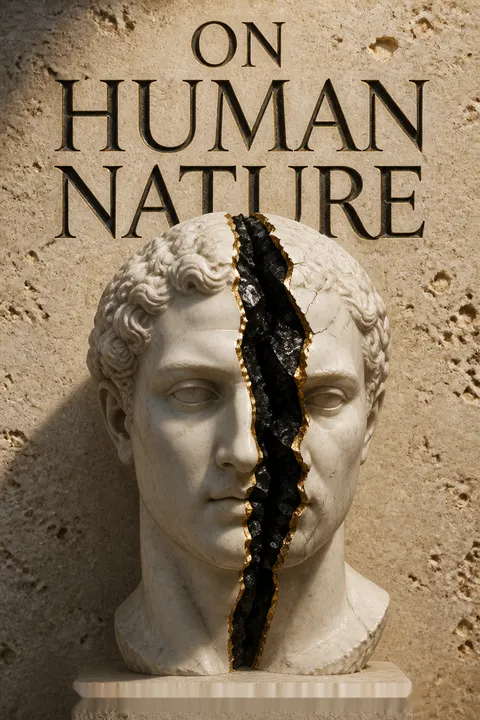

Belangrijkste inzichten
1. De menselijke natuur is fundamenteel egoïstisch en geneigd tot wreedheid
De mens is het enige dier dat anderen pijn doet zonder ander doel dan die pijn te veroorzaken.
Aangeboren kwaadaardigheid. Schopenhauer stelt dat mensen een fundamenteel vermogen tot wreedheid bezitten dat hen onderscheidt van andere dieren. Waar dieren alleen schade toebrengen om te overleven, kunnen mensen pijn veroorzaken puur voor psychologisch genot.
Psychologische drijfveren. Menselijke wreedheid komt voort uit complexe psychologische motieven, zoals:
- Schadenfreude (plezier in het lijden van anderen)
- Jaloezie en haat
- De wens om dominantie te tonen
- Psychologische compensatie voor persoonlijke tekortkomingen
Systemische uiting. Deze aangeboren kwaadaardigheid is niet alleen individueel, maar manifesteert zich ook in maatschappelijke structuren, van persoonlijke relaties tot grootschalige politieke systemen die lijden in stand houden.
2. Overheid en sociale orde ontstaan uit noodzaak, niet uit aangeboren goedheid
De staat is slechts een instelling die bestaat om haar leden te beschermen tegen aanvallen van buitenaf of interne onenigheid.
Oorsprong van bestuur. Sociale structuren ontstaan niet uit altruïsme, maar uit de dringende behoefte om de inherent conflicterende belangen van mensen te beheersen. Overheden functioneren als mechanismen om de destructieve neigingen van de mens te controleren.
Machtsdynamiek:
- Macht gaat vooraf aan recht
- Politieke systemen draaien fundamenteel om het beheersen van de menselijke natuur
- Monarchieën zijn natuurlijker dan democratische systemen
- Sociale orde vereist geconcentreerde autoriteit
Pragmatisch perspectief. Schopenhauer ziet overheidsvormen als praktische oplossingen om menselijke complexiteit te managen, niet als idealistische uitingen van menselijk potentieel.
3. Karakter is aangeboren en onveranderlijk
Het gedrag van een mens, in zijn geheel genomen, wordt niet beheerst door zijn rede of door enige voornemens die hij maakt.
Vooraf bepaalde essentie. Het fundamentele karakter van een individu is vastgesteld vóór bewuste keuze, diep geworteld in de metafysische wil in plaats van in rationele besluitvorming.
Kenmerken van karakter:
- Morele aanleg is genetisch bepaald
- Intellectuele capaciteit kan het kernkarakter slechts beperkt beïnvloeden
- Persoonlijke handelingen weerspiegelen consequent de onderliggende aard
- Externe ervaringen onthullen het karakter, maar veranderen het niet
Psychologisch determinisme. Onze handelingen zijn uitingen van een onveranderlijke innerlijke essentie, waarbij de rede meer toeschouwer dan bestuurder is van onze fundamentele natuur.
4. Vrije wil is een illusie; onze handelingen zijn vooraf bepaald
Het hele verloop van iemands leven, met al zijn grote en kleine gebeurtenissen, is net zo noodzakelijk vooraf bepaald als het verloop van een klok.
Metafysische beperking. Menselijke handelingen zijn niet spontaan, maar volgen een vooraf bepaalde koers die wordt gevormd door het aangeboren karakter en externe omstandigheden.
Deterministisch kader:
- Individueel karakter is vaststaand
- Motieven creëren voorspelbare gedragslijnen
- Persoonlijke keuze is een illusie
- Handelingen vloeien voort uit aangeboren aanleg
Filosofische consequenties. Dit perspectief daagt traditionele ideeën over persoonlijke verantwoordelijkheid uit en suggereert dat ons gevoel van eigen macht fundamenteel misleidend is.
5. Moreel instinct overstijgt rationeel redeneren
Moreel handelen volgt een regel zonder enig doel.
Intuïtieve moraliteit. Ethisch gedrag ontspringt aan een dieper bewustzijn dat buiten intellectueel begrip ligt en werkt via instinct in plaats van berekende overweging.
Kenmerken van moreel bewustzijn:
- Functioneert onafhankelijk van rationeel denken
- Ontspringt uit een “beter bewustzijn”
- Verschijnt als een dwingend gebod
- Overstijgt individuele intellectuele vermogens
Spirituele dimensie. Moreel instinct vertegenwoordigt een hoger vorm van inzicht die niet volledig verklaard kan worden binnen traditionele filosofische kaders.
6. Sympathie en mededogen zijn de hoogste morele deugden
Wanneer je in contact komt met een mens, probeer dan niet objectief zijn waarde en waardigheid te beoordelen.
Mededogende blik. Ware morele uitmuntendheid ontstaat door het erkennen van gedeelde menselijke kwetsbaarheid in plaats van het beoordelen van individuele prestaties of tekortkomingen.
Principes van mededogen:
- Erken universeel lijden
- Geef empathie voorrang boven kritische beoordeling
- Begrijp menselijke beperkingen
- Overstijg individuele verschillen
Ethische transformatie. Mededogen vertegenwoordigt een diepgaande filosofische benadering die kunstmatige barrières tussen mensen oplost.
7. Intellectuele capaciteit garandeert geen morele uitmuntendheid
Fijne geesten zijn zelden fijne zielen.
Scheiding tussen intelligentie en moraliteit. Intellectuele bekwaamheid vertaalt zich niet automatisch in ethisch gedrag of emotionele intelligentie.
Complexiteit intellect-moraal:
- Cognitieve vermogens zijn verschillend van morele aanleg
- Genialiteit garandeert geen goedheid
- Moreel karakter overstijgt rationeel denken
- Emotionele capaciteit weegt zwaarder dan intellectuele prestaties
Holistisch begrip. Ware menselijke uitmuntendheid vereist een integratie van intellectuele en emotionele vermogens.
8. De wereld is een manifestatie van collectief lijden
De wereld is zelf het Laatste Oordeel over haar.
Universele pijn. Het bestaan wordt fundamenteel gekenmerkt door lijden, waarbij individuele ervaringen bredere metafysische omstandigheden weerspiegelen.
Dynamiek van lijden:
- Pijn is een inherent aspect van het leven
- Individuele ervaringen spiegelen collectieve worstelingen
- Bestaan omvat voortdurende confrontatie met beperkingen
- Bewustzijn ontstaat door het erkennen van universeel lijden
Filosofisch perspectief. Het begrijpen van lijden wordt een weg naar diepere existentiële inzichten.
9. Individuele identiteit bestaat voorbij fysieke manifestatie
Je bestaat in alles buiten jezelf evenzeer als in je eigen persoon.
Metafysische verbondenheid. Persoonlijke identiteit overstijgt fysieke grenzen en verbindt mensen via een diepere, niet-fysieke essentie.
Principes van identiteit:
- Bewustzijn reikt verder dan individuele ervaring
- Persoonlijke grenzen zijn illusoir
- Fundamentele wil verbindt alle wezens
- Individueel bestaan maakt deel uit van een groter metafysisch geheel
Spirituele implicaties. Menselijke identiteit is een complex, verbonden fenomeen dat verder gaat dan louter fysieke aanwezigheid.
10. Het menselijk bestaan is een reis van zelfontdekking
Het leven is de manifestatie van karakter, van datgene wat we met dat woord bedoelen.
Existentiële doelstelling. Het leven dient als middel om de fundamentele aard van zichzelf te begrijpen, waarbij innerlijke aanleg zichtbaar wordt door externe ervaringen.
Proces van zelfontdekking:
- Ervaringen fungeren als spiegels die het intrinsieke karakter weerspiegelen
- Handelingen tonen de onderliggende aanleg
- Persoonlijke groei omvat het herkennen van aangeboren neigingen
- Bewustzijn ontstaat door voortdurende zelfreflectie
Filosofische navigatie. Bestaan wordt een diepgaande verkenning van de individuele essentie.
Samenvatting van recensies
Over de menselijke natuur krijgt wisselende beoordelingen, met een gemiddelde score van 3,98 uit 5. Lezers waarderen Schopenhauers inzichten over menselijk gedrag en moraliteit, al vinden sommigen zijn visie te pessimistisch. Het boek behandelt onderwerpen als de menselijke natuur, overheid, vrije wil en karakter. Velen prijzen Schopenhauers schrijfstijl en de prikkelende ideeën, terwijl anderen moeite hebben met de zware filosofische inhoud. Sommige recensenten merken ook problemen op met de vertalingen. Over het geheel genomen ervaren lezers het boek als intellectueel stimulerend, ook al zijn ze het niet altijd eens met alle argumenten van Schopenhauer.
Veelgestelde vragen
What's "On Human Nature" by Arthur Schopenhauer about?
- Essays on Human Nature: The book is a collection of essays by Arthur Schopenhauer, translated by T. Bailey Saunders, focusing on various aspects of human nature.
- Philosophical Exploration: It delves into philosophical themes such as morality, free will, character, and the nature of government.
- Schopenhauer's Perspective: The essays reflect Schopenhauer's views on the inherent nature of humans, often highlighting the darker aspects of human behavior and society.
- Ethical and Metaphysical Themes: The book combines ethical reflections with metaphysical inquiries, offering a comprehensive look at human existence.
Why should I read "On Human Nature" by Arthur Schopenhauer?
- Insightful Analysis: Schopenhauer provides a deep and often critical analysis of human nature, offering insights that are still relevant today.
- Philosophical Depth: The book is a valuable resource for those interested in philosophy, particularly in understanding the complexities of human behavior and morality.
- Timeless Themes: It addresses timeless themes such as the struggle between good and evil, the nature of free will, and the role of government.
- Influential Work: Schopenhauer's ideas have influenced many later thinkers, making this book an important read for understanding the development of philosophical thought.
What are the key takeaways of "On Human Nature" by Arthur Schopenhauer?
- Human Nature's Duality: Schopenhauer explores the dual nature of humans, capable of both great good and profound evil.
- Moral Instinct vs. Reason: He discusses the conflict between moral instincts and rational thought, suggesting that true morality lies beyond reason.
- Determinism and Free Will: The book examines the concept of free will, arguing that human actions are determined by character and circumstances.
- Role of Government: Schopenhauer critiques the role of government, suggesting it is necessary due to the inherent lack of right in human nature.
How does Schopenhauer define "Character" in "On Human Nature"?
- Innate and Unchangeable: Schopenhauer views character as innate and unchangeable, determined by one's will and not by reason or experience.
- Manifestation of Will: Character is the manifestation of an individual's will, which is consistent and reveals itself through actions.
- Moral and Intellectual Aspects: He distinguishes between moral character, which is related to one's will, and intellectual character, which is related to one's understanding.
- Reflection of Self: Life is seen as a reflection of one's character, providing an opportunity for self-understanding and growth.
What is Schopenhauer's view on "Free Will and Fatalism" in "On Human Nature"?
- Deterministic View: Schopenhauer argues that human actions are determined by character and circumstances, leaving no room for free will in the traditional sense.
- Metaphysical Freedom: He suggests that true freedom lies outside the physical world, in the metaphysical realm where one's character is a free act.
- Life as Predetermined: Life is seen as a predetermined course, much like the movement of a clock, with actions unfolding according to necessity.
- Moral Implications: This deterministic view leads to the idea that life itself is a form of judgment, where one's actions reflect their true character.
How does Schopenhauer address "Moral Instinct" in "On Human Nature"?
- Instinct vs. Reason: Schopenhauer contrasts moral instinct with reason, suggesting that true moral actions arise from instinct rather than rational deliberation.
- A Priori Nature: Moral instinct is described as a rule of action given a priori, guiding behavior without the need for conscious understanding.
- Conflict with Reason: He highlights the conflict between moral instincts and rational thought, where the latter often leads to selfishness and deceit.
- Role in Ethics: Moral instinct is seen as a fundamental aspect of ethical behavior, providing a direct connection to the better consciousness beyond reason.
What does Schopenhauer say about "Government" in "On Human Nature"?
- Necessity of Government: Schopenhauer argues that government is necessary due to the inherent lack of right in human nature, serving to protect individuals from each other.
- Critique of State: He critiques the state as a parody of the moral law, suggesting it is a crutch rather than a true solution to human problems.
- Balance of Power: The book discusses the balance between despotism and anarchy, advocating for a government that leans towards despotism to maintain order.
- Role of Law: Schopenhauer emphasizes the role of law in restraining human behavior, as moral freedom is not achievable within the physical world.
What are the best quotes from "On Human Nature" and what do they mean?
- "Man is at bottom a savage, horrible beast." This quote reflects Schopenhauer's view of the inherent cruelty and egoism in human nature.
- "Life is the manifestation of character." It suggests that life serves as a mirror for one's character, providing opportunities for self-understanding.
- "The world is itself the Last Judgment." This implies that life is a form of judgment where one's actions reveal their true nature and moral standing.
- "The will itself is independent of all knowledge." This highlights the idea that the will is a fundamental aspect of human nature, unaffected by rational thought.
How does Schopenhauer explore "Ethical Reflections" in "On Human Nature"?
- Moral Law vs. State: Schopenhauer contrasts the moral law with the state, suggesting that true morality lies beyond the reach of government and law.
- Role of Honour: He discusses the principle of honour as an abuse of human freedom, often leading to actions that are not truly virtuous.
- Innocence and Experience: The book explores the concept of innocence as a state of ignorance, with true understanding arising from experience and self-reflection.
- Critique of Modern Morality: Schopenhauer critiques modern morality as superficial, emphasizing the need for genuine moral understanding beyond societal norms.
What is Schopenhauer's perspective on "Human Nature" in "On Human Nature"?
- Inherent Egoism: Schopenhauer views human nature as inherently egoistic, driven by a will to live that often leads to conflict and suffering.
- Dual Nature: He acknowledges the dual nature of humans, capable of both good and evil, with character playing a central role in determining behavior.
- Role of Suffering: Suffering is seen as an integral part of human existence, providing opportunities for self-understanding and moral growth.
- Philosophical Inquiry: The book encourages philosophical inquiry into the nature of humanity, challenging readers to reflect on their own character and actions.
How does Schopenhauer address "Character" in "On Human Nature"?
- Fixed and Innate: Schopenhauer argues that character is fixed and innate, determined by one's will and not subject to change through experience or reason.
- Manifestation of Will: Character is the manifestation of an individual's will, revealing itself through actions and decisions.
- Moral and Intellectual Aspects: He distinguishes between moral character, related to one's will, and intellectual character, related to one's understanding.
- Self-Understanding: Life is seen as a reflection of one's character, providing opportunities for self-understanding and growth.
How does Schopenhauer's "On Human Nature" relate to modern philosophical thought?
- Influence on Existentialism: Schopenhauer's exploration of free will, determinism, and the nature of suffering has influenced existentialist thinkers like Nietzsche and Sartre.
- Critique of Rationalism: His critique of rationalism and emphasis on the will as a fundamental aspect of human nature challenges modern philosophical assumptions.
- Relevance to Ethics: The book's exploration of moral instinct and character continues to be relevant in contemporary ethical discussions.
- Philosophical Legacy: Schopenhauer's ideas have left a lasting impact on modern philosophy, encouraging ongoing inquiry into the complexities of human nature.
Over de auteur
Andere boeken van Arthur Schopenhauer




PDF downloaden
EPUB downloaden
.epub digital book format is ideal for reading ebooks on phones, tablets, and e-readers.








































