Punti chiave
1. La natura umana è fondamentalmente egoista e incline alla crudeltà
L’uomo è l’unico animale che infligge dolore agli altri senza altro scopo se non quello di farlo.
Malevolenza insita. Schopenhauer sostiene che gli esseri umani possiedono una capacità fondamentale di crudeltà che li distingue dagli altri animali. A differenza di questi ultimi, che nuocciono solo per sopravvivere, l’uomo può infliggere sofferenza semplicemente per soddisfazione psicologica.
Motivazioni psicologiche. La crudeltà umana nasce da spinte psicologiche complesse, tra cui:
- Schadenfreude (piacere derivante dalla sofferenza altrui)
- Invidia e odio
- Desiderio di affermare la propria supremazia
- Compensazione psicologica per proprie inadeguatezze
Manifestazione sistemica. Questa malevolenza innata non si limita all’individuo, ma si osserva nelle strutture sociali, dalle relazioni personali ai grandi sistemi politici che perpetuano la sofferenza.
2. Il governo e l’ordine sociale emergono dalla necessità, non dalla bontà intrinseca
Lo Stato è semplicemente un’istituzione che esiste per proteggere i suoi membri da attacchi esterni o dissensi interni.
Origine del governo. Le strutture sociali non nascono dall’altruismo, ma dall’urgenza di gestire gli interessi conflittuali degli esseri umani. I governi fungono da meccanismi per controllare le tendenze distruttive dell’umanità.
Dinamiche di potere:
- La forza precede il diritto
- I sistemi politici mirano fondamentalmente a controllare la natura umana
- Le monarchie sono più naturali dei sistemi democratici
- L’ordine sociale richiede un’autorità concentrata
Prospettiva pragmatica. Schopenhauer vede i sistemi governativi come soluzioni pratiche per gestire la complessità umana, non come rappresentazioni idealistiche del potenziale umano.
3. Il carattere è innato e immutabile
La condotta di un uomo, presa nel suo insieme, non è governata dalla ragione né da alcuna risoluzione che possa prendere.
Essenza predeterminata. Il carattere fondamentale di un individuo si stabilisce prima della scelta consapevole, radicato profondamente nella volontà metafisica piuttosto che nella decisione razionale.
Manifestazioni del carattere:
- La disposizione morale è genetica
- La capacità intellettuale ha un potere limitato nel modificare il carattere profondo
- Le azioni personali riflettono costantemente la natura sottostante
- Le esperienze esterne rivelano, ma non trasformano, il carattere fondamentale
Determinismo psicologico. Le nostre azioni sono espressioni di un’essenza interna immutabile, con la ragione che funge più da osservatore che da controllore della nostra natura profonda.
4. Il libero arbitrio è un’illusione; le nostre azioni sono predeterminate
L’intero corso della vita di un uomo, in tutti i suoi eventi grandi e piccoli, è necessariamente predeterminato come il corso di un orologio.
Vincolo metafisico. Le azioni umane non sono spontanee, ma seguono una traiettoria predeterminata, modellata dal carattere innato e dalle circostanze esterne.
Quadro deterministico:
- Il carattere individuale è fisso
- I motivi generano schemi comportamentali prevedibili
- La scelta personale è un’illusione
- Le azioni emergono dalla disposizione innata
Implicazioni filosofiche. Questa visione sfida le nozioni tradizionali di responsabilità personale, suggerendo che il nostro senso di agenzia è fondamentalmente errato.
5. L’istinto morale trascende la ragione razionale
L’azione morale procede secondo una regola senza alcun oggetto.
Moralità intuitiva. Il comportamento etico origina da una coscienza più profonda che esiste al di là della comprensione intellettuale, operando attraverso l’istinto piuttosto che il ragionamento calcolato.
Caratteristiche della coscienza morale:
- Opera indipendentemente dal pensiero razionale
- Emerge da una “coscienza superiore”
- Si manifesta come un imperativo categorico
- Trascende la capacità intellettuale individuale
Dimensione spirituale. L’istinto morale rappresenta una forma superiore di comprensione che non può essere pienamente spiegata attraverso i tradizionali schemi filosofici.
6. Simpatia e compassione sono le virtù morali più elevate
Quando entri in contatto con un uomo, non tentare di valutarlo oggettivamente secondo il suo valore e la sua dignità.
Prospettiva compassionevole. La vera eccellenza morale nasce dal riconoscere la vulnerabilità umana condivisa, piuttosto che dal giudicare successi o fallimenti individuali.
Principi della compassione:
- Riconoscere la sofferenza universale
- Dare priorità all’empatia rispetto alla valutazione critica
- Comprendere i limiti umani
- Trascendere le differenze individuali
Trasformazione etica. La compassione rappresenta un approccio filosofico profondo che dissolve le barriere artificiali tra gli individui.
7. La capacità intellettuale non garantisce l’eccellenza morale
Le menti fini sono raramente anime fini.
Disconnessione tra intelligenza e moralità. Il talento intellettuale non si traduce automaticamente in comportamento etico o intelligenza emotiva.
Complessità intellettuale-morale:
- L’abilità cognitiva è distinta dalla disposizione morale
- Il genio non assicura la bontà
- Il carattere morale trascende il pensiero razionale
- La capacità emotiva conta più del successo intellettuale
Comprensione olistica. La vera eccellenza umana richiede l’integrazione delle capacità intellettuali ed emotive.
8. Il mondo è una manifestazione della sofferenza collettiva
Il mondo è esso stesso il Giudizio Universale su di esso.
Dolore universale. L’esistenza è fondamentalmente caratterizzata dalla sofferenza, con le esperienze individuali che riflettono condizioni metafisiche più ampie.
Dinamiche della sofferenza:
- Il dolore è un aspetto intrinseco della vita
- Le esperienze individuali rispecchiano lotte collettive
- L’esistenza comporta un confronto continuo con i limiti
- La coscienza emerge dal riconoscimento della sofferenza universale
Prospettiva filosofica. Comprendere la sofferenza diventa una via per una più profonda comprensione esistenziale.
9. L’identità individuale esiste oltre la manifestazione fisica
Esisti in tutto ciò che è fuori di te tanto quanto nella tua persona.
Interconnessione metafisica. L’identità personale trascende i confini fisici, collegando gli individui attraverso un’essenza più profonda e non materiale.
Principi dell’identità:
- La coscienza si estende oltre l’esperienza individuale
- I confini personali sono illusori
- La volontà fondamentale connette tutti gli esseri
- L’esistenza individuale fa parte di un quadro metafisico più ampio
Implicazioni spirituali. L’identità umana rappresenta un fenomeno complesso e interconnesso, oltre la semplice esistenza fisica.
10. L’esistenza umana è un viaggio di scoperta di sé
La vita è la manifestazione del carattere, di quel qualcosa che intendiamo con questa parola.
Scopo esistenziale. La vita serve come meccanismo per comprendere la propria natura fondamentale, rivelando la disposizione interna attraverso le esperienze esterne.
Processo di scoperta di sé:
- Le esperienze agiscono come specchi che riflettono il carattere intrinseco
- Le azioni dimostrano la disposizione sottostante
- La crescita personale implica il riconoscimento delle tendenze innate
- La coscienza emerge attraverso una continua riflessione su sé stessi
Navigazione filosofica. L’esistenza diventa un’esplorazione profonda dell’essenza individuale.
Sintesi delle recensioni
Sulla natura umana riceve recensioni contrastanti, con una valutazione media di 3,98 su 5. I lettori apprezzano le intuizioni di Schopenhauer sul comportamento umano e sulla morale, anche se alcuni trovano le sue opinioni eccessivamente pessimistiche. Il libro affronta temi come la natura umana, il governo, il libero arbitrio e il carattere. Molti riconoscono lo stile di scrittura di Schopenhauer e le sue idee stimolanti, mentre altri faticano ad affrontare la densità del contenuto filosofico. Alcuni recensori segnalano problemi nelle traduzioni. Nel complesso, il libro viene considerato intellettualmente stimolante, anche se non tutti concordano con ogni argomentazione di Schopenhauer.
FAQ
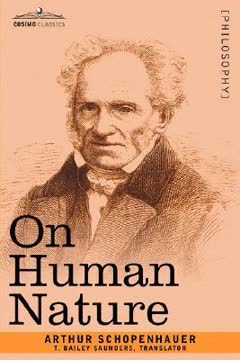
What's "On Human Nature" by Arthur Schopenhauer about?
- Essays on Human Nature: The book is a collection of essays by Arthur Schopenhauer, translated by T. Bailey Saunders, focusing on various aspects of human nature.
- Philosophical Exploration: It delves into philosophical themes such as morality, free will, character, and the nature of government.
- Schopenhauer's Perspective: The essays reflect Schopenhauer's views on the inherent nature of humans, often highlighting the darker aspects of human behavior and society.
- Ethical and Metaphysical Themes: The book combines ethical reflections with metaphysical inquiries, offering a comprehensive look at human existence.
Why should I read "On Human Nature" by Arthur Schopenhauer?
- Insightful Analysis: Schopenhauer provides a deep and often critical analysis of human nature, offering insights that are still relevant today.
- Philosophical Depth: The book is a valuable resource for those interested in philosophy, particularly in understanding the complexities of human behavior and morality.
- Timeless Themes: It addresses timeless themes such as the struggle between good and evil, the nature of free will, and the role of government.
- Influential Work: Schopenhauer's ideas have influenced many later thinkers, making this book an important read for understanding the development of philosophical thought.
What are the key takeaways of "On Human Nature" by Arthur Schopenhauer?
- Human Nature's Duality: Schopenhauer explores the dual nature of humans, capable of both great good and profound evil.
- Moral Instinct vs. Reason: He discusses the conflict between moral instincts and rational thought, suggesting that true morality lies beyond reason.
- Determinism and Free Will: The book examines the concept of free will, arguing that human actions are determined by character and circumstances.
- Role of Government: Schopenhauer critiques the role of government, suggesting it is necessary due to the inherent lack of right in human nature.
How does Schopenhauer define "Character" in "On Human Nature"?
- Innate and Unchangeable: Schopenhauer views character as innate and unchangeable, determined by one's will and not by reason or experience.
- Manifestation of Will: Character is the manifestation of an individual's will, which is consistent and reveals itself through actions.
- Moral and Intellectual Aspects: He distinguishes between moral character, which is related to one's will, and intellectual character, which is related to one's understanding.
- Reflection of Self: Life is seen as a reflection of one's character, providing an opportunity for self-understanding and growth.
What is Schopenhauer's view on "Free Will and Fatalism" in "On Human Nature"?
- Deterministic View: Schopenhauer argues that human actions are determined by character and circumstances, leaving no room for free will in the traditional sense.
- Metaphysical Freedom: He suggests that true freedom lies outside the physical world, in the metaphysical realm where one's character is a free act.
- Life as Predetermined: Life is seen as a predetermined course, much like the movement of a clock, with actions unfolding according to necessity.
- Moral Implications: This deterministic view leads to the idea that life itself is a form of judgment, where one's actions reflect their true character.
How does Schopenhauer address "Moral Instinct" in "On Human Nature"?
- Instinct vs. Reason: Schopenhauer contrasts moral instinct with reason, suggesting that true moral actions arise from instinct rather than rational deliberation.
- A Priori Nature: Moral instinct is described as a rule of action given a priori, guiding behavior without the need for conscious understanding.
- Conflict with Reason: He highlights the conflict between moral instincts and rational thought, where the latter often leads to selfishness and deceit.
- Role in Ethics: Moral instinct is seen as a fundamental aspect of ethical behavior, providing a direct connection to the better consciousness beyond reason.
What does Schopenhauer say about "Government" in "On Human Nature"?
- Necessity of Government: Schopenhauer argues that government is necessary due to the inherent lack of right in human nature, serving to protect individuals from each other.
- Critique of State: He critiques the state as a parody of the moral law, suggesting it is a crutch rather than a true solution to human problems.
- Balance of Power: The book discusses the balance between despotism and anarchy, advocating for a government that leans towards despotism to maintain order.
- Role of Law: Schopenhauer emphasizes the role of law in restraining human behavior, as moral freedom is not achievable within the physical world.
What are the best quotes from "On Human Nature" and what do they mean?
- "Man is at bottom a savage, horrible beast." This quote reflects Schopenhauer's view of the inherent cruelty and egoism in human nature.
- "Life is the manifestation of character." It suggests that life serves as a mirror for one's character, providing opportunities for self-understanding.
- "The world is itself the Last Judgment." This implies that life is a form of judgment where one's actions reveal their true nature and moral standing.
- "The will itself is independent of all knowledge." This highlights the idea that the will is a fundamental aspect of human nature, unaffected by rational thought.
How does Schopenhauer explore "Ethical Reflections" in "On Human Nature"?
- Moral Law vs. State: Schopenhauer contrasts the moral law with the state, suggesting that true morality lies beyond the reach of government and law.
- Role of Honour: He discusses the principle of honour as an abuse of human freedom, often leading to actions that are not truly virtuous.
- Innocence and Experience: The book explores the concept of innocence as a state of ignorance, with true understanding arising from experience and self-reflection.
- Critique of Modern Morality: Schopenhauer critiques modern morality as superficial, emphasizing the need for genuine moral understanding beyond societal norms.
What is Schopenhauer's perspective on "Human Nature" in "On Human Nature"?
- Inherent Egoism: Schopenhauer views human nature as inherently egoistic, driven by a will to live that often leads to conflict and suffering.
- Dual Nature: He acknowledges the dual nature of humans, capable of both good and evil, with character playing a central role in determining behavior.
- Role of Suffering: Suffering is seen as an integral part of human existence, providing opportunities for self-understanding and moral growth.
- Philosophical Inquiry: The book encourages philosophical inquiry into the nature of humanity, challenging readers to reflect on their own character and actions.
How does Schopenhauer address "Character" in "On Human Nature"?
- Fixed and Innate: Schopenhauer argues that character is fixed and innate, determined by one's will and not subject to change through experience or reason.
- Manifestation of Will: Character is the manifestation of an individual's will, revealing itself through actions and decisions.
- Moral and Intellectual Aspects: He distinguishes between moral character, related to one's will, and intellectual character, related to one's understanding.
- Self-Understanding: Life is seen as a reflection of one's character, providing opportunities for self-understanding and growth.
How does Schopenhauer's "On Human Nature" relate to modern philosophical thought?
- Influence on Existentialism: Schopenhauer's exploration of free will, determinism, and the nature of suffering has influenced existentialist thinkers like Nietzsche and Sartre.
- Critique of Rationalism: His critique of rationalism and emphasis on the will as a fundamental aspect of human nature challenges modern philosophical assumptions.
- Relevance to Ethics: The book's exploration of moral instinct and character continues to be relevant in contemporary ethical discussions.
- Philosophical Legacy: Schopenhauer's ideas have left a lasting impact on modern philosophy, encouraging ongoing inquiry into the complexities of human nature.