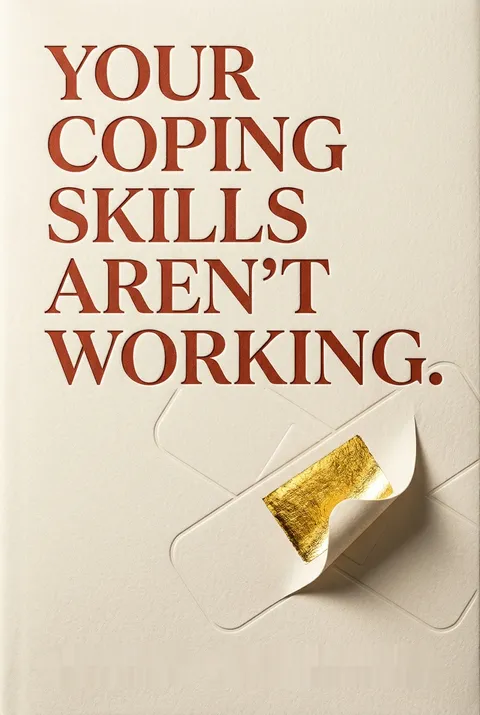

Key Takeaways
1. Your Current Coping Skills Are the Problem
Your coping skills are part of the problem, triggering the all-too-familiar and upsetting outcomes.
Self-sabotage cycle. Many of us find ourselves stuck in repetitive, self-defeating patterns, despite our best intentions. These "coping skills" were developed to help us navigate difficult situations, often originating in childhood. However, as adults, these very strategies can become obstacles, preventing us from achieving our goals and leading to frustration, isolation, or unhappiness.
Friction in change. Attempting to change behavior without addressing the underlying core beliefs that drive it creates immense internal friction. It's like trying to swim without knowing how, while an internal voice screams "Danger!" This makes the change process exhausting and often unsuccessful, as we're constantly fighting against our ingrained perceptions of reality.
Beyond surface-level. The book argues that these problematic coping mechanisms are not just bad habits, but deeply rooted responses to past experiences. Recognizing that these skills, once protective, now hinder us is the first crucial step. It shifts the focus from merely stopping a behavior to understanding its purpose and finding healthier alternatives.
2. Unmet Childhood Needs Form Your Origin Story
The way our needs were unmet in childhood tells us a lot about how we cope as adults and get in our own way.
Childhood's lasting impact. Our earliest experiences, particularly how our core emotional needs were met (or not met) by caregivers, form the "origin story" of our personality. These formative years, when our brains are still developing, lead us to create often-skewed "child logic" to explain the world and our place in it.
Five core needs. Schema therapy identifies five fundamental emotional needs that, if consistently unmet, predispose us to develop problematic coping patterns:
- Safety, love, and care
- Self-confidence and sense of identity
- Validated feelings and needs
- Loving discipline and limits
- Joy, playfulness, and creativity
The inner child. These unmet needs create an "inner child" within us—a part that still holds the emotions, beliefs, and memories from when these needs first went unfulfilled. Connecting with this inner child through compassion and dialogue is essential for healing, as it allows us to address the "unfinished business" of our past.
3. Schemas: Deep-Seated Beliefs from Early Life
A schema is a snapshot from a moment in time in your childhood when a particular experience was engrained within you as a kind of “rule” explaining how things worked in your world.
Internalized rules. Schemas are deeply ingrained patterns of memories, emotions, and core beliefs about ourselves, others, and the world, formed during childhood. They act as internal "rules" that dictate how we perceive and react to situations, often without conscious awareness.
Examples of schemas:
- Emotional Deprivation: Expecting others to let you down emotionally.
- Abandonment: Intense fear of losing loved ones.
- Defectiveness: Feeling inherently flawed or unacceptable.
- Unrelenting Standards: Believing you must always strive for perfection.
- Punitiveness: Harsh self-criticism and judgment.
Connecting past to present. Understanding the roots of your schemas in your childhood origin story provides crucial insight into what triggers you today. This compassionate understanding of your child-self's coping mechanisms is the foundation for providing yourself with the care and validation you lacked.
4. Modes: The Characters Acting Out Your Schemas
The term “mode” is a label for a self-state made up of a particular mindset triggered by schemas.
Schemas as traits, modes as states. While schemas are deep-seated traits or triggers, modes are dynamic "self-states" or mindsets that manifest as patterns of behavior in response to these schemas. They are like characters in the "theater of your personality," each with their own voice, intentions, and ways of coping.
Five basic mode types:
- Inner Child Mode: The core of our emotions (sadness, joy, fear, etc.).
- Coping Child Mode: Reactions to pain (vulnerable, angry, impulsive, rebellious child).
- Difficult Coping Mode: Maladaptive survival patterns (detached protector, compliant surrenderer, bully, etc.).
- Inner Critic Mode: Internalized discipline and authority (punitive, demanding aspects).
- Healthy Caring Adult Mode: Our ideal, compassionate, and effective self.
Understanding the interplay. Modes interact around schema triggering. The Inner Child feels unmet needs, activating schemas. In response, Coping Child, Difficult Coping, and Inner Critic modes emerge as attempts to manage this pain, often making things worse. Recognizing these modes allows us to gain distance and choose different reactions.
5. The Healthy Caring Adult: Your Inner Ideal Parent
The healthy caring adult mode is characterized by mindsets and ways of behaving that are connected to positive feelings, generative thoughts, and motivations that help you feel effective in the world, fulfilled, and emotionally aware.
Your ideal self. The Healthy Caring Adult (HCA) is your compassionate, well-grounded self, capable of managing other modes and connecting with your inner child. It embodies the person you aspire to be, acting as an ideal parent who provides care, sets limits, and holds your core values.
Multiple roles of the HCA:
- Ideal Parent: Cares for the inner child and sets boundaries for problematic modes.
- Value Holder: Embodies your deepest values and aspirations.
- Healthy Perspective: Offers clarity and distance from triggered moods.
- Confident Guide: Brings bravery, resolve, kindness, and generosity to challenges.
A voice and a position. The HCA is primarily a voice and a position you speak from internally. It's about making a conscious decision to step into this role, bringing together compassion, authority, and a commitment to your well-being. This shift in perspective is a practice, much like learning a musical instrument, requiring consistent effort.
6. Dialogue with Modes: The Core of Self-Talk
Your healthy caring adult can dialogue with your coping child and difficult coping modes and manage them with cognitive, emotional, and behavioral tools.
Building trust. Engaging in dialogue with your modes is crucial for change. This involves building a trusting relationship where your HCA validates, cares for, and supports your other modes, while also setting necessary limits. This process, rooted in "limited reparenting" and "empathic confrontation," opens communication with your inner child.
Six principles of mode dialogue:
- Connect: Get the mode's attention with empathy.
- Goal: Validate the mode's original, often protective, intention.
- Explain Harm: Show how the mode's current behavior is counterproductive.
- Limit: Clearly state what behavior needs to change.
- Care: Directly soothe and validate the inner child's unmet needs.
- Promise: Reassure all modes that the HCA will address their goals and care for the inner child effectively.
Practice makes perfect. These dialogues, though initially feeling awkward or lengthy, become intuitive with practice. They allow you to intervene when modes are triggered, preventing old patterns from taking over and creating space for new, healthier responses.
7. Nurturing Your Inner Child: The Heart of Healing
Your inner child is finally connecting with someone who is listening and who cares!
The ultimate goal. The primary purpose of managing your modes is to create an unobstructed path for your Healthy Caring Adult to connect with and nurture your Inner Child. This connection allows your Inner Child, often for the first time, to safely express its core feelings and unmet needs.
Providing internal safety. Your HCA provides the internal safety and validation that your Inner Child lacked in childhood. This self-provided care is a powerful deepening of self-esteem, transforming the Inner Child's pain and vulnerability into an opportunity for healing and growth.
From coping to thriving. By consistently engaging in this dialogue, the Inner Child learns to trust the HCA's ability to protect and provide. This reduces the need for problematic coping modes, freeing up emotional energy and allowing the Inner Child's natural joy, playfulness, and creativity to emerge, leading to a more fulfilling life.
8. Behavior Change: The Engine of Your Growth
Behavior change plays a special role as an engine that drives an upward cycle or spiral of change.
Beyond self-talk. While self-talk and mode dialogue are crucial, tangible behavior change is the ultimate goal and a powerful catalyst for further growth. Each time you step outside your comfort zone and successfully implement a new behavior, you reinforce your HCA's authority and build confidence.
The upward cycle:
- Identify: Pinpoint a difficult behavior and its underlying mode.
- Picture: Envision an alternative action aligned with HCA values.
- Dialogue: Use mode image diary to address the mode's resistance.
- Flashcard: Create a quick HCA message for in-the-moment intervention.
Metabolizing stuckness. This four-step formula helps you "metabolize" your stuckness. Each successful behavior change triggers a mode, providing another opportunity for HCA intervention. This continuous engagement pushes the limits of your resilience, leading to sustained progress and a deeper sense of self-efficacy.
9. Mindfulness: Fueling Self-Awareness and Compassion
Mindful attention to your own experience in day-to-day life will help you connect the principles of the healthy caring adult with your own life values.
The fuel for change. Mindfulness—nonjudgmental attention to your present experience—is indispensable for schema therapy. It helps you develop a grounded, calm, and patient baseline perspective, which serves as the "mindful home" for your Healthy Caring Adult.
Mindfulness in practice:
- Formal Meditation: Regular sitting or walking meditation to focus attention on breath, body sensations, and sensory input.
- Informal Awareness: Applying mindful attention during daily activities to notice thoughts, emotions, and physical shifts.
- Mode Management: Using mindfulness to observe triggered modes from a distance, allowing for HCA intervention.
Beyond symptom relief. While mindfulness can calm and treat symptoms, its deeper purpose in this context is to foster joy, gratitude, and a sense of belonging to something larger than oneself. This spiritual dimension adds fulfillment, making the practice more engaging and reinforcing the HCA's compassionate and loving qualities.
10. The Ecosystem of Growth: Sustaining Your New Self
The goal of setting up an ecosystem of growth is to set in place a series of habits that support each other and incorporate the new parts of you as you discover them.
Interlocking habits. As you consistently apply schema therapy tools, your smaller daily changes begin to interlock, forming a self-sustaining "ecosystem of growth." This system ensures that your evolution continues, even when you're not actively focusing on it.
Six phases of the ecosystem:
- Behavior-Change Goals: Small, actionable steps.
- Planner: Scheduling and alerts for consistency.
- Building-Block Appointments: Introducing new positive habits.
- Interceptor Appointments: Pre-emptive mode management for challenging events.
- Self-Retreats: Periodic reflection on values and identity.
- Revising Life Goals: Updating aspirations based on new self-awareness.
From coping to shaping. This ecosystem transforms you from merely coping with life's challenges to actively shaping your destiny. It fosters patience, reduces high-stakes thinking, and allows you to see how small, consistent efforts contribute to profound, long-term personal transformation and a deeper sense of who you are.
Review Summary
Your Coping Skills Aren't Working introduces Schema Therapy, a therapeutic approach addressing maladaptive coping patterns from childhood. Readers praise the book's accessible writing, practical exercises, and compassionate tone. The author explains how unmet core emotional needs create schemas that develop into problematic adult behaviors. The book teaches readers to develop a "healthy caring adult" mode to reparent their inner child. Reviewers appreciate the inclusive approach, downloadable worksheets, and clear examples. While some found the "inner child" concept infantile, most found it helpful for understanding triggers and developing healthier responses.
People Also Read







Download PDF
Download EPUB
.epub digital book format is ideal for reading ebooks on phones, tablets, and e-readers.








































