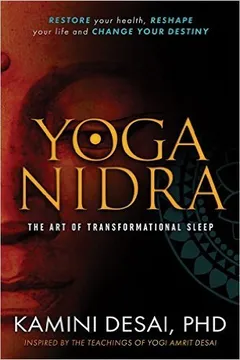
Key Takeaways
1. Yoga Nidra is the art of conscious non-doing that reveals our true nature as the container of awareness.
Yoga Nidra is not about doing more, it is about doing less.
The power of non-doing. Unlike traditional meditation techniques that require active mental effort to quiet the mind, Yoga Nidra leverages the body's natural biological sleep process to induce deep states of spacious awareness. By releasing the struggle to achieve a specific state, we effortlessly slip into a realm of profound relaxation where healing happens spontaneously.
Floating as an analogy. The author compares this practice to floating on water, which is not an active struggle but a surrender to being held. When we stop efforting, the mind naturally settles, and the energy normally consumed by mental chatter is freed to restore the physical body.
- Releasing the struggle to keep ourselves upright
- Allowing ourselves to be carried by the waters of life
- Transitioning from active doing to passive being
Accessing the fourth state. Through this systematic relaxation, we transcend the ordinary states of waking, dreaming, and deep sleep to touch turiya, the fourth state of consciousness. In this state, we rest as pure, unconditional awareness, realizing that we are the silent backdrop behind all of life's changing experiences.
2. Human suffering stems from confusing the temporary contents of the mind with the eternal container of the Self.
The union between the seer and the seen is the source of suffering.
Confusing container and contents. We suffer because we mistakenly identify with our passing thoughts, emotions, and physical sensations instead of the silent awareness that observes them. Just as we look at a pot of spaghetti and only notice the food rather than the container, we look at our lives and say "I am sad" instead of recognizing that sadness is simply passing through us.
The sky of awareness. The true Self is like a vast sky that remains completely unaffected by the weather patterns, clouds, or storms passing through it. By establishing ourselves as the sky rather than the clouds, we develop an inner stability that cannot be shaken by external circumstances.
- The Self is the unchanging constant behind changing experiences
- Thoughts and emotions are temporary waves on the ocean of consciousness
- True peace is accessible independent of external conditions
Stilling the mind's modifications. Patanjali’s Yoga Sutras state that when we still the fluctuations of the mind, the seer abides in its own true nature. Yoga Nidra achieves this by systematically quieting the mental movie, allowing the blank screen of awareness to finally become visible.
3. The five Kleshas map our descent from formless spiritual oneness into rigid ego identification.
We mistake the mind and emotions to be the totality of who we are.
The five Kleshas. The ancient yogic concept of the kleshas maps the psychological descent from spiritual wholeness into the illusion of separation and suffering. This process begins with avidya (ignorance or forgetfulness of our true nature), which acts as the root cause of all subsequent human afflictions.
Ego and binary survival. Once we forget our connection to the Source, we develop asmita (egoism) and begin using raga (attraction) and dvesha (aversion) to secure pleasure and avoid pain. We frantically try to manage the contents of our life container, falsely believing that external circumstances dictate our internal peace.
- Avidya: Forgetting that we are spiritual beings having a human experience
- Asmita: Identifying solely with our programmed personality and ego
- Raga and Dvesha: Chasing pleasure and running from pain to feel whole
- Abhinevesha: Clinging to life and defending our self-image at all costs
Resolving obstacles backward. The Yoga Sutras teach that these subtle obstacles can be destroyed by resolving them back into their primal cause through self-realization. Yoga Nidra systematically reverses this descent, dissolving the ego's defenses and restoring us to the metaphorical Garden of Eden.
4. Systematically slowing brainwaves allows us to enter the restorative Delta state while remaining fully conscious.
Yoga Nidra is stilling the fluctuations of mind…and abiding as one’s true nature…through conscious entry into the sleep state.
Slowing the brainwaves. During our normal waking state, our brains operate in high-frequency Beta and Gamma waves, keeping us highly identified with our daily dramas. Yoga Nidra systematically guides us down into Alpha, Theta, and Delta states, slowing our mental cycles from up to 100 Hz down to a near-silent 0.5 Hz.
The conscious Delta state. Entering the Delta brainwave state while remaining fully conscious is a rare feat that allows for profound physical and psychological rejuvenation. In this state, the body releases human growth hormone (HGH) and reduces cortisol, effectively reversing the biological aging process.
- Alpha waves: Inducing relaxed focus, super learning, and light trance
- Theta waves: Accessing the subconscious mind and consolidating memories
- Delta waves: Releasing growth hormones and initiating deep cellular repair
The gap of nothingness. In the deepest Delta state of Yoga Nidra, we enter a "gap" where all thoughts and the sense of a separate "I" completely dissolve. This temporary extinction of the ego allows us to experience our true, limitless nature before returning to waking life.
5. The five Koshas map our embodiment from the formless Bliss body to the dense Physical body.
The koshas delineate the subtle process by which energy progressively condenses out of the soup of unmanifest potential and eventually densifies into what we know and see as the concrete and visible physical body.
The five sheaths. The Taittiriya Upanishad outlines the five koshas, or illusory sheaths of embodiment, that map our existence from the formless to the physical. These sheaths act like layers of an onion, with each layer becoming progressively denser as it moves further from the Source.
From ether to ice. The author uses the metaphor of water states to describe the density of these bodies, comparing the Bliss body to ether and the Physical body to ice. It is far easier to reshape water (the Energy body) than it is to chisel a block of ice (the Physical body).
- Anandamayakosha: The Bliss body, the thinnest veil of individuality
- Vijnanamayakosha: The Wisdom body, the seat of intuition and intellect
- Manamayakosha: The Mental body, which processes sensory impressions
- Pranamayakosha: The Energy body, which animates the physical form
- Anamayakosha: The Physical body, composed of dense foodstuff
Targeting the energy body. The Integrative Amrit Method of Yoga Nidra focuses heavily on the Pranamayakosha (Energy body) because it is the bridge between mind and matter. By working at this fluid level, we can quickly influence both the physical form and the deeper mental structures.
6. Prana is manifest Divinity that can be ridden back to its Source when the mind is stilled.
Just as a wave naturally returns to the ocean, energy (Shakti) wants to return to consciousness (Shiva).
Prana as manifest divinity. Prana is the intelligent life force that animates our bodies, digests our food, and carries out millions of complex biological processes without our conscious effort. When the mind is highly agitated, it hijacks this vital energy, leaving the body depleted and vulnerable to disease.
Riding the energy home. In the Amrit Method of Yoga Nidra, we quiet the mind so that prana can accumulate enough momentum to escape the gravitational pull of our thoughts. Once freed, this energy naturally returns to its Source, transforming from a biological healing force into an evolutionary spiritual power.
- Prana is the Holy Spirit or manifest aspect of the Divine
- The mind acts as a thief, stealing energy away from spiritual union
- Quieting the mind allows prana to carry out accelerated cellular repair
The horse and rider. The author shares the metaphor of a boy riding a horse; when the rider (the mind) completely releases the reins, the horse (prana) instinctively knows the way back home. By surrendering all mental control, we allow our life force to guide us back to pure consciousness.
7. We choose our karma not by what happens to us, but by how we respond internally.
Karma is not what happens to you. Karma is how you are with what happens to you.
The internal law of karma. Most people view karma as a system of cosmic punishment or reward, but it is actually a neutral law of cause and effect. While we cannot always control external events, we have total control over our internal reactions, which ultimately determine our life outcomes.
The mathematical formula. The author presents a simple formula: external events plus internal reactions equal the final action or outcome. This means that we are the active creators of our own destiny, as our internal state dictates how we experience reality.
- External events are neutral occurrences beyond our direct control
- Internal reactions are driven by unconscious past programming (samskaras)
- We choose our karma by consciously choosing our internal response
Breaking the cycle. When we react defensively to a situation, we plant seeds that reinforce that exact same reaction in the future. By using Yoga Nidra to bring these unconscious reactions to light, we can choose a different response and alter our karmic trajectory.
8. Dis-identification creates the vital space needed to witness our thoughts rather than blindly react to them.
The basic principle of a samskara is that it becomes stronger and deeper through the process of repetition (and weaker through withdrawal).
Samskaras as mental grooves. Samskaras are the deep-seated mental and emotional grooves carved into our subconscious mind by past experiences and repetitive behaviors. Like water flowing through the Grand Canyon, our thoughts and actions naturally follow these pre-existing pathways, making our behavior highly predictable and automatic.
The power of dis-identification. Dis-identification is the process of creating a conscious gap between ourselves and our automatic impulses. By stepping back and witnessing our thoughts rather than acting on them, we withdraw the energy that keeps these subconscious grooves alive.
- Nerves that fire together, wire together in the brain
- Starving an unhelpful habit of attention causes it to wither and die
- The "burn" of resisting a habit is the sign of karma being cleared
Removing the sunglasses. Our samskaras act like colored sunglasses that distort how we perceive the world, causing us to react to the past rather than the present. Yoga Nidra loosens these glasses, allowing us to see reality clearly and respond from a place of conscious choice.
9. Planting an Intention at the Bliss body level rewrites our unconscious programming without mental conflict.
When we use Intention in Yoga Nidra, we initiate transformation at the level of the unconscious or Bliss body.
Sankalpa as a spiritual seed. An Intention, or Sankalpa, is a highly specific, positive statement of truth planted deep within the subconscious during Yoga Nidra. Unlike waking affirmations that create mental conflict, an Intention planted in the Bliss body bypasses the critical mind and rewrites our core programming.
The fertile soil of the Bliss body. During the deepest states of Yoga Nidra, the mind is completely silent, leaving the Bliss body as a clean, unwritten slate. When we place our Intention here, it is received without any doubt, fear, or resistance, allowing it to manifest effortlessly in our daily lives.
- Intentions must be stated in the present tense to maximize their potency
- A primary Intention declares our true nature as silent, eternal Presence
- A secondary Intention acts as a path clearer to remove limiting habits
Effortless transformation. When an Intention is successfully planted at the seed level, our waking behaviors begin to shift naturally without the need for willpower or discipline. The old, self-destructive habits simply fall away because the underlying programming has been rewritten.
10. Yoga Nidra restores physiological balance by neutralizing chronic stress and activating the body's self-healing mechanisms.
Relaxation doesn’t happen by doing more, yet this is how most of us go about it.
The epidemic of chronic stress. In our modern society, we are constantly in a state of sympathetic dominance, keeping our bodies in a low-level fight-or-flight response. This chronic stress floods our systems with cortisol, which suppresses the immune system, disrupts digestion, and accelerates the aging process.
Restoring homeostatic balance. Yoga Nidra acts as a powerful physiological reset button, activating the parasympathetic nervous system and returning the body to homeostasis. During the practice, the body releases a cocktail of healing neurotransmitters that promote deep cellular repair and emotional stability.
- GABA: Acts as the body's natural tranquilizer to reduce anxiety and tension
- Melatonin: Regulates sleep cycles, acts as an antioxidant, and slows aging
- Dopamine: Increases motivation, focus, and our capacity to experience pleasure
Healing at the root. Rather than treating individual symptoms of stress, Yoga Nidra works at the root cause by balancing the active (Pingala) and receptive (Ida) energies. By restoring this natural equilibrium, we unleash the body's innate intelligence to heal itself from chronic illness, trauma, and exhaustion.
Review Summary
Download PDF
Download EPUB
.epub digital book format is ideal for reading ebooks on phones, tablets, and e-readers.








































