
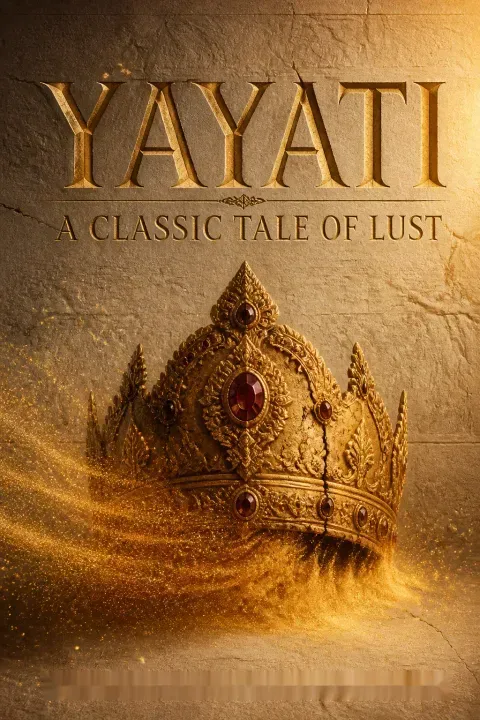


Plot Summary
Prologue
An aged Yayati,1 no longer king, wonders why he wants to recount his life. He compares human lives to flowers on a creeper: some offered to gods in worship and thus evoking devotion, some adorning the hair of maidens as silent witnesses to love's pleasures. All flowers eventually fall to earth and are lost.
The infant Yayati,1 the adolescent, the youth, and the man were all of a piece, but the Yayati1 who now perceives his past sees what all earlier versions could not. He cannot resist dwelling on his life, hoping the world might see, however faintly, through his eyes what he himself had failed to see: the tatters of a rich brocade, a story that might warn others of life's pitfalls.
The prologue establishes Yayati not as a confessor seeking absolution but as a witness to his own lifelong blindness. The flower metaphor is deceptively simple: it suggests both fatalism (all flowers fall) and differentiation (some served devotion, some served desire). This tension between destiny and agency is the novel's central philosophical problem. Yayati's admission that he failed to see positions the entire narrative as an act of belated perception, a looking-back that transforms experience into wisdom only after the damage is irreversible. The image of the rich brocade reduced to tatters frames the story as an account of ruin, not glory. The prologue thus primes readers to treat what follows as parable rather than entertainment.
A Mother's Midnight Confession
At age six, Yayati1 is furious that his mother7 never nursed him and gives her a day of cold silence. That night she comes to his bed weeping and reveals a secret she had hidden: he had an elder brother, Yati,5 who vanished into the forest before Yayati1 was born.
Yati5 had been taken to a great rishi's hermitage and was so drawn to it that she dragged him home by force; that same night, he slipped away forever. The queen's7 sobbing confession shakes the child from his world of flowers and dreams. He clasps her hand and swears he will never, never become an ascetic.
That night he dreams of himself as king, stalking the world with a whip, lashing every hermit and beggar he meets. He has matured in a single night, his first acquaintance with grief hardening into a lifelong hatred of renunciation.
The childhood promise is a negative identity formation: Yayati defines himself not by what he will become, but by what he must never become. His mother's manipulation, weeping until he swears against asceticism, binds him to worldly life through guilt rather than genuine desire. The dream of whipping hermits reveals how thoroughly he has internalized her grief as aggression against renunciation itself. This foundational trauma explains his later inability to find meaning in anything beyond the senses: asceticism is not a path he rejected but one he was emotionally blackmailed into swearing against before he could understand it.
The Horse and the Kiss
At fourteen, during the town festivities, Yayati1 watches soldier after soldier fail to ride a wild horse. Defying his terrified mother,7 he vaults into the arena and mounts the beast. He rides four furious rounds to surging applause, but on the fifth, distracted by wanting to see his mother's7 proud face, his grip slackens.
The horse throws him, plunging him into eight days of unconsciousness. When he wakes, the maid Alaka,13 daughter of his childhood nurse Kalika, is tending him. As she applies medicine to his forehead, her jasmine-scented hair brushes his cheek.
Intoxicated, Yayati1 pulls her close and kisses her passionately, his first taste of romantic desire. The moment shatters when pain from his injured leg makes him scream and collapse. During his long recovery, the memory of that kiss haunts him continuously.
The horse ride and the kiss are parallel initiations into Yayati's twin obsessions: public glory and private pleasure. Both nearly destroy him (the fall, the injury), and both leave him wanting more. His distraction on the fifth round, needing to witness his mother's admiration at the moment of triumph, hints at a performative self-consciousness that will plague all his pursuits. He cannot simply experience; he must imagine himself being seen experiencing. The kiss with Alaka initiates him into desire, but it is desire already fused with danger, pleasure that comes at the body's expense.
Brother in the Cave
While escorting the victory horse across Aryavarta, Yayati1 decides to hunt elephants at night. In pitch darkness near a forest pond, he hears what he thinks is an elephant drinking and shoots, only to hear a human cry.
The wounded ascetic rages that an impure youth who has kissed a woman cannot touch his feet. When Yayati1 identifies himself, the ascetic reveals himself as Yati,5 his lost brother.5 Yati5 leads him to a cave where a tiger lounges like a kitten and cobras nestle with glowing hood-jewels.
Yati5 eats bitter fruit with relish, explaining that his hatred of sweetness, women, and all bodily pleasure will lead him to mastery over the soul. He refuses to return to their mother7 but warns Yayati:1 conquering the world is easier than mastering the mind.
The encounter with Yati dramatizes the novel's central conflict as physical opposition: the cave (renunciation) versus the palace (indulgence), bitter fruit versus sweet, tiger-as-pet versus horse-as-conquest. Yati's warning is the book's thesis statement, which Yayati will spend his life proving true by failing to achieve it. The arrow that wounds Yati, shot in darkness at what Yayati thought was an elephant, is a perfect metaphor for how the pursuit of pleasure can inadvertently wound what is sacred. The two brothers embody opposite extremes that the novel will ultimately reject as unsustainable.
A King's Deathbed Terror
Summoned home by his father's12 grave illness, Yayati1 sits vigil by King Nahusha's12 bedside. In a lucid moment, Nahusha12 confesses the curse: after defeating Indra, his arrogance swelled until he demanded Indra's wife be carried to him in a palanquin borne by great rishis.
Impatient with their pace, he kicked the sage Agastya on the head. Agastya cursed that Nahusha's12 children would never know happiness. Nahusha12 then tries to see his victory signet ring bearing the inscription of his triumph, but his sight has failed.
He screams in terror and falls back dead. That night, fleeing the horror of death, Yayati1 returns to Ashokavan and takes the maid Mukulika9 to bed. Her body becomes his refuge from mortality, and the pattern of his life solidifies: when afraid, seek pleasure.
Nahusha's deathbed confession strips worldly achievement of all meaning in a single devastating scene. The king who defeated Indra cannot see his own victory inscription, cannot hold back death, cannot do anything but weep and cling. Yayati's response, fleeing into Mukulika's arms, is the template for his entire life: when confronted with existential terror, he seeks sexual oblivion. The curse's content is less important than the psychological structure it creates: Yayati now has permission to interpret every misfortune as fated, every failure as inherited, every unhappiness as proof of the curse's truth.
The Friend Who Chose Duty
After his father's12 funeral, Yayati1 receives a letter from Kacha,4 the young ascetic he befriended during a peace sacrifice at Maharishi Angiras's hermitage. Kacha4 writes that war has erupted between gods and demons. The demons' preceptor, Maharishi Shukra,6 possesses Sanjeevani, the power to revive slain warriors, making them invincible.
Kacha4 has resolved to infiltrate the demon kingdom, become Shukra's6 disciple, and acquire the secret, fully expecting to die. Subsequent letters reveal Kacha's4 fate: demons murdered him, burned his body, and mixed his ashes into Shukra's6 wine.
When Shukra6 drank, Kacha's4 essence entered his body. Forced to revive the disciple living within him, Shukra6 taught Kacha4 the Sanjeevani hymn from inside his own heart. Kacha4 emerged alive, now effectively Shukra's6 son by shared bodily substance, and returned to the gods.
Kacha's story functions as a heroic counter-narrative embedded within Yayati's self-absorbed account. Where Yayati flees death, Kacha walks into it. Where Yayati seeks pleasure, Kacha accepts suffering. The surreal details of Kacha's death and rebirth (ashes mixed into wine, learning Sanjeevani from within his preceptor's heart) literalize the novel's preoccupation with what we internalize from those we consume and those who consume us. Kacha becomes part of Shukra and is reborn from him; this spiritual gestation stands in stark contrast to the purely physical unions Yayati pursues.
Alaka's Golden Hair
While searching for his lost brother,5 Yayati1 encounters a young woman attempting suicide by drowning. He rescues her: it is Alaka,13 his first kiss from adolescence, now ruined by marriage to a gambler who staked her in a game and lost. Yayati1 brings her home.
During the journey, she sleeps in his tent for safety, their intimacy innocent. But the treacherous servant Mandar10 reports their closeness to Yayati's mother.7 The Queen Mother,7 to protect the royal bloodline, has Alaka13 poisoned in a cellar. Yayati1 finds her dying, barely able to see or hear.
He plucks one golden hair as a keepsake. As death claims her, he kisses her fiercely, and she whispers her last word: poison. Yayati's1 relationship with his mother7 shatters. He vows silent vengeance, refusing to speak to her and rejecting every princess she selects for his marriage.
Alaka's death is the novel's sacrifice of innocence, the price extracted for Yayati's entry into adult sexuality. The Queen Mother, who wept over Yati's disappearance, now murders an innocent to preserve the bloodline's purity. The maternal body is thus split: nurturer and destroyer in one figure. Alaka's golden hair becomes a fetish that will haunt Yayati's desire for decades, a synecdoche for the whole woman he could not save. The cellar where she dies becomes a recurring space of female suffering and disposal. Yayati's silence toward his mother afterward is his first act of moral cowardice: he knows and does nothing.
The Maiden in the Well
Still grieving Alaka13 and estranged from his mother,7 Yayati1 hunts near the demon kingdom border. He finds Devayani2 trapped in a dry well, fallen there during a quarrel with Sharmishtha,3 daughter of Demon King Vrishaparva, over a sari Kacha4 had given Devayani.2
The argument escalated until Sharmishtha3 insulted Devayani's2 father as a dependent. Yayati1 fashions a cradle of arrows and lifts Devayani2 out. She seizes his hand and claims marriage by that touch. Captivated by her beauty and seeing the match as vengeance against his mother,7 Yayati1 agrees.
Maharishi Shukra6 approves but warns Yayati1 never to hurt his daughter. As punishment for the quarrel, Devayani2 demands Sharmishtha3 become her personal maid for life. To spare her people from Shukra's6 wrath, Sharmishtha3 accepts servitude.
The well rescue inverts the rescue fantasy: Devayani is not passive but an active agent who seizes Yayati's hand and claims him. Her instantaneous transformation from damsel to strategist reveals the will to power beneath her beauty. Yayati's acceptance for multiple, contradictory reasons (attraction, rebellion against his mother, hope of countering the curse) demonstrates how thoroughly mixed his motives always are. Sharmishtha's acceptance of servitude introduces the novel's counter-logic: that true power lies not in domination but in willing sacrifice for others' sake. The three characters are now locked into a triangle that will take decades to resolve.
The Wedding Night Betrayed
On their wedding night, Yayati1 enters the chamber eager for union. Devayani2 smells wine on his breath and recoils in disgust, calling him drunk and unbearable. She invokes Kacha's4 name, saying he abhorred liquor. Jealousy explodes in Yayati:1 this is his palace, not Kacha's4 cottage.
Devayani2 storms out, and the first night of their marriage ends in bitter separation. The next day, Sharmishtha3 persuades Yayati1 to visit the supposedly ill Devayani,2 who extracts from him a solemn oath sworn on her father's6 feet never to touch liquor again.
Yayati1 submits but feels defeated. As months pass, he realizes his wife gives him physical pleasure without emotional warmth. Her touch feels like stone. She refuses to dance for him, guards her dignity jealously, and lives absorbed in her own beauty. Yayati1 remains lonely and unfulfilled.
The wedding night disaster crystallizes the Devayani-Yayati marriage as a collision of incompatible worldviews. His wine-scented breath becomes the sensory emblem of everything she finds alien in him: his Kshatriya worldliness, his bodily indulgence, his distance from the ascetic ideal she still unconsciously measures against Kacha. Her invocation of Kacha's name at their most intimate moment is a psychological wound that festers. The oath she extracts is a counterfeit intimacy, creating obligation where love should have grown organically. Sharmishtha's peacemaking role already reveals her as the mediating figure who understands both sides enough to bridge them.
The Underground Passage
Devayani,2 jealous of Sharmishtha,3 exiles her to Ashokavan. There Sharmishtha3 paints Yayati's1 portrait, garlands it daily, and falls in love with the image. One night, Devayani2 dresses Yayati1 as an ascetic and sends him to Ashokavan as a joke on Sharmishtha.3
In disguise, he discovers a secret underground passage and, seeing her devotion to his portrait, reveals her future love. When Devayani2 later visits her father,6 Yayati1 enters Sharmishtha's3 room through the passage, calling her childhood name Shama. She opens the hidden door, and they consummate their love. For months their secret meetings continue, the moon their only witness.
Sharmishtha3 wrestles with guilt but justifies her love as sacred worship, following in Mother Parvati's footsteps. She becomes pregnant with Puroo.8 Yayati1 maintains the marriage facade with Devayani2 while finding with Sharmishtha3 the emotional intimacy his wife denies him.
The secret passage literalizes the psychological architecture of Yayati's life: movement between worlds through hidden channels, an existence divided between public legitimacy and private truth. Sharmishtha's love for Yayati's portrait before she loves the man suggests that her devotion has a projective quality, yet her willingness to embrace the real, flawed Yayati transforms that projection into genuine commitment. Her justification of the affair through Parvati's example is simultaneously self-deception and profound spiritual insight: she genuinely experiences her love as worship. The underground passage, with its darkness and secrecy, is the novel's image of love outside social sanction, a space where true connection can exist only in hiding.
Exile by Storm
At Yadu's14 naming ceremony, Devayani2 notices Sharmishtha's3 pregnant body. Sharmishtha3 claims the child comes by a sage's blessing. A palmist reads both infants' hands and predicts Puroo8 will be a great king while Yadu14 will be unlucky.
Enraged, Devayani2 locks Sharmishtha3 and baby Puroo8 in the cellar where Alaka13 died. During Devayani's2 acclaimed spring dance performance, Yayati1 slips away, frees them, and entrusts them to his friend Madhav.11 Madhav11 drives them through a storm to a ruined temple far from Hastinapur, then returns drenched and soon dies of fever.
Sharmishtha,3 clutching Puroo8 against the rain, begins eighteen years of exile, walking barefoot through forests, hiding in temples, a hunted refugee with an infant. She will not see Yayati1 again for nearly two decades.
The cellar where Alaka died now holds Sharmishtha and Puroo, creating a symbolic lineage of women buried by the palace's cruelty. Devayani's spring dance, performed while Sharmishtha suffocates below, is the novel's most pointed image of how art and beauty can coexist with, and even conceal, atrocity. Madhav's death from exposure establishes the novel's moral calculus: every act of love (his loyalty to Yayati) carries a cost that is never evenly distributed. The storm that batters Sharmishtha's flight outward is both natural obstacle and symbolic baptism, washing away her old identity as maid and preparing her for eighteen years of self-reliance.
Eighteen Years of Emptiness
After Sharmishtha's3 exile, a drunken Yayati1 forces his way into Devayani's2 chamber demanding sex. She makes him swear on her father's6 name never to touch her again. Cast out, he encounters Mandar,10 his mother's7 former servant, now posing as a sage with a philosophy of radical hedonism: life is transient, death certain, pleasure the only real good.
For eighteen years, Mandar10 and Mukulika9 supply Yayati1 with a stream of women, wine, and hunting at Ashokavan. Yayati's1 debauchery destroys Madhavi, who drowns herself after being drugged into his bed, and Taraka, who goes insane and burns to death chasing sparks she mistakes for flowers.
Both were innocent women tied to his dead friend Madhav.11 Devayani2 takes over state administration, ruling alone. Yayati1 sinks deeper into numbness, occasionally glimpsing his own emptiness but always fleeing back into the next cup, the next woman, the next hunt.
The eighteen-year gap is the novel's most audacious structural choice: a generation simply lost to debauchery, rendered as a blur of interchangeable women and cups of wine. Mandar's philosophy, which dresses nihilistic hedonism in spiritual language, works because it tells Yayati exactly what he wants to hear. The destruction of Madhavi and Taraka demonstrates that this 'harmless' pleasure is predation: it consumes the most vulnerable. Devayani's rule without Yayati completes their mutual estrangement. They are married in name only, two parallel lives that never intersect except in mutual resentment. The number eighteen, symbolic of maturity, is bitterly ironic: these are years of spiritual regression.
The Son Who Returned
In exile near the Himalayas, Sharmishtha3 raises Puroo8 with help from Yati,5 who has recovered his sanity through Kacha's4 guidance. Puroo8 becomes a skilled warrior and loves Alaka,13 a girl with golden hair like Yayati's1 childhood love.
When Dasyu tribals capture Prince Yadu14 leading the Hastinapur army, nineteen-year-old Puroo8 rides to war without his mother's permission. He infiltrates the enemy camp and frees Yadu14 at great personal risk. In Hastinapur, a frantic Devayani2 sends the Prime Minister to beg Yayati1 to lead a rescue.
Yayati,1 deep in debauchery at Ashokavan, refuses with cruel indifference: he would not lift a finger even if Devayani2 herself were captured. Sharmishtha,3 terrified for Puroo's8 safety, arrives near the capital to learn her son is returning a hero alongside the prince14 he saved.
Puroo's anonymous rescue of Yadu is the novel's moral center: the son Yayati never raised performs the duty Yayati refuses. The golden-haired Alaka who loves Puroo is both a repetition of and a redemption of Yayati's first Alaka: where the first was destroyed by the palace's cruelty, this one will be saved by Puroo's integrity. Yayati's refusal to rescue even his own son completes his moral descent into absolute self-absorption. The messenger's journey between frantic queen and indifferent king dramatizes the chasm that has opened at the kingdom's heart. Puroo's heroism, unclaimed and unrecognized, is love that requires no audience.
Old Age by Curse
Desperate to satisfy Yayati's1 latest craving, Mukulika9 and Mandar10 drug and kidnap a golden-haired girl13 who came searching for her lover (she is Puroo's8 Alaka13 ). She lies unconscious in his bedroom. That same night, Maharishi Shukra6 storms into Ashokavan with Devayani2 and, seeing Yayati's1 debauched state, curses him with instant old age.
Before a mirror, Yayati's1 body shrivels into white-haired decrepitude. Shukra6 offers escape: if a son will exchange his youth for this old age, the curse can transfer. Yadu14 recoils in horror and refuses. Puroo8 steps forward, reveals his identity, and calmly offers his youth.
With the golden-haired girl13 waiting in the bedroom, Yayati1 accepts. Puroo8 instantly ages into an old man. Devayani2 flees. Sharmishtha,3 arriving too late, collapses weeping over her son's ruined body while Yayati1 turns toward the bedroom where his prize awaits.
The curse that makes Yayati's inner state physically visible is the novel's theatrical climax. The mirror, which Yayati has used throughout his life to admire his own beauty, now reflects the truth he has evaded: his spiritual decay. Puroo's offer and Yayati's acceptance are the novel's moral crisis compressed into a single exchange. Yadu's refusal is natural but limited; Puroo's sacrifice is unnatural and transcendent. Sharmishtha's arrival, weeping over her ruined son while Yayati turns toward the bedroom, creates the novel's most unbearable tableau of selfishness versus love. The golden-haired girl, drugged and waiting, is the final object in a lifetime of objectification.
Death Renounced for Love
As Yayati1 turns toward the bedroom, Sharmishtha's3 sobbing stops him. For the first time in eighteen years, his conscience ignites. He begins reciting the counter-curse to return Puroo's8 youth, knowing it means his own death. He completes two recitations.
As he begins the third, Kacha4 arrives, having acquired power equal to Shukra's6 through penance. Kacha4 uses it to restore Puroo's8 youth without Yayati's1 death. Restored, Puroo8 falls at Devayani's2 feet, renouncing the throne in Yadu's14 favor. His selflessness finally melts her frozen heart.
The people demand Puroo8 as king; Devayani2 agrees. After Puroo's8 coronation, Yayati,1 Devayani,2 and Sharmishtha3 retire to the forest with Kacha.4 Yayati's1 parting truth, born of a lifetime of excess: desire is never satisfied by indulgence; like sacrificial fire, it grows with every offering.
The resolution refuses Yayati a heroic death. He is saved by Kacha's grace, which he did not earn and could not predict. This theological structure suggests that redemption is relational rather than transactional: it comes through the web of relationships (Kacha's friendship, Sharmishtha's devotion, Puroo's sacrifice) that Yayati has consistently betrayed but that nonetheless hold him. Devayani's transformation through Puroo's selflessness completes the novel's arc: the woman who demanded a maid now receives a son's love that demands nothing in return. The forest retirement is not punishment but integration, the three who were torn apart by desire now choosing renunciation together.
Analysis
Yayati1 adapts a minor myth from the Mahabharata into a profound psychological study of desire's central paradox: that it grows by feeding, not by satisfaction. Khandekar transforms Yayati1 from a mythological cautionary figure into a recognizably modern character, a man who mistakes pleasure for happiness and consumption for fulfillment, and who cannot understand why the more he gets, the emptier he feels. The novel's great achievement is to make this spiritual condition feel not like moral failing but like existential tragedy: Yayati1 is trapped in a self he did not fully choose, shaped by a promise extracted from him as a child and a curse he inherited before birth.
The rotating first-person narration is the novel's structural masterstroke. Each narrator reveals truths the others cannot see or will not admit. Yayati's1 account is self-serving but honest about its failures; Devayani's2 reveals the wound beneath her cruelty; Sharmishtha's3 elevates the maid into the spiritual center of the tale. Truth emerges not from any single voice but from the friction between them. This polyphonic form embodies the book's deepest insight: that no self can see itself clearly, that we depend on others to reveal what we cannot face alone.
The curse on Nahusha's12 children serves as both supernatural plot device and psychological template. Whether literally real or a family pattern of narcissism and self-destruction, its effects are identical. Yayati1 lives as though fated for unhappiness, and his fatalism becomes self-fulfilling prophecy. The novel's answer to the curse is not counter-magic but Puroo's8 selfless sacrifice and Kacha's4 unearned grace: love that costs everything, and mercy that cannot be demanded, only received. That the story ends in the forest rather than the palace, in renunciation rather than triumph, is its final refusal of easy consolation. Desires, Yayati1 learns, are never extinguished by indulgence; like sacrificial fire, they can only be managed, never quenched.
Review Summary
Yayati is a critically acclaimed novel based on a story from the Mahabharata. Readers praise its exploration of human nature, philosophical depth, and complex characters. Many consider it a masterpiece of Marathi literature, with beautiful prose and timeless wisdom. The novel delves into themes of lust, duty, and the search for meaning in life. While some found it challenging or slow-paced, most reviewers were deeply moved by the story and its insights into human psychology and morality.
People Also Read





Characters
Yayati
King consumed by insatiable desireKing of Hastinapur, son of the legendary Nahusha12, cursed before birth that Nahusha's12 children will never know happiness. Yayati is driven by twin hungers: for glory that would equal or surpass his father's12 conquests, and for sensual pleasure that promises escape from the terror of death first glimpsed at his father's12 bedside. He is intelligent, charismatic, and capable of genuine love, but his inability to distinguish between pleasure and happiness, between consuming and cherishing, repeatedly undermines every relationship. His childhood promise to his mother7 never to become an ascetic leaves him trapped in worldly life without the spiritual resources to find meaning in it. He narrates his own story with self-serving blindness, yet his honesty about his failures is what makes his account compelling.
Devayani
Queen driven by ego and revengeDaughter of Maharishi Shukra6, the preceptor of demons, and wife of King Yayati1. Her core psychological wound is unrequited love for Kacha4, the ascetic who chose duty over her. She converts this rejection into an obsession with power, status, and revenge, marrying Yayati1 to prove she can be queen despite Kacha's4 curse that no Brahmin would wed her. Her towering ego functions as both weapon and shield, preventing genuine intimacy while protecting her from the vulnerability of loving again. She experiences the world primarily as it reflects upon herself, demanding that everyone and everything serve her dignity. Beneath the arrogance lies a woman capable of great artistry, fierce maternal love, and, as the story will test, transformation through grace.
Sharmishtha
Princess who became a sacrificial maidDaughter of Vrishaparva, the Demon King, raised as a princess but reduced to being Devayani's2 maid as punishment for a childhood quarrel. She accepts this humiliation to save her people from Maharishi Shukra's6 wrath, transforming forced servitude into willing sacrifice. Her defining quality is a radical capacity for selfless love: for her father, for her people, and eventually for Yayati1, whom she loves with clear-eyed devotion that sees his flaws and chooses to love anyway. An amateur painter and deeply reflective, she finds in nature and art the spiritual sustenance that others seek in power or pleasure. She follows what she calls the path of Mother Parvati: love as worship, sacrifice as the highest form of self-expression.
Kacha
Ascetic who chose duty over loveSon of Brihaspati, preceptor of the gods, and a young ascetic of unusual depth. He befriends Yayati1 during a peace sacrifice and later undertakes a dangerous mission to acquire Sanjeevani (power to revive the dead) from the demons. He represents the integration of duty, wisdom, and compassion that eludes the other major characters. His choice to renounce Devayani's2 love for his people's survival establishes him as someone who subordinates personal desire to collective good without becoming cold or inhuman. He is a poet as much as a sage, composing verses on the soul's journey while also capable of playing with children and admiring flowers. His letters to Yayati1 articulate the novel's deepest philosophical insights about body and soul, desire and duty.
Yati
Elder brother lost to extreme asceticismYayati's1 elder brother who renounced the world as a child, vanishing into the forest before Yayati1 was born. He pursues an extreme asceticism that hates women, sweetness, and all bodily pleasure, eventually driving him to madness. He wanders the earth seeking the power to convert all women into men. After years of insanity, he is recovered through Kacha's4 patient guidance and finds the middle path between total renunciation and worldly indulgence. He becomes a protector and guide to Sharmishtha3 during her exile.
Maharishi Shukra
Volatile sage and Devayani's fatherPreceptor of the demons, father of Devayani2. A brilliant ascetic who acquired Sanjeevani through penance only to lose it when Kacha4 tricked him. He spends eighteen years acquiring a destructive power in response. Emotionally volatile, he is driven by pride in his achievements and a paternal love that expresses as controlling possessiveness. His curse on Yayati1 for mistreating Devayani2 sets the novel's climax in motion. He represents the danger of great power wielded without emotional mastery.
Queen Mother
Widow who poisons to protect bloodlineWidow of King Nahusha12 and mother of Yati5 and Yayati1. Her grief over Yati's5 disappearance makes her possessive of Yayati1 and ruthless toward threats to his royal status. She poisons Alaka13 in a cellar to prevent a maid from contaminating the bloodline. Her maternal love, intense but distorted, becomes indistinguishable from violence. She eventually retires to the Bhrigu Mountain with Kacha4, spending her final years near the son she lost and the sage who restored him.
Puroo
Son who sacrificed his youthSon of Yayati1 and Sharmishtha3, raised in exile near the Himalayas. He inherits his father's1 warrior courage and his mother's3 capacity for self-sacrifice. His rescue of his half-brother Yadu14 from tribal captivity and his willing exchange of his youth for his father's1 old age represent the novel's highest ideal of love expressed through action. His selfless renunciation of the throne in Yadu's14 favor, even after being restored, finally melts Devayani's2 frozen heart and breaks the cycle of ego and revenge that has governed the palace.
Mukulika
Maid turned procurer of womenA palace maid who becomes Yayati's1 first lover on the night of his father's12 death. Banished by the Queen Mother7, she later becomes a disciple of the false sage Mandar10 and spends eighteen years procuring women for Yayati's1 endless debauchery. Her own humanity is gradually eroded into instrumental function, her devotion to Yayati1 curdling from love into complicity in predation. She represents the corrupting effect of serving unchecked power.
Mandar
False sage preaching hedonistic nihilismFormer servant of the Prime Minister who betrayed Yayati's1 affair with Mukulika9 to the Queen Mother7, leading to Alaka's13 death. He reinvents himself as a sage with a seductive philosophy: life is transient, death is certain, pleasure is the only real good, and morality is a fiction of the weak. For eighteen years, he supplies Yayati1 with women and wine, enabling his self-destruction. He represents the corruption of spiritual language into rationalization for exploitation.
Madhav
Loyal friend who died for his loyaltyYayati's1 closest friend, a poet and connoisseur of the arts. When Yayati1 needs someone to drive Sharmishtha3 and baby Puroo8 out of Hastinapur to safety, Madhav undertakes the mission without hesitation. He drives through a storm to a ruined temple outside the city, returns drenched, contracts a fatal fever, and dies. His fiancée Madhavi and his niece Taraka are both later destroyed by Yayati's1 debauchery, making Madhav's death the first ripple in a widening circle of collateral damage.
King Nahusha
Cursed father of YayatiYayati's1 father, a legendary warrior who defeated the god Indra. His arrogance led him to kick a sage, Agastya, on the head, earning the curse that his children would never know happiness. On his deathbed, blind and terrified, he reveals the curse to Yayati1. His life exemplifies the novel's warning that unchecked pride and desire destroy both oneself and one's descendants.
Alaka
First love killed by the palaceDaughter of Yayati's1 childhood nurse Kalika, she was his first kiss during his recovery from the horse accident. Married to a gambler who staked her in a game and lost, she fled and was rescued by Yayati1, only to be poisoned by the Queen Mother7 in a cellar. She died in Yayati's1 arms, leaving him a single golden hair as a keepsake. Her memory and that golden hair haunt his desires for the rest of his life.
Yadu
Son who refused his father's burdenSon of Yayati1 and Devayani2, raised in the palace by his mother. He leads an army against Dasyu tribals and is captured, only to be rescued by his unknown half-brother Puroo8. When his cursed father1 demands a son exchange youth for old age, Yadu recoils in horror and refuses, revealing the limits of filial duty when it is untempered by the kind of selfless love Puroo8 embodies.
Plot Devices
Sanjeevani
Power to revive the deadA sacred hymn acquired by Maharishi Shukra6 through severe penance to Lord Shiva, giving him the ability to resurrect slain warriors. Kacha4 infiltrates the demon kingdom to steal this secret for the gods. After being killed, cremated, and mixed into Shukra's6 wine, Kacha4 learns the hymn from within Shukra's6 own heart and is revived. He returns to the gods with the power, ending the war. The loss of Sanjeevani drives Shukra's6 eighteen-year penance for an even more destructive power. The device establishes the novel's mythological stakes and creates the bond (and curse) between Kacha4 and Devayani2 that reverberates throughout the story.
Agastya's Curse
Inherited doom on Nahusha's childrenKing Nahusha12, after defeating Indra, kicked the sage Agastya on the head while being carried in a palanquin. Agastya cursed that Nahusha's12 children would never know happiness. This curse hangs over Yayati's1 entire life as both supernatural fate and psychological inheritance. Yayati1 interprets every misfortune as proof of the curse's truth, creating a fatalistic self-understanding that becomes self-fulfilling. The curse is never formally broken; instead, it is transcended through Puroo's8 sacrifice and Kacha's4 grace, suggesting that inherited patterns of destruction are overcome not by counter-magic but by selfless action.
The Underground Passage
Hidden tunnel enabling secret loveA concealed passage connecting the palace to Ashokavan, discovered by Yayati1 in disguise as an ascetic. It becomes the physical means by which he conducts his secret affair with Sharmishtha3, entering her room at night and leaving before dawn. The passage literalizes the psychological architecture of Yayati's1 life: movement between worlds through hidden channels, an existence divided between public legitimacy and private truth. It is also the escape route through which Yayati1 frees Sharmishtha3 from the cellar and sends her into exile. The passage's darkness and secrecy embody the novel's theme of love forced to exist outside social sanction.
Youth-Old Age Exchange Curse
Enables the novel's central moral testMaharishi Shukra's6 curse on Yayati1 transforms him instantly into a decrepit old man, but Shukra6 offers a counter-curse: if any son of Yayati's1 blood voluntarily exchanges his youth for this old age, the transfer will occur, and the youth will only return to the son at Yayati's1 death. This device forces the novel's climactic moral test. Yadu14 refuses the exchange out of self-preservation. Puroo8 offers his youth out of selfless love. Yayati's1 acceptance, driven by his craving for the golden-haired girl13 waiting in his bedroom, represents the ultimate triumph of desire over duty, which is then overturned only by Sharmishtha's3 grief and Kacha's4 miraculous intervention.
The Golden Hair
Fetish linking past and present lovesA single golden hair plucked from the dying Alaka13 becomes Yayati's1 lifelong keepsake and the emblem of his inability to move beyond lost love. Twenty years later, his obsession crystallizes into a demand for a golden-haired woman, leading Mandar10 and Mukulika9 to drug and kidnap Puroo's8 beloved, whose name is also Alaka13. The golden hair connects the novel's two Alakas13 across generations, symbolizing how desire fixated on an irretrievable past can become predatory. The motif closes when the second Alaka's13 golden hair becomes the bait that draws Yayati1 to the bedroom where his curse and redemption await.
FAQ
Synopsis & Basic Details
What is Yayati: A Classic Tale of Lust about?
- King's Unquenchable Thirst: The novel centers on King Yayati, a powerful ruler of Hastinapur, who despite possessing immense wealth, power, and marital relationships with Devayani and Sharmishtha, remains perpetually unsatisfied in his pursuit of sensual pleasures.
- Curse and Consequences: Haunted by a family curse that dooms him to unhappiness, Yayati's story explores the consequences of unchecked desire and the illusion of fulfillment through worldly means.
- Sacrifice and Redemption: The narrative delves into themes of sacrifice and redemption, duty, and the search for meaning beyond physical gratification, as Yayati's actions impact the lives of those around him, including his wives and sons.
Why should I read Yayati: A Classic Tale of Lust?
- Exploration of Human Desire: The novel offers a deep dive into the complexities of human desire, questioning the pursuit of pleasure as a path to happiness and exploring the consequences of unchecked ambition.
- Complex Character Dynamics: The intricate relationships between Yayati, Devayani, and Sharmishtha provide a compelling study of power, love, and sacrifice, challenging readers to consider different perspectives on morality and duty.
- Timeless Philosophical Themes: Khandekar's work grapples with timeless philosophical questions about the meaning of life, the nature of happiness, and the balance between worldly pursuits and spiritual fulfillment, making it relevant to contemporary readers.
What is the background of Yayati: A Classic Tale of Lust?
- Mythological Foundation: The novel is rooted in the ancient Indian epic Mahabharata, drawing inspiration from the story of King Yayati but reimagining the characters and themes to explore contemporary social and moral issues.
- Cultural Context: Written in Marathi, the novel reflects the cultural and social landscape of mid-20th century India, grappling with the clash between traditional values and modern aspirations, particularly in the context of post-independence society.
- Author's Inspiration: Khandekar's introduction reveals his personal reflections on the story of Yayati, inspired by Kalidas and his observations of the moral degeneration accompanying physical advancement in the world, shaping his interpretation of the characters and their motivations.
What are the most memorable quotes in Yayati: A Classic Tale of Lust?
- "The life of man is dedicated to prowess.": This quote, repeated by Yayati's father, encapsulates the Kshatriya dharma and the societal expectation of valor and strength, driving Yayati's early actions and shaping his identity.
- "It is easier to conquer the world than to master the mind...": This wisdom, imparted by Yati to Yayati, highlights the central theme of the novel – the struggle for self-control and the futility of external achievements without inner peace.
- "In life, it is the sweet fruit that is most likely to be infested.": This observation by Kacha serves as a metaphor for the corrupting influence of pleasure and the inherent dangers of unchecked desire, foreshadowing Yayati's downfall.
What writing style, narrative choices, and literary techniques does Vishnu Sakharam Khandekar use?
- Philosophical Interweaving: Khandekar seamlessly integrates philosophical reflections and moral commentary into the narrative, prompting readers to contemplate the deeper meaning of the characters' actions and the story's themes.
- Character-Driven Narrative: The novel prioritizes character development and psychological exploration, delving into the motivations, desires, and inner conflicts of Yayati, Devayani, and Sharmishtha to create complex and relatable figures.
- Symbolic Language: Khandekar employs rich symbolism and metaphorical language, using elements like flowers, colors, and natural imagery to represent the characters' emotional states and the novel's overarching themes of love, desire, and sacrifice.
Hidden Details & Subtle Connections
What are some minor details that add significant meaning?
- Kalika's Affection: The childhood memory of Kalika, a maid, showing Yayati affection ("My little prince, you are getting naughtier everyday. I fed you as a baby.") foreshadows Yayati's later search for genuine connection and the limitations of his royal status in fulfilling his emotional needs.
- The Astrologer's Prophecy: The astrologer's forecast that Yayati "will be King and will come by all kinds of pleasures. But he will never be happy" foreshadows Yayati's lifelong dissatisfaction and the futility of his pursuit of worldly pleasures, highlighting the curse's influence.
- Yati's Hermitage Description: The description of Yati's hermitage, with its thorny bed and firefly illumination, contrasts sharply with Yayati's opulent palace, symbolizing the different paths to fulfillment and the rejection of material comforts in pursuit of spiritual enlightenment.
What are some subtle foreshadowing and callbacks?
- The Bird Incident: Yayati's killing of the bird as a youth foreshadows his later loss of innocence and connection with nature, marking his transition towards a devotee of power and foreshadowing his future moral compromises.
- Alaka's Jasmine Fragrance: The recurring motif of Alaka's jasmine-scented hair, initially associated with innocent affection, later becomes a symbol of lost love and the fleeting nature of beauty, haunting Yayati with the memory of what could have been.
- Echoes of Nahusha's Fall: The parallels between Yayati's actions and those of his father, Nahusha (desire for another's wife, arrogance of power), subtly foreshadow Yayati's own moral decline and the cyclical nature of the family curse.
What are some unexpected character connections?
- Kacha and Sharmishtha's Bond: The subtle implication of a deep, unspoken understanding between Kacha and Sharmishtha, stemming from their shared values and spiritual connection, provides a counterpoint to the more overtly passionate relationships in the novel.
- Yati and Alaka's Parallel Paths: The shared experience of renunciation, albeit in vastly different forms, connects Yati and Alaka, highlighting the diverse ways in which individuals seek meaning and escape from the complexities of worldly life.
- Devayani and Nahusha's Shared Traits: The parallel between Devayani's ambition and Nahusha's arrogance, both leading to downfall, suggests a hereditary predisposition towards certain character flaws, reinforcing the theme of fate and inherited destiny.
Who are the most significant supporting characters?
- Kacha: As the embodiment of selfless duty and spiritual enlightenment, Kacha serves as a moral compass for Yayati, challenging his pursuit of pleasure and offering an alternative path to fulfillment through sacrifice and devotion.
- Sharmishtha: Representing enduring love and quiet strength, Sharmishtha provides a contrasting perspective to Devayani's ambition, embodying the power of selfless devotion and offering Yayati a glimpse of genuine connection beyond societal constraints.
- Yati: As the renunciate brother, Yati embodies the rejection of worldly pleasures and the pursuit of spiritual enlightenment, serving as a constant reminder of the alternative path Yayati could have taken and highlighting the limitations of his chosen path.
Psychological, Emotional, & Relational Analysis
What are some unspoken motivations of the characters?
- Yayati's Fear of Mortality: Beneath his pursuit of pleasure lies a deep-seated fear of aging and death, driving his desperate attempts to cling to youth and beauty as a means of denying his own mortality.
- Devayani's Insecurity: Despite her outward confidence and ambition, Devayani is driven by a deep-seated insecurity stemming from her past rejection by Kacha and her awareness of Sharmishtha's quiet strength, fueling her need for control and validation.
- Sharmishtha's Yearning for Recognition: While outwardly selfless, Sharmishtha harbors a subtle desire for recognition and validation, evident in her artistic pursuits and her quiet pride in Puroo's achievements, seeking to transcend her role as a mere maid.
What psychological complexities do the characters exhibit?
- Yayati's Internal Conflict: Yayati grapples with a profound internal conflict between his desire for sensual gratification and his yearning for deeper meaning and connection, leading to a cycle of indulgence, guilt, and renewed pursuit of pleasure.
- Devayani's Ambivalence: Devayani exhibits ambivalence towards love and power, torn between her desire for genuine connection and her need for control and validation, resulting in a complex and often contradictory personality.
- Sharmishtha's Suppressed Desires: Sharmishtha's quiet strength masks a lifetime of suppressed desires and unfulfilled potential, leading to a subtle undercurrent of melancholy and a yearning for a life beyond her prescribed role.
What are the major emotional turning points?
- Yayati's Encounter with Yati: The unexpected meeting with his renunciate brother forces Yayati to confront the limitations of his chosen path and the hollowness of his worldly achievements, sparking a period of introspection and self-doubt.
- Devayani's Discovery of Sharmishtha's Affair: The revelation of Yayati's relationship with Sharmishtha shatters Devayani's carefully constructed world, unleashing a torrent of jealousy, anger, and a desperate need for control, leading to the curse.
- Puroo's Sacrifice: Puroo's selfless act of taking on Yayati's old age serves as a profound emotional turning point, forcing Yayati to confront the consequences of his actions and recognize the true meaning of love and duty, ultimately leading to his redemption.
How do relationship dynamics evolve?
- Yayati and Devayani: Their relationship evolves from a marriage of convenience to a battleground of power and resentment, marked by a growing distance and a fundamental inability to understand each other's needs and desires.
- Yayati and Sharmishtha: Their connection deepens from a subtle understanding to a forbidden love, offering Yayati a glimpse of genuine connection and selfless devotion, but ultimately leading to tragedy and separation due to societal constraints and Devayani's jealousy.
- Devayani and Sharmishtha: Their relationship transforms from a bitter rivalry to a complex dynamic of power and resentment, with Sharmishtha's quiet strength and enduring love serving as a constant reminder of Devayani's own insecurities and limitations.
Interpretation & Debate
Which parts of the story remain ambiguous or open-ended?
- The Nature of Yayati's Redemption: While Yayati ultimately renounces his worldly desires and returns Puroo's youth, the extent of his genuine transformation remains open to interpretation, leaving readers to question whether his final act is truly selfless or merely a consequence of his failing body.
- The Morality of Devayani's Actions: Devayani's actions, particularly her treatment of Sharmishtha and her role in perpetuating the curse, raise questions about the morality of her choices and whether her ultimate acceptance of Yayati's renunciation constitutes genuine forgiveness or merely a resignation to fate.
- The Significance of Kacha's Absence: The limited exploration of Kacha's motivations and his ultimate fate leaves readers to speculate about his true feelings for Devayani and the extent to which his actions were driven by duty or personal desires, adding a layer of ambiguity to his role in the narrative.
What are some debatable, controversial scenes or moments in Yayati: A Classic Tale of Lust?
- Yayati's Treatment of Women: Yayati's objectification of women and his pursuit of pleasure at their expense raise ethical questions about his character and the novel's portrayal of female agency, sparking debate about whether he is a victim of fate or a perpetrator of harm.
- Devayani's Enslavement of Sharmishtha: Devayani's decision to force Sharmishtha into servitude is a morally ambiguous act, prompting discussion about the ethics of power and the justification of revenge, challenging readers to consider the complexities of justice and forgiveness.
- The Justification of Puroo's Sacrifice: Puroo's willingness to take on his father's old age raises questions about the ethics of self-sacrifice and whether it is morally justifiable to prioritize the desires of one individual over the well-being of another, sparking debate about the limits of filial duty.
Yayati: A Classic Tale of Lust Ending Explained: How It Ends & What It Means
- Renunciation as Resolution: The ending sees Yayati renouncing his kingdom and worldly pleasures, embracing a life of asceticism alongside Sharmishtha, suggesting that true fulfillment lies in detachment and spiritual pursuits rather than sensual gratification.
- Puroo's Kingship: Puroo's ascension to the throne symbolizes the triumph of selfless duty and the potential for a more just and compassionate rule, offering a glimmer of hope for the future of Hastinapur.
- Ambiguous Legacy: Despite his renunciation, Yayati's legacy remains complex and ambiguous, leaving readers to ponder the lasting impact of his actions and the extent to which he truly achieved redemption, highlighting the enduring consequences of choices and the elusive nature of happiness.
Download PDF
Download EPUB
.epub digital book format is ideal for reading ebooks on phones, tablets, and e-readers.








































