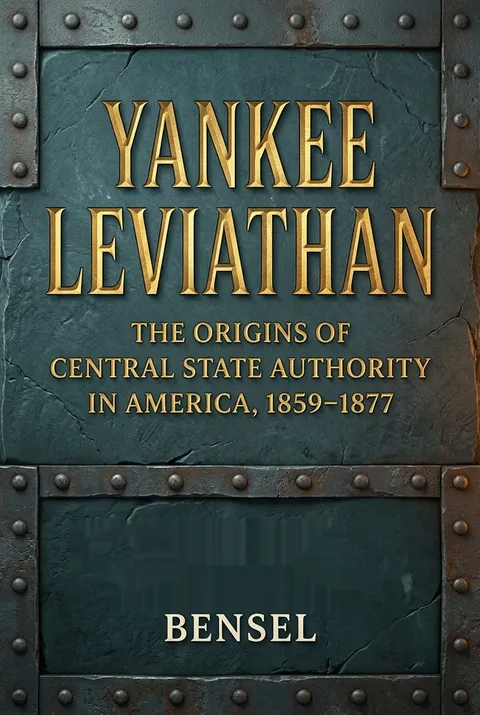

Key Takeaways
1. The Civil War, Not the Constitution, Forged the American State
In that sense, then, an account of American state formation can begin with the Civil War with little lost in historical continuity or theoretical generality.
A New Beginning. The American state, as a truly centralized and sovereign entity, did not emerge from the Constitutional Convention of 1787, but rather from the crucible of the Civil War. The antebellum government was a "mere shell" by 1860, with limited administrative presence and sovereignty contingent on state consent. The war rendered this old structure anachronistic, paving the way for a fundamentally new national state.
Sovereignty Established. Union victory definitively settled the long-standing question of national versus state sovereignty. Before the war, the right of states to secede was a contentious issue, but the Union's triumph affirmed the federal government's fundamental attributes of territorial and governmental sovereignty. This outcome was not inevitable, depending entirely on the North's will and strength to impose its vision.
Foundational Moment. The conflict transformed the national government, strengthening it in every dimension of institutional design and substantive policy. It committed the entire apparatus to promoting northern industrial development and western settlement. This period, more than the nation's founding, represents the true foundational moment in American political development, setting the stage for its future trajectory.
2. Southern Separatism Was the Primary Catalyst for State Formation
Recognition of the primacy of southern separatism in American state formation — the large something that did happen - emphasizes the membership of the United States in that class of nations that have had as one of their most prominent developmental influences the ebb and flow of separatist threats to national cohesion.
Existential Threat. Southern separatism posed an existential threat to the Union, compelling the North to consolidate power and define national identity. The South's secession was a rational response to the perceived threat of Republican control over the federal government, which promised to undermine the plantation economy and slavery. This forced the Union to articulate a robust nationalism.
Republican Imperatives. Northern resistance to secession was driven by a dual imperative:
- Preventing Disintegration: Fear that successful secession would lead to further fragmentation of the Union.
- Maintaining Hegemony: The need to preserve the Republican coalition's dominance and its program for national economic development.
The war became an extension of antebellum conflicts over economic and political power.
Unavoidable Conflict. The political economy of secession made conflict highly likely. Southern leaders, believing disentanglement would be easy and economically advantageous, rejected compromises that would accelerate northern industrial development. This intransigence, coupled with events like John Brown's raid, pushed the nation towards an "irrepressible conflict" where northern nationalism became inextricably linked to suppressing southern independence.
3. The Confederacy: A Paradox of Statist Mobilization from an Agrarian Base
In fact, however, many features of the Confederate war mobilization were far more statist and modern than their counterparts in the Union.
Agrarian Statism. Despite its "premodern" agrarian base and states' rights ideology, the Confederacy rapidly constructed a highly centralized and interventionist state. This was a stark contrast to its antebellum opposition to federal power, demonstrating that southern leaders prioritized national survival over philosophical consistency when faced with an external threat.
Comprehensive Controls. The Confederate state implemented extensive economic and social controls:
- Conscription: The first military draft in American history, allocating labor across the economy.
- Impressment: Forcible appropriation of private property (supplies, slaves, factories) with government-set prices.
- Industrial Direction: Direct control over private production (e.g., wool, cotton, ordnance) and state-owned enterprises.
- Railroad Control: Centralized direction of rail operations and impressment of rolling stock.
These measures gave the government almost absolute command over the southern economy.
Revolutionary Leap. This state-directed mobilization, far exceeding the pre-war economy's capabilities, represented a "remarkable leap" beyond its social base. It aimed to ameliorate class conflict (e.g., taxing overseers for soldiers' families) and demonstrated a statist ambition that, had the Confederacy survived, could have led to a more interventionist reorganization of its political economy.
4. The Union's Market-Oriented War Effort Fueled Incremental State Expansion
The northern war effort mobilized materiel and men by relying on voluntary contracts within a comparatively robust capitalist market.
Capitalist Mobilization. Unlike the Confederacy, the Union's war effort largely relied on its robust capitalist markets. Voluntary contracts for military supplies and manpower meant the central state intervened less directly in industrial and agricultural sectors, allowing them to operate with relative autonomy.
Financial Centralization. The primary area of significant state expansion in the Union was the financial system:
- Abandonment of Gold Standard: Insulated the domestic economy from foreign market fluctuations.
- Legal Tender Greenbacks: Nationalized currency and modified private contracts.
- National Banking System: Restructured capital markets, tying banks to federal debt and creating a national currency.
These policies brought the Treasury into an intimate and influential relationship with the nation's financial system.
Incremental Adaptation. While impressive in scale, the Union's state-building was an "incrementalist, though accelerated adaptation" of existing capacities to advancing industrial and commercial interests. It avoided the "cannibalistic" demands of the Confederate state, reinforcing the "renewable vitality of northern commerce and productive capacity" rather than fundamentally transforming its social base.
5. Finance Capital's Rise Was Tied to the State, Yet Led to Disillusionment
When the Civil War ended, the interests of finance capitalists and the American state were probably more closely linked than at any other point in the nineteenth century.
War-Forged Alliance. The Union's massive war debt and financial policies created a new class of finance capitalists, deeply intertwined with the state's fiscal health. New York City solidified its position as the nation's financial hub, and domestic capital markets gained autonomy from European influence due to the war.
Treasury Incompetence. Despite this close linkage, finance capitalists grew increasingly disillusioned with the Treasury's administrative capacity. Secretaries like McCulloch and Boutwell were criticized for:
- Clumsy Market Interventions: Aggravating seasonal money market stringency.
- Political Motivations: Prioritizing party patronage and political demands over financial stability.
- Lack of Expertise: Failing to understand complex market operations.
This incompetence became a primary driver of their policy preferences.
Advocates for Stability. Finance capitalists, through influential journals and figures like David Wells, became staunch advocates for:
- Resumption of Gold Standard: To insulate markets from political interference and Treasury blunders.
- Reduced Government Spending: To ensure budgetary surpluses and facilitate debt retirement.
- Civil Service Reform: To professionalize the bureaucracy and remove political influence.
Their opposition to radical Reconstruction was partly rooted in these concerns, as it implied continued government spending and market instability.
6. Reconstruction's Failure Stemmed from Republican Internal Contradictions
The abandonment of Reconstruction also brought to an end the hegemonic supremacy of the Republican party and the thoroughgoing identification of state and party during the Civil War era.
Party Fragmentation. Reconstruction failed largely due to internal contradictions within the Republican party. As various factions achieved their pre-war goals (e.g., tariff protection, western settlement), their interests diverged, eroding the party's revolutionary zeal and transforming it into a broker of competing economic agendas.
The Dilemma of Land. A core dilemma was the need for massive land redistribution from former Confederates to freedmen to ensure black economic and political independence. However, this threatened to:
- Widen Class Cleavages: Potentially extending demands for wealth redistribution to northern workers.
- Undermine Property Rights: Setting a dangerous precedent for capitalist property relations.
The Republican party ultimately shied away from this radical step.
Fiscal Starvation. Without land redistribution, loyalist power in the South relied on federal military occupation and civil administration. However, northern factions, particularly finance capitalists, prioritized fiscal retrenchment, tax reduction, and specie resumption. This led to a "slow starvation" of Reconstruction, as military forces and administrative support were gradually withdrawn, leaving southern Republicans vulnerable.
7. Post-War Policies Systematically Impoverished the South, Accelerating Northern Growth
The systemic impact of these policies reinforced the already significant advantages the North possessed in the national marketplace.
Economic Exploitation. Union victory and subsequent policies systematically impoverished the South. War devastation, coupled with federal policies like cotton excise taxes, protective tariffs, and the concentration of federal services in the North, led to a massive redistribution of wealth from the South to northern industrial and western expansion.
Underdevelopment Ensured. The forced integration of the plantation system into the national economy relegated southern cities to secondary roles, hindering their industrial and financial development. Capital formation and advanced production functions were concentrated in the North, making the South a dependent, peripheral region.
Northern Acceleration. This economic exploitation of the South significantly accelerated northern modernization. The wealth drained from the South, combined with foreign exchange from cotton exports, subsidized northern industrialization and western expansion. This allowed the Republican party to maintain its developmental coalition by offering benefits (like military pensions) to western agrarians, delaying their potential revolt against eastern capital.
8. Inverted Class Alignments Hindered National Class-Based Politics
This cross-sectional inversion of class alignments made the articulation of coherent class claims (consistent across the entire nation) impractical in national politics, because an attack on economic privilege could only be made by sacrificing the elite interests of one of the two major parties.
A Divided Elite. The American upper class was deeply divided post-Civil War:
- Northern Elite: Industrialists and financiers, committed to national economic dominance via the Republican party.
- Southern Elite: Plantation owners, committed to regional autonomy via the Democratic party.
This schism prevented a unified elite front against lower-class demands.
Cross-Sectional Inversion. This elite division led to an "inverted class alignment" in national parties:
- Republicans: Northern economic elites + southern freedmen/poor whites.
- Democrats: Southern plantation elites + northern immigrant workers/subsistence farmers.
This meant that an attack on economic privilege by one party would inadvertently harm its own elite interests in another region.
Social Democracy's Barrier. This unique party structure made the emergence of a coherent national social-democratic movement difficult. Appeals to class solidarity were undermined by regional loyalties and the fact that "lower class" interests were split between parties whose regional elites were diametrically opposed. This structural impediment contributed to the comparative weakness of socialist movements in the U.S.
9. The U.S. Army Remained a Northern Institution, Insulated from Southern Influence
The result was that the U.S. Army, the largest and most professional arm of the central state, remained a northern army until after the turn of the century.
Northern Dominance. The Civil War fundamentally altered the composition of the U.S. Army's officer corps. Southern officers largely resigned to join the Confederacy, and subsequent federal statutes barred Confederate veterans from commissions. This ensured the army remained a predominantly northern institution, insulated from southern separatist influence.
Political Tool. This northern-dominated army was a crucial tool for the Republican party during Reconstruction, enforcing federal authority and protecting loyalist voters. However, its effectiveness was hampered by inadequate troop numbers and a lack of sustained political will from Washington.
Post-Reconstruction Legacy. Even after Reconstruction ended and former Confederates regained political power in the South, the army's northern identity persisted. This meant that a significant arm of the central state remained beyond the influence of southern separatists, providing a check on their ability to challenge national unity, even as they gained substantial influence over other federal policies.
People Also Read


Download PDF
Download EPUB
.epub digital book format is ideal for reading ebooks on phones, tablets, and e-readers.








































