
Plot Summary
Storm on the Horizon
Audra, a shy Lithuanian girl, lives under the shadow of Russian occupation in 1893, where even her name and language are forbidden. Her parents, loving but secretive, try to shield her from the dangers of their resistance work. Audra's world is small, defined by the rhythms of farm life and the warmth of her family, but tension simmers beneath the surface. Her father's "magic" is more than sleight of hand—it's a cover for something dangerous. When Russian Cossacks arrive, the storm that has been brewing finally breaks, and Audra is thrust into a world where silence and obedience are no longer options. The chapter sets the emotional stakes: the loss of innocence, the threat to identity, and the first stirrings of courage.
Flames and Flight
The arrival of Cossack soldiers shatters Audra's life. Her parents' secret resistance work is exposed, and their home is set ablaze. In the chaos, Audra's father stays behind to stall the soldiers, while her mother and Audra flee across the fields. When her mother is captured, Audra is forced to run alone, clutching her father's heavy bag—her only link to her family and their cause. The burning of her home is both literal and symbolic: everything familiar is lost, and Audra is left with nothing but questions, fear, and a mysterious package she must deliver. The trauma of this night marks the end of childhood and the beginning of Audra's journey into resistance.
Into the Forest's Shadow
Alone and injured, Audra hides in the forest, evading soldiers who search for her. The woods, once a place of childhood exploration, become a realm of fear and uncertainty. She is forced to rely on her wits and the kindness of strangers, as villagers risk their own safety to help her evade capture. The forest is both a physical and emotional landscape—full of shadows, memories, and the weight of her parents' absence. Audra's grief and guilt are overwhelming, but the promise she made to her mother—to deliver the package—becomes her anchor. The chapter explores the loneliness of exile and the first glimmers of solidarity among the oppressed.
The Burden of Secrets
Audra's journey to the village of Venska is fraught with hunger, pain, and uncertainty. She meets Lukas, a resourceful and enigmatic boy who helps her find her way. The package she carries is revealed to be a book—an object of immense danger and value in a land where Lithuanian words are banned. Audra's anger and confusion grow: how could a book be worth so much suffering? Yet, as she delivers it to Milda, a woman at the heart of the underground resistance, she begins to understand the stakes. The burden of secrets—her parents', her own—becomes a crucible for her emerging sense of purpose.
A Village of Defiance
In Venska, Audra discovers a network of ordinary people engaged in extraordinary acts of resistance. Milda's home is a hub of clandestine activity, with a hidden library and a secret school where children learn their forbidden language. Audra is offered shelter, food, and—most importantly—truth. She learns that her parents were part of a vast movement to smuggle books and preserve Lithuanian identity. The villagers' quiet defiance inspires Audra, but she is still reluctant to join their cause. The chapter is a turning point: Audra moves from isolation to community, from ignorance to understanding, and from fear to the first stirrings of agency.
The Book's True Weight
Audra's initial resentment toward the book she carried gives way to awe as she witnesses its impact. In Milda's underground library, she sees shelves of banned books—each a seed of hope and resistance. She learns that the Russian Empire's true goal is not just to control land, but to erase Lithuanian culture and memory. Books are not just objects; they are weapons in a war for identity. Audra's struggle to read and write becomes symbolic of her struggle to claim her own voice. The chapter explores the transformative power of literacy and the realization that words can be as dangerous—and as vital—as any weapon.
Milda's Hidden Library
Milda reveals the full extent of the underground movement: a network of book smugglers, secret schools, and hidden libraries. Audra is invited to join, but her fear and grief hold her back. When Cossack soldiers raid the village, Milda's quick thinking and the solidarity of the townspeople save Audra and the precious books. The experience is harrowing, but it cements Audra's bond with her new allies. She begins to see herself not just as a victim, but as a potential actor in the struggle. The chapter is rich with tension, camaraderie, and the sense that every act of learning is an act of rebellion.
Lessons in Disguise
To survive as a smuggler, Audra must learn to blend in, to lie convincingly, and to carry contraband under the noses of the enemy. Milda and Lukas teach her the tricks of the trade—how to hide books, how to pass as a harmless peasant, how to use distraction and misdirection. Audra's training is both practical and psychological: she must overcome her instinct to hide and instead learn to act. The lessons are often delivered through games and stories, blurring the line between magic and survival. The chapter is a montage of growth, as Audra's confidence and skills begin to match her courage.
The Smuggler's Apprentice
Audra's initiation into the world of book smuggling is fraught with mistakes and close calls. She learns the routes, the signals, and the dangers of the borderlands. Her partnership with Lukas deepens, marked by banter, rivalry, and growing trust. Together, they face soldiers, betrayals, and the ever-present threat of informants. Audra's failures are painful, but each one teaches her something vital about herself and the cause. The chapter is a coming-of-age crucible, as Audra moves from apprentice to true participant in the resistance.
The Price of Words
The cost of resistance becomes brutally clear. Audra is confronted by Officer Rusakov, a relentless Cossack who offers her a terrible bargain: betray her friends in exchange for her parents' freedom. The moral dilemma is excruciating—every choice carries the risk of losing someone she loves. Audra's loyalty is tested, and she must decide what kind of person she wants to be. The chapter is a meditation on the price of integrity, the pain of loss, and the courage required to choose the greater good over personal desire.
Betrayal and Bargains
Haunted by the possibility of saving her parents, Audra wrestles with guilt and temptation. She is nearly broken by the weight of her choices, but the support of Lukas, Milda, and the community helps her find her footing. The resistance is not just about smuggling books—it is about forging a new identity, one that is rooted in solidarity, sacrifice, and hope. Audra's journey becomes a mirror for the nation's struggle: to survive, to remember, and to resist erasure. The chapter is emotionally raw, exploring the inner battles that define true heroism.
Courage in the Ashes
Tragedy strikes again as the Cossacks burn villages, destroy homes, and punish anyone suspected of resistance. Audra witnesses the devastation firsthand, but also the resilience of her people. Even as books are burned and lives are lost, the hunger for knowledge and freedom only grows stronger. Audra's grief is tempered by a newfound sense of purpose—she is no longer running from fear, but toward a vision of a free Lithuania. The chapter is a testament to the endurance of hope in the face of overwhelming darkness.
The Border's Cold Embrace
Audra and Lukas undertake a perilous mission to cross the border into Prussia, where Lithuanian books are still printed. The journey is fraught with physical and psychological danger—icy rivers, watchful soldiers, and the ever-present risk of betrayal. The border is both a literal and symbolic threshold: to cross it is to risk everything for the promise of a future. Audra's ingenuity and Lukas's resourcefulness are tested to the limit, but together they succeed in bringing back a new supply of books. The chapter is a celebration of courage, partnership, and the power of small victories.
Smoke and Sacrifice
The Russian crackdown intensifies, culminating in the infamous Kražiai Massacre. Soldiers attack a church where villagers have gathered to protect their faith and culture. Audra, Lukas, and Ben are caught in the chaos, forced to choose between escape and solidarity. Smoke bombs, quick thinking, and sheer luck save many lives, but the cost is high—Ben is lost, and the community is left to mourn its dead. The chapter is a harrowing account of collective sacrifice, the brutality of oppression, and the unbreakable spirit of those who refuse to be silenced.
The Massacre at Kražiai
In the aftermath of the massacre, Audra and Lukas help survivors, tend to the wounded, and bear witness to the suffering of their people. The loss of Ben, revealed to be Audra's grandfather, is a personal and communal blow. Yet, even in grief, the community finds strength in each other and in the stories they share. Audra's understanding of her own legacy deepens—she is not just a smuggler, but a link in a chain of resistance that stretches back generations. The chapter is a meditation on memory, mourning, and the responsibility to carry the flame forward.
The Power of Stories
Audra embraces her role as both smuggler and storyteller. She learns to read and write, to craft her own narratives, and to see herself as an agent of change. The act of writing becomes an act of defiance—a way to preserve history, inspire others, and imagine a different future. The community's hunger for books is undiminished, and Audra's work takes on new meaning. The chapter is a celebration of the enduring power of stories to heal, unite, and transform.
Loss, Legacy, and Return
Years pass, and the struggle continues. Audra loses friends and mentors, but gains wisdom and resilience. The press ban is finally lifted, and Lithuania moves toward independence. Audra is reunited with her parents, and with Lukas, who has reconciled with his own past. Together, they build a new life, raising children who will never know the silence and fear of occupation. The chapter is both an ending and a beginning—a testament to the enduring legacy of those who fought for words, for memory, and for freedom.
Freedom's Lasting Flame
The story closes with Audra, now a mother, reading to her children in a free Lithuania. The sacrifices of the past are honored, and the work of resistance is revealed to be the foundation of the nation's rebirth. The flame of freedom, kindled by countless acts of courage, continues to burn. Audra's journey—from frightened girl to storm of change—becomes a symbol for her people. The chapter is a final affirmation: words can change the world, and stories can outlast empires.
Analysis
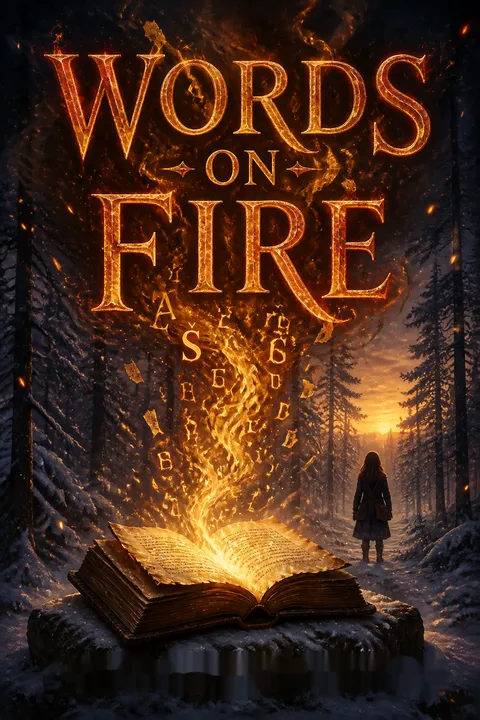
"Words on Fire" is a powerful meditation on the relationship between language, identity, and resistance. Set against the backdrop of Russian-occupied Lithuania, the novel dramatizes the existential stakes of cultural erasure: to lose one's words is to lose oneself. Through Audra's journey from frightened child to courageous smuggler, the story explores the psychological costs of oppression and the redemptive power of community. The book's central metaphor—the forbidden book—serves as a vessel for memory, hope, and the possibility of change. Nielsen's narrative structure, rich in foreshadowing and echo, underscores the cyclical nature of trauma and resilience. The lessons are clear and urgent: freedom is never given, only won through collective sacrifice; stories are not luxuries, but necessities; and even the smallest acts of defiance can kindle a flame that outlasts tyranny. In a modern context, "Words on Fire" is a reminder that the fight for language, truth, and dignity is ongoing—and that the stories we tell, and the words we dare to speak, are themselves acts of liberation.
Review Summary
People Also Read

Characters
Audra Zikaris
Audra begins as a timid, sheltered girl, her world defined by fear and silence under Russian occupation. The trauma of losing her parents and home forces her into a journey of survival and self-discovery. Psychoanalytically, Audra's arc is one of individuation: she must integrate the courage, cunning, and compassion she inherits from her parents with her own emerging sense of agency. Her relationships—with Milda, Lukas, and the resistance—transform her from a passive observer to an active participant in history. Audra's development is marked by guilt, grief, and the constant tension between self-preservation and sacrifice. Ultimately, she becomes a symbol of her nation's resilience: a storm that cannot be silenced.
Lukas
Lukas is Audra's guide, partner, and eventual confidant. Outwardly clever and daring, he masks deep wounds: the son of a Russian officer, he is torn between two worlds. His humor and bravado conceal a longing for belonging and a fear of betrayal. Lukas's relationship with Audra is complex—marked by rivalry, affection, and mutual dependence. He teaches her the skills of smuggling, but also learns from her courage and integrity. Lukas's journey is one of reconciliation: with his past, with his father, and with his own identity as a Lithuanian. He embodies the possibility of transformation and the power of chosen family.
Milda
Milda is the heart of the underground movement—a woman of disguises, secrets, and unwavering resolve. She provides shelter, wisdom, and emotional support to Audra and countless others. Milda's psychoanalytic role is that of the "good mother"—nurturing, instructive, but also demanding. She challenges Audra to grow, to learn, and to risk. Her hidden library and secret school are symbols of cultural survival. Milda's own losses and sacrifices are never far from the surface, but she channels her grief into action. Her legacy is the community she builds and the hope she sustains.
Ben Kagan
Ben is a veteran of past uprisings, scarred by failure and loss. He is both a leader and a loner, driven by a sense of duty to atone for the past. His relationship with Audra is fraught—he is protective, critical, and often harsh, but his love is revealed to be deep and familial. Ben's psychoanalytic function is that of the "wounded father"—a figure whose authority is both a burden and a gift. His death is a turning point, forcing Audra to claim her own legacy. Ben's story is a meditation on the costs of resistance and the necessity of hope.
Officer Rusakov
Rusakov is the face of Russian authority—ruthless, cunning, and obsessed with order. Yet, he is not a caricature; his relationship with Lukas reveals a capacity for conflict and even change. Rusakov's pursuit of Audra and the resistance is both personal and political. He is driven by a belief in the righteousness of empire, but haunted by the costs. Psychoanalytically, he represents the "shadow"—the force that must be confronted and integrated for true freedom to be achieved. His eventual fall is both a victory and a warning: power built on fear is always fragile.
Lina and Henrikas Zikaris (Audra's Parents)
Audra's parents are the emotional and moral foundation of her journey. Their love is fierce, but their secrets are a source of pain. They represent the older generation of resistance—willing to risk everything for the future. Their arrest and exile are the catalyst for Audra's transformation. Psychoanalytically, they are the "lost objects" whose absence propels the hero's quest. Their eventual reunion with Audra is both a personal and national restoration.
Roze
Roze is a younger girl who looks up to Audra and represents the children whose futures are at stake. Her vulnerability and courage highlight the intergenerational stakes of the struggle. Roze's presence is a reminder that the fight for words is also a fight for the right to grow, learn, and dream.
Violeta and Filip
Violeta and Filip are among the villagers who risk their lives to protect Audra. They embody the spirit of communal resistance—ordinary people performing extraordinary acts. Their actions demonstrate that heroism is not limited to the few, but is a collective endeavor.
The Priest
The priest provides moral guidance and practical support to the resistance. His sermons and actions frame the struggle as both a spiritual and political battle. He represents the enduring power of faith and the role of the church as a sanctuary for the oppressed.
The Community
The villagers, students, and townspeople who populate Audra's world are not mere background—they are the soil in which resistance grows. Their gradual shift from fear to defiance mirrors Audra's own journey. The community's resilience, grief, and hope are the true measure of the story's stakes.
Plot Devices
The Forbidden Book
The book Audra carries is more than contraband—it is a vessel of language, history, and hope. Its journey mirrors Audra's own: hidden, hunted, but ultimately transformative. The book's weight is both literal and metaphorical, representing the burden and blessing of heritage. Its presence drives the plot, catalyzes relationships, and crystallizes the stakes of the conflict.
Disguise and Deception
Characters survive by adopting false identities, using magic tricks, and mastering the art of the lie. Disguise is both a practical necessity and a psychological motif—everyone is hiding something, from the enemy and from themselves. The motif of magic blurs the line between illusion and reality, highlighting the power of narrative to shape perception.
The Journey and the Threshold
Audra's repeated journeys—across fields, forests, and borders—are rites of passage. Each crossing is a test of courage, ingenuity, and loyalty. The border is both a literal obstacle and a metaphor for transformation: to cross is to risk, to change, to become.
Foreshadowing and Echo
The story is structured around cycles of loss and renewal: homes burned, books destroyed, but always rebuilt and rewritten. Early warnings and small acts of defiance foreshadow larger confrontations. The motif of the storm—Audra's name—echoes throughout, signaling both danger and the promise of cleansing change.
The Power of Storytelling
Stories—fairy tales, histories, personal accounts—are woven throughout the plot. They provide comfort, instruction, and inspiration. Audra's journey to literacy mirrors the nation's struggle to reclaim its voice. The act of writing becomes an act of rebellion, and the final chapters affirm that stories can outlast empires.
Download PDF
Download EPUB
.epub digital book format is ideal for reading ebooks on phones, tablets, and e-readers.








































