


Key Takeaways
Overthinking isn't insight, it's a lie that keeps you stuck
Rumination masquerades as self-awareness. Susan Nolen-Hoeksema, who spent twenty years studying what she calls overthinking, defines it as churning over negative thoughts and feelings in endless loops that never resolve. When depressed people ruminated for just eight minutes in her lab, they felt intensely insightful ("Now I see how bad my marriage really is"). They were wrong. Rumination doesn't strip away rose-colored glasses; it hands you tunnel vision that only illuminates what's broken.
The distorted lens effect. A bad mood acts like a filter, showing only the negative slices of past, present, and future while blocking equally valid positive memories. Overthinkers generate worse solutions to problems, feel less certain about them, and lose the motivation to act even on solutions they know would help.
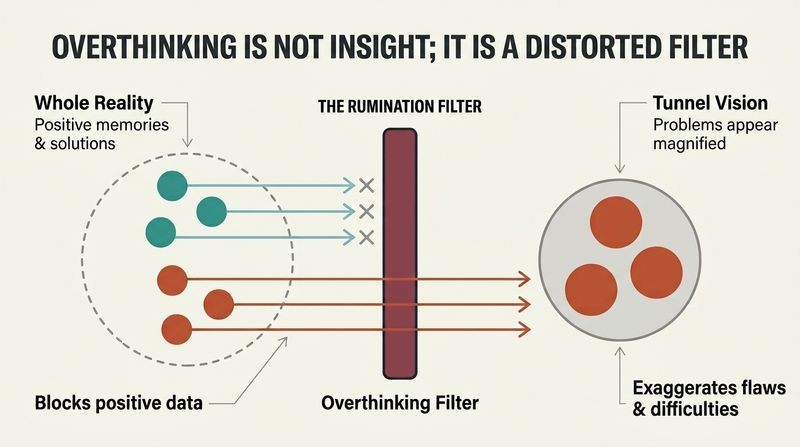
What's striking is how this inverts the therapy culture assumption that more introspection equals more health. The finding aligns with research on "depressive realism" being overstated: ruminators aren't seeing truth, they're mood-congruent memory retrieval in action, a well-documented cognitive bias. The distinction between rumination and genuine reflection also echoes Ethan Kross's later work on "chatter," where the ruminating voice narrows attention rather than widening it. One nuance worth flagging: the book treats overthinking as almost uniformly toxic, yet some processing of negative emotion is protective. The real skill is knowing when reflection curdles into rumination.
Watch small worries double like yeast until they swallow your whole life
The yeast effect. Nolen-Hoeksema's metaphor for how rumination expands: you start kneading one specific worry, and like bread dough it doubles, spreading from a single event to unrelated concerns and finally to sweeping verdicts about your worth. A landscape designer named Franny begins fretting over one demanding client, then jumps to old rejections, her boyfriend, her attractiveness, her health, her son's drinking, resolving none of it.
Three flavors of overthinking. She identifies distinct patterns:
1. Rant-and-rave: wounded self-righteousness plotting revenge on those who wronged you.
2. Life-of-their-own: inventing dramatic causes for a bad mood until problems seem real that barely exist.
3. Chaotic: unrelated worries flooding in at once, so disorienting you shut down or reach for alcohol.
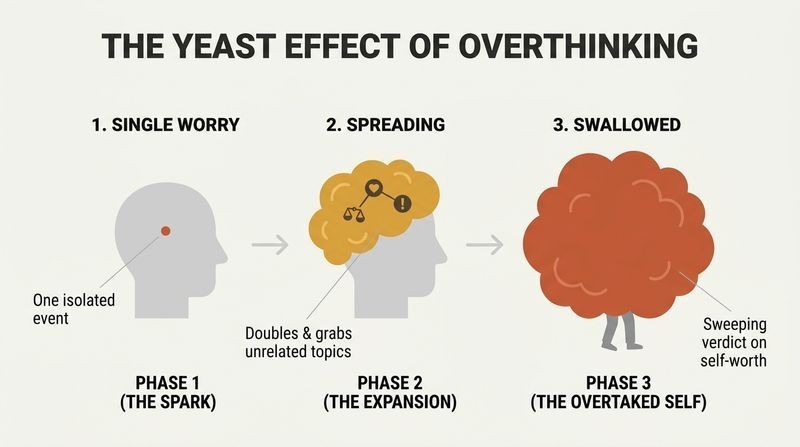
The yeast metaphor is more than charming, it captures the associative architecture of memory. Gordon Bower's network theory, which the author cites, showed that mood itself links otherwise unrelated memory nodes. So a bad mood functions like a master key, unlocking every negative room in the house at once. This explains why a curt email from your boss can end with you questioning your entire career. A useful extension: cognitive behavioral therapy targets exactly this spreading activation by forcing specificity, keeping the thought pinned to the actual triggering event rather than letting it metastasize into global self-judgment.
Women ruminate more, and it doubles their risk of depression
The two-to-one gap. Women are twice as likely as men to become seriously depressed, a ratio found across cultures. Nolen-Hoeksema's research pinpoints rumination as a major statistical contributor. In her study of roughly 1,300 people, women reported overthinking more than men when sad, and this accounted for a large chunk of the depression gap. Crucially, overthinking is equally toxic for both sexes; women simply fall into it more often.
Why women get pulled in. She points to social roots rather than hormones: chronic strains like unequal pay (74 cents to the dollar then) and carrying most of the housework, higher rates of sexual trauma, defining themselves through relationships, and being trained from girlhood to attend to feelings while being told those feelings are uncontrollable.
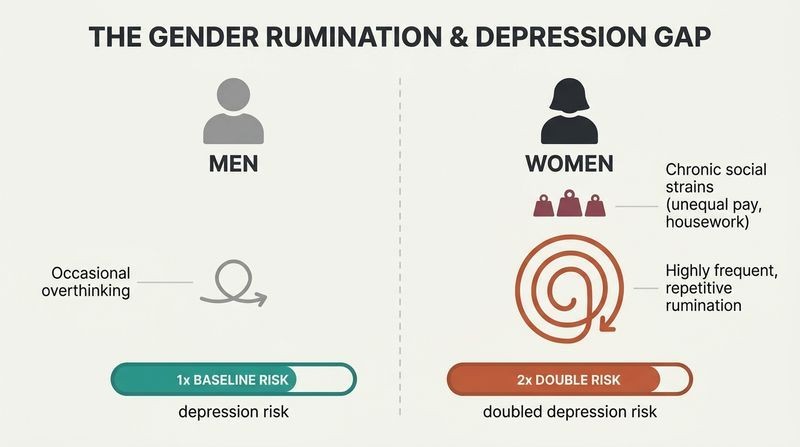
The gender claim is the book's spine and its most debated. Nolen-Hoeksema deliberately steers away from biological determinism toward social explanation, a defensible stance given the cross-cultural consistency of the ratio. A controlled detail strengthens her case: when sad, 92% of women versus 46% of men chose a rumination task over a distraction task, suggesting genuine behavioral difference, not just greater willingness to admit feelings. Still, later meta-analyses find rumination explains only part of the gap; trauma exposure and hormonal transitions (postpartum, perimenopause) also matter. The book's strength is refusing the lazy "it's just hormones" shrug and locating leverage in changeable conditions.
Break the grip first with active distraction, before solving anything
Escaping quicksand has three steps. Break the grip, climb to higher ground, then avoid future traps. Step one is counterintuitive: stop analyzing and distract yourself. Just eight minutes of pleasant, absorbing distraction lifted moods, sharpened thinking, and improved problem-solving in her experiments. Distraction cuts the phone lines between the brain's negative nodes so they stop feeding each other.
Make it active and engrossing. Distractions requiring concentration and movement (a hard squash match, cooking elaborate food, jogging) beat passive ones. Other grip-breakers include the "thought police" (silently yelling STOP), scheduling a daily "worry hour" to postpone rumination, prayer or meditation, calling a friend who redirects rather than co-ruminates, and writing thoughts down. Avoid the false fixes: binge eating and alcohol, which narrow focus onto worries and breed new problems.
This is where the book diverges sharply from Freudian catharsis models. The claim that distraction is therapeutic, not avoidant, unsettles people schooled to "process" everything. The resolution is timing: distraction is a circuit breaker, not a solution, deployed to restore the cognitive bandwidth needed for actual problem-solving. This maps neatly onto modern emotion-regulation research distinguishing adaptive distraction from chronic experiential avoidance. The alcohol point deserves emphasis: the "alcohol myopia" finding (Steele and Josephs) shows intoxication sharpens attention on whatever dominates, so a drink doesn't drown sorrows, it spotlights them. Overthinkers are twice as likely to binge drink, a vicious feedback loop.
Choose your lens: you have the right to reframe any situation
Higher ground begins with a decision. Once free of the grip, resist the urge to avoid problems entirely (that just breeds new ones). Instead, deliberately adjust your focus. Lori, a mom coaching her son's soccer team, spent nights ruminating after a parent smeared her as "hypercompetitive." She finally declared she had the right to choose her perspective, confined worry to a set hour, refused the victim frame, and moved her team up a league anyway.
Feel the emotion, then act past it. Accept that you're angry or sad without building an airtight legal case that you're justified. Emotions needn't dictate action. Rhonda, who fired off a furious email to an editor, embraced her anger but recognized her higher goal (getting her book published) and repaired the relationship rather than escalating.
The "right to choose your perspective" anticipates the reappraisal techniques central to Stoicism and modern CBT alike: events are neutral until interpreted. What's valuable here is the sequencing. Reappraisal fails when attempted mid-flood, which is why the author insists on breaking the grip first. There's a subtle feminist argument embedded too: women socialized to seek permission for their feelings get stuck litigating whether anger is "allowed" instead of acting on it. The move from "am I justified?" to "what's my goal?" is a quiet act of agency. One caution: reframing can shade into gaslighting oneself if genuine injustices get reframed away rather than addressed.
When your mood tanks for no reason, suspect sleep, hunger, or hormones first
Keep it simple before going deep. Life-of-their-own overthinking thrives when you feel bad without knowing why, then invent grand causes: a failing marriage, a wasted life, a hollow soul. Often the real culprit is embarrassingly mundane. Nolen-Hoeksema urges checking the simple explanations first: Did you sleep badly? Are you hungry or hungover? Is it that time of the month? A grouchy boss or a child's bad grade can sour a whole day.
Mood distorts judgment more than we admit. Psychologist Norbert Schwarz shifted people's ratings of their entire lives just by planting a quarter for them to "find" beforehand. If a stray coin can move your life satisfaction, a bad night's sleep can manufacture a fake existential crisis. Nap, eat, or get busy, and watch the phantom problems shrink.
This is behavioral economics smuggled into self-help. Schwarz's misattribution research (including his famous finding that weather skews life-satisfaction surveys) demonstrates how readily we mistake transient bodily states for verdicts about our lives. The practical wisdom resembles the recovery community's HALT check: never trust your thinking when Hungry, Angry, Lonely, or Tired. What the book adds is a specific warning against the introspection reflex, the trained habit of treating every mood as a meaningful signal. Sometimes a feeling is just low blood sugar wearing a philosophical costume. The discipline of checking physiology before narrative is deceptively powerful and almost never taught.
Stop comparing yourself; happy people ignore the scoreboard
Social comparison poisons the unhappy. Sonja Lyubomirsky's research revealed a sharp divide. Unhappy people constantly measure themselves against others and let the ranking govern their mood. In one study, unhappy students felt worse getting an excellent evaluation when a peer scored higher than they felt getting a poor evaluation when a peer scored even lower. Their self-worth tracked their rank, not their actual performance.
Happy people run on internal standards. They largely ignore comparison information, judging themselves against their own values and goals. A sense of entitlement ("I deserve what they have") feeds comparison, and a vacuum of values leaves you defenseless against pop culture's yardsticks. The remedy is to ask: does this even matter to me? Can I be satisfied with what I have? What are my actual goals?
Lyubomirsky's counterintuitive finding, that relative position trumps absolute outcome for unhappy people, prefigures a decade of social-media research. The mechanism she identified in a lab now operates at planetary scale through Instagram and LinkedIn, engineered to serve upward comparisons continuously. The prescription (build internal standards) is sound but harder than the book implies, because identifying authentic values requires the very quiet reflection that a comparison-saturated culture makes scarce. Worth connecting to self-determination theory: intrinsic goals (growth, relationships, contribution) protect well-being, while extrinsic goals (wealth, status, image) that depend on outperforming others reliably erode it, even when achieved.
Ditch goals that aren't yours; chase success, not the absence of failure
Unhealthy goals trap you in rumination. Trin, a Stanford student, pursued becoming a neurologist with steely determination, though her eyes only lit up at poetry. After her father's sudden death, she heard him say "follow your heart" and realized medicine was never in hers; it was a bid for her father's love. She switched to literature and found relief. Healthy goals share four traits:
1. They come from you, not others (catch yourself saying "I should" and ask "who says?").
2. They're realistic and feasible.
3. Conflicting goals get consciously resolved or scaled down.
4. They aim at achieving success, not avoiding failure.
Approach beats avoidance. Carol Dweck's research shows children oriented toward success attempt harder tasks and bounce back; those avoiding failure play safe and crumble at setbacks, ruminating when things go wrong.
The four criteria distill decades of motivation science into a usable checklist. The approach-avoidance distinction (Dweck, later Elliot and Higgins) is one of psychology's most robust findings: promotion-focused people frame goals as gains to pursue, prevention-focused people as losses to avoid, and the latter live in chronic vigilance for threat, ideal soil for rumination. Jennifer Crocker's "contingencies of self-worth" adds a sharp edge: when your worth hinges on hitting a goal (thinness, a title), every stumble becomes an existential threat. The "who says?" test is deceptively profound, surfacing how many life scripts we run were written by parents, culture, or a critical inner voice we mistake for our own.
Forgiveness is self-medicine that literally lowers your blood pressure
Letting go heals the body, not just the mind. Forgiving doesn't mean condoning the offense or dropping accountability; you can still press charges. It means releasing the grip that anger and revenge hold on you. In a study by Witvliet and colleagues, people who imagined harboring a grudge showed spikes in heart rate and blood pressure, while those imagining forgiveness stayed calmer. Chronic unforgiveness may translate into chronic cardiovascular strain and immune suppression.
This runs against entitlement culture. Our era insists we're owed retribution against anyone who wrongs us, publicly if possible. Fran couldn't stop ruminating about her alcoholic father's beatings until she chose to forgive him, not to excuse him, but to reclaim her own life. Self-forgiveness matters too, especially for the guilt that fuels parents' and caregivers' ruminations.
The physiological data reframes forgiveness from moral virtue to health intervention, which may persuade the skeptical better than any sermon. Carl Thoreson's cardiac work, cited here, showed forgiveness training improved coronary outcomes in heart-attack survivors. This connects to broader research on hostility as a cardiac risk factor (the Type A studies eventually narrowed the toxic ingredient to chronic anger and cynicism). The book's careful separation of forgiveness from reconciliation is philosophically important and often missed: you can forgive someone you never speak to again. Where it could go further is acknowledging that premature forgiveness, urged before a victim has processed the harm, can itself become a form of suppression.
Broaden your base so one bad role can't collapse your whole self
A single-role identity is fragile. When your entire self-concept rests on one pillar (mother, or career, or wife), any crack there threatens everything, so you become hypervigilant for trouble and devastated when it comes. Sheila built her whole identity around being the perfect mom with perfect kids; when a pediatrician flagged a possible heart murmur in her daughter, her world caved in, precisely because she'd isolated herself with only her children and her worries.
Diversify your sources of self-worth. Add a few roles that connect to your values and bring new relationships: a skill like pottery, volunteering at a shelter, a cause you care about. Then a setback in one domain has others to lean on, and a supportive network to draw from. This isn't about frantic busyness; it's about not betting your entire self on a single outcome.
This is portfolio theory applied to identity: concentration risk is dangerous whether in stocks or selfhood. The insight dovetails with sociologist Patricia Linville's "self-complexity" research, which found that people with more distinct self-aspects were buffered against depression and illness after stress, because a blow to one aspect didn't spill over. The counterintuitive implication is that the intensely devoted single-role person, often praised as admirable, is psychologically overexposed. For caregivers and stay-at-home parents especially, the book's advice cuts against cultural pressure to pour everything into the family. Balance, here, is not indulgence but insurance.
Manufacture small joys during crisis; positive emotion is real medicine
Positive emotions strategies. Susan Folkman's term for deliberately infusing stressful stretches with brief good feelings: recalling happy times, telling yourself something comforting, finding a silver lining, using humor. Letitia, whose sister was dying of brain cancer, made a point of eating a peppermint patty, noticing the sky, and remembering a fun shopping trip every single day. Caregivers who did this adjusted better over time regardless of how depressed they were at the loss.
The evidence is stark. Barbara Fredrickson's "broaden and build" theory holds that positive emotions widen thinking and speed physical recovery from stress. Most haunting is the nun study: researchers scored autobiographies 180 sisters wrote in their twenties. Those expressing the least positive emotion were 2.5 times more likely to have died by 2000, and died about ten years earlier, than the most positive.
The nun study (Danner, Snowdon, Friesen) is one of longevity research's cleanest natural experiments, because convent life held diet, healthcare, marital status, and income roughly constant, isolating emotional style. A decade of life difference from a few sentences written at twenty-two is arresting. Fredrickson's broaden-and-build has since accumulated strong support: positive affect measurably expands attentional scope and creative flexibility, the opposite of rumination's tunnel vision. The subtle brilliance of Folkman's framing is that these are strategies, deliberate and trainable, not lucky dispositions. One honest limitation: forced positivity can backfire for the clinically depressed, so the emphasis on small, genuine moments rather than manufactured cheer matters enormously.
Turn 'why did this happen?' into any answer you can live with
Find your story. In Nolen-Hoeksema's bereavement research, people who could answer the question "why did my loved one die?" stopped ruminating and recovered within months. Those who couldn't stayed depressed for years. Remarkably, the content of the answer didn't matter. Religious ("God's plan"), existential ("you're born and you die"), or medical ("three packs a day gave her lung cancer") all worked equally well. What healed was reaching closure, not reaching truth.
Meaning can't be handed to you. Bereaved people bristled at others prescribing how they should feel ("you should be happy she's with God now"). Between 70% and 80% eventually found something positive in their loss, not money, but growth in character, deeper relationships, reordered priorities, a fiercer appreciation of life. Psychotherapy, whatever its school, essentially offers a coherent story that restores a sense of insight and control.
That any coherent explanation heals, regardless of accuracy, is a profound and slightly unsettling claim. It aligns with narrative psychology (Dan McAdams) and terror-management research: humans are meaning-making machines, and unresolved "why" loops are corrosive precisely because they stay open. Jerome Frank's insight that all therapies share a persuasive narrative frame anticipated the "common factors" debate in psychotherapy outcome research, where the specific technique matters less than the coherent account and the relationship. The finding on post-traumatic growth (70-80% finding benefit) tempers the trauma-as-pure-damage narrative, though critics rightly warn that reported growth sometimes reflects coping illusion rather than measurable change. Either way, the closure mechanism is real.
Analysis
Published in 2003, Women Who Think Too Much distilled Susan Nolen-Hoeksema's twenty years as the field's leading rumination researcher into accessible self-help. Its structure is smart: Part I diagnoses overthinking and its costs, Part II delivers a three-phase escape (break the grip, move to higher ground, avoid future traps), and Part III applies the toolkit to relationships, family, children, work, health, and loss through extended case narratives. The book's enduring contribution is empirical rather than inspirational. Where most self-help asserts, Nolen-Hoeksema cites controlled experiments, many her own, showing that rumination is not the royal road to insight it feels like, but a mood-congruent amplifier that degrades memory, problem-solving, and motivation while corroding relationships and predicting depression.
The book's central bet, that overthinking causally drives women's doubled depression risk, was scientifically influential and clinically productive; rumination-focused CBT and mindfulness-based cognitive therapy owe it a debt. Yet the gender framing has aged into the book's most contestable feature. The mechanism is sound and cross-culturally replicated, but rumination explains only part of the depression gap, and the sociocultural diagnosis (entitlement culture, quick-fix obsession, belly-button navel-gazing, a vacuum of values) reads as early-2000s cultural commentary layered atop rigorous science. Those chapters are the weakest, trading data for op-ed.
What holds up beautifully is the practical architecture. The insistence that distraction must precede problem-solving resolves the old catharsis-versus-avoidance debate through timing. The four-criteria test for healthy goals, the physiological case for forgiveness, self-complexity as insurance against collapse, and the finding that any coherent meaning heals grief are each grounded in citable research and immediately usable. The prose occasionally over-relies on composite case studies that can feel tidy, resolving too neatly. But as a translation of serious affective science into livable strategy, it remains unusually honest: it never promises the ruminating mind is telling the truth, and that single reframe is worth the book.
Review Summary
Women Who Think Too Much receives mixed reviews. Some readers find it insightful and helpful for managing overthinking, while others criticize its outdated views and stereotypical depictions of women. The book's strengths include practical strategies for overcoming rumination and relatable examples. However, many readers express frustration with the repetitive content, lengthy case studies, and perceived sexist undertones. Despite these criticisms, some readers appreciate the book's scientific approach and its ability to validate their experiences with overthinking.
People Also Read

FAQ
What's Women Who Think Too Much about?
- Focus on Overthinking: The book delves into the issue of overthinking, especially among women, and its detrimental effects on mental health and well-being.
- Strategies for Change: Susan Nolen-Hoeksema offers practical strategies to help women escape the cycle of overthinking and adopt a healthier mindset.
- Cultural Context: It examines societal and psychological factors that contribute to women's tendency to overthink, including historical shifts in values and expectations.
Why should I read Women Who Think Too Much?
- Understanding Overthinking: The book provides insights into why overthinking is more prevalent in women and how it can be harmful.
- Practical Solutions: Nolen-Hoeksema offers actionable strategies to combat overthinking and improve emotional health.
- Empowerment: It empowers women to reclaim their lives by recognizing and addressing overthinking patterns, leading to greater self-efficacy and resilience.
What are the key takeaways of Women Who Think Too Much?
- Overthinking is Common: Many women experience overthinking, which can lead to negative emotional states and hinder decision-making.
- Practical Strategies: The book outlines methods for breaking free from overthinking, such as engaging in distractions and seeking support.
- Cultural Influences: It discusses how societal expectations contribute to women's overthinking, emphasizing the need for self-awareness and growth.
What are the best quotes from Women Who Think Too Much and what do they mean?
- "Overthinking is not your friend." This quote highlights that overthinking clouds judgment and exacerbates negative emotions.
- "I’m not going to let this situation take over my life!" Encourages taking control of thoughts and emotions, rather than letting circumstances dictate mental state.
- "Follow your heart." Reminds readers to prioritize personal values over societal expectations, promoting authenticity and self-acceptance.
How does Women Who Think Too Much define overthinking?
- Definition of Overthinking: It involves repeatedly analyzing negative thoughts and feelings, leading to a cycle of worry and distress.
- Types of Overthinking: The book identifies three types: rant-and-rave, life-of-their-own, and chaotic overthinking, each with distinct thought patterns.
- Consequences: Overthinking can impair emotional health, hinder decision-making, and damage relationships, making it crucial to manage these patterns.
How can I break free from overthinking as suggested in Women Who Think Too Much?
- Engage in Distractions: Use positive distractions, like hobbies or physical activities, to interrupt overthinking and improve mood.
- Join the Thought Police: Actively tell yourself to stop overthinking using phrases like "Stop!" or visual cues to regain control.
- Schedule Thinking Time: Set aside specific times to reflect on worries, allowing focus on other tasks without guilt.
What strategies does Women Who Think Too Much suggest for moving to higher ground?
- Adjust Your Focus: Shift perspective from negative interpretations to a balanced view, empowering better decision-making.
- Feel Your Pain: Accept emotions without letting them dictate actions, allowing constructive processing and forward movement.
- Just Do Something Small: Taking small actions toward solving problems can break the cycle of overthinking and build momentum.
How does Women Who Think Too Much address the triggers for overthinking?
- Common Triggers: Identifies themes like relationships, work stress, family dynamics, and health concerns as triggers for overthinking.
- Personal Stories: Shares case studies and anecdotes to illustrate how these triggers manifest and lead to overthinking.
- Strategies for Each Trigger: Provides tailored strategies for addressing overthinking related to specific triggers.
What role does societal pressure play in overthinking according to Women Who Think Too Much?
- Cultural Expectations: Discusses how societal norms and expectations, especially regarding women's roles, contribute to overthinking.
- Historical Shifts: Examines how changes in women's status and opportunities have created new pressures, leading to increased self-scrutiny.
- Need for Self-Compassion: Emphasizes self-acceptance and compassion to counter negative effects of societal pressure on mental health.
How can I avoid future traps of overthinking as outlined in Women Who Think Too Much?
- Identify Weak Spots: Recognize themes and situations that trigger overthinking to minimize exposure.
- Plug the Holes: Develop skills and resources to address weaknesses, such as therapy or courses to improve coping strategies.
- Broaden Your Base: Cultivate multiple sources of self-esteem and fulfillment to ensure a balanced perspective and reduce overthinking.
How does Women Who Think Too Much suggest women cope with health-related overthinking?
- Information Gathering: Seek accurate information about health concerns to reduce uncertainty and empower decision-making.
- Support Networks: Connect with others who have similar experiences for comfort and understanding.
- Mindfulness and Relaxation: Practice mindfulness and relaxation techniques to manage anxiety related to health issues.
What insights does Women Who Think Too Much offer about coping with loss and trauma?
- Natural Grieving Process: Acknowledges grieving as a natural response to loss and encourages feeling emotions.
- Finding Meaning: Suggests finding meaning in loss to aid healing, such as reflecting on positive aspects or lessons learned.
- Support Systems: Emphasizes seeking support from friends, family, or groups to process grief and move forward.
Download PDF
Download EPUB
.epub digital book format is ideal for reading ebooks on phones, tablets, and e-readers.








































