

Key Takeaways
Treat love as a biological necessity, not a lifestyle luxury
Love is oxygen for the brain. Cacioppo, a social neuroscientist, argues that a healthy romantic connection is as essential to well-being as clean water, exercise, or sleep. Evolution sculpted our brains specifically to build and benefit from lasting bonds, and when those bonds fray, mental and physical health collapse. She opens with physicist Paul Dirac, a near-mute genius who formed no friendships until a woman named Manci coaxed him open over years. In one letter he wrote that she had made him human.
The trend runs the wrong way. Half of American adults are now single, up from 22 percent in 1950, and roughly 20 percent of the population reports loneliness severe enough to be a major source of unhappiness. Love, she insists, is endlessly adaptable but never expendable.
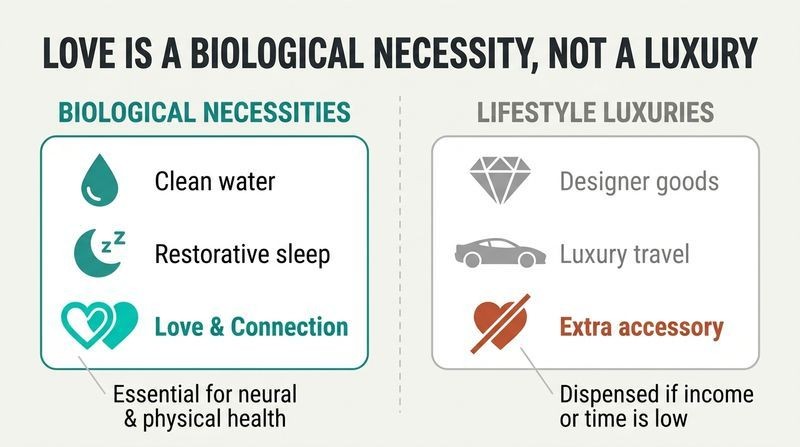
The framing productively medicalizes something usually left to poets, aligning with Harvard's 85-year Study of Adult Development, which found relationship quality at 50 predicted health at 80 better than cholesterol. One caution worth flagging: elevating romantic love to biological necessity risks pathologizing the contentedly single, a group Cacioppo herself belonged to for 37 years without feeling lonely. Her own distinction between being alone and feeling lonely softens this. The deeper claim, that connection of some kind is non-negotiable for the nervous system, is well supported. Whether that connection must be romantic, as opposed to communal or purposeful, is where reasonable scientists still diverge.
Love is not merely a feeling but a way of thinking
Love lights up your smartest hardware. Mapping prior brain scans, Cacioppo identified a love network of twelve regions. Romantic love activates the expected reward and emotional centers (the dopamine-rich ventral tegmental area, the limbic system), but it also fires the angular gyrus, a recently evolved cortical region tied to metaphor, creativity, imagination, and abstract self-representation. Einstein reportedly had an unusual one. Crucially, joy and surprise do not trigger it. Love does.
Same map, everyone. Whether a person is gay, straight, male, or female, if someone is significant to them they activate this network the same essential way. Romantic love burns hotter in both the pleasure centers and the self-referential cortex than friendship does. This is why she reframes love as cognition, not just emotion, a phenomenon that recruits the brain's most human machinery.
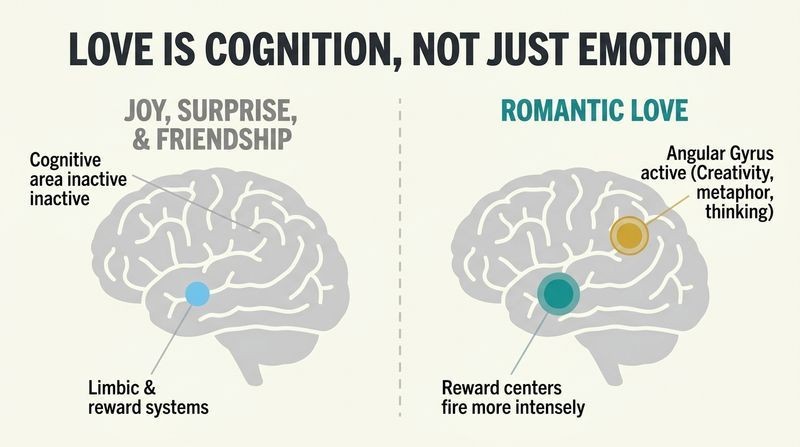
Locating love in the angular gyrus rather than only the reward system is the book's boldest scientific move, and it dovetails with embodied-cognition research suggesting abstract thought is built from bodily and relational experience. A healthy skeptic should note the limits of reverse inference: a region activating during love does not prove love is thinking, since the angular gyrus also handles arithmetic and spatial attention. Still, the finding that love and simple positive affect diverge neurally is meaningful. It suggests the folk intuition that infatuation makes you dumb is backwards. On certain tasks, thinking of a beloved measurably sharpens performance.
Loneliness is subjective and kills as reliably as smoking
It is a feeling, not a headcount. Drawing on her late husband John Cacioppo's pioneering work, she explains loneliness as an evolutionary alarm, like hunger or thirst, that signals damage to your social body and pushes you to reconnect. You can be married and lonely, or solitary and content. A meta-analysis of 70 studies and over three million people found loneliness raises the odds of early death by 25 to 30 percent, comparable to obesity.
The paradox that traps people. The alarm meant to reconnect you instead makes you hypervigilant to social threat, so you read rejection into neutral faces and push allies away. Lonely people even anthropomorphize objects (think Tom Hanks naming a volleyball Wilson). Her antidote is the acronym GRACE: Gratitude, Reciprocity, Altruism, Choice, and Enjoyment, small deliberate practices that quiet the alarm.
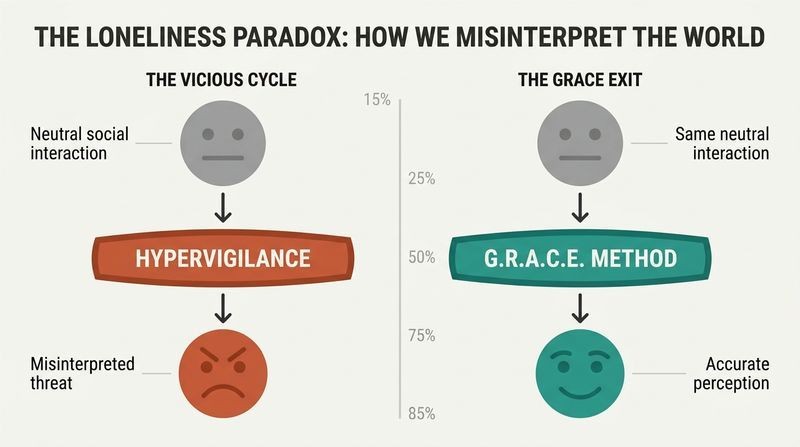
The reframing of loneliness as adaptive rather than shameful is genuinely useful, echoing pain science: the sensation exists to protect you, and malfunctions only when chronic. The counterintuitive Reciprocity advice, that the worst thing you can do for a lonely person is help them (ask them to help you instead), is supported by research on mattering and purpose. One nuance: the smoking comparison, while quotable, comes from correlational data where reverse causation lurks, since illness itself isolates people. Cacioppo's own longitudinal work controlling for baseline factors strengthens the case, but the effect size should be held as strong association rather than settled mechanism.
Your partner's name, flashed subliminally, speeds up your brain
A ten-millisecond window into the heart. Cacioppo built what students dubbed the Love Machine, a test that flashes a romantic partner's name for about 26 milliseconds, too fast for conscious perception but enough to prime the brain, then measures reaction time on a word task. People primed with a true beloved's name recognized words roughly 20 percent faster than when primed with a friend's name, and the more in love they reported being, the faster they went.
Why it matters practically. The test bypasses the rationalizing frontal lobe and reveals genuine preference, which is why torn students used it to choose between suitors and usually responded I knew it. Dopamine released by the beloved's positive associations floods connected regions, including those parsing language. Love, in other words, is a performance enhancer the conscious mind cannot fake.
The Love Machine cleverly adapts the implicit association test, long used to expose hidden bias, and flips it toward hidden affection. That methodological inversion is elegant: the same tool that reveals prejudices we wish to suppress can surface preferences we struggle to articulate. A fair critique is generalizability, since the striking demonstrations often involve small samples of undergraduates and self-reported love scores. But the core mechanism, that emotionally salient primes accelerate downstream cognition, is robust across affective priming literature. The takeaway for readers is humbling: gut feelings about who you love are often measurable neural facts arriving before your deliberating mind catches up.
Rekindle desire through the back of the brain, not the bedroom
Love and lust split the insula. The insula, buried deep in the cortex, handles bodily cravings and self-awareness. Cacioppo's analysis of 20 studies found desire activates the posterior (rear) insula, which processes concrete sensations like taste and touch, while love activates the anterior (front) insula, tied to abstract feeling. She compares the relationship to winemaking: desire is the crushed grapes, love the elixir aged from them.
A practical brain hack. Because the posterior insula also lights up for food, temperature, smell, and movement, couples whose physical spark has dimmed can reawaken it without focusing on the bedroom. Cook and taste new dishes together, cuddle, share pleasant scents, walk, run, or dance. Studies show couples who dance together report being happier together. The insula needs both a cognitive and a sensory connection to fully fire, so feed it through the senses.
This is among the book's most actionable insights, and it resonates with the Arons' classic finding that couples doing novel, arousing activities together (not just pleasant ones) report renewed relationship satisfaction. The posterior-anterior insula gradient maps neatly onto a broader neural principle: rear regions handle the concrete here-and-now, front regions handle abstraction. Reframing intimacy problems as sensory-activation problems rather than moral or attraction failures is compassionate and testable. The nuance readers should keep is dosage: shared novelty helps, but the underlying emotional safety matters more. A tense couple cooking together may simply relocate the tension to the kitchen.
Expectations quietly kill gratitude, so plan less and improvise more
Happiness is outcome minus expectation. Cacioppo married John on impromptu notice in a Paris park after he texted DO YOU WANT TO GET MARRIED AFTER WORK TODAY, dodging police who caught the wedding party standing on forbidden grass. The lesson: a Yale study by Robb Rutledge found happiness tracks not how much people win but the gap between expectation and result. Low expectations plus a small reward beats high expectations unmet.
Rein in the overactive frontal lobe. The prefrontal cortex, the brain's inner parent, plans, suppresses urges, and delays gratification, but on overdrive it breeds rumination and rigid scripts. A Dutch study found partners stop feeling grateful for sacrifices once they expect them. Quieting the PFC (through a 90-minute nature walk, meditation, or spontaneity) boosts creativity and mood. Let go of the script, she argues, as an act of faith rather than sacrifice.
The expectations-kill-gratitude formulation is a relationship-specific application of the well-established hedonic prediction-error model, the same math that explains why lottery winners adapt and why surprise gifts delight more than expected ones. Pairing it with prefrontal overactivity is insightful: rumination and perfectionism share neural signatures with obsessive-compulsive patterns. The practical risk is misreading the advice as lower your standards, which Cacioppo explicitly rejects. The distinction is subtle but vital: releasing scripts about how love should look differs from tolerating how a partner treats you. Improvisation works when it flows from security, not from resignation. Her Paris wedding worked because the commitment underneath was certain.
Love expands the self, making two people smarter together than apart
Me becomes we, literally. Drawing on Arthur and Elaine Aron's self-expansion theory, Cacioppo explains that romantic love folds a partner's identity into your own sense of self, which is why couples say we and feel a partner's wins as their own. Her scans show the more two people's selves overlap, the more the angular gyrus activates, the same metaphor-processing region that lights up for love.
The lover's cognitive edge. People predict a beloved's actions faster and more accurately than a stranger's, and this is love, not mere familiarity, since repeated exposure to a stranger produced no such edge. Thinking about a beloved makes people better at reading other people's mental states too. She cites the artist couple Isabel and Ruben Toledo, who communicated almost wordlessly, and Marie and Pierre Curie, whose shared scientific dream produced Nobel-winning work neither could have done alone.
Self-expansion is one of relationship science's most durable frameworks, and Cacioppo's neuroimaging gives it a physical address. The idea that we literally incorporate loved ones into our self-representation is supported by studies showing people are slower to distinguish traits of self versus close partner, as if the mental boundary blurs. The productive extension here is that love is not zero-sum with achievement, countering the fools-in-love cliche and the myth that ambitious people should stay unattached. A skeptic might ask whether the cognitive edge reflects love or simply extensive shared knowledge, but her familiarity control (repeated exposure to strangers yielding no benefit) is a genuinely clever rebuttal.
A loving partner's touch heals wounds faster and dulls physical pain
Love is measurable medicine. Cacioppo catalogs the physical dividends of satisfying relationships: better sleep, stronger immunity, fewer recurrent strokes, higher cancer survival. In one study, married patients were 2.5 times more likely to be alive fifteen years after coronary bypass surgery than single patients, and those who rated their marriage highly satisfying hit 3.2 times. Janice Kiecolt-Glaser's blister-wound experiments found couples who interacted warmly healed 60 percent faster than combative ones.
Touch rewires pain. In James Coan's studies, people bracing for electric shocks felt significantly less pain, with less threat-related brain activity, when holding a partner's hand. Tellingly, the effect vanished in unhappy couples, whose partner's hand offered no more relief than being alone. It is not the marriage certificate but the quality of the bond that heals. When John endured stage IV cancer, she never left his side, understanding her presence altered his biological reality.
The finding that relationship quality, not mere partnership status, drives health outcomes is the crucial refinement and rescues this from feel-good territory. It aligns with research showing bad marriages elevate inflammatory markers and cardiovascular risk, sometimes worse than being single. The hand-holding paradigm demonstrates something profound about social baseline theory: the brain treats a trusted other as a resource that offloads threat regulation, conserving metabolic effort. One honest limitation is selection effects, since healthier, wealthier people marry and stay married at higher rates. Yet the wound-healing and shock experiments are randomized enough to isolate the social buffering mechanism convincingly. Quality of connection is the active ingredient.
Love is a decision you make, not an accident that befalls you
Intimacy can be engineered. Cacioppo highlights the Arons' famous experiment sending strangers through separate doors to answer 36 escalating personal questions, ending with four minutes of silent eye contact. The protocol reliably manufactured intimacy, and two participants married six months later. Writer Mandy Len Catron replicated it and fell in love, concluding that love did not happen to them, they chose it through action.
Self-disclosure is the engine. Revealing your inner truths (hopes, fears, memories) strengthens bonds, and as disclosure rises, so does relationship satisfaction. German psychologist Marcus Mund studied nearly 500 long-term couples and found loneliness had no link to the quality of physical connection but a strong link to a lack of self-disclosure. Couples who hide their true selves set themselves up for suffering. The empowering flip side: if you are dissatisfied, disclosure is a lever you can actually pull.
The choice framing is both liberating and, handled carelessly, a trap. Liberating because it hands agency back to people who feel love is pure luck or chemistry. The 36 questions work because escalating reciprocal vulnerability triggers the perception that another person knows and accepts you, which social psychology identifies as the core of intimacy. The trap is implying anyone can love anyone with enough effort, which ignores compatibility and consent. Cacioppo's honest addendum, that disclosure either deepens a relationship or reveals you should leave it, resolves this well. The Mund finding is especially provocative: it suggests couples anxious about their physical spark may be misdiagnosing a disclosure deficit.
Grief heals through action and other people, not the passage of time
Time is not the healer. After John died suddenly of cancer complications in 2018, coughing up blood after saying I love you, Cacioppo nearly ended her life. She quotes his own counsel: the worst thing to tell a griever is that time will heal, because healing comes from actions, cognitions, and how you approach others. Grief physically endangers the body, with heart-attack risk spiking up to 21 to 28 times in the first day and broken heart syndrome deforming the heart's chamber.
Run toward, not away. A friend she called Coach prescribed six miles daily for a year, tough love over sympathy, using unpredictable check-ins (what psychologists call variable-ratio reinforcement) to drive change. About 10 percent of mourners fall into complicated grief, where the reward-anticipating nucleus accumbens keeps expecting the lost person to return. Avoidance prolongs it; facing the pain, even by screaming while skydiving, releases endorphins and lets the mind process loss.
The insistence that avoidance backfires aligns with the grief science of Mary-Frances O'Connor, cited here, and with exposure-based therapies broadly: suppressed emotion demands more cognitive fuel than processed emotion. The nucleus accumbens finding is poignant and clarifying, reframing complicated grief not as weakness but as a brain literally still forecasting reunion. Coach's variable-ratio schedule is a shrewd real-world use of operant conditioning, though readers should note the ethics of tough love depend heavily on trust and timing; the same approach could wound a more fragile person. The larger message, that recovery is behavioral and relational rather than merely chronological, is both scientifically sound and quietly radical.
When time feels short, switch from collecting to savoring
Aging rewires priorities for the better. Laura Carstensen, the Stanford psychologist who officiated the Paris wedding, developed socio-emotional selectivity theory: when people perceive time as open-ended (usually when young) they collect (money, status, contacts) for future use. When time feels limited (through age or illness) they shift to emotional balance, prioritizing meaningful relationships and the present over the future.
The positivity dividend. Contrary to the assumption that nearing the end brings despair, older people are often happier, and their memory rewires to favor positive images over negative or neutral ones. After surviving cancer, John stopped advising graduate students to mentor undergraduates, reasoning that with grad students you change a career, but with undergraduates you change a life. Cacioppo's practical proposal: young couples can borrow this wisdom, deliberately savoring experiences and forgiving small grievances, effectively thinking like wiser older people to grow happier together now.
Socio-emotional selectivity is one of the most replicated findings in lifespan psychology, and its counterintuitive punchline, that the elderly are on average emotionally happier than the young, reliably surprises people steeped in decline narratives. The mechanism, a shifting time horizon rather than age itself, is elegantly demonstrated by studies where young people facing endings (graduation, relocation, even a pandemic) adopt the same present-focused, relationship-prioritizing pattern. The actionable extension, deliberately adopting a foreshortened-horizon mindset to boost present happiness, is promising but double-edged: chronically imagining time as short can also fuel anxiety. The healthiest reading is periodic perspective-taking, a memento mori that clarifies what matters rather than a constant deathbed lens.
Analysis
Wired for Love occupies an unusual genre: a rigorous neuroscience primer smuggled inside a grief memoir. That fusion is both its power and its methodological tension. Cacioppo wants love to be simultaneously universal (twelve brain regions activating identically across all humans) and singular (her irreplaceable seven years with John Cacioppo, the cofounder of social neuroscience). The book's persuasive force comes from her willingness to be her own case study, turning the researcher into the researched.
Intellectually, the throughline is a corrective to Cartesian dualism and to neuroscience's own history of treating the brain as an isolated computer. Her preferred metaphor, the brain as a smartphone useless without its network, reframes cognition as fundamentally relational. This is a genuine paradigm, not a platitude, and it connects to attachment theory, Dunbar's social brain hypothesis, and social baseline theory, which holds that the human brain assumes proximity to allies as its default resting state and treats isolation as metabolically expensive emergency.
The book's most original scientific contribution is relocating love from the limbic reward system alone into higher cortical regions like the angular gyrus, arguing love is cognition. Readers should weigh this against the reverse-inference problem endemic to fMRI: shared activation does not prove shared function. Cacioppo is generally careful, using clever controls (the familiarity manipulation, the anterior-posterior insula dissociation, lesion patient RX) to push past correlation toward mechanism.
Where the book is most vulnerable is the tension between science and consolation. Grief-stricken, she reaches for Feynman's letter to his dead wife and Celine Dion's bronze cast of her husband's hand, moments where the neuroscientist yields to the mourner. This is honest rather than sloppy. The lasting takeaway is unified and hard-won: connection is not decoration on a human life but its load-bearing structure, measurable in wound-healing rates, survival curves, and DNA transcription, and losing it registers in the brain as physical injury.
Review Summary
Wired for Love receives mixed reviews. Many praise its blend of neuroscience and personal memoir, finding it touching and informative. Readers appreciate Cacioppo's insights into the brain's response to love and her personal love story. However, some criticize the book's narrow focus on heterosexual romantic love, lack of inclusivity, and limited scientific depth. Critics argue it overlooks other forms of love and connection. Despite these concerns, many find the book engaging and recommend it for those interested in the science of love and relationships.
People Also Read

Glossary
Love network
Twelve brain regions activated by loveA map, derived by Cacioppo from pooled brain-imaging studies, of twelve brain regions that activate during love. It includes the expected reward and emotional centers (ventral tegmental area, limbic system) but also higher-order cortical regions such as the angular gyrus that handle abstract thought and self-representation. All three studied love types (romantic, maternal, companionate) engage these regions, but with differing intensity and pattern.
The Love Machine
Subliminal test revealing hidden preferenceA computer test Cacioppo designed (formally a system for detecting a cognitive-emotional state) that flashes a person's name for about 26 milliseconds, below conscious awareness, then measures reaction speed on a word task. Priming with a beloved's name speeds performance by roughly 20 percent, exposing genuine romantic preference before the deliberating frontal lobe can interfere.
Self-expansion theory
Love merges partner into selfA framework from psychologists Arthur and Elaine Aron holding that people are driven to broaden themselves, primarily through close relationships in which the concept of self (me) expands to include the partner (we). Cacioppo found that the more two partners' selves overlap, the more the angular gyrus activates, giving couples measurable cognitive and creative advantages.
Paradox of loneliness
Alarm that sabotages reconnectionJohn and Stephanie Cacioppo's observation that loneliness, an evolutionary alarm meant to push us to reconnect, instead makes us hypervigilant to social threat. Lonely people read rejection into neutral cues and push away potential allies, making the condition self-reinforcing. Loneliness is subjective (you can feel it while married or in a crowd) rather than a measure of objective isolation.
GRACE
Five-step antidote to lonelinessCacioppo's acronym for combating loneliness: Gratitude (list what you appreciate), Reciprocity (ask lonely people to help you, not the reverse), Altruism (volunteer regularly for something larger than yourself), Choice (recognize loneliness partly as a mindset you can change), and Enjoyment (deliberately savor and share positive experiences).
Complicated grief
Prolonged grief that won't resolveThe roughly 10 percent of bereaved people who remain unable to recover a year after loss, yearning for the deceased as if reunion were still possible. Brain scans by Mary-Frances O'Connor show the reward-anticipating nucleus accumbens stays active in these mourners but not in ordinary grievers, and researchers have likened its harm to a traumatic brain injury.
Socio-emotional selectivity theory
Time horizon reshapes what mattersStanford psychologist Laura Carstensen's theory that perceived time remaining shapes priorities. When time feels open-ended, people collect resources like money and status for the future. When time feels limited, through age or illness, they prioritize emotional meaning, present experience, and close relationships, and their memory shifts to favor positive information, often making them happier.
Mirror neuron system
Neurons firing when observing actionA set of neurons, first found in macaques at Parma, that fire both when you perform an action and when you watch someone else perform it, and that respond to perceived intention. Cacioppo linked it to how lovers anticipate each other's actions and how elite tennis players predict serves, arguing it underlies the wordless understanding between deeply bonded partners.
FAQ
What's "Wired for Love" about?
- Exploration of Love: "Wired for Love" by Stephanie Cacioppo delves into the neuroscience behind love, exploring how romantic connections impact our brains and bodies.
- Personal Journey: The book is also a memoir, detailing Cacioppo's personal experiences with love, loss, and her relationship with her late husband, John Cacioppo.
- Scientific Insights: It combines scientific research with personal anecdotes to provide a comprehensive understanding of the biological and emotional aspects of human connection.
- Broader Implications: The book discusses the societal and personal implications of love, including its role in mental and physical health.
Why should I read "Wired for Love"?
- Unique Perspective: The book offers a unique blend of scientific research and personal narrative, providing both emotional and intellectual insights into love.
- Understanding Relationships: It helps readers understand the complexities of romantic relationships and the biological underpinnings that drive them.
- Practical Advice: Cacioppo provides practical advice on how to nurture and sustain love, making it relevant for anyone interested in improving their personal relationships.
- Emotional Resonance: The personal stories of love and loss add an emotional depth that resonates with readers, making the scientific concepts more relatable.
What are the key takeaways of "Wired for Love"?
- Love is Biological: Love is not just an emotion but a biological necessity that impacts our mental and physical health.
- Neuroscience of Love: The book explains how love activates specific brain regions, enhancing cognitive functions and emotional well-being.
- Importance of Connection: Social connections are crucial for survival, and loneliness can have detrimental effects on health.
- Adaptability of Love: Love is adaptable and evolves with societal changes, but it remains a fundamental human need.
How does Stephanie Cacioppo define love in "Wired for Love"?
- Complex Phenomenon: Love is described as a complex neurobiological phenomenon that involves both emotional and cognitive processes.
- Beyond Emotion: It is not just an emotion but also a way of thinking that involves the brain's pleasure centers and cognitive systems.
- Universal Experience: Love is a universal experience, hardwired into human nature, transcending cultural and personal differences.
- Biological Necessity: Cacioppo argues that love is a biological necessity, essential for realizing our full potential as human beings.
What is the "Love Machine" mentioned in "Wired for Love"?
- Dating Gizmo: The "Love Machine" is a computer-based test designed by Cacioppo to measure unconscious romantic preferences.
- Subliminal Priming: It uses subliminal priming to reveal true feelings by tracking response times to names of potential partners.
- Scientific Purpose: Initially created to test the power of positive emotions on the brain, it became popular among students for dating advice.
- Unconscious Preferences: The test highlights how unconscious preferences can influence romantic decisions, often aligning with gut feelings.
How does "Wired for Love" address the concept of loneliness?
- Biological Alarm: Loneliness is described as a biological alarm that signals social danger and motivates reconnection.
- Health Risks: Chronic loneliness is linked to various health risks, including heart disease, depression, and cognitive decline.
- Social Isolation: The book emphasizes the importance of social connections and the detrimental effects of prolonged isolation.
- Coping Strategies: Cacioppo offers strategies to combat loneliness, such as fostering gratitude, reciprocity, and altruism.
What role does neuroscience play in "Wired for Love"?
- Brain Activation: The book explores how love activates specific brain regions, enhancing cognitive functions and emotional well-being.
- Mirror Neurons: It discusses the role of mirror neurons in understanding and anticipating a partner's actions and intentions.
- Neuroplasticity: Cacioppo highlights the brain's ability to adapt and rewire itself in response to love and social connections.
- Scientific Foundation: The book provides a scientific foundation for understanding the biological basis of love and its impact on human behavior.
What are the best quotes from "Wired for Love" and what do they mean?
- "Love is a biological necessity." This quote emphasizes the fundamental role of love in human survival and well-being.
- "The heart has its reasons that the reason does not know." It highlights the complexity of love, which often defies logical explanation.
- "Love will evolve." This suggests that while societal norms change, the essence of love remains constant and adaptable.
- "We are wired for love." It underscores the idea that love is an intrinsic part of human nature, deeply embedded in our biology.
How does "Wired for Love" explore the relationship between love and health?
- Physical Benefits: The book discusses how love can improve physical health by reducing stress and enhancing immune function.
- Healing Power: Love is shown to promote healing and recovery, with supportive relationships leading to better health outcomes.
- Pain Reduction: Physical touch and emotional support from a partner can reduce the perception of pain and improve well-being.
- Longevity: Satisfying relationships are linked to increased longevity and a lower risk of chronic diseases.
What personal experiences does Stephanie Cacioppo share in "Wired for Love"?
- Meeting John Cacioppo: She shares the story of meeting her husband, John, and how their relationship developed.
- Coping with Loss: The book details her journey through John's illness and eventual death, offering insights into grief and resilience.
- Scientific Journey: Cacioppo discusses her career in neuroscience and how her personal experiences influenced her research.
- Rediscovering Love: She reflects on finding love again and the lessons learned from her relationship with John.
How does "Wired for Love" address the challenges of modern relationships?
- Digital Age Dating: The book explores the complexities of dating in the digital age, including choice overload and the fear of missing out.
- Changing Norms: It discusses how societal changes have impacted marriage rates and the nature of romantic relationships.
- Expectations vs. Reality: Cacioppo examines the role of expectations in relationships and the importance of adaptability.
- Sustaining Love: The book offers strategies for sustaining love in the face of modern challenges, emphasizing communication and connection.
What scientific methods are used in "Wired for Love" to study love?
- fMRI Studies: Functional magnetic resonance imaging (fMRI) is used to observe brain activity in response to love-related stimuli.
- Subliminal Priming: The Love Machine employs subliminal priming to reveal unconscious romantic preferences.
- Case Studies: The book includes case studies of patients with brain lesions to understand the neural basis of love.
- Meta-Analysis: Cacioppo conducts meta-analyses of previous studies to map the neural network of love in the brain.
Download PDF
Download EPUB
.epub digital book format is ideal for reading ebooks on phones, tablets, and e-readers.








































