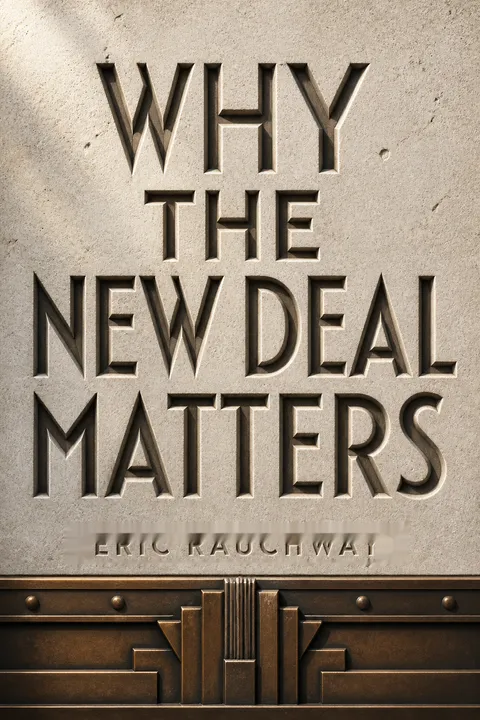

Key Takeaways
1. The New Deal rescued American democracy from the brink of authoritarianism.
The New Deal mattered then, at the cusp of spring in 1933, because it gave Americans permission to believe in a common purpose that was not war.
Averting crisis. In the winter of 1932, with unprecedented unemployment and widespread desperation, many Americans felt their nation was plagued by destructive inactivity, while an invisible enemy of fascism gathered strength abroad. The outgoing Hoover administration, clinging to traditional economic principles, violently suppressed the Bonus Army—destitute World War I veterans seeking aid—an act that highlighted the government's detachment and the fragility of democratic institutions. This stark contrast with rising authoritarianism globally underscored the urgent need for a new approach.
A new direction. American voters, tired of assurances from sleek businessmen and a government that turned guns on its own citizens, chose a "New Deal" promising federal jobs, worker protections, and farmer relief. Franklin D. Roosevelt, upon his inauguration, pledged to apply "social values more noble than mere monetary profit" and emphasized national interdependence. His administration's swift action and commitment to a common, peaceable purpose offered a stark alternative to the authoritarian paths taken by nations like Germany, proving that democracy could emerge stronger from severe crisis.
Work, not war. Roosevelt's approach to the Bonus Army's return in 1933 exemplified this shift: instead of force, he offered work in the Civilian Conservation Corps (CCC) and sent Eleanor Roosevelt to engage with the veterans. This humane response, coupled with the promise of meaningful employment, dissolved the protest and even convinced former critics that the New Deal was a necessary step toward improving the unemployment situation. It demonstrated that the government could work for its people, fostering a renewed faith in democratic processes and laying the groundwork for a unified stance against global fascism.
2. It pioneered visionary regional planning and public power for economic development.
Development not only entailed restoring pre-Depression conditions, it would bring modernity and wider-spread prosperity to perennially poor and chronically struggling parts of the country.
Taming the wild. The Tennessee Valley Authority (TVA), a cornerstone of the early New Deal, transformed the impoverished and erosion-plagued Tennessee Valley. Before the TVA, the Clinch and Tennessee Rivers were muddy, prone to catastrophic flooding, and their surrounding lands "farmed 'em to death," leading to widespread poverty and lack of basic amenities like electricity. Visionaries had long seen the potential in harnessing the rivers' power, but it took the New Deal's expansive vision to realize it.
Public power's promise. Roosevelt championed public ownership of power plants, not as a government takeover, but as a "national yardstick" to measure and regulate private utility prices, ensuring affordable electricity for all. The TVA's mission extended beyond power generation to comprehensive regional development, encompassing:
- Flood control and erosion prevention
- Improved river navigation
- Production of cheap fertilizer
- Attraction of new industries and jobs
- Raising the standard of living and per capita income
A mixed legacy. The TVA's twenty dams, including the architecturally innovative Norris Dam, brought modernity and prosperity, but not without cost. Thousands of families were displaced, and the program perpetuated racial segregation, hiring black workers into lower-skilled jobs and excluding them from model towns like Norris. Later, the TVA's reliance on coal and nuclear power to meet wartime and postwar demand shifted its environmental impact, and its role in the secret Oak Ridge project for the atomic bomb revealed the dual nature of its harnessed power.
3. The Indian New Deal sought self-determination but faced complex challenges and resistance.
The Indian Office should dwindle, and its powers should go instead to the Indians themselves.
Reversing assimilation. For decades, U.S. policy aimed to dismantle Native landholdings and assimilate Indigenous peoples, but the Indian New Deal, under Commissioner John Collier, sought a radical reversal. Collier, an admirer of Native cultures, believed that "modernity and white Americanism are not identical" and aimed to restore sovereign authority to Native nations, allowing them to "improve their lives along the lines of their own culture and institutions." This vision was a direct challenge to the "planless individualism" he believed had led to the Great Depression.
Public works and conservation. The Indian Emergency Conservation Work (IECW) program, a Native version of the CCC, swiftly employed thousands of unemployed Indigenous people, particularly Navajos, in vital conservation efforts like irrigation and erosion control. The Public Works Administration (PWA) also invested millions in building schools, hospitals, and infrastructure on reservations, including the iconic Navajo Council House at Window Rock, designed with local materials and traditional methods. These projects provided much-needed jobs and infrastructure, symbolizing a tangible commitment to tribal self-government.
Unintended consequences. Despite these efforts, Collier's policies, particularly the forced reduction of Navajo sheep and goat herds to combat overgrazing, generated deep resentment. This program, while ecologically necessary, destroyed a traditional source of subsistence, disproportionately affected women's wealth, and was seen as a threat to Navajo culture and independence. The Navajos narrowly rejected the Wheeler-Howard Act, which aimed to formalize tribal self-government, largely due to this anger. This episode highlighted the tension between federal planning and genuine self-determination, demonstrating that even well-intentioned federal interventions could disrupt traditional ways of life.
4. The New Deal transformed urban infrastructure and catalyzed a historic racial realignment.
The city as it is today, a peninsula served by bridges that allow automobiles—too many, to be sure—to pass in and out, by an airport where cross-country and transoceanic flights can take off and land, is a creation of the New Deal.
Building modern cities. The New Deal profoundly reshaped American urban landscapes, particularly in places like San Francisco. Massive Public Works Administration (PWA) and Works Progress Administration (WPA) projects constructed iconic landmarks such as the Bay Bridge, Treasure Island (for an airport and exposition), and the Golden Gate Bridge approaches. Beyond grand structures, the New Deal also built essential civic buildings like the accessible Sunshine School and recreational spaces like Aquatic Park, making cities more functional and inclusive, though often perpetuating existing social inequalities.
Racial paradoxes. While the New Deal brought widespread benefits, its programs often reinforced racial discrimination. Federal housing policies, through agencies like the Home Owners' Loan Corporation (HOLC) and Federal Housing Administration (FHA), explicitly "redlined" black neighborhoods, deeming them high-risk and making it nearly impossible for residents to secure mortgages. This systemic racism contributed to enduring wealth gaps and concentrated pollution in these communities, a legacy still visible today in places like Hunters Point.
A political shift. Despite these profound flaws and the administration's reluctance to fully support civil rights legislation (like the anti-lynching bill), the New Deal catalyzed a historic political realignment for African Americans. Disillusioned by the Republican Party's abandonment of civil rights and drawn to the Democrats' "bread and butter" economic policies, black voters increasingly shifted their allegiance. The creation of a "Black Cabinet" of advisors and the Justice Department's strategic legal challenges, culminating in United States v. Classic, laid the groundwork for future civil rights victories, demonstrating that even an imperfect ally could offer more hope than a distant one.
5. It established a foundational commitment to economic security and the dignity of work.
To Roosevelt, it was vital that the state provide its citizens with the dignity of earning a living by work, not merely hand out monetary assistance.
Beyond charity. Facing a crisis of unprecedented scale, Roosevelt rejected the notion that relief should be left solely to charity or local governments, arguing that "modern society, acting through its Government, owes the definite obligation to prevent the starvation or the dire want of any of its fellow men and women who try to maintain themselves but cannot." His experience as New York governor with the Temporary Emergency Relief Administration (TERA) solidified his belief in work relief over direct cash "doles," emphasizing the moral and spiritual value of earning a living.
Rapid job creation. This philosophy underpinned the Civil Works Administration (CWA), launched in late 1933, which aimed to put 4 million Americans to work immediately. Hopkins, its energetic head, ensured rapid deployment by leveraging existing state offices and military resources, issuing paychecks to over 800,000 workers within a week. The CWA provided "real jobs at real wages," strengthening both the economy and democracy by moving millions from "charity to self-sustaining consumers of goods earned by their own labor," and explicitly barring racial discrimination.
Enduring security. Though the CWA was temporary, its success paved the way for the more durable Works Progress Administration (WPA) in 1935, which employed millions on diverse projects, from construction to the arts, under a "security wage" system. Concurrently, the Social Security Act of 1935 established permanent federal programs for old-age pensions, unemployment insurance, and disability support. These initiatives fundamentally reshaped the relationship between citizens and their government, creating a safety net and affirming the state's role in ensuring economic security and the dignity of labor.
6. Widespread public works, from roads to art, made government tangible and fostered national pride.
The roads and sidewalks—and post offices, schools, parks, playgrounds, airports, harbors, and innumerable other constructions—they provided citizens public spaces in which we are not merely welcome, but which belong to us and give us pride.
Visible impact. The New Deal's public works programs, particularly the WPA, left an indelible mark on the American landscape, often in the most mundane yet essential ways. WPA workers laid thousands of miles of new sidewalks and improved hundreds of thousands of miles of roads, literally paving the way for postwar economic growth and suburbanization. These ubiquitous, often stamped, concrete strips and thoroughfares made government action tangible, providing safety and beautification for neighborhoods across the nation.
Inclusive infrastructure. Beyond basic infrastructure, the New Deal's commitment to an "inclusive man-made world" extended to social security provisions for disabled Americans, foreshadowing modern accessibility features like sidewalk ramps. The sheer scale and variety of WPA projects—from schools and post offices to parks and airfields—aimed to revive not just the economy but also democracy, showing Americans that their government worked for them by building public spaces that fostered community and pride.
Art for the people. A profoundly important, though comparatively modest, aspect of the WPA was its Federal Project No. 1, which employed artists, writers, musicians, and theater professionals. This initiative, driven by the belief that "they've got to eat just like other people," produced public art that depicted ordinary Americans at work, ennobling their labor and fostering a sense of shared national identity. The American Guide Series, for instance, documented the country's diverse peoples and cultures, implicitly illustrating the interdependence that was a cornerstone principle of the New Deal, even as it acknowledged persistent inequalities.
7. Despite its flaws and budget limitations, the New Deal's ambition for social justice remains a model for modern crises.
Civilization cannot go back.
A transformative vision. The New Deal, though often constrained by budget limitations and political compromises, represented a fundamental shift in American governance. It was not merely a "bailout" or "stimulus" but a deliberate effort to "restore and at the same time remodel" the nation's social and economic arrangements, introducing a "broadening conception of social justice." Roosevelt recognized that the Depression had exposed deep-seated injustices and poverty, declaring that "evil things formerly accepted will not be so easily condoned."
Enduring legacy. Many New Deal institutions—like the FDIC, an activist Federal Reserve, Social Security, and unemployment insurance—continue to function today, providing a crucial safety net that has prevented subsequent economic downturns from spiraling into another Great Depression. These successes, however, sometimes foster an "overly optimistic" view that the American economy no longer needs fundamental restructuring. Yet, ongoing crises like climate change and persistent economic inequality demonstrate that the New Deal's ambition for systemic change remains profoundly relevant.
A call to action. Roosevelt's vision extended globally, shaping Allied war aims and postwar institutions around the "Four Freedoms" and ideals of "improved labor standards, economic advancement, and social security." Today, calls for a "Green New Deal" echo this transformative spirit, seeking to address modern challenges like climate change and inequality through comprehensive federal action. The New Deal's enduring significance lies in its incompletely realized but doggedly pursued effort to improve the economy by improving democracy, offering a powerful blueprint for justly enduring the "man-made world" of the anthropocene.
Review Summary
Why the New Deal Matters receives mixed reviews averaging 3.97/5 stars. Readers appreciate Rauchway's accessible writing style, focus on specific locations and programs like the TVA, and honest treatment of the New Deal's racial and social shortcomings. Many praise its relevance to modern policy debates and its examination of FDR's democratic vision. However, critics note the book lacks comprehensiveness, depth, and detail, feeling too brief for experienced readers. Some desire more analysis of negative impacts and better organization. Overall, reviewers recommend it as a solid introduction for those with basic knowledge seeking to understand the New Deal's lasting influence.
People Also Read







Download PDF
Download EPUB
.epub digital book format is ideal for reading ebooks on phones, tablets, and e-readers.








































