

Key Takeaways
Your love life runs on ancient hardware, not modern software
The Peases argue that human sexual desire is largely hardwired, laid down over hundreds of thousands of years and unchanged by fifty years of social progress. They use a computer metaphor: nature is your brain's hardware, nurture is the software running on it. Under stress, the brain reverts to default settings, meaning ancient preferences override politically correct ideals.
The consequence is stark. Divorce rates exceed 50% in many countries, affair rates run 30 to 60%, and people flock to therapists blaming personal failure. But conflict between the sexes is the biological norm. The book's promise is not resignation but leverage: once you grasp that your urges are chemical and inherited, you can take the wheel rather than blame your hormones for every choice.
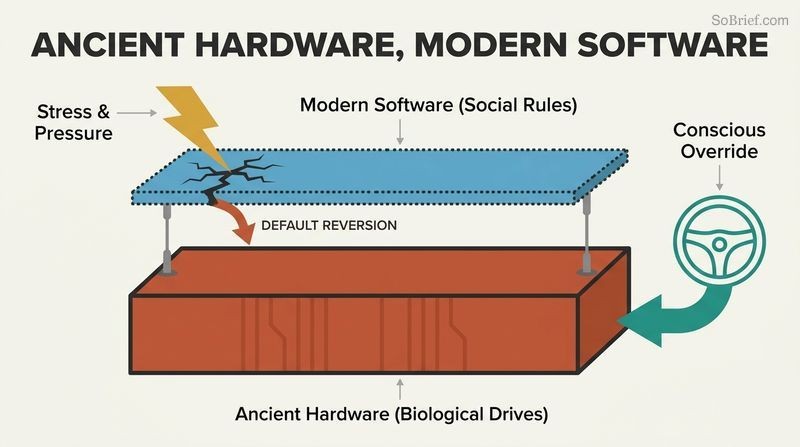
The hardware-software framing is memorable but risks genetic determinism, a charge evolutionary psychology often faces. Critics like Cordelia Fine (Delusions of Gender) note how readily such stories rationalize the status quo. The Peases hedge by invoking the frontal lobes as the seat of choice, which is the more defensible position. Behavioral genetics broadly supports partial heritability of mating behavior, yet culture demonstrably reshapes courtship across centuries. The strongest version of their claim is modest: biology sets defaults, environment writes over them. That is closer to Steven Pinker's blank-slate critique than to hard determinism, and it is worth holding both truths at once.
Men trade resources for sex; women trade sex for resources
This is the book's central engine. Drawing on David Buss's survey of over 10,000 people across 37 cultures, the authors report that women value a mate's financial prospects roughly twice as highly as men do, a pattern stable since studies began in the 1930s. Men, in every culture sampled, prioritize youth, health, and beauty as signals of fertility.
The logic is reproductive asymmetry. A woman can bear only one child a year and faces a decade-plus investment raising it, so she evolved to scrutinize whether a man can provide and will commit. A man's cheapest path to genetic success is quantity, so he became a visual, opportunistic seeker of fertile-looking partners. The authors frame relationships bluntly as an exchange of goods and services dressed up as compatibility.
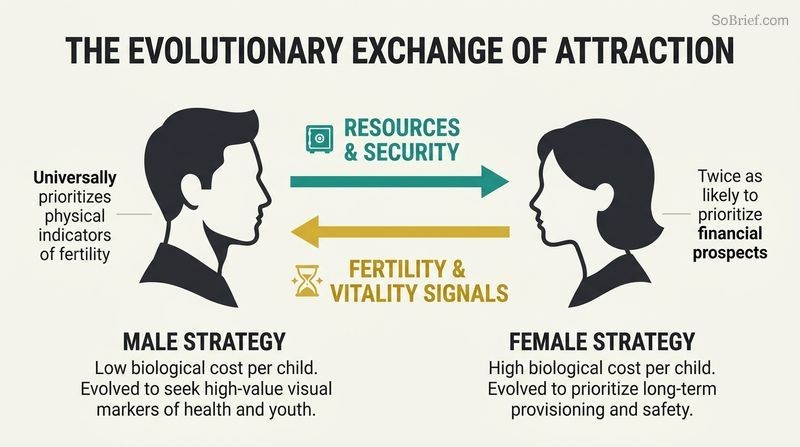
This resource-for-sex model is Buss's Sexual Strategies Theory, robust in cross-cultural replication but hotly contested on mechanism. Alice Eagly's social role theory argues the preference for wealthy men shrinks precisely where women gain economic power, suggesting the pattern tracks structural inequality, not just genes. Notably, the authors' own data (a third of American women out-earn husbands, executive women still preferring higher earners) cuts both ways. The honest synthesis: evolved dispositions and social conditions co-produce these preferences. Reducing intimacy to a transaction is rhetorically punchy but flattens the documented human capacity for companionate love that outlasts any ledger of exchange.
Falling in love is a drug high that expires in two years
Brain scans by Bartels, Zeki, Fisher, and Brown show that gazing at a new lover lights up the same dopamine-rich reward circuits as cocaine. Romantic love, the authors argue, is literally an addiction: sleeplessness, obsessive calling, loss of appetite, and euphoria are symptoms of surging dopamine and norepinephrine paired with crashed serotonin.
Donatella Marazziti found new lovers and OCD sufferers both had serotonin levels about 40% below normal, explaining the fixation. Crucially, when she retested couples a year or two later, the chemistry had reset to baseline even in intact relationships. The practical rule: wait up to two years before making major emotional or financial commitments, because you are, in effect, sober up after the drug wears off. Roughly 10% of long-term couples retain that early activation.
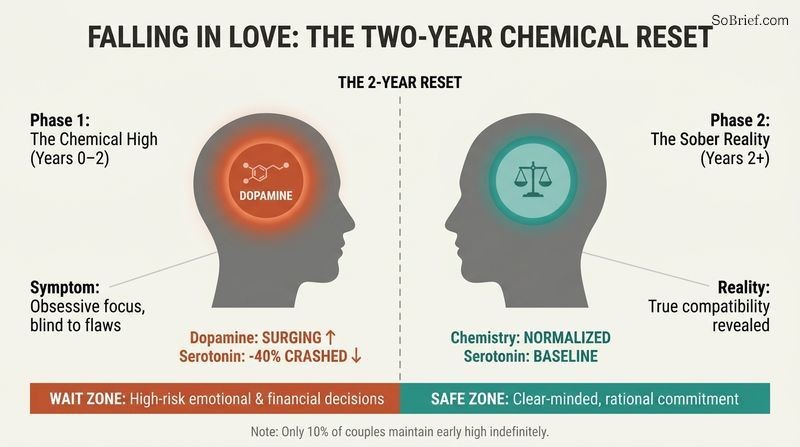
The addiction analogy is neurologically sound as far as shared dopaminergic pathways go, and Helen Fisher's work anchors it well. But equating love with mental illness oversells the pathology. The reward system also fires for meaningful work, music, and parenting, so lighting up like cocaine is not unique to romance. The more useful lesson is temporal: infatuation has a shelf life, and mistaking its expiry for a failed relationship drives needless breakups. This dovetails with Sternberg's triangular theory, where passion peaks early while intimacy and commitment build slowly. The two-year waiting rule is genuinely actionable advice hiding inside the neuroscience.
A man's brain files sex and love in separate rooms
The authors describe the male brain as a honeycomb of single-function compartments, citing Raquel and Ruben Gur's finding that the connective tissue between hemispheres has up to 30% fewer connections in men. This monotracking architecture lets a man have sex with a woman he neither loves nor likes, then forget it, the way you forget a shave.
For women, the authors argue, love and sex switch on together in the brain, so sex without emotional connection feels almost unintelligible. Hence the perennial standoff: when a cheating man insists it was just sex, he may be telling the literal truth, but his partner cannot believe it. The authors also introduce the Nothing Room, a mental space men retreat to several times daily to recharge, where they genuinely think about nothing.
The compartmentalization claim leans on brain-structure differences that later meta-analyses (Eliot, Joel) have shown to be smaller and more overlapping than 1990s studies suggested. Male and female brains form a mosaic, not two clean types. That said, the behavioral observation that men report decoupling sex from emotion more readily than women survives in survey data independent of the neuroanatomy. The Nothing Room is folk psychology, not science, yet it captures a real communication trap: interrogating a partner's silence as concealment. The takeaway holds better as relational insight than as verified neurobiology, and readers should treat the wiring story as metaphor.
Men and women define cheating by two incompatible rulebooks
For men, an affair is physical: intercourse or oral sex, connection optional. For women, an affair is emotional: intimate lunches, confessional texts, or an emotional bond can betray a partner even without a single kiss. This explains why a woman's first question is not what did you do but do you love her, since love signals the redirection of resources.
The authors catalog nine affair types (from the Do-I-Still-Have-Market-Value Affair to the Getting-Even Affair) and puncture myths, including the belief that unhappiness at home causes cheating. Researcher Shirley Glass found many affairs begin as friendships that quietly cross a line, and that emotional distance, not misery, is the real predictor. Their defense: make your partner your daily number-one priority and avoid the situations that let affairs start.
The gendered definition of infidelity maps onto Buss's jealousy research, where men report more distress over sexual betrayal and women over emotional betrayal, a finding that partly replicates but weakens outside forced-choice survey formats. The classification of nine affair types is clinically flavored folk taxonomy rather than validated typology, yet it usefully reframes affairs as symptoms of specific unmet needs rather than moral failures. Glass's emotional-distance insight is the durable contribution here and aligns with Gottman's research showing that friendship erosion, not conflict per se, predicts divorce. The prescription to guard against tempting situations echoes behavioral economics: manage environments, not just willpower.
You will pair up with someone at your own Mating Rating
Everyone carries a Mating Rating, a rough score of desirability out of ten that we assign instantly to everyone we meet. The book's core matchmaking claim, echoed across mating research, is that lasting couples share roughly equal ratings. A seven ends up with a seven. Trouble erupts when one partner's rating shifts, say he wins a promotion or she stops caring for her appearance, creating a gap that breeds criticism and overcompensation.
A rating is not fixed. You raise yours through goals, fitness, grooming, education, and confidence. The authors offer a quiz and insist desirability is more about attitude and effort than birth lottery. The practical move: honestly assess your own number, then seek partners at that level rather than chasing tens who will never reciprocate.
The matching hypothesis is one of social psychology's better-supported findings, documented by Walster's famous computer-dance study and confirmed in assortative mating data on attractiveness, education, and income. Reducing a person to a single scalar is crude, but it captures the statistical reality that people sort into similar tiers. The empowering twist, that the score is movable, aligns with research on self-improvement and confidence signaling. One caution: framing human worth as a market number can corrode self-esteem and encourage transactional thinking. The healthier reading treats the Mating Rating as descriptive of aggregate patterns, not a verdict on any individual's value.
Stop meeting partners by accident; recruit them like a hire
Most people meet mates through sheer chance, then wonder why half of marriages fail. The authors flip the script: choosing a life partner deserves at least the rigor of a senior job hire. Write a detailed list of your non-negotiable criteria, because the brain's reticular filter absorbs under 5% of surroundings and starts spotting whatever you name, the way you see blue Toyotas everywhere once you decide to buy one.
Then play the numbers game. Graham Steele, newly single at fifty, screened 20,000 online profiles down to 1,000, contacted them, applied filters like a salesman working a funnel, and married Emma, whom he chose from that pool. The authors estimate over 1.5 million compatible matches exist for each person. The point is not romance-by-spreadsheet but refusing to leave your future to a hormone rush at a bar.
The list-and-filter method is pop-psychology's version of what economists call optimal stopping and search theory. It counters a genuine bias: people over-weight chemistry, which the book itself frames as an unreliable two-year drug. The reticular-activating-system explanation for why lists work is oversimplified but points to real attentional priming effects. Steele's 20,000-profile funnel is impressive and extreme, and survivorship bias lurks (we hear the success story, not the thousands who filtered forever and found no one). Barry Schwartz's paradox of choice also warns that excessive options can reduce satisfaction. Still, the core corrective, deciding criteria before infatuation hijacks judgment, is sound.
For women, a man doing the dishes beats an expensive dinner
The authors' most counterintuitive practical claim: the biggest aphrodisiac for a woman is not an erect penis or a $300 restaurant bill but the sight of a man vacuuming, cooking, and feeding the kids. Stress is the number-one killer of female desire, because women's emotions are entwined with arousal. A tired, resentful woman places sex near the bottom of her list.
Women evolved with far lower testosterone (men have 10 to 20 times more) and a smaller sexual-desire hub in the hypothalamus, so they rarely initiate. What flips the switch is feeling loved, safe, and unburdened. The authors also note women carry roughly 10,000 touch receptors to men's 3,000, craving non-sexual cuddling that men habitually misread as a sex signal. The prescription for men: reduce her load, touch without agenda, and desire follows.
This is the book at its most useful and its best supported by relationship science. Studies of heterosexual couples (Kornrich and colleagues, and later work in the Journal of Family Issues) find that equitable division of household labor correlates with higher sexual frequency and satisfaction, though the causal direction is debated. The insight that desire follows perceived fairness and reduced stress converges with Emily Nagoski's dual-control model, where lowering the brakes matters more than pressing the accelerator. The evolutionary framing (testosterone, receptor counts) is secondary to the actionable core. The touch-receptor figure is widely cited yet poorly sourced, so lean on the behavioral takeaway rather than the number.
Your nose hunts for immune-system opposites you were built to breed with
In Claus Wedekind's sweaty T-shirt experiment, women smelled shirts worn by different men and consistently preferred the scent of those whose major histocompatibility complex, the gene family running the immune system, differed most from their own. Pairing immune opposites produces children with stronger, more varied immunity, which is why we feel unexplained attraction to some strangers and none to relatives.
The twist: women on the contraceptive pill reversed the preference, favoring men with similar genes, as though the body's pregnancy simulation flipped the instinct toward kin-like safety. This is what sexual chemistry actually is, the authors argue, and it hides in scent below conscious awareness. It also explains the childhood aversion to breeding with the familiar, an anti-inbreeding safeguard shared with other mammals.
The MHC-scent finding is one of evolutionary psychology's most cited results, and it has partially replicated, though a 2014 attempt failed and the effect sizes are modest. The pill-reversal claim is the more provocative and clinically resonant piece: it raises the unsettling possibility that a woman who chose a partner while medicated might experience shifted attraction after stopping, a hypothesis that remains debated rather than settled. What is durable is the broader lesson that attraction operates through channels below deliberation. It reframes chemistry from mystical destiny to olfactory immunology, which is both humbling and, for anyone puzzled by inexplicable magnetism, quietly clarifying.
Being loved adds years to your life; loneliness subtracts them
The authors marshal medical evidence that love is not a luxury but a survival factor rivaling diet and genes. In Harvard's Mastery of Stress study, men who rated their mothers as cold developed serious midlife disease at far higher rates than those who felt warmly parented, and among men who rated both parents cold, essentially all fell ill. A Case Western study of 8,500 men found those who said their wives did not love them developed three times as many ulcers.
Married people outlive the unmarried across nearly every disease. Linda Waite's research put the gap at about ten years for men and four for women. A Swedish study of 17,000 people found the isolated and lonely were four times likelier to die over six years. The takeaway: intimate connection is preventive medicine, and social isolation is a clinical risk factor.
This aligns with some of the most robust findings in health psychology. Holt-Lunstad's meta-analyses conclude that weak social connection raises mortality risk comparably to smoking and more than obesity, giving the authors' claims real empirical spine. The marriage-longevity gap is well documented, though selection effects complicate it: healthier, wealthier people are likelier to marry and stay married, so marriage is partly a marker as well as a cause. The parental-warmth studies are older and correlational. Still, the convergent evidence that belonging buffers stress and disease is strong. It reframes the entire book's subject: mating is not just about genes or pleasure but about the biology of staying alive.
Analysis
Why Men Want Sex and Women Need Love is a popular-science relationship manual built on the scaffolding of evolutionary psychology, chiefly David Buss's cross-cultural mating research and the brain-imaging work of Fisher, Brown, Bartels, and Zeki. Its structure is anthology-like: neuroscience of love, then gendered wish lists, then casual sex, affairs, partner selection, and improvement tactics, all leavened with jokes and case vignettes. The audience is the frustrated modern dater or spouse who suspects, against prevailing egalitarian rhetoric, that men and women want systematically different things.
The book's great strength is synthesis and actionability. It translates dense findings (serotonin depletion in new love, the two-year hormone window, assortative mating, household labor and desire, MHC scent preference) into memorable rules a reader can use tonight. Its central thesis, that reproductive asymmetry produced enduring differences in male and female mating psychology, is genuinely supported in the cross-cultural literature, particularly regarding age, resource, and attractiveness preferences.
The weaknesses are equally clear. The authors repeatedly invoke a rigid nature-over-nurture story that contemporary neuroscience (Fine, Eliot, Joel) has softened, showing brain sex differences to be smaller and more overlapping than the 1990s studies they cite. Their own data occasionally undercut their claims, as when female economic independence shifts preferences, supporting Eagly's social-role account over pure adaptation. The transactional framing of love as goods-for-services is rhetorically vivid but reductive, and the humor sometimes tips into stereotype that dates the 2009 text.
Read critically, the book is best treated as a probabilistic map of aggregate tendencies, not a deterministic verdict on individuals. Its most valuable contributions are the least ideological: love has a chemical expiry date, fairness and reduced stress fuel female desire, connection is preventive medicine, and choosing a partner deserves deliberate criteria rather than a hormone gamble. Those insights survive the scientific caveats and justify the read.
Review Summary
Why Men Want Sex and Women Need Love explores biological and psychological differences between men and women regarding sex and relationships. Reviews are mixed, with some praising its scientific approach and insights, while others criticize it for promoting stereotypes and outdated views. Readers found the book entertaining and informative, appreciating its humor and practical advice. However, some felt it oversimplified complex issues and reinforced gender stereotypes. Overall, the book sparked discussion about gender dynamics in relationships, though its conclusions remain controversial.
People Also Read





Glossary
Mating Rating
Desirability score out of tenThe authors' term for each person's overall desirability on the mating market, informally scored zero to ten. People unconsciously assign it to everyone they meet, based on the traits each sex values. The book claims lasting couples share roughly equal ratings and that a person can raise theirs through fitness, resources, education, grooming, and confidence.
Three brain systems for mating
Lust, romantic love, attachmentThe authors' model, drawn from Helen Fisher, that mating runs on three distinct neurochemical systems: lust (driven by testosterone and estrogen in the hypothalamus and amygdala), romantic love (dopamine-fueled obsession centered in the caudate), and long-term attachment (oxytocin-based bonding in the ventral putamen and pallidum). Each produces different feelings and behaviors.
Nothing Room
Male mental blank-out stateThe authors' playful label for a mental space many men enter several times a day to recharge, during which they genuinely think about nothing. They argue women lack this need and often misread it as concealment when a man answers what are you thinking with nothing.
70% hips-to-waist ratio
Waist is 70% of hipsThe hourglass proportion where a woman's waist measures about 70% of her hip width. Citing Devendra Singh's research, the authors call it a cross-cultural signal of fertility and health that men are hardwired to find attractive regardless of overall body weight, holding constant even across decades of Playboy centerfolds and Old Master paintings.
Love map
Childhood-formed attraction blueprintAn internal blueprint of the traits a person finds attractive, formed from childhood experiences and largely set between ages six and fourteen. It acts as a scorecard for rating potential mates and combines brain hardwiring with learned criteria absorbed from parents, friends, and early environment.
Sweaty T-shirt experiment
Scent-based immune-gene mate testClaus Wedekind's 1995 study in which women rated the scent of unwashed men's shirts and preferred those whose major histocompatibility complex (immune-system genes) differed most from their own, favoring genetic diversity in offspring. The book notes women on the contraceptive pill reversed this, preferring men with similar genes.
The 9% Rule
Assess nine before choosingFrom a computer simulation by Peter Todd and Geoffrey Miller, the finding that after sampling about nine potential partners out of a large pool, a person has enough information to set realistic standards and choose well. Assessing fewer gives too little data; assessing many risks passing up a good match.
FAQ
What's Why Men Want Sex and Women Need Love about?
- Exploration of Dynamics: The book explores the fundamental differences between men and women in terms of attraction, sex, and love.
- Biological and Evolutionary Basis: It explains how these differences are shaped by biological and evolutionary factors.
- Relationship Improvement: The authors provide practical advice for enhancing relationships through better understanding and communication.
Why should I read Why Men Want Sex and Women Need Love?
- Insight into Relationships: Gain a deeper understanding of the motivations behind male and female behaviors in relationships.
- Evidence-Based Advice: The book offers scientifically backed insights, making the information credible and applicable.
- Practical Strategies: It provides actionable advice to improve romantic relationships and navigate common challenges.
What are the key takeaways of Why Men Want Sex and Women Need Love?
- Different Agendas: Men often seek physical gratification, while women desire emotional connection.
- Biological Influences: Many desires and behaviors are hardwired into our brains, influenced by evolutionary factors.
- Communication Importance: Effective communication is crucial for maintaining healthy relationships.
How do men and women view love differently according to Why Men Want Sex and Women Need Love?
- Men's Perspective: Men often see love and sex as separate, with sex being a physical act.
- Women's Perspective: Women typically require an emotional bond before engaging in sexual activity.
- Brain Activity Differences: Different areas of the brain are activated in men and women when experiencing love.
What are the biological factors influencing attraction discussed in Why Men Want Sex and Women Need Love?
- Hormonal Influences: Hormones like testosterone and estrogen drive sexual attraction and behavior.
- Physical Cues: Men are attracted to visual cues of youth and health, while women look for stability.
- Evolutionary Psychology: Preferences are rooted in evolutionary past, focusing on survival and reproduction.
What are the best quotes from Why Men Want Sex and Women Need Love and what do they mean?
- “Sex is like air...”: Highlights the importance of sexual intimacy, often taken for granted until absent.
- “Love is only the dirty trick...”: Suggests romantic love is a biological mechanism for reproduction.
- “When you understand that your urges...”: Emphasizes recognizing the biological basis of emotions for better relationship management.
What are the six common myths about cheating discussed in Why Men Want Sex and Women Need Love?
- Myth 1: Mainly men cheat: Women cheat at similar rates, especially in their twenties and thirties.
- Myth 2: Cheater profile exists: Anyone can cheat under the right circumstances, not limited to a specific type.
- Myth 3: Monogamy leads to affairs: Affairs often occur early in marriage due to relationship uncertainty.
How does Why Men Want Sex and Women Need Love address the topic of casual sex?
- Different Motivations: Men are more open to casual sex due to biological drives, while women seek emotional connections.
- Self-Esteem and Validation: Women may engage in casual sex for self-esteem or to evaluate long-term potential.
- Emotional Consequences: Casual sex can lead to guilt and dissatisfaction for women, contrasting with men's experiences.
What strategies does Why Men Want Sex and Women Need Love suggest for improving relationships?
- Effective Communication: Open dialogue about needs and desires is crucial for bridging gender perspectives.
- Understanding Biological Drives: Recognizing biological influences helps partners navigate differences.
- Building Emotional Connections: Fostering emotional intimacy enhances sexual satisfaction and relationship longevity.
How does Why Men Want Sex and Women Need Love explain the differences in sexual drive between men and women?
- Biological Factors: Men have higher testosterone levels, leading to a stronger sex drive.
- Emotional Connection: Women often need emotional intimacy for sexual arousal.
- Stress Impact: Stress can dampen a woman's desire, making a supportive environment crucial.
What is the significance of the "70% hips-to-waist ratio" mentioned in Why Men Want Sex and Women Need Love?
- Indicator of Fertility: Associated with higher fertility and reproductive health, attracting men.
- Cultural Universality: Preference for this body shape is consistent across cultures, indicating a biological basis.
- Impact on Self-Image: Understanding this ratio can help women recognize biological attraction factors.
How does Why Men Want Sex and Women Need Love suggest handling a cheating partner?
- Open Communication: Discuss the affair openly to understand reasons and decide on the relationship's future.
- Avoid Blame: Focus on relationship dynamics rather than blame for constructive conversations.
- Consider Counseling: Professional help can guide and support partners through infidelity's emotional fallout.
About the Author




Download PDF
Download EPUB
.epub digital book format is ideal for reading ebooks on phones, tablets, and e-readers.








































