
Key Takeaways
1. Hinduism: A Pluralistic Faith Without Dogma
"I am proud to belong to the only major religion in the world that does not claim to be the only true religion."
A unique faith. Hinduism stands apart from many other major religions due to its lack of a single founder, prophet, organized church, or compulsory beliefs. It is an eclectic, expansive, and inclusive faith, often described as "Wikipedia-like" in its authorial diversity. This inherent flexibility allows for a wide spectrum of doctrines and practices, from pantheism to agnosticism, without requiring adherence to any specific dogma.
Personal spiritual journey. The faith emphasizes that religion is an intensely personal matter, where prayer is a private communion between an individual and their chosen image of the Divine. Hindus are encouraged to find their own truth, drawing from a rich tapestry of scriptures and philosophies, often in translation, and are not bound by rigid rituals or visible signs of faith. This approach fosters an attitude of openness and questioning, rather than blind adherence.
Acceptance of all truths. A core tenet of Hinduism is the acceptance that all ways of belief are equally valid. This is encapsulated in the Rig Veda's "ekam sat vipra bahudha vadanti" – "That which exists is One; the sages call It by various names." This profound understanding leads Hindus to readily venerate saints and sacred objects of other faiths, fostering a spirit of universal acceptance rather than mere tolerance.
2. The Philosophical Core: Self-Realization and Cosmic Unity
"The Hindu believes that every soul is a circle whose circumference is nowhere, but whose centre is located in the body, and that death means the change of this centre from body to body…."
Brahman and Atman. At the heart of Hindu philosophy, particularly Advaita Vedanta, is the concept of Brahman, the Absolute, the universal soul that suffuses all creation, and Atman, the individual soul. The profound insight is that Atman and Brahman are essentially one and the same, leading to the ultimate goal of moksha, or self-realization—the liberation from earthly bonds and the realization of this divine union.
Unknowability of God. Hindu thought makes a virtue out of the unknowability of God, often expressed as "neti, neti" ("not this, not this") in the Upanishads. God is nirguna (without qualities, shape, or gender) and transcends time and space, yet can also be imagined in myriad saguna (with form) manifestations like Brahma, Vishnu, and Shiva. This flexibility allows for both abstract philosophical contemplation and accessible idol worship.
Karma and reincarnation. The doctrine of punarjanmam (reincarnation) and karma (action and its consequences) explains suffering and inequality as results of past actions, guiding individuals towards ethical living. The four Purusharthas—dharma (moral code), artha (material well-being), kama (pleasure), and moksha (salvation)—provide a comprehensive framework for human life, balancing worldly desires with spiritual aspirations.
3. Diversity and Evolution: Hinduism as a Living Tradition
"Hinduism has never been uniform or unchanging, immovable or unalterable. It is a religion that has abjured the immutable revelation for the growth of human consciousness."
A banyan tree faith. Hinduism is likened to a banyan tree, with branches spreading wide and taking root, symbolizing its capacity to absorb and integrate diverse traditions, beliefs, and practices. This agglomerative nature allowed it to accommodate local deities, tribal faiths, and even reform movements like Buddhism and Jainism, often incorporating them into its vast pantheon.
Multiple sacred texts. Unlike faiths with a single holy book, Hinduism boasts a rich corpus of scriptures, including Srutis (revealed texts like the Vedas and Upanishads), Smritis (remembered human compositions like Dharmashastras), Itihasas (epics like Ramayana and Mahabharata), Puranas (mythological stories), Agamas (ritualistic texts), and Darshanas (philosophical schools). These texts are often complementary yet sometimes contradictory, inviting individual interpretation.
Dynamic and adaptable. Hinduism has continuously evolved, from the nomadic faith of the Rig Veda to the philosophical inquiries of the Upanishads, and later the devotional Bhakti movement. This adaptability allowed it to survive numerous invasions and challenges, demonstrating a remarkable resilience by reasserting itself through internal reforms and the popularization of its core tenets.
4. Addressing Societal Flaws: Caste, Superstition, and Fatalism
"The Hindu who says that caste discrimination is incompatible with his dharma is a better Hindu than one who insists her religion does not permit her to engage a low caste cook in her house."
Caste as a social construct. While some sacred texts mention a varna system, the rigidities and discriminatory practices of caste, particularly "Untouchability," are largely seen as societal accretions rather than intrinsic religious tenets. Reformers like Dr. Bhimrao Ambedkar and Sree Narayana Guru challenged caste from within Hinduism, emphasizing the Upanishadic principle of the unity and equality of all souls.
Superstition and godmen. Popular Hinduism often includes elements of superstition, such as a fondness for astrology, and a reverence for gurus and godmen. While some gurus are figures of genuine spiritual learning, others are charlatans exploiting the credulous. The author notes that this phenomenon reflects a societal drift and a search for meaning, rather than a core religious dictate.
Fatalism vs. free will. The concept of karma and reincarnation can sometimes be misinterpreted as Hindu fatalism, leading to resignation to one's lot. However, the Bhagavad Gita encourages individuals to "raise themselves by the self," implying free will and the capacity to shape one's fate through righteous action (dharma) in partnership with the divine within.
5. Great Souls and Reformers: Shaping the Hindu Way
"Shakya Muni [the Buddha] came not to destroy, but he was the fulfilment, the logical conclusion, the logical development of the religion of the Hindus…."
Adi Shankara's Advaita Vedanta. In the 8th century CE, Adi Shankara revitalized Hinduism with Advaita Vedanta, emphasizing the non-dualistic unity of Atman and Brahman. His philosophical rigor, extensive travels, and establishment of monastic orders (mutths) helped integrate diverse Hindu thoughts and practices, making complex philosophical ideas accessible and promoting an ethical life.
The Bhakti Movement. Beginning in South India and sweeping northward, the Bhakti movement (12th-18th centuries) popularized Hinduism through devotional poetry, songs, and a focus on a loving relationship with a personal God. Poet-saints like Kabir, Mirabai, and Tulsidas brought spiritual wisdom to the masses in vernacular languages, transcending caste and gender barriers and strengthening the faith against external challenges.
Modern reformers. Figures like Raja Rammohan Roy, Swami Dayanand Saraswati, Sree Narayana Guru, Sri Aurobindo, and Swami Vivekananda continued to reform and reassert Hinduism in the face of colonial influence and internal rigidities. They championed social justice, universalism, and a rational approach to faith, ensuring Hinduism remained dynamic and relevant in changing times.
6. Hindutva: A Political Ideology Distinct from Hinduism
"Hinduism is only a derivative, a fraction, a part of Hindutva."
A modern political construct. Hindutva, meaning "Hinduness," is a political ideology primarily articulated by Vinayak Damodar Savarkar in the early 20th century. It defines a Hindu not primarily by religious dogma but by ethnic, cultural, and political terms, asserting that India is the motherland, ancestral land, and holy land of Hindus. This concept explicitly excludes faiths like Islam and Christianity, whose origins lie outside India.
Cultural nationalism. M. S. Golwalkar, a key ideologue of the RSS, further developed Hindutva as a form of "cultural nationalism," rejecting the concept of territorial nationalism that grants equal citizenship rights to all inhabitants. He argued that India's national regeneration could only come through the revival of its Hinduness, viewing other communities as "guests" or "invaders" who must assimilate or live at the mercy of the Hindu nation.
Deen Dayal Upadhyaya's Integral Humanism. Upadhyaya, a later ideologue, sought to provide a more comprehensive philosophical basis for Hindutva through "Integral Humanism." While advocating for a holistic development of body, mind, intellect, and soul, and emphasizing duties over rights, his vision still rooted Indian nationhood in Hindu culture, demanding that minorities "identify themselves completely with Indian life" and its Hindu traditions.
7. Hindutva's Vision: Cultural Nationalism and Exclusion
"To remain in India, Muslims would have to submit themselves to Hindus."
Exclusionary definition of nationhood. Hindutva ideologues like Savarkar and Golwalkar define the Indian nation (Hindu Rashtra) as inherently Hindu, based on a shared race, culture, and holy land. This framework inherently marginalizes Muslims and Christians, whose holy sites and cultural origins are seen as external to India, thereby denying them full and equal belonging unless they fully assimilate into a prescribed Hindu cultural identity.
Historical revisionism. Hindutva promotes a narrative of India's past as a "wounded civilization," subjected to centuries of Muslim conquest and rule, which enfeebled the Hindu people. This selective interpretation demonizes Muslim rulers and ignores periods of assimilation and coexistence, serving to justify present-day grievances and foster anti-Muslim sentiment. Historical facts that contradict this narrative are often dismissed or rewritten.
Imposition of uniformity. The Hindutva project seeks to impose a singular, uniform Hindu identity, often at the expense of India's inherent diversity. This includes efforts to standardize religious practices, promote Hindi as a national language, and enforce slogans like "Bharat Mata ki Jai," which can be uncomfortable for minorities whose religious beliefs may not align with deifying the motherland.
8. The Distortion of Hinduism by Hindutva
"To reduce the soaring majesty of an inclusive, free-ranging, eclectic and humane faith to the petit-bourgeois morality of narrow-minded bigots is a far greater betrayal of our culture than anything an artist can paint."
Contradiction of core Hindu values. Hindutva's quest for a codified, doctrinaire, and unified faith directly contradicts the essence of Hinduism, which is characterized by its eclecticism, diversity, and lack of rigid dogmas. Swami Vivekananda's emphasis on universal acceptance and the idea that "Truth is One but sages call It by different names" stands in stark contrast to Hindutva's exclusionary and majoritarian tendencies.
Assault on cultural freedom. In the name of a narrow and often inauthentic view of Hindu culture, Hindutva activists engage in moral policing, attacking artists, vandalizing exhibitions, and banning books that offer heterodox interpretations or challenge their conservative sensibilities. This suppression of artistic and intellectual freedom, often invoking colonial-era laws, betrays Hinduism's historical openness to diverse expressions and inquiry.
Pseudoscience and obscurantism. The Hindutva movement often promotes uncritical and fantasy-laden claims about ancient Indian scientific accomplishments, sometimes at the expense of genuine historical achievements. This tendency to prioritize ideology over scientific fact, as seen in claims about ancient plastic surgery or the rejection of evolution, risks plunging India into obscurantism and undermining its intellectual heritage.
9. Reclaiming Hinduism: A Call for Inclusivity and Tolerance
"I not only consider myself both a Hindu and a liberal, but find that liberalism is the political ideology that most corresponds to the wide-ranging and open-minded nature of my faith."
Rejecting Hindutva's perversion. Many liberal Hindus actively resist Hindutva, viewing it as a malign distortion of their faith. They are ashamed of the violence and bigotry perpetrated in Hinduism's name, asserting that such actions contradict the core tenets of tolerance, acceptance, and non-violence (ahimsa) that define true Hinduism. The "Not In My Name" protests exemplify this rejection.
Return to foundational principles. The call is to return to the fundamentals of Hinduism as taught by sages like Adi Shankara and Swami Vivekananda: a faith of astonishing breadth, range of belief, and universal acceptance. This involves recognizing that all ways of worshipping God are equally valid and that the pursuit of spiritual truth is a personal journey, not a collective imposition.
Hinduism for the 21st century. Hinduism's non-dogmatic, eclectic, and flexible nature makes it an ideal faith for a post-modern world characterized by uncertainty. Its emphasis on inquiry, self-realization, and the acceptance of multiple truths offers a path to peace and coexistence, rather than the conflict and division promoted by rigid fundamentalisms.
10. Indian Nationalism vs. Hindu Nationalism
"To accept the idea of India you had to spurn the logic that had divided the country."
Pluralism as India's essence. Indian nationalism, as envisioned by its founding fathers like Mahatma Gandhi and Jawaharlal Nehru, is fundamentally pluralistic, embracing differences of caste, creed, language, and culture. It explicitly rejected the idea that religion should be a determinant of nationhood, distinguishing itself from the communal logic that led to the creation of Pakistan.
Hindutva's divisive agenda. Hindu nationalism, in contrast, seeks to define Indianness through a singular, Hindu identity, thereby reducing non-Hindus to second-class citizens or outsiders. This approach, which demands conformity and loyalty to a specific cultural and religious framework, undermines the very basis of India's diverse democracy and threatens to create a "second Partition" in the Indian soul.
Unity in diversity. The true strength of India lies in its ability to manage diversity and maintain consensus on how to disagree. Hinduism, with its inherent inclusiveness, has historically provided a cultural framework for this pluralism. To allow Hindutva to impose a narrow, majoritarian identity is to betray this legacy and risk tearing the country apart, rather than fostering genuine national unity.
Review Summary
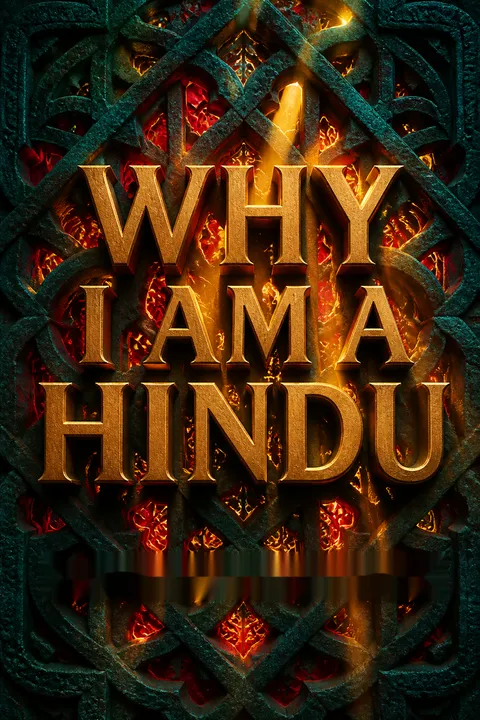
Why I am a Hindu receives mixed reviews. Some praise its exploration of Hinduism's pluralistic nature and Tharoor's personal reflections. Critics argue the book becomes politically motivated in later sections, targeting BJP and Hindutva. Many appreciate the historical and philosophical insights into Hinduism but find the political commentary distracting. Some view it as a timely defense of secular Hinduism, while others see it as biased propaganda. Overall, readers are divided on whether the book successfully balances religious exploration with political critique.
People Also Read


About the Author

Download PDF
Download EPUB
.epub digital book format is ideal for reading ebooks on phones, tablets, and e-readers.








































