Key Takeaways
1. Femininity is defined by an empty space rather than a fixed essence
In the place of feminine identity, there is a gap.
The non-existence of 'The Woman'. Lacan’s provocative claim that "The Woman does not exist" means there is no universal, pre-programmed blueprint for what it means to be a woman. Unlike men, who easily fit into generalizations and uniforms, a woman must construct her identity from scratch. This lack of an innate essence creates a psychological void that every girl must navigate.
The search for a formula. Because there is no ready-made answer, women often look to external models to define themselves. They ask "What is it to be a woman?" and seek answers through various roles:
- Mimicking their mothers or maternal figures.
- Following shifting fashion trends to find the "missing dress."
- Experiencing post-menstrual depression when biological changes fail to provide an instant psychological transformation.
The missing uniform. This perpetual search explains why a woman with a wardrobe full of clothes can still genuinely feel she has "nothing to wear." The missing item is not a physical garment, but the definitive uniform of "The Woman"—an impossible, ultimate answer to her identity. Thus, femininity is characterized by an ongoing process of becoming rather than a static destination.
2. Women study desire through triangles and the "Other Woman"
What interests her is less the man or the woman, than the relation between them.
The feminine question. When a woman observes a couple, her gaze often lingers on the other woman rather than the man. She is driven by the fundamental question: "What does she have that has made this man her partner?" This inquiry is not necessarily born of jealousy, but of a research program to decode the mystery of male desire.
Triangular dynamics. To study this desire, women frequently construct or participate in psychological triangles. By positioning themselves in relation to another woman who is loved or desired by a man, they attempt to grasp the secret of what traps his interest. Examples of this dynamic include:
- Shakespeare's Viola disguising herself as a page to court Olivia on behalf of the Duke.
- Freud's patient Dora facilitating her father's affair with Mrs. K to observe what her impotent father loved in her.
- Women actively matchmaking for their friends or fathers to study the resulting romantic dynamics.
Borrowing desire. This triangular structure reveals that a woman's desire is often routed through the desire of another. Like children who claim they want a toy only because another child wants it, women's psychological radar is tuned to desires rather than objects. Consequently, many "female fantasies" are actually borrowed from the fantasy frames of men.
3. Men split their love objects, while women split their own identities
One woman is loved in an idealized way and another is desired sexually.
The male split. Men struggle to integrate affection and sexual desire, leading to a psychological doubling of their love objects. This "Madonna-Prostitute" split forces men to divide women into two distinct categories: the idealized, pure lady who cannot be desired sexually, and the debased woman who is sexually exciting but cannot be loved. Historical figures like Brahms and Goethe famously lived out this exhausting dichotomy.
The female equivalent. In contrast, women do not split their external objects; instead, they split their own egos. A woman internalizes the division imposed by male desire, oscillating between different facets of her own identity. According to psychoanalyst Helene Deutsch, this internal splitting manifests in specific ways:
- A woman's daydreams shifting between tender maternal scenes and dark, exhibitionistic fantasies.
- The psychological assumption of both the "mother" and the "prostitute" roles within the self.
- Conforming to the contradictory expectations of a partner to maintain his desire.
The price of alienation. By adapting to the male fantasy frame, a woman risks alienating her true self. She occupies a specific place in a structure—like Audrey Hepburn's character in Love in the Afternoon—becoming an interchangeable element in a man's ritualized series of lovers. Her identity becomes temporarily locked within the conditions set by his desire.
4. The symbolic phallus must mediate real sexual relations
Prior to the husband’s use of his penis, a mediation is necessary, one which is situated in the symbolic register...
The symbolic gap. Human sexuality is never a simple, natural union between two biological bodies; it requires a symbolic mediator. This mediator, historically represented by the phallus, is entirely distinct from the physical male organ. Without this symbolic sanction, the transition from the natural world to the cultural world of human desire fails.
Cultural and literary rituals. Throughout history, various cultures and narratives have highlighted the necessity of this non-human, symbolic third party:
- Defloration rituals where a bride is first deflowered by a tribal elder, a priest, or a mechanical instrument rather than the husband.
- Indigenous beliefs attributing pregnancy to ancestral spirits in rocks or brooks rather than physical coitus.
- The Greek novel Daphnis and Chloe, where the young lovers cannot successfully make love until the master—representing the symbolic law—arrives.
The modern man-machine. In contemporary culture, this symbolic requirement manifests in the cinematic obsession with cyborgs and high-tech heroes. To be a "real man" today, a biological male body is not enough; it must incorporate something symbolic, like the mechanical circuitry of Robocop or the high-tech submarine in Innerspace. Masculinity must be reinforced from the outside because its symbolic transmission is in crisis.
5. Obsessional men act dead, while hysterical women try to revive them
The obsessional maintains his desire as forbidden.
The mortified man. Obsessional men are plagued by the unconscious question, "Am I alive or dead?" To protect themselves from the terrifying unpredictability of desire, they mortify their lives through rigid routines, endless timetables, and constant verbal self-commentary. By acting like corpses, they attempt to avoid the risk of failure and the deflation of their phallic fantasies.
The hysterical spark. Hysterical women are naturally drawn to these "dead" men, creating a classic psychological partnership. The hysteric, to whom things are always happening, makes it her mission to disrupt the obsessional's routine and force him to show signs of life. This dynamic plays out in predictable domestic battles:
- The woman interrupting the man while he tries to read his newspaper at a designated time.
- The hysterical demand for the obsessional to "stop being so boring" or to dance at a party.
- The woman challenging the man's rigid verbal formulas to expose the gap between language and life.
Desire by proxy. Because the obsessional fears the real encounter of desire, he often abdicates his place to a friend or rival. He may engineer situations where his partner sleeps with another man while he watches, or court a woman on behalf of a friend, like Antonio in The Merchant of Venice. By keeping his desire forbidden or mediated by a proxy, he safely avoids his own psychological castration.
6. A woman's desire is often structured around her own subtraction or disappearance
The woman here seems to link an erotic value to her own subtraction, to privilege it, in a sense, whereas men will do everything precisely to avoid their own disappearing.
The eroticization of absence. While men go to great lengths to assert their presence and control, a key current of female sexuality involves the sexualization of her own disappearance. In masturbatory and romantic fantasies, a woman may find erotic value not in an image of active pleasure, but in her own subtraction from the scene. Her pleasure is paradoxically linked to being missed or left behind.
The partner as solitude. This psychological structure is illustrated beautifully in Mary Shelley's Mathilda, where the heroine chooses solitude as her true partner. Rather than protesting her father's abandonment, she gives the empty space of his absence an erotic value. This reveals a crucial choice for women:
- Battling with a man to possess what she lacks.
- Renouncing possession entirely and turning the empty space of "not having" into a precious jewel, much like a nun dedicating her life to God.
- Staging her own vanishing in daily life—failing to turn up for dates or work—to ensure she is missed.
The phantom lover. Because a woman's love aims at something absolute and unconditional, she often bypasses real, flawed men in favor of a phantom. She may remain physically faithful to a husband while mentally embracing a ghost who is beyond him. This explains the success of films like Truly, Madly, Deeply and the gothic appeal of Dracula, where the living dead represents a more reliable partner than any flesh-and-blood man.
7. True love is addressed to a lack or a wounded image, not perfection
If infatuation is so often directed towards a flawless image, love is addressed to an image that has been wounded.
The wounded image. There is a fundamental difference between infatuation and true love. Infatuation demands a perfect, flawless mirror image, which is easily shattered by reality. Love, however, only truly begins when the ideal image is struck, flawed, or revealed to be mortal. It is the vulnerability—the castration—of the other that captures the heart.
The lesson of Biondetta. In Cazotte's The Devil in Love, the protagonist Alvaro is indifferent to the beautiful, perfect Biondetta until she is wounded in a fight. Only when she is bleeding and mortal does he call her by her name and fall in love. This narrative demonstrates that:
- Love is addressed to a lack of knowledge, not absolute power.
- A partner becomes human and lovable only when their flaws are exposed.
- We love others not for what they have, but for what they lack.
The appeal of weakness. This explains why men are so often loved not for their strength, but for their worries and vulnerabilities. Charlotte Brontë fell for the Reverend Nicholls only when she saw him deliver a sermon "white, shaking, and voiceless." To show one's weakness is to invite love, because love is ultimately a gift of what one does not have to someone who does not want it.
8. The mother-child bond is haunted by unconscious negativity and maternal legacy
No mother–child relation can escape the presence of some measure of unconscious negativity.
The shadow of the grandmother. The relationship between a mother and her child is never a simple, dual bond; it is deeply influenced by the mother's own childhood and her relationship with her parents. A woman's wish for a child is often an extension of her desire to receive a gift from her father. When this original desire is disappointed, the resulting ambivalence is projected onto her own offspring.
Unconscious anxieties. This underlying negativity explains the intense, often irrational fears that haunt pregnant women. They may worry obsessively that their baby will be deformed or born a "monster." This anxiety is not a biological instinct, but a psychological inscription of past disappointments:
- The child becoming the site of both intense love and repressed hatred.
- Pregnancy cravings (like chocolate or seafood) acting as symbolic signs of the mother's past demands on her own mother.
- The dread of losing femininity or being "disfigured" by childbirth, as seen in Madame de Sévigné's letters to her daughter.
The vanishing child. Children are highly sensitive to this unconscious current and may attempt to materialize the mother's fear of absence. They may physically fall, get lost, or act out the role of the "vanished baby" to satisfy the maternal fantasy. The cultural fascination with stolen or missing children reflects this deep-seated psychic tension between presence and disappearance.
9. Men fall in love with stupid details, while women seek unconditional proof
The magnetism will depend on the unconscious constructions of the man, which can hardly be predicted.
The tyranny of the detail. Masculine love is fundamentally fetishistic, relying on highly specific, often absurdly trivial details to trigger desire. A man does not fall in love with a woman's holistic character; he falls in love with the way she buttered her toast, the shine on her nose, or a specific colored ribbon. These senseless details are linked to his unconscious Oedipal history and cannot be rationalized.
The demand for love. For a woman, love is not triggered by a static detail but by an ongoing demand for unconditional proof. Because love cannot be spoken once and for all, she requires her partner to repeat his declarations endlessly. This demand is not for a physical object, but for a sign of his love:
- Asking "Do you love me?" repeatedly to test his commitment.
- Demanding to know exactly why he loves her, forcing him to struggle with the limits of language.
- Valuing the "thought" and the act of giving over the material value of the gift itself.
The comedy of the lover. This difference makes the man in love a naturally comical figure. In classic comedies, men are reduced to fools by their ridiculous obsessions with single details or objects. Women, on the other hand, maintain their good sense because their focus is on the broader, shifting network of desire and speech rather than a rigid, fetishized point.
10. Unposted letters preserve the unfinished nature of desire and the self
The letter is unfinished because the person who wrote it is unfinished.
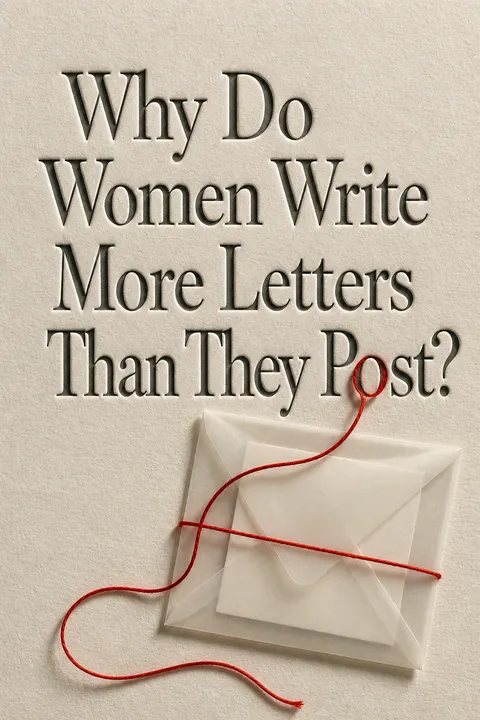
The unposted letter. Why do women write more letters than they post? A letter that remains unposted is not a failure of communication, but a preservation of desire. To post a letter is to pin down a definitive meaning, to freeze the self in a specific moment in time. By keeping the letter unsent, a woman respects the gap between language and her changing existence.
The unfinished self. A woman's life is often a little bit ahead of her descriptions. As she carries a letter around, her feelings and circumstances shift, prompting her to rewrite it continuously. The unposted letter highlights this dynamic:
- A refusal to be reduced to a single, static meaning or verbal formula.
- An appeal to the desire of the Other, which must remain unsatisfied to persist.
- The understanding that writing is ultimately a way of framing an emptiness rather than filling it.
Putting oneself in the place of the letter. When Audrey Hepburn in Love in the Afternoon or Kim Novak in Vertigo destroy their letters, they choose to put themselves in the place of the unsent message. They realize that words are never enough to represent their true identity. By withholding the written word, they force the man to confront them as a living riddle rather than a readable text.
Review Summary
About the Author
Other books by Darian Leader




Download PDF
Download EPUB
.epub digital book format is ideal for reading ebooks on phones, tablets, and e-readers.








































