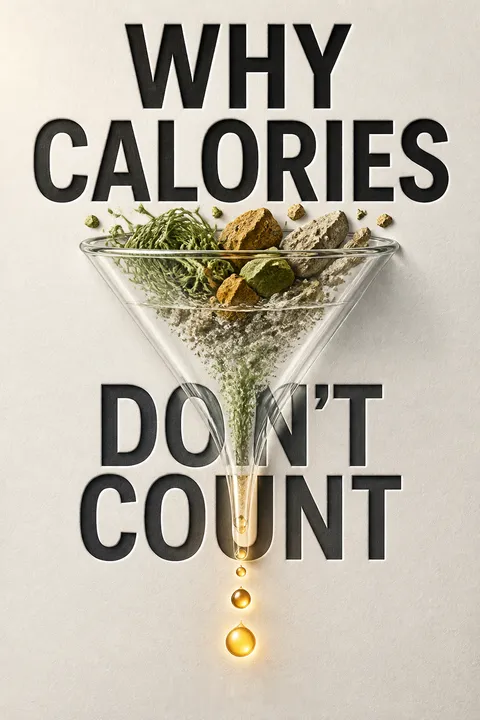

Key Takeaways
1. Calorie Counts Are Misleading, Not Meaningless
ALL of the calorie-counts that you see everywhere today are WRONG.
Caloric availability. The calorie counts on food labels are estimates of the total energy in the food, not the amount your body can actually extract and use. This is because digestion and metabolism are complex processes that vary depending on the food's composition and how it's processed. The number of calories listed on a package is not the same as the number of usable calories we finally get out of the food.
Three calorie values. There are three different calorie values to consider:
- A – the number of calories actually in the food
- B – the number of calories on the side of the pack
- C – the number of usable calories we finally get out of the food
Understanding the difference. While calorie counts aren't perfect, they're still a useful starting point for making informed food choices. The key is to understand that they're just estimates and that the actual number of calories your body absorbs can vary.
2. The Atwater Factors: A Century-Old Approximation
We live not upon what we eat, but upon what we digest.
Atwater's contribution. Wilbur Olin Atwater developed a system for estimating the usable energy in food based on its protein, fat, and carbohydrate content. These "Atwater factors" (4 calories per gram of protein and carbs, 9 calories per gram of fat) are still widely used today.
Limitations of Atwater factors. The Atwater system is a simplification of a complex process. It doesn't account for factors like:
- The digestibility of different foods
- The thermic effect of food (the energy your body uses to digest and process food)
- Individual differences in metabolism
Specific factor system. A more precise, but less practical, approach is to use specific factors for different foods. For example, the energy value of protein in rice is different from the energy value of protein in potatoes.
3. Digestion: The Food-to-ATP Tube
Deliveroo’s outlook is simple: the way to eat healthy is by having more information and more selection.
From food to fuel. Digestion is the process of breaking down food into smaller molecules that your body can absorb. This process involves both mechanical and chemical digestion, starting in the mouth and continuing through the stomach and small intestine.
Key organs and enzymes:
- Salivary amylase: Breaks down starch in the mouth
- Pepsin: Digests protein in the stomach
- Bile: Emulsifies fats in the small intestine
- Pancreatic enzymes: Further break down carbs, fats, and proteins
Small intestine absorption. The small intestine is where most nutrients are absorbed into the bloodstream. The large intestine absorbs water and electrolytes, forming feces.
4. ATP: The Universal Energy Currency
I like keeping my metabolism on its toes. Like what’s it gonna be today, complete starvation or 6,000 calories?
ATP is key. Adenosine triphosphate (ATP) is the primary energy currency of cells. The metabolism of glucose, fatty acids, and amino acids is all about generating ATP.
Mitochondria power plants. Mitochondria are organelles within cells that are responsible for producing most of the ATP. They use the Krebs cycle and oxidative phosphorylation to convert food into energy.
Metabolic pathways:
- Glycolysis: Breaks down glucose into pyruvate
- Beta-oxidation: Breaks down fatty acids into acetyl-CoA
- Krebs cycle: Oxidizes acetyl-CoA to produce electrons
- Oxidative phosphorylation: Uses electrons to generate ATP
5. Protein: The Satiety Powerhouse
When life gives you lemons, ask for something higher in protein
Protein's unique role. Protein is more satiating than carbs or fat, meaning it helps you feel fuller for longer. This is due to a combination of factors, including:
- Increased release of satiety hormones
- Slower digestion
- Higher thermic effect
Protein leverage hypothesis. The body prioritizes protein intake, so if a diet is low in protein, you'll eat more overall to meet your protein needs.
High-protein diets. High-protein diets can be effective for weight loss, but it's important to choose healthy protein sources, such as lean meats, fish, beans, and lentils.
6. Fiber: The Gut's Best Friend
My internet connection and my diet are missing one thing in common… Fibre
Two types of fiber. Dietary fiber is a type of carbohydrate that the body can't digest. There are two types of fiber:
- Soluble fiber: Dissolves in water and forms a gel, slowing digestion
- Insoluble fiber: Adds bulk to stool and promotes regularity
Burkitt's fiber hypothesis. Denis Burkitt proposed that a lack of fiber in the Western diet was a major cause of many chronic diseases.
Benefits of fiber:
- Promotes healthy bowel function
- Reduces the risk of colon cancer
- Helps regulate blood sugar levels
- May lower cholesterol levels
- Promotes satiety
7. Ultra-Processed Foods: A Modern Dilemma
This cannot be a piecemeal, voluntary approach – calorie labelling should be mandatory for all restaurants, cafes and takeaways, with no exemptions, to create a level playing field and ensure people are able to make informed choices about the food they eat, wherever they choose to eat.
NOVA classification. Carlos Monteiro developed the NOVA system for classifying foods based on their degree of processing. Ultra-processed foods are industrial formulations with many ingredients, often including additives not used in home cooking.
Characteristics of ultra-processed foods:
- High in sugar, salt, and fat
- Low in protein and fiber
- Often contain artificial flavors, colors, and preservatives
- Highly palatable and addictive
Health concerns. Diets high in ultra-processed foods are linked to weight gain, obesity, type 2 diabetes, and other chronic diseases. This is due to a combination of factors, including their high caloric density, low satiety, and impact on gut health.
8. Privilege Shapes Calorie Choices
The cheapest food is that which furnishes the largest amount of nutriment at the least cost; and the best food is that which is both most healthful and cheapest.
Socioeconomic disparities. Access to healthy food is not equal. Low-income communities often have limited access to fresh produce and an abundance of fast-food restaurants and convenience stores selling ultra-processed foods.
Food insecurity. Food insecurity, or limited access to food due to lack of money or resources, is a major problem in many wealthy countries. This can lead to both undernutrition and overconsumption of unhealthy foods.
The role of privilege. Money, time, and knowledge all play a role in shaping food choices. Those with more resources are better able to afford and prepare healthy meals.
9. Focus on Food Quality, Not Just Quantity
We live not upon what we eat, but upon what we digest.
Beyond calorie counting. Instead of obsessing over calorie numbers, focus on the quality of your food. Choose whole, unprocessed foods that are rich in nutrients and fiber.
Prioritize protein and fiber. These two nutrients are key for satiety and can help you eat less overall. Include protein sources like lean meats, fish, beans, and lentils in your diet. Load up on fiber-rich foods like fruits, vegetables, and whole grains.
Limit sugar and refined carbs. These foods are often high in calories and low in nutrients. They can also cause rapid spikes in blood sugar, leading to cravings and overeating.
Review Summary
Why Calories Don't Count received mixed reviews, with readers appreciating the author's scientific expertise and accessible writing style. Many found the book informative and thought-provoking, praising its exploration of calorie measurement, digestion, and diets. However, some criticized the misleading title and overly technical sections. Readers valued the debunking of fad diets and insights into food insecurity. While some found the personal anecdotes entertaining, others felt they detracted from the core message. Overall, the book was seen as a valuable resource for understanding the science behind weight management and making informed dietary choices.
People Also Read


FAQ
1. What is Why Calories Don’t Count by Giles Yeo about?
- Challenging calorie myths: The book debunks the idea that all calories are equal and that simply counting them leads to weight loss.
- Science of weight loss: Giles Yeo explores the history, measurement, and science of calories, digestion, metabolism, and how different foods yield different amounts of usable energy.
- Societal and dietary context: The book also examines the impact of ultra-processed foods and socioeconomic factors on obesity and health.
2. Why should I read Why Calories Don’t Count by Giles Yeo?
- Debunks common diet advice: The book exposes why calorie counts on packaging are often misleading and why popular dieting advice can be flawed.
- Empowers informed choices: Readers gain a deeper understanding of how the body processes food, enabling healthier and more confident food decisions.
- Addresses social context: Yeo discusses how privilege, environment, and food insecurity affect diet and health, encouraging empathy and awareness.
3. What are the key takeaways from Why Calories Don’t Count by Giles Yeo?
- Calories are not equal: The calories listed on food labels do not reflect the actual usable energy our bodies extract.
- Protein and fiber matter: Foods high in protein and fiber are more satiating and provide fewer net calories, aiding weight management.
- Focus on health, not weight: Prioritizing overall health and food quality is more effective than obsessing over calorie counting or weight alone.
4. How does Giles Yeo define and explain “caloric availability” in Why Calories Don’t Count?
- Usable energy concept: Caloric availability is the number of calories our bodies can actually extract and use from food, which is often less than the total or labeled amount.
- Influencing factors: Protein and fiber reduce caloric availability because protein requires more energy to metabolize and fiber is largely indigestible.
- Dietary implications: Understanding caloric availability helps explain why high-protein, high-fiber diets can promote weight loss even if calorie counts appear similar.
5. How are calories in food measured, and why are calorie labels often inaccurate according to Giles Yeo?
- Bomb calorimeter method: Food calories are measured by burning food in a bomb calorimeter, capturing all released heat, which overestimates usable energy.
- Atwater factors: Standard calorie counts use Atwater factors, which adjust for digestion but still oversimplify the complex process of metabolism.
- Label limitations: These methods ignore individual differences, food processing, and energy lost as heat, making calorie labels rough estimates rather than precise values.
6. What is the Atwater factor system, and why does Giles Yeo critique it in Why Calories Don’t Count?
- Definition: The Atwater system assigns fixed calorie values to fat, carbs, protein, and alcohol based on early digestion studies.
- Historical context: Developed over 120 years ago, these factors still underpin most food labeling worldwide.
- Critique: The system oversimplifies digestion and metabolism, failing to account for energy lost as heat or differences in food processing, leading to inaccuracies in actual usable calories.
7. How does the human body convert food into usable energy, as described in Why Calories Don’t Count?
- Digestion and absorption: Food is broken down into proteins, fats, and carbohydrates, which are absorbed into the bloodstream.
- ATP production: These nutrients are metabolized in cells to produce ATP, the body’s energy currency, through processes like glycolysis and the Krebs cycle.
- Energy storage and use: Excess nutrients are stored as glycogen or fat, and ATP powers all bodily functions, with energy expenditure divided into basal metabolism, activity, and thermogenesis.
8. What role do protein and fiber play in weight loss and satiety according to Giles Yeo?
- Protein’s satiating effect: Protein is more filling than fats or carbs, reducing hunger and overall calorie intake.
- Higher energy cost: The body expends more energy digesting and metabolizing protein, increasing diet-induced thermogenesis.
- Fiber’s benefits: Fiber slows digestion, supports gut health, and reduces net calorie absorption, aiding weight management and lowering disease risk.
9. How does Why Calories Don’t Count by Giles Yeo address ultra-processed foods and their impact on health?
- Definition and classification: Ultra-processed foods are industrial products with many additives, classified as Group 4 in the NOVA system.
- Health risks: These foods are typically high in sugar, salt, and fat, but low in protein and fiber, making them more calorically available and linked to weight gain.
- Socioeconomic factors: Ultra-processed foods are often cheaper and more accessible, especially in deprived areas, contributing to health inequalities.
10. What does Giles Yeo say about the relationship between privilege, food insecurity, and obesity in Why Calories Don’t Count?
- Food insecurity in wealthy nations: Even in rich countries, millions lack consistent access to nutritious food, affecting diet quality.
- Deprivation and diet: Lower socioeconomic status leads to reliance on cheaper, ultra-processed foods, increasing obesity risk.
- Challenging stigma: Yeo urges readers to recognize systemic issues and privilege, rather than blaming individuals for their weight or food choices.
11. What practical dietary advice does Giles Yeo offer in Why Calories Don’t Count?
- Focus on nutrient quality: Prioritize protein (~16% of daily energy), fiber (>30g/day), and limit free sugars (<5% of daily energy).
- Moderation and sustainability: Choose diets that fit your biology and lifestyle, such as flexitarian approaches, for long-term success.
- Navigating real-world choices: When eating ultra-processed foods, select options higher in protein and fiber and lower in sugar, salt, and fat.
12. How does Giles Yeo propose redefining calorie counting with “net metabolisable energy” in Why Calories Don’t Count?
- Limitations of current labels: Traditional Atwater factors don’t account for energy lost during digestion and metabolism.
- Adjusted values: Yeo suggests more accurate values—9 cal/g fat, 3.8 cal/g sugar, 3.6 cal/g complex carbs, 3.2 cal/g protein—to reflect usable energy.
- Dietary impact: This correction helps explain why high-protein and high-fiber diets are more effective for weight loss, even when calorie counts appear similar.
About the Author
Other books by Giles Yeo
Download PDF
Download EPUB
.epub digital book format is ideal for reading ebooks on phones, tablets, and e-readers.








































