
Key Takeaways
1. The brain is a parallel, distributed, and decentralized machine
Our brains are a vastly parallel and distributed system, each with a gazillion decision-making points and centers of integration.
Decentralized neural networks. The human brain does not operate under the command of a single, centralized "boss" or executive controller. Instead, it is a highly decentralized, parallel, and distributed system composed of millions of specialized processors. These local networks, or modules, run constantly and simultaneously, managing everything from basic bodily functions to complex cognitive tasks without any central oversight.
Small-world architecture. To process information efficiently without consuming unsustainable amounts of energy, the brain utilizes a specific structural design. It maximizes local connectivity through short, fast connections while maintaining a few long-distance pathways to link distant regions. This "small-world" architecture allows for highly specialized local processing while ensuring rapid global communication across the entire network.
- Sparse global connections prevent the brain from becoming unsustainably large.
- Local modules automate specific tasks to optimize processing speed.
- The system is robust, lacking a single point of failure.
Automatic execution. Most of our daily behaviors are executed automatically by these specialized circuits. From the visual processing that allows us to perceive depth to the motor coordination required to play an instrument, our brain machinery runs on its own steam. We are largely unaware of the vast sea of nonconscious computations occurring beneath our conscious experience.
2. The illusion of a unified "self" is constructed after the fact
The common assumption among scientists is that we know who and what we are only after the fact of nervous system action.
The conscious delay. One of the most counterintuitive discoveries of modern neuroscience is that conscious awareness is a slow, post hoc phenomenon. Our brains initiate and execute actions long before we become consciously aware of our intention to act. Experiments demonstrate a significant time lag between the brain's preparation for movement and our conscious realization of that choice.
Post hoc rationalization. Because we live with a slight "tape delay," our conscious mind is constantly playing catch-up with our automatic brain. When we observe ourselves performing an action, we immediately construct a narrative to explain why we did it. This process is entirely retrospective, meaning we fabricate reasons for our behavior after the fact.
- Brain activity begins up to ten seconds before conscious awareness of a decision.
- We pull our hand away from a hot stove before we consciously feel the pain.
- Our conscious mind acts as an observer, not the initiator, of our actions.
The illusion of unity. Despite the decentralized nature of our brains, we possess an overwhelming sense of being a single, unified "self" in control of our lives. This illusion is a powerful evolutionary adaptation that helps us navigate our environment. It binds our fragmented experiences into a coherent, continuous stream of consciousness.
3. The "Interpreter" module in the left hemisphere creates our personal narrative
The psychological unity we experience emerges out of the specialized system called 'the interpreter' that generates explanations about our perceptions, memories, and actions and the relationships among them.
The narrative engine. Located in the left hemisphere, the "Interpreter" is a unique, specialized module driven to find patterns and infer causality. It constantly monitors the behaviors, emotions, and cognitive states produced by all the other independent modules. It then weaves these disparate pieces of information into a seamless, logical story that explains our actions.
Confabulation and fudging. The interpreter is only as good as the information it receives, and it will readily fabricate explanations when it lacks the facts. In split-brain patients, when the left hemisphere observes the right hemisphere performing an action, it immediately invents a plausible, post hoc reason to explain the behavior, completely unaware of the true cause.
- A split-brain patient shown a snow scene to the right brain and a chicken claw to the left points to a shovel and a chicken, explaining that the shovel is needed to "clean out the chicken shed."
- The interpreter prioritizes the "gist" of a story over literal, veridical accuracy.
- It explains sudden physiological shifts, like an adrenaline rush, using whatever environmental cues are available.
Virtual reality. Because the interpreter is driven to make sense of the world, it can easily be hijacked by faulty or manipulated data. Whether through virtual reality experiments or neurological damage, the interpreter will construct a convincing reality based on whatever sensory inputs are present, demonstrating that our conscious reality is largely a virtual construction.
4. Human brains are hardwired with preexisting evolutionary complexity
Sperry challenged this conception and argued that the brain is built in a very specific way, genetically determined, and that we arrive from the baby factory mostly prewired.
Prewired for survival. Contrary to the "blank slate" theories of behaviorism, the human brain does not enter the world as an empty vessel waiting to be written upon. It arrives equipped with highly specialized, genetically determined neural networks. These prewired circuits provide us with built-in templates and intuitive knowledge designed to help us survive.
Innate intuitive physics. Infants possess a rich, pre-existing understanding of the physical world long before they have the experience to learn it. They intuitively grasp the basic laws of physics, expecting objects to be solid, permanent, and subject to gravity, and they show surprise when these rules are violated.
- Babies expect objects to be cohesive and not spontaneously splinter apart.
- We possess built-in fear templates for evolutionary threats, such as snakes.
- Our visual system automatically adjusts our perception of brightness and color based on evolutionary success.
Selection over instruction. Learning is not a process of writing new information onto a blank slate, but rather a process of selecting from pre-existing capacities. The brain's large-scale organizational plan is under strict genetic control, while local, fine-grained connections are refined through experience and activity-dependent processes.
5. Free will is a miscast concept when viewed from a single-brain perspective
The simple truth is that even the most strident determinists and fatalists at the personal psychological level do not actually believe they are pawns in the brain’s chess game.
A misleading debate. The traditional debate over free will is often framed as a choice between complete freedom from physical laws or total determinism. However, this is a false dichotomy. We do not actually want to be free from the physical laws of nature, as we rely on these deterministic processes to execute our actions with precision and consistency.
The limits of determinism. Even though the brain is a physical system that follows natural laws, it is also a highly complex, non-linear chaotic system. This means that absolute prediction of human behavior is theoretically impossible, as minuscule variations in initial conditions can yield vastly different outcomes over time.
- Newtonian laws are emergent collective phenomena, not fundamental laws at the atomic level.
- Quantum mechanics introduces fundamental probability and uncertainty into the physical world.
- We cannot predict the macro-level behavior of a complex system solely from its micro-level parts.
The power of belief. Regardless of the physical laws governing our brains, our beliefs about free will have a profound, measurable impact on our behavior. Studies show that when people are primed to disbelieve in free will, they exhibit less self-control, cheat more often, and behave more aggressively toward others.
6. Mind emerges from brain but also constrains it through layered interactions
I will maintain that the mind, which is somehow generated by the physical processes of the brain, constrains the brain.
Emergent properties. The relationship between the mind and the brain is best understood through the concept of emergence. Just as traffic is an emergent property of interacting cars that ultimately constrains how those individual cars can move, the mind is an emergent property of the brain that exerts top-down constraints on neural activity.
Layered communication. The brain operates as a layered system, where higher-level mental states (such as beliefs, thoughts, and desires) interact with and constrain lower-level physical processes. This top-down constraint allows our mental lives to perform real work, rather than being mere passive by-products of neural firing.
- Beliefs can override basic biological urges, such as choosing to fast or resist temptation.
- The mind acts as a higher-level program that is compiled down to the physical hardware of the brain.
- We require a new scientific vocabulary to describe how these different layers interact.
Complementarity of layers. We cannot fully understand the mind by reducing it to individual neurons, just as we cannot predict the properties of ice solely by studying isolated water molecules. Both bottom-up and top-down analyses are necessary, as they represent complementary, logically irreducible levels of description.
7. Personal responsibility is a social contract, not a brain mechanism
Responsibility is a dimension of life that comes from social exchange, and social exchange requires more than one brain.
The social space. Personal responsibility is not a physical property located within an individual brain. There is no "responsibility center" in the human cortex. Instead, responsibility is an emergent property that exists only in the social space between two or more interacting brains.
Rules of engagement. Just as the concept of traffic laws is meaningless for a single car on a desert island, the concept of personal responsibility is meaningless for an isolated brain. It is a social contract, a set of rules we agree to follow to live together in cooperative groups.
- An abnormal brain scan does not automatically mean a person cannot follow social rules.
- Responsibility is a rule that emerges from group interactions and social expectations.
- We are genetically wired to be social and to enforce cooperation within our groups.
The social brain. Our brains evolved specifically to navigate these complex social networks. We are equipped with specialized systems, such as mirror neurons and theory of mind, that allow us to simulate the emotions of others, predict their behaviors, and maintain the social cohesion necessary for our survival.
8. The justice system must balance our evolutionary drive for retribution with scientific reality
Our modern legal system may have evolved by building on preexisting cognitive mechanisms that support fairness-related behaviors in dyadic interactions.
Innate retributive urges. Humans possess a strong, intuitive desire for retributive justice—giving offenders their "just deserts." This moral intuition is not a learned cultural construct, but an evolved mechanism designed to punish free-riders and maintain cooperation within early human groups.
The challenge of neuroscience. As brain science increasingly enters the courtroom, it challenges our traditional views of culpability and intent. However, using brain scans to excuse criminal behavior is a category error, as an abnormal brain does not automatically render a person incapable of following social rules.
- Brain scans show group averages and cannot reliably predict individual behavior or intent.
- Accountability is a social necessity; without punishment, cooperation within groups collapses.
- We must balance our retributive instincts with utilitarian and restorative goals.
Shaping our future. Because we are the law, we have the power to reconstruct our legal frameworks as our scientific understanding of the human condition evolves. We must design a justice system that maintains social order and accountability while respecting the physical realities of the human brain.
Review Summary
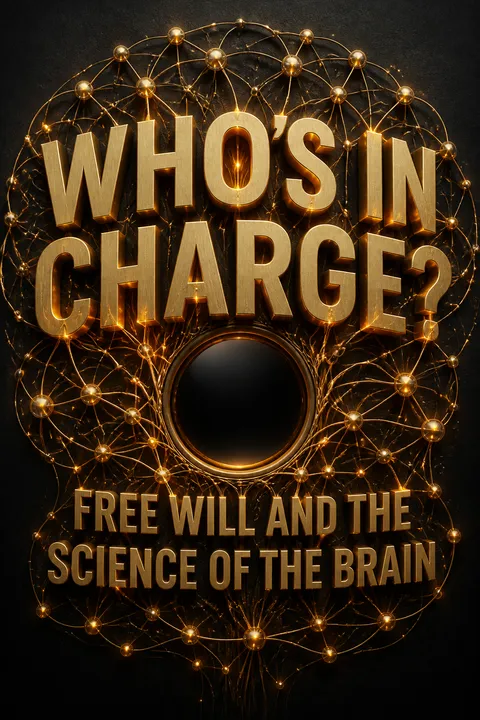
Who's in Charge?: Free Will and the Science of the Brain explores the complex relationship between neuroscience and free will. Gazzaniga argues against neurological determinism, proposing that emergent properties of the brain and social interactions allow for personal responsibility. Many readers found the book thought-provoking, praising Gazzaniga's accessible writing style and fascinating insights into brain function. Some critiqued the book's organization and felt certain arguments were underdeveloped. Overall, reviewers appreciated the book's examination of free will, consciousness, and moral responsibility in light of modern neuroscience findings.
People Also Read