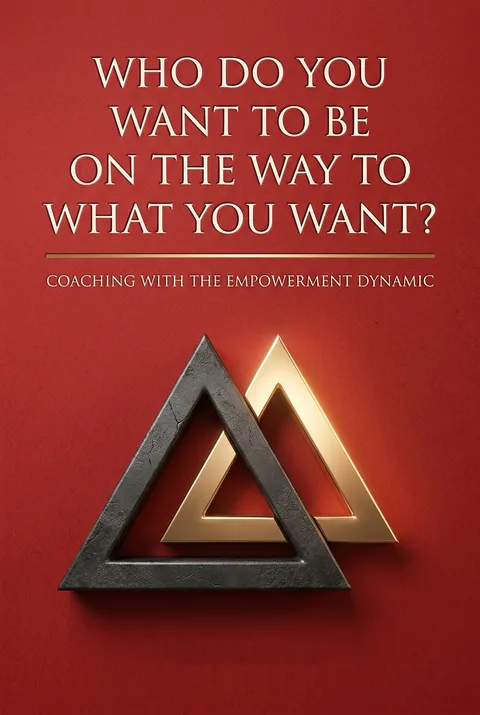

Key Takeaways
1. Unmasking the Dreaded Drama Triangle (DDT)
When you get caught in the grip of the DDT, it has a toxic effect on your relationships with others and with yourself.
Recognizing reactivity. The Dreaded Drama Triangle (DDT) describes three universal, reactive roles people adopt when facing uncomfortable emotions: Victim, Persecutor, and Rescuer. These roles are problem-focused and anxiety-driven, creating a cycle of drama that prevents genuine resolution and personal growth. Sophia, the coach, emphasizes that these are behaviors, not inherent identities, allowing for observation without self-judgment.
The three roles:
- Victim: Feels powerless, says "Poor me" or "Why me?", blames external circumstances or others, seeks rescue. Sophia's client, RJ, initially felt like a victim when her coaching program was canceled.
- Persecutor: Controls, blames, criticizes, says "It's all your fault," often to avoid feeling like a victim. RJ recognized her own strong Persecutor tendencies, especially in her leadership style.
- Rescuer: Overly helpful, seeks to fix problems for others, says "Let me help," often ignores their own needs, and can inadvertently disempower others. Sophia herself admitted to often defaulting to this role.
Breaking the cycle. Understanding the DDT is the first step toward breaking free from its grip. By noticing and naming these roles as they appear in real-time, individuals can gain awareness of their reactive patterns. This awareness creates a "choice point," allowing them to decide whether to remain stuck in drama or shift towards more empowering responses.
2. Embracing The Empowerment Dynamic (TED*)
The Empowerment Dynamic and it describes us when we’re at our best, living as our best self.
A positive alternative. The Empowerment Dynamic (TED*) offers a positive alternative to the reactive roles of the DDT. It consists of three empowering roles: Creator, Challenger, and Coach. These roles are outcome-focused, intention-driven, and foster growth, learning, and authentic connection, moving individuals out of drama and into a state of personal power.
The empowering roles:
- Creator: The positive alternative to the Victim. Focuses on "What do I want?" and "What is mine to do?", taking responsibility for choices and actions. Sophia encouraged RJ to shift from feeling victimized by a situation to being a Creator of her desired outcome.
- Challenger: The positive alternative to the Persecutor. A truth-teller who builds up, encourages growth, and holds others accountable without blame. The Challenger's intention is to learn and grow, even when facing difficult realities.
- Coach: The positive alternative to the Rescuer. Asks questions, fosters curiosity, and empowers others to find their own solutions, rather than fixing problems for them. This role emphasizes self-care as a prerequisite for effectively supporting others.
Shifting perspective. The transition from DDT to TED* involves a fundamental shift in perspective from problem-focused thinking to outcome-focused thinking. It's about recognizing that while life will always present challenges, individuals have the power to choose how they respond. This dynamic framework helps individuals cultivate their innate capacity for growth and self-mastery.
3. Your Human Operating System: Focus, Inner State, Behavior (FISBE)
If you aren’t privy to the way you operate in the moment, your system will keep running the old and often outdated programs.
Internal mechanics. Sophia introduces the FISBE model (Focus, Inner State, Behavior) as a blueprint for understanding our human operating system. This model illustrates how our thoughts (Focus) directly influence our emotions (Inner State), which in turn drive our actions (Behavior). Recognizing this interconnectedness is crucial for conscious change.
The FISBE components:
- Focus (Thoughts): What we pay attention to and think about. This is the starting point of our operating system. For RJ, her focus on John's lateness led to thoughts about his unreliability and disrespect.
- Inner State (Emotions): The feelings that arise in response to our thoughts. RJ's thoughts about John's lateness evoked frustration and anger.
- Behavior (Actions): The actions we take as a result of our inner state. RJ's anger led her to sarcastically point out John's lateness in front of others.
Upgrading your system. Just as a computer needs software updates, our human operating system benefits from conscious upgrades. By becoming aware of our focus, we can intentionally shift our thoughts from problems to desired outcomes. This shift in focus naturally alters our inner state, leading to more empowering behaviors and breaking old, reactive patterns.
4. The Three Levels of Listening: From Right to Collaboration
When someone goes even deeper and dips into Level Three, bringing their full presence and intuition to the conversation, well, it’s a beautiful human connection, and we’re all wired to thrive with that kind of connection.
Beyond hearing words. Effective listening is a cornerstone of healthy relationships and leadership. Sophia introduces the Three Levels of Listening to help clients understand how their listening habits impact communication and trust. Moving beyond superficial listening is essential for fostering genuine connection and collaboration.
The three levels:
- Level 1: Listening to Be Right: Focused on agreeing or disagreeing, seeking opportunities to interject one's own viewpoint, and "winning the point." This level is self-centered and creates barriers to understanding. RJ admitted this was her default listening mode, especially with her team.
- Level 2: Listening for Possibilities: Suspending judgment, focusing deeply on what the other person is saying, and genuinely seeking to learn more. Questions arise from the speaker's information, fostering support and acknowledgment.
- Level 3: Listening for Collaboration: The deepest level, combining Level 2 with intuition and sensing the energy or unspoken feelings. It aims to ignite new ideas and foster creative solutions through profound human connection. Tara exemplifies this, often sensing Sophia's unspoken feelings.
Cultivating trust. Practicing Level 2 and 3 listening builds trust, making others feel seen, heard, and loved. This creates a safe environment where people are willing to share ideas and contribute creatively. Sophia encourages starting with "friendly curiosity" in easy conversations and asking, "Do I want to connect or convince?" to guide listening choices.
5. Transforming Complaints into Commitments
I often say that behind every complaint is a commitment.
Unveiling true desires. Sophia teaches that complaints, while seemingly negative, are actually valuable indicators of what we truly care about. Instead of getting stuck in the "Victim" role of complaining, individuals can learn to examine their complaints to uncover the underlying commitments and desires. This reframing transforms a source of frustration into a pathway for clarity and action.
The process of transformation:
- Identify the complaint: Pinpoint what is bothering you. RJ's complaint about John's lateness was a clear example.
- Get curious: Ask "What is this complaint trying to tell me?" or "What do I want that is being blocked?"
- Uncover the commitment: Discover the deeper value or desire behind the complaint. For RJ, her complaint about John's lateness was rooted in her commitment to running a "tight ship" and not looking bad, influenced by her father's expectations.
Shifting focus. By understanding the commitment behind a complaint, individuals can shift their focus from what they don't want to what they do want. This empowers them to take responsibility for creating their desired outcomes, rather than remaining a victim to their frustrations. This simple yet profound shift is a key step in moving from the DDT to TED*.
6. Befriending Your Inner Drama: The Internal DDT and TED*
The part of us we don’t want to accept is a window to what we most want in life.
Internal dialogue. The DDT roles (Victim, Persecutor, Rescuer) don't just play out in external interactions; they also manifest in our internal dialogue. Sophia's personal experience of her "Inner Persecutor" criticizing her for admiring elegant homes, followed by her "Inner Rescuer" suggesting she go home, revealed how these roles operate within. Recognizing this "Inner DDT" is a powerful step towards self-awareness.
Observing inner voices:
- Inner Victim: "I feel powerless to attain my dream."
- Inner Persecutor: "Why do you come out here, anyway? You just make yourself feel bad."
- Inner Rescuer: "You’ll feel better if you just go home."
Cultivating self-compassion. Instead of judging or suppressing these inner voices, Sophia learned to listen to them with curiosity and compassion. This practice of "noticing and naming" allows for distance from the drama, weakening its grip. By accepting these parts of herself, Sophia could then ask, "What experience do I want to create?" and shift to her "Inner TED*."
The Inner TED:*
- Inner Creator: "What do I want in this situation? What do I really care about right now?"
- Inner Challenger: "I have courage to face uncomfortable situations. What is here for me to learn?"
- Inner Coach: "How do I nourish and care for myself so that I’m able to effectively support others?"
This internal shift from DDT to TED* allows individuals to transform self-criticism into self-empowerment, fostering a more loving and productive relationship with themselves.
7. Harnessing Dynamic Tension for Growth
Learning to ease into the tension—instead of resisting or rejecting it—actually propels you forward.
The gap between desire and reality. Dynamic tension describes the natural energy that exists in the gap between what we want (desired outcome) and our current reality. Sophia initially experienced this tension negatively when RJ declined further coaching, feeling disappointment and regret. However, her mentor Tara helped her reframe this tension.
Two ways to relate to tension:
- DDT Response: Resisting the tension, leading to anxiety, frustration, and the activation of Victim, Persecutor, or Rescuer roles. Sophia's initial reaction to RJ's "no" involved her Inner Persecutor criticizing her and her Inner Rescuer suggesting comfort eating.
- TED Response:* Embracing the tension as a creative force, like an eagle using wind currents to soar. This involves acknowledging the reality without judgment and focusing on a desired outcome.
Shifting the dynamic. Sophia learned to shift her focus from the "problem" of RJ saying no to her desired outcome: "I trust my client and her process and have faith that she will change when she is ready." This reframing changed her emotional state from heavy anxiety to calm trust. The tension remained, but its feeling transformed, becoming a positive force for learning and growth.
Eagle wisdom. Tara's metaphor of the eagle flying into a storm illustrates this principle: instead of resisting, the eagle relaxes and uses the wind's tension to gain altitude. Similarly, by accepting life's inherent tensions and consciously choosing our focus, we can use them to propel ourselves towards our goals and personal evolution.
8. The Universal Creator Essence Within
The Creator essence is the formless, infinite intelligence that gives energy to all that lives.
Innate wisdom. Ted, Sophia's wise mentor, describes the Creator essence as the innate, formless, infinite intelligence residing within every living being. It is the impulse to grow, thrive, and express one's true nature. This essence is not something to be earned or destroyed; it simply is. Ted's personal epiphany in the forest, feeling a "cascade of calm" and "connected to everything," solidified his belief in this inherent goodness.
Beyond flawed nature. Ted challenges the belief that humans are fundamentally flawed, a notion that has caused much suffering. Instead, he posits that recognizing and nurturing our Creator essence is the most important work we can do. This understanding fosters self-love and appreciation, which then extends to others.
Manifestations of Creator essence:
- The inherent drive of a coneflower to grow and bloom given the right conditions.
- Gabe's internal drive to pursue digital design and skiing, despite initial fears.
- Sophia's desire to paint, shifting from a problem-focused goal ("good enough to show to friends") to a Creator-focused one ("a person who enjoys painting").
A revolutionary idea. Embracing the Creator essence in ourselves and others can transform how we interact with the world. It shifts our focus from judgment and control to mutual growth and continuous learning, paving the way for a kinder, more collaborative world where everyone's inherent worth is recognized.
9. Self-Care as a Revolutionary Act for Impact
I now realize that for anyone who wishes to bring about cultural change, self-care isn’t just a responsibility—it’s a revolutionary act.
Beyond indulgence. Sophia, a recovering Rescuer, initially struggled with self-care, viewing it as selfish. Her friend Tara, however, reframes self-care not as a luxury, but as a fundamental responsibility, especially for those seeking to make a positive impact in the world. True self-care is about nurturing one's spirit and meeting one's own needs first, like a "mature mother" who cares for herself to be capable of caring for her child.
The pitfalls of neglecting self-care:
- Depletion and resentment: Constantly prioritizing others' needs leads to burnout.
- Victim mentality: Seeking external sources to "fill the hole inside," leading to craving and dissatisfaction.
- Overworking and distraction: Using busyness, alcohol, or other diversions to numb uncomfortable feelings, rather than addressing them.
Self-care as world care. Tara emphasizes that self-care is "world care." By emptying our "vessels" of endless demands and cultivating inner wisdom, we become more resilient, authentic, and capable of contributing meaningfully. Sophia's small acts of self-care—watering flowers, journaling, taking breaks, connecting with friends—replenished her soul and increased her capacity for service.
A radical shift. In a culture that often equates worth with constant striving and productivity, prioritizing self-care is a radical act. It allows individuals, particularly leaders and change-makers, to connect with their Creator essence, ensuring their efforts are sustainable and genuinely impactful, rather than driven by a need to please or fix.
10. The Guiding Question: Who Do You Want to Be?
I think the larger question here is, who do you want to be, on your way to what you want?
Beyond outcomes. Ted poses a profound question that shifts the focus from merely achieving goals to embodying desired qualities: "Who do you want to be, on your way to what you want?" This question encourages individuals to define their identity and values, allowing these to guide their actions and choices, rather than solely chasing external accomplishments.
Sophia's painting example:
- Problem-focused goal: "Paint a picture good enough to show to friends" (driven by external approval).
- Identity-focused question: "What kind of person do I want to be, while I’m learning to paint?"
- Desired identity: "I am a person who enjoys being around others who like to paint. My pulse quickens when I walk into an artist’s studio. I feel the childlike joy of playing with colors and shapes. I am a person who longs to paint."
A compass for life. Focusing on "who you want to be" provides a broader purpose and acts as an internal compass, guiding decisions even when circumstances are unpredictable. This approach fosters a more enjoyable and expansive journey, moving beyond compulsive to-do lists and the pressure to constantly "do more, do better, and try harder."
Embracing the human experience. This question encourages acceptance of all parts of oneself—foibles, flaws, worries, and fears—as integral to the human experience. By making friends with oneself and listening to inner wisdom, individuals can unlock their joy and contribute authentically to a better world, embodying their best self in every step of their journey.
People Also Read


Download PDF
Download EPUB
.epub digital book format is ideal for reading ebooks on phones, tablets, and e-readers.








































