
Key Takeaways
1. America's Founding: A Paradox of Freedom and Slavery
Slavery at Monticello and the Founding Fathers’ other slave estates in Virginia is as important to understanding Jefferson and the birth of the United States as the Declaration of Independence and the Constitution. They were equally inseparable from the creation of the United States.
Jefferson's hypocrisy. Thomas Jefferson, the author of the Declaration of Independence proclaiming "all men are created equal," personally owned over a hundred slaves at Monticello. He ordered the whipping of enslaved children and sold families, prioritizing economic interests over moral convictions, unlike George Washington who freed his slaves upon death. This fundamental contradiction, where ideals of liberty coexisted with brutal slavery, became America's "original sin."
Foundational compromise. The United States was founded on a compromise that swept the slavery dilemma under the rug, ensuring a "White community" based on strict racial laws. The Constitution, while a radical democratic vision, excluded Black people, women, and non-landowning men. This deliberate omission, driven by Southern states' threats of secession, passed the "poisoned baton" of racial conflict to future generations, ensuring that freedom and slavery were "the two parents of the United States."
Enduring legacy. Jefferson's words inspired global freedom movements, yet his actions cemented a racial hierarchy that has repeatedly threatened to tear the nation apart. The conflicts over Black freedom, state power, and competing historical narratives—from the Civil War to the 2021 Capitol attack—are direct consequences of this unresolved paradox. The nation's creation was made possible by ignoring the "biggest thorn in the side of freedom."
2. The Civil War's Lingering Shadow: A Narrative of Falsehoods
The American South lost the Civil War, but they won the narrative war.
Rewriting history. Despite the Civil War being fought to preserve slavery, the American South successfully propagated the "Lost Cause" myth, portraying the conflict as a noble defense of states' rights and a traditional way of life. This historical revisionism, fueled by academics like William Dunning and popular culture, obscured the brutal reality of slavery and the Confederacy's explicit white supremacist goals, as articulated by Confederate Vice President Alexander Stephens.
Monuments of propaganda. Thousands of monuments to Confederate generals and slave owners, erected decades after the war, served as political propaganda. These statues, particularly prevalent during periods of Black progress (early 20th century and 1950s/60s Civil Rights era), aimed to legitimize segregation and white supremacy. They were not somber memorials but triumphant symbols, like Montgomery's Victory Column, celebrating the "restoration of Southern values" after Reconstruction.
The cost of denial. This "propaganda of history" has had profound consequences, fostering a deep-seated resistance to confronting America's racist past. Bryan Stevenson's work in Montgomery, with memorials like the National Memorial for Peace and Justice, directly challenges these myths, revealing the political function of lynching and the continuity of racial terror. The refusal to acknowledge historical truths perpetuates a "post-genocide society" struggling to heal.
3. Frontier Myths: Erasing Indigenous Genocide for White Expansion
To live past the end of your myth is a perilous thing.
Jackson's ethnic cleansing. The westward expansion of the United States, driven by "manifest destiny," involved the systematic genocide and displacement of indigenous peoples. President Andrew Jackson, revered by Donald Trump, spearheaded this brutal campaign, signing the Indian Removal Act and defying Supreme Court rulings to seize land for white settlement and the expansion of slavery. This created a model for future U.S. military conquests and racial violence.
The "New World" illusion. The myth of an "empty" North American continent, divinely destined for white Europeans, effectively erased the existence of millions of indigenous people. Early pilgrims like John Winthrop viewed indigenous mass deaths as divine cleansing. This narrative, romanticized in art and literature, justified the "uninterrupted racial terror" of the 19th century, where the "frontier" was seen as a "magical fountain of youth" for white America, free from history's burdens.
A collapsing narrative. Donald Trump's presidency, with its pessimistic and xenophobic rhetoric, reflects a nation living "past the end of its myth." The idea of an ever-expanding frontier, offering endless opportunities, has given way to anxieties about shrinking resources and demographic change. This white supremacy, rooted in figures like Jackson, is the "logical endpoint" of a frontier ideology that historically demanded the genocide of indigenous populations and the exclusion of non-whites.
4. American Apartheid: Segregation's Enduring Economic and Social Cost
The dilemma of the American conscience can hardly be better stated.
Conditional utopia. James Baldwin, in his 1965 Cambridge Union debate, powerfully articulated how the "American dream" was built on the "constant and deliberate exploitation" of Black Americans. He likened it to Ursula K. Le Guin's "Omelas," a utopia whose prosperity rests on the perpetual torment of a child. Baldwin argued that this systemic racism not only harmed Black people but also "irrevocably corrupted White Americans," destroying their moral lives.
Buckley's defense of hierarchy. William F. Buckley, a leading conservative intellectual, countered Baldwin by denying structural racism and blaming Black people for their lack of progress. He argued that the "white race" was "more advanced" and justified segregation as a pragmatic necessity until "genuine cultural equality" was achieved. Buckley's rhetoric, which camouflaged racism in intellectual euphemisms, helped forge a new conservative movement uniting affluent Northern whites with segregationist Southern whites.
Political realignment. This ideological divide, manifested in the 1960s Civil Rights movement, led to a historic political realignment. White conservative voters abandoned the Democratic Party for the Republicans, who adopted "law and order" rhetoric and "Southern Strategy" dog whistles. This shift cemented the Republican Party as the "White party," perpetuating a system where Black freedom was sacrificed for white Americans' perceived sense of security, echoing the "wages of whiteness" described by W. E. B. Du Bois.
5. Militarized Policing: From Attica to George Floyd, a Cycle of Violence
George Floyd did not represent anything new. What was new was the ability to show the images and the way in which the images could then be disseminated.
The "new Jim Crow." The brutal killing of George Floyd in 2020, captured on video, ignited the largest political protests in U.S. history, exposing the continuity of police violence against Black Americans. This incident, like the Rodney King beating in 1991 and the Attica prison massacre in 1971, highlighted how visual evidence is often required for Black testimony to be taken seriously. These events are part of a broader pattern of "mass incarceration" and "zero tolerance" policing that disproportionately targets Black communities.
Nixon's "law and order." Richard Nixon's 1968 presidential campaign capitalized on white fear of urban riots, promising "law and order" while shifting resources from social programs to police and law enforcement. This initiated the "militarization" of police, equipping them with military-grade gear and fostering an "army-like" approach to Black neighborhoods. This policy, later expanded by Bill Clinton's 1033 program, transformed Black communities into "war zones," eroding trust and exacerbating violence.
Systemic dehumanization. From the sadistic conditions at Attica prison to the demonization of Black children as "superpredators," the justice system has consistently treated Black individuals as less than human. This systemic dehumanization, often justified by pseudoscientific racism, allows for brutal violence and impunity for perpetrators. The cycle of police brutality and the subsequent backlash against protests demonstrate how "the American story" is repeatedly marked by violence against Black bodies.
6. White Flight: How Racism Undermined Public Investment
I use the drained pool as a metaphor for a country that used to invest in a common future for its citizens, that used to invest in the public. But only as long as the public was considered white.
"Drain the pool" politics. Heather McGhee's research reveals how white resistance to sharing public resources with Black Americans led to the deliberate defunding and destruction of public goods. From public swimming pools filled with concrete to the closure of city parks and zoos, white communities chose to eliminate shared amenities rather than integrate. This "drain the pool" mentality explains why the world's richest country often has dilapidated infrastructure and lacks universal social safety nets.
Economic consequences of racism. White Americans' support for public investment plummeted in the 1960s as Black people gained civil rights, driven by the false belief that resources shared with non-whites were a "zero-sum game." This racialized opposition to redistribution has led to:
- Lower public tax revenues compared to Europe
- Underinvestment in healthcare, education, and infrastructure
- Disproportionate suffering for both poor Black and white communities
- The "deaths of despair" phenomenon among rural white men, who often reject life-saving public healthcare to avoid sharing with minorities.
Residential segregation's legacy. Policies like "redlining" and "zoning laws" systematically excluded Black families from white neighborhoods, creating segregated suburbs and underfunded urban ghettos. This "white flight" was not just a social phenomenon but a deliberate political project, subsidized by federal programs, to maintain racial hierarchies. It created a "geographic caste system" that continues to perpetuate inequality in housing, schools, and life expectancy, demonstrating how racism "irrevocably corrupted White Americans."
7. Memory Laws: The Republican War on American History
If any other country introduced this kind of law requiring a positive narrative about the country to be spread in schools, it would immediately be perceived as an authoritarian swing and a serious warning signal.
Controlling the narrative. Republicans are actively implementing "memory laws" to control the teaching of American history, banning discussions of systemic racism, slavery, and segregation under the guise of stopping "critical race theory." This offensive, inspired by authoritarian regimes like Viktor Orbán's Hungary and Vladimir Putin's Russia, aims to replace critical historical analysis with a "patriotic" narrative that portrays America in an exclusively positive light, making it "impossible to understand Nazism."
Book bans and academic suppression. This "war on history" includes widespread book bans in schools and libraries, targeting anti-racist, feminist, and LGBTQ+ literature. Teachers who discuss "white privilege" or structural racism face dismissal and harassment, creating a climate of fear reminiscent of McCarthyism. This suppression of academic freedom and critical thought is designed to prevent future generations from confronting uncomfortable truths about America's past.
A global authoritarian trend. The American right's embrace of Orbán's model—which includes state control of media, universities, and historical narratives—signals a significant shift towards authoritarian nationalism. Figures like Tucker Carlson and prominent Republican senators openly advocate for a "strong authoritarian state" to win the "culture war," demonstrating a willingness to dismantle democratic institutions to preserve a white, conservative identity. This mirrors the tactics of regimes that use "memory laws" to cultivate national self-esteem rather than historical accuracy.
8. January 6th: A Violent Culmination of White Nationalist Anger
It was a farce but no joke.
An extremist attack. The January 6, 2021, storming of the U.S. Capitol was a historic attack on American democracy, driven by thousands of "ordinary" Trump supporters, militia groups, and neo-Nazis. This violent insurrection, aimed at overturning the 2020 election results and assassinating political figures, was not an isolated incident but the culmination of years of escalating white nationalist anger and Trump's rhetoric of "Stop the Steal."
Trump's complicity. Roger Stone, a long-time Trump confidant, played a key role in planning the attack, coordinating with right-wing extremists and spreading false claims of election fraud. Trump himself fueled the violence, refusing to intervene for 187 minutes and reportedly expressing support for hanging Vice President Mike Pence. This blurring of lines between the far-right and the Republican establishment demonstrated Trump's willingness to resort to violence to retain power.
The party's radicalization. The Republican Party's response to January 6th was not condemnation but consolidation around Trump. The few Republicans who criticized the attack were ostracized, while the party leadership actively sought to shut down investigations and defend the perpetrators as "patriots." This signaled a new, more violent and lawless phase for the American right, where support for political violence became normalized, and the party's main goal became to "game the electoral system" for Trump's return.
9. California's Transformation: A Blueprint for Pluralist Democracy
California may not have overcome its past, but it has managed to tame its most destructive forces.
From conservative stronghold to liberal beacon. California, once a bastion of social conservatism and the birthplace of the modern right, has transformed into a left-liberal stronghold. This shift, exemplified by the election of progressive leaders and overwhelming support for diversity and immigration, challenges the narrative of inevitable nationalist triumph. It demonstrates that a state can move beyond a deeply racist past to embrace pluralism.
The power of demographic change and activism. While demographic shifts (California became a white minority state in 1980) played a role, the change was also driven by sustained activism. Figures like Robert "Bobby" Kennedy and community organizers like Cesar Chavez and Dolores Huerta mobilized diverse working-class communities. The Democratic Party, by embracing anti-racism and immigrant rights, successfully built a "California Coalition" that rejected xenophobic populism, proving that non-white voters are not a guaranteed bloc but must be actively engaged.
A model for the future. California's economic success, despite its diversity and progressive policies, refutes the xenophobic claims that immigration leads to societal collapse. The state's commitment to higher minimum wages, strong LGBT rights, and ambitious climate policies, even in defiance of national trends, offers a "vivid alternative" to "custodial democracy." It shows that investing in public goods and fostering tolerance can lead to both economic prosperity and social cohesion, raising the "political cost of racism."
10. Racism: America's Enduring Achilles' Heel and Global Vulnerability
If the United States does fall as a superpower, it will likely be due in large part to racism and the poison it has spread in the American democratic ecosystem.
A chronic conflict. From Alexis de Tocqueville in the 1830s to Chinese diplomat Wang Huning in the 1980s, foreign observers have consistently identified racism as America's fundamental and most explosive problem. They recognized that the dehumanization of Black people was incompatible with democratic ideals, creating a "wound in humanity" that remains unhealed and a nation in "chronic conflict with its own ideals."
Exploiting divisions. Today, adversaries like China and Russia actively exploit America's racial divisions, viewing racism as the "ticking time bomb" that could lead to its collapse. Nationalist figures like Alexander Dugin and Chinese demagogues like Hu Xijin enthusiastically cheer on Trumpism, believing that fueling internal conflicts and weakening democratic institutions from within is the most effective way to diminish U.S. global influence.
The threat to democracy. The escalating political violence, the unprecedented availability of weapons, the demographic shifts, and the collapse of trust in institutions all point to a perilous future. The Republican Party's embrace of authoritarianism and its active efforts to dismantle democratic processes at the state level, often fueled by racist anxieties, pose a greater threat than external enemies. The choice is stark: embrace California's model of pluralist democracy or risk the "Orbánization" of America, where racism continues to poison the democratic ecosystem.
Review Summary
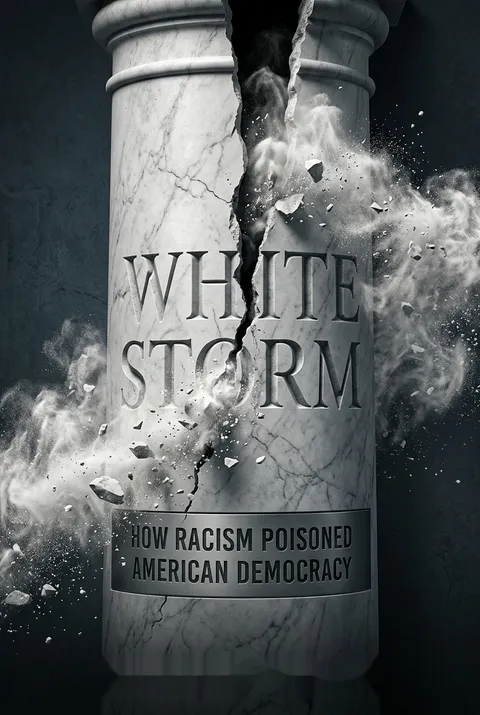
The White Storm receives overwhelmingly positive reviews (4.66/5), praised for its thorough research tracing American racism from slavery to January 6th. Readers appreciate Gelin's accessible writing and detailed historical analysis, including discussions of Thomas Jefferson, James Baldwin, police militarization, and the Republican Party's evolution. Several reviewers note the book's emotional impact and importance for understanding current events. One critique mentions the book doesn't address recent attempts by politicians to rectify past racist statements. Originally published in Swedish, reviewers find it relevant for all audiences despite some Sweden-specific references.
People Also Read




Download PDF
Download EPUB
.epub digital book format is ideal for reading ebooks on phones, tablets, and e-readers.








































