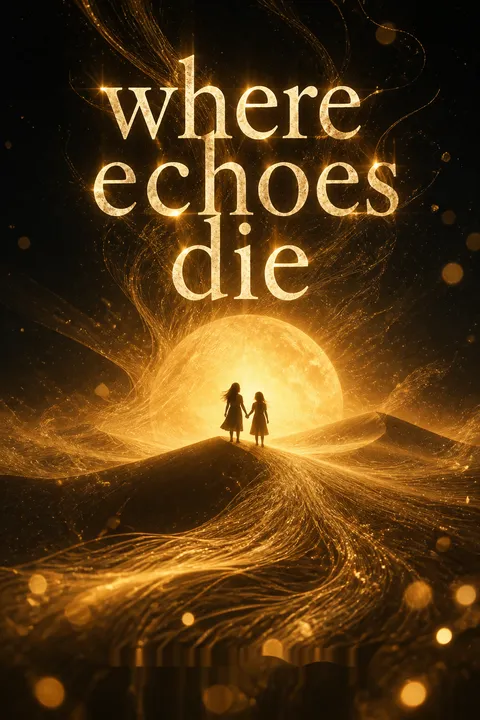

Plot Summary
Sisters on the Road
Beck and Riley Birsching, reeling from their mother's recent death, embark on a cross-country road trip to the mysterious desert town of Backravel, Arizona. Beck, the older sister, is driven by a compulsion to understand her mother's obsession with the town, while Riley is more reluctant, seeking only a sense of normalcy. The journey is tense, filled with Beck's secret hope that Backravel will provide closure, and Riley's desire to move on. Their relationship is marked by love, but also by the strain of grief and the secrets Beck keeps—especially the letter from their mother that seems to beckon them to Backravel. The desert landscape mirrors their emotional exhaustion, and the drive is both a physical and psychological crossing into the unknown.
Arrival in Backravel
The sisters arrive in Backravel, greeted by the Sterlings, their hosts, and settle into a trailer behind a modest house. The town is eerily normal on the surface, but Beck is immediately struck by its oddities: the lack of information online, the pristine yet empty streets, and the sense that time itself feels off. The sisters must lie to their father about their true destination, deepening the sense of isolation. Beck's curiosity is piqued by the guest log in the trailer, which reveals a pattern of visitors—especially a woman named Delia Horton, who, like their mother, returned to Backravel over and over. The sisters' dynamic is tested as Beck's obsession with their mother's past grows, and Riley's discomfort with the town intensifies.
Haunted by Mother's Past
Through flashbacks and Beck's memories, we see Ellery Birsching's relentless pursuit of the truth about Backravel. Ellery was a journalist who became consumed by the town's mysteries, collecting stories of lost time, miraculous healings, and inexplicable events. Beck idolized her mother's investigative drive, but also witnessed how it tore their family apart—leading to Ellery's job loss, her father's departure, and the family's financial decline. Now, in Backravel, Beck is determined to finish what her mother started, even as she fears inheriting Ellery's obsession and unraveling herself. The sisters' grief is compounded by the sense that Ellery's story is unfinished, and Beck feels compelled to find the missing pieces.
The Town That Forgets
As Beck and Riley explore the town, they encounter its unsettling atmosphere: residents who seem familiar yet forgetful, a lack of churches or cemeteries, and a pervasive sense of déjà vu. Beck's investigation leads her to the local library, where she discovers incomplete records, missing information, and hints of a military past. The town's people, including the enigmatic Avery and her father Ricky, are evasive about Backravel's origins and the purpose of the treatment center on the plateau. Beck's own sense of time and memory begins to slip, mirroring the town's collective amnesia. The sisters' bond is strained as Beck delves deeper, and Riley grows increasingly uneasy.
Slipping Through Memories
Beck experiences episodes of "slipping," where she loses track of time and finds herself reliving moments from her past. These episodes intensify in Backravel, echoing her mother's decline into confusion before her death. The phenomenon is not unique to Beck; townspeople like Mr. Sterling and even Avery exhibit similar lapses. The treatment center is revealed to be a place where "unspooling" occurs—a process that allows people to revisit and even relive moments before their trauma or illness. The cost, however, is a gradual erosion of memory and identity. Beck is both fascinated and terrified, recognizing the same patterns that destroyed her mother.
The Desert's Pull
Beck is drawn to the outskirts of Backravel, where she encounters a mysterious woman living in a makeshift camp. This "Desert Woman" is disoriented, lost in time, and seems to know Beck and her mother. She hints at a deeper truth about Backravel and the dangers of unspooling. Beck's encounters with her are unsettling, as the woman's identity and memories shift, but she becomes a key to understanding the town's curse. The desert itself is a character—vast, timeless, and holding the remnants of military experiments that may have warped reality. Beck's obsession grows, even as Riley's health and spirit begin to falter.
The Tour and the Tour Guide
Beck finally meets Avery, the daughter of Ricky, who serves as the town's unofficial tour guide. Avery is both alluring and guarded, challenging Beck's questions and deflecting inquiries about the treatment center and her family's past. Their relationship is charged with tension and attraction, as Beck senses a kindred spirit in Avery's restlessness and pain. Through their interactions, Beck learns more about the town's founding, the original military base, and the mysterious "source" that Ellery sought. Avery's own memories are unreliable, and she is caught between loyalty to her father and her growing connection to Beck.
Unspooling and the Treatment Center
Beck is granted an audience with Ricky at the treatment center, where he explains the process of unspooling: using the unique properties of Backravel's soil to allow people to relive moments before their trauma, effectively erasing pain but also erasing memory. Ricky believes he is offering salvation, but Beck sees the danger—people lose themselves, their pasts, and their ability to move forward. The treatment center is both sanctuary and prison, and Beck realizes her mother was both a patient and a collaborator, helping Ricky search for a deeper "source" of the town's power. The ethical and emotional stakes are raised as Beck confronts the possibility of losing herself.
The Woman in the Desert
The Desert Woman is revealed to be Wynona Carnes, Avery's mother and Ricky's estranged wife. Wynona was once a scientist at the original military base, and she has been trapped in a cycle of unspooling and forgetting, unable to escape the desert or reunite with her family. Her memories are fragmented, but she holds crucial knowledge about the origins of Backravel and the dangers of the "source." Beck, Avery, and Wynona's stories converge, as they realize that Ricky's quest to control time and memory has left a trail of broken lives. The reunion is painful, as Avery confronts the truth about her family and her own lost years.
Secrets in the Notes
Beck discovers her mother's hidden notes and an unfinished exposé on Backravel, revealing Ellery's growing horror at the town's practices. Ellery's investigation uncovered the fraud, manipulation, and psychological harm caused by Ricky's treatments, but she was unable to stop him or save herself. The notes also contain clues to the location of the original laboratory—the "source" of Backravel's power. Beck is forced to confront the reality that her mother's obsession was both a search for healing and a descent into self-destruction. The sisters' relationship reaches a breaking point, as Riley demands to leave and Beck refuses to abandon the mystery.
Sickness and Separation
As Beck and Riley remain in Backravel, they both fall ill—the physical manifestation of the town's curse. Riley's condition worsens, and she is taken to the treatment center, separated from Beck. The town's facade of happiness crumbles as more residents succumb to sickness and confusion. Beck's desperation peaks as she realizes that unspooling is not a cure, but a trap that keeps people from moving on. The sisters' bond is tested to its limit, and Beck must choose between clinging to the past or saving her sister.
The Truth About Backravel
Beck, Avery, Wynona, and Ricky descend into the hidden laboratory beneath the desert, where the true "source" of Backravel's power is revealed: a mineral or chemical residue from military experiments that warps time and memory. Ricky, driven by grief and the desire to reunite his family, attempts to use the source to reset the town and bring back the dead. The confrontation is explosive—literally and emotionally—as the lab begins to collapse and the characters are forced to choose between repeating the past or escaping to an uncertain future. Beck's understanding of her mother's choices deepens, and she must decide what she is willing to forget.
The Labyrinth Below
In the chaos of the collapsing lab, Beck experiences a final, vivid unspooling—a return to her happiest memory with her mother on the river. The scene is both a gift and a test: Beck can choose to remain in the echo of the past, or fight her way back to reality and save those she loves. The boundaries between memory and present blur, and Beck is forced to confront the pain of letting go. The cost of healing is not forgetting, but accepting loss and moving forward. The family's cycle of grief and obsession is finally broken.
The Family Unravels
Beck chooses to leave the echo of the past, saying a final goodbye to her mother and returning to the present. The survivors—Beck, Riley, Avery, and Wynona—emerge from the ruins of Backravel, forever changed. Ricky is gone, and the town's spell is broken. The residents must face the world outside, with all its pain and possibility. Beck and Riley reconcile, acknowledging the ways they failed and saved each other. Avery and Wynona begin to heal their fractured relationship, and Beck and Avery's connection deepens into hope for the future.
The Choice to Remember
In the aftermath, Beck and the others are hospitalized, recovering from their ordeal. The process of healing is slow and uncertain, as they grapple with the memories they have lost and the ones they choose to keep. Beck and Riley rebuild their bond, learning to forgive themselves and each other. Avery, unmoored from Backravel's cycle, must find a new path. The survivors are left with scars, but also with the freedom to move forward. The story's emotional climax is not in solving the mystery, but in choosing to live with loss and embrace the future.
The River and the Goodbye
Beck's last vision of her mother is on the river, the place where she was happiest. Ellery explains that Backravel is an echo—a place where people try to live in the past, but lose themselves in the process. Beck must choose to leave the echo and return to life, accepting that grief is part of moving on. The goodbye is bittersweet, but necessary. Beck's journey is not about finding answers, but about learning to let go.
After Backravel: Healing
Beck and Riley, now free from Backravel, begin to rebuild their lives with their father and Julie. The trauma of their experience lingers, but they are determined to support each other and move forward. Beck reconnects with Avery, who is also struggling to find her place in the world. The survivors of Backravel must learn to live with uncertainty, memory, and hope. The story ends not with closure, but with the promise of healing and the courage to face tomorrow.
Tomorrow's Sunrise
On a hospital rooftop, Beck and Avery watch the sunrise over a real city, no longer trapped in the echo of Backravel. Their connection is tentative but real, a symbol of the possibility of love and growth after loss. Beck has learned that healing is not about erasing pain, but about carrying it forward and choosing to live. The past will always echo, but the future is unwritten. The story closes with the hope that, even after the deepest grief, there is always a new day.
Analysis
Courtney Gould's Where Echoes Die is a haunting meditation on grief, memory, and the seductive danger of living in the past. Through the lens of speculative fiction, the novel interrogates the human desire to erase pain and the psychological cost of refusing to move forward. Backravel is both a literal and metaphorical echo chamber, a place where time loops and the past is endlessly replayed, but at the cost of identity and growth. The unspooling process, while promising healing, ultimately traps its victims in cycles of forgetting, mirroring the real-world temptations of nostalgia, denial, and avoidance. The novel's emotional core is the relationship between Beck and Riley, sisters navigating the aftermath of loss and the challenge of forging a future without their mother. Beck's journey is one of painful self-discovery: she learns that true healing is not found in answers or in the past, but in the courage to let go and embrace uncertainty. The story's queer romance between Beck and Avery adds depth, showing that love and connection are possible even after the deepest wounds. Ultimately, Where Echoes Die is a powerful exploration of the necessity of grief, the limits of memory, and the hope that, even after the echo fades, a new day can begin.
Review Summary
Where Echoes Die receives mixed reviews, averaging 3.57 stars. Readers praise Courtney Gould's atmospheric writing and the creepy setting of Backravel, Arizona—a town with no cars, cemeteries, or churches. Many appreciate the exploration of grief and the sapphic romance, though some find it underdeveloped. Common criticisms include slow pacing, an unlikeable protagonist (Beck), and confusing sci-fi elements. Several reviewers felt the ending was rushed or left questions unanswered. While the mystery initially engages readers, many were disappointed with how it resolved. Fans of Gould's debut generally prefer it over this sophomore effort.
Characters
Beck Birsching
Beck is the seventeen-year-old protagonist, driven by the need to understand her mother's obsession with Backravel and to find closure after Ellery's death. She is fiercely protective of her younger sister Riley, but also secretive and self-sacrificing to a fault. Beck's psychological journey is marked by her struggle with memory, identity, and the temptation to lose herself in the past. She inherits her mother's investigative drive and emotional intensity, but fears repeating Ellery's mistakes. Beck's development is a painful process of learning to let go, accept loss, and choose life over endless searching. Her relationship with Avery offers both a mirror and a path to healing.
Riley Birsching
Riley, fifteen, is Beck's younger sister and emotional anchor. She is logical, direct, and desperate for stability after years of chaos. Riley resents her mother's obsession and Beck's secrecy, but loves her family deeply. Her psychological arc is about learning to forgive—both her mother and Beck—and to accept that grief cannot be solved or avoided. Riley's illness in Backravel is both literal and symbolic, representing the cost of refusing to move on. Her reconciliation with Beck is a hard-won victory, and she emerges as a survivor determined to build a new life.
Ellery Birsching
Ellery is the sisters' late mother, a journalist whose fixation on Backravel destroyed her career and family. She is brilliant, relentless, and ultimately consumed by her need to understand and control the mysteries of time and memory. Ellery's legacy is both a gift and a curse to Beck, who idolizes and fears becoming her. In death, Ellery remains a haunting presence, her unfinished story driving the plot. Her final message to Beck is a lesson in the necessity of letting go and accepting the limits of love and knowledge.
Avery Carnes
Avery is the daughter of Ricky and Wynona, and serves as Beck's guide and eventual love interest. She is sharp, guarded, and deeply wounded by her family's secrets and the endless cycle of unspooling. Avery's relationship with Beck is a source of both comfort and pain, as they recognize their shared longing for escape and meaning. Avery's development is about reclaiming agency, confronting her father's manipulation, and choosing to move forward. Her reunion with her mother and connection with Beck offer hope for healing.
Ricky Carnes
Ricky is the founder of Backravel and the architect of its unspooling treatments. He is both a visionary and a villain, convinced that he can save people by erasing their pain—even at the cost of their memories and identities. Ricky's motivations are rooted in the loss of his son and the collapse of his family. His psychological complexity lies in his genuine belief in his mission, even as it destroys those he loves. Ricky's downfall is tragic, as he is consumed by the very cycle he created.
Wynona Carnes (Desert Woman)
Wynona is Avery's mother and Ricky's estranged wife, trapped in the desert and in cycles of forgetting. Once a scientist at the original military base, she understands the true dangers of Backravel's power. Wynona's arc is one of regret, longing, and the desperate hope to save her daughter. Her reunion with Avery is bittersweet, and her knowledge is crucial to breaking the town's curse. Wynona embodies the cost of obsession and the possibility of redemption.
The Sterlings (Greg, Ruthie, Daniel)
The Sterling family represents the ordinary people caught in Backravel's web. Greg and Ruthie are kind but forgetful, and their son Daniel is a survivor of the town's treatments. Their story illustrates the seductive promise of unspooling—safety, health, and happiness—but also its dangers. The Sterlings' relationship with Beck and Riley is both supportive and tragic, as they are ultimately powerless to escape the town's fate.
Delia Horton
Delia is a mysterious figure who, like Ellery, returned to Backravel repeatedly. Her presence in the guest log and Ellery's notes symbolizes the town's magnetic pull on the lost and grieving. Delia's story is a cautionary tale about the dangers of seeking solace in the past.
Katie and Friends
Katie, Daniel, and their friends are the town's youth, shaped by Backravel's cycles. They offer Riley a glimpse of normalcy and belonging, but are also victims of the town's forgetting. Their interactions with Beck and Riley highlight the costs of staying versus leaving.
Beck and Riley's Father (and Julie)
The sisters' father, now remarried to Julie, represents the possibility of a new life and the challenge of moving on. His absence and eventual return force Beck and Riley to confront their own choices and the meaning of family after loss.
Plot Devices
Unspooling and the Echo of Time
The central plot device is the process of "unspooling," enabled by the unique properties of the desert soil—possibly the result of military experiments. Unspooling allows people to relive moments before their trauma, erasing pain but also erasing memory and identity. The town itself becomes an echo chamber, where time loops and the past is both a refuge and a prison. This device is used to explore the psychological costs of refusing to move on, the allure of nostalgia, and the dangers of erasing pain without healing. The narrative structure mirrors this device, with frequent slips into memory, flashbacks, and blurred boundaries between past and present. Foreshadowing is used throughout, as Beck's own slipping and the town's collective amnesia hint at the ultimate price of unspooling. The final descent into the lab literalizes the metaphor, forcing the characters to confront the source of their pain and choose between endless repetition and the risk of living.

Download PDF
Download EPUB
.epub digital book format is ideal for reading ebooks on phones, tablets, and e-readers.








































