
Plot Summary
Blue Death, Blue Creation
The story opens with the accidental discovery of Prussian Blue, a pigment that would color not only the canvases of Europe but also the darkest chapters of human history. From the vibrant blue of art to the blue-stained bricks of Auschwitz, the pigment's chemical byproduct—cyanide—becomes a tool of mass death. The narrative weaves through the lives of those who created, profited from, and suffered under the shadow of this chemical, showing how beauty and horror can spring from the same source. The pigment's journey from artistic marvel to instrument of genocide encapsulates the duality of scientific progress: every creation holds the seed of destruction, and every innovation can be twisted by the needs and fears of its age.
The Poisoned Roots of Progress
Fritz Haber, a German chemist, embodies the paradox of scientific advancement. His process for extracting nitrogen from the air feeds billions, yet the same chemistry enables the creation of deadly gases used in World War I. The chapter explores how the pursuit of knowledge and national pride can lead to both salvation and devastation. Haber's personal life is marked by tragedy—his wife's suicide after witnessing the horrors of his inventions, and his own exile and death, haunted by the knowledge that his work would later be used to murder his own people. The narrative underscores the moral ambiguity of progress, where the line between benefactor and destroyer blurs, and the consequences of discovery ripple through generations.
Singularities in War and Mind
Karl Schwarzschild, a brilliant physicist, solves Einstein's equations of general relativity from the trenches of World War I, discovering the concept of the singularity—an inescapable abyss in space-time. As he grapples with the implications of his work, he is consumed by a sense of impending doom, both in the cosmos and within himself. His body succumbs to disease, mirroring the collapse he predicts in the universe. The singularity becomes a metaphor for the psychological and societal black holes that can form when collective will or trauma is compressed beyond endurance. Schwarzschild's insights foreshadow the destructive potential of concentrated power, whether in physics or in the human soul.
The Alchemist's Shadow
The narrative traces the lineage from alchemy to chemistry, focusing on figures like Johann Conrad Dippel, whose experiments with life and death inspire both scientific breakthroughs and literary horror. Dippel's quest for the elixir of life and his gruesome experiments echo in the creation of Prussian Blue and the birth of Frankenstein's monster. The chapter explores how the desire to transcend natural limits can lead to both enlightenment and monstrosity. The boundary between genius and madness blurs, and the unintended consequences of tampering with nature become a recurring motif. The alchemist's shadow lingers over every scientific advance, a reminder of the dangers of unchecked ambition.
The Harvest of Atoms
The Haber-Bosch process revolutionizes agriculture, doubling the world's food supply and enabling unprecedented population growth. Yet, this same process sustains the machinery of war, prolonging conflict and amplifying its toll. The chapter examines the ethical dilemmas faced by scientists whose discoveries have dual uses. The bones of the dead—human and animal—are ground into fertilizer, blurring the line between nourishment and annihilation. The narrative reflects on the interconnectedness of life and death, creation and destruction, and the ways in which scientific progress can both sustain and threaten civilization.
The Black Sun Dawns
As Europe descends into fascism and war, the metaphor of the singularity returns. The concentration of collective will—millions united in purpose, whether for creation or destruction—becomes a force as inescapable as a black hole. The rise of totalitarian regimes, the horrors of the Holocaust, and the unleashing of atomic power are all seen as manifestations of this psychic singularity. The chapter explores the psychological mechanisms that allow societies to cross points of no return, where moral and rational boundaries dissolve. The black sun, both literal and figurative, rises over a world that has ceased to understand itself.
The Unraveling of Certainty
The birth of quantum mechanics shatters the classical worldview. Werner Heisenberg, Erwin Schrödinger, and their contemporaries grapple with a reality that defies intuition: particles are waves, certainty is replaced by probability, and observation alters the observed. The narrative follows their personal struggles—illness, obsession, rivalry—as they confront the limits of knowledge. The uncertainty principle becomes both a scientific and existential revelation, forcing humanity to accept ambiguity at the heart of reality. The chapter captures the vertigo of a world where the ground beneath our feet is no longer solid, and the quest for understanding leads only to deeper mysteries.
The Heart of Mathematics
In the modern era, Shinichi Mochizuki claims to have solved one of mathematics' deepest problems, but his proof is so abstract and alien that no one can understand it. The mathematical community is divided between awe and suspicion, as the boundaries of human comprehension are tested. Mochizuki's isolation and refusal to explain his work evoke the loneliness of the true visionary, and the possibility that some knowledge may be forever out of reach. The chapter explores the psychological toll of genius, the allure and danger of abstraction, and the ways in which the frontiers of thought can become impassable barriers.
The Curse of Grothendieck
Alexander Grothendieck, one of the greatest mathematicians of the twentieth century, revolutionizes the field with his radical abstractions, only to abandon mathematics and society altogether. His life becomes a parable of the dangers of seeking total understanding. Grothendieck's journey from brilliance to hermitage is marked by spiritual crises, ecological activism, and a growing sense that his discoveries are too powerful, too dangerous for humanity. The narrative delves into the psychological costs of genius, the burden of knowledge, and the temptation to erase oneself from history. Grothendieck's retreat is both a warning and a lament for a world that cannot bear the fruits of its own intellect.
The Hermit and the Dreamer
Grothendieck's final years are spent in seclusion, haunted by dreams and visions. He burns his papers, forbids the publication of his work, and seeks to dissolve his influence. The chapter explores the interplay between creativity and madness, the thin line between revelation and delusion. Grothendieck's encounters with admirers and would-be disciples are marked by cryptic questions and refusals, as he becomes a living symbol of the unknowable. The narrative reflects on the loneliness of those who venture too far beyond the boundaries of common understanding, and the price paid for glimpsing the heart of the heart.
The Quantum Divide
The rivalry between Schrödinger and Heisenberg crystallizes the philosophical crisis at the core of quantum mechanics. Schrödinger's wave equation offers elegance and intuition, while Heisenberg's matrix mechanics demands the abandonment of visualization. Their debates, both public and private, mirror the broader struggle to reconcile the strange truths of the quantum world with human experience. The chapter dramatizes the emotional intensity of scientific discovery, the pain of misunderstanding, and the exhilaration of glimpsing new realities. The divide between the two men becomes a metaphor for the split in the human mind when confronted with the incomprehensible.
The Uncertainty Principle
Heisenberg's uncertainty principle formalizes the inherent limitations of measurement and prediction in the quantum realm. The realization that reality itself is fundamentally indeterminate challenges the very foundations of science and philosophy. The narrative explores the implications of this discovery for free will, causality, and the nature of existence. The uncertainty principle becomes a symbol of the humility required in the face of the unknown, and a reminder that some mysteries may never be resolved. The chapter captures the awe and terror of confronting a universe that resists final explanation.
The Duel of Giants
At the Solvay Conference, the greatest minds of the age gather to debate the meaning of quantum mechanics. Einstein refuses to accept the abandonment of determinism, while Bohr and Heisenberg defend the new paradigm. Their intellectual duel is both a clash of ideas and a drama of personalities, with the future of science hanging in the balance. The chapter portrays the poignancy of genius confronting its own limits, the dignity of dissent, and the inevitability of change. The outcome is a world where certainty is forever lost, and the pursuit of knowledge becomes an endless negotiation with ambiguity.
The Cat in the Box
Schrödinger's famous thought experiment—his cat, both alive and dead—embodies the paradoxes at the heart of quantum mechanics. The chapter explores the philosophical and emotional implications of a reality where contradictions coexist, and where observation creates the world it observes. The cat becomes a symbol of the unresolved tensions between knowledge and ignorance, life and death, possibility and actuality. The narrative reflects on the ways in which science, in its quest for truth, can generate enigmas more profound than any it set out to solve.
The Night Gardener's Lament
In a quiet mountain town, the narrator encounters the night gardener, a former mathematician turned recluse. Their conversations, set against the backdrop of dying trees and poisoned dogs, become meditations on mortality, loss, and the limits of human understanding. The gardener's stories—of family secrets, ecological collapse, and the slow death of knowledge—echo the themes of the larger narrative. The chapter is suffused with melancholy, as the beauty of the natural world is shadowed by the inevitability of decay and the persistence of mystery.
Gardens of Knowledge and Ruin
The garden becomes a metaphor for the human pursuit of knowledge: cultivated, beautiful, but always threatened by rot and ruin. The chapter explores the ways in which scientific and technological advances, like invasive species, can disrupt the balance of life. The stories of fertilizers, poisons, and plagues mirror the broader narrative of progress and its discontents. The gardener's wisdom—born of failure and humility—offers a counterpoint to the hubris of the great scientists, suggesting that true understanding may lie in acceptance rather than conquest.
The Limits of Comprehension
As the narrative draws to a close, the focus shifts to the growing gap between what humanity can achieve and what it can comprehend. The proliferation of theories, equations, and technologies creates a world that is increasingly alien to its creators. The chapter reflects on the psychological and ethical challenges of living in an age where the fruits of genius are both indispensable and unfathomable. The limits of comprehension become not just a scientific problem, but a human one, shaping the destiny of individuals and societies alike.
When We Cease to Understand
The final chapter contemplates the consequences of a world where understanding has reached its limits. The stories of scientists, mathematicians, and ordinary people converge in a meditation on the beauty and terror of the unknown. The narrative suggests that the quest for knowledge is both a blessing and a curse, and that the greatest danger may lie not in what we do not know, but in what we can no longer understand. The book ends with a call to humility, wonder, and the acceptance of mystery as the ultimate horizon of human experience.
Analysis
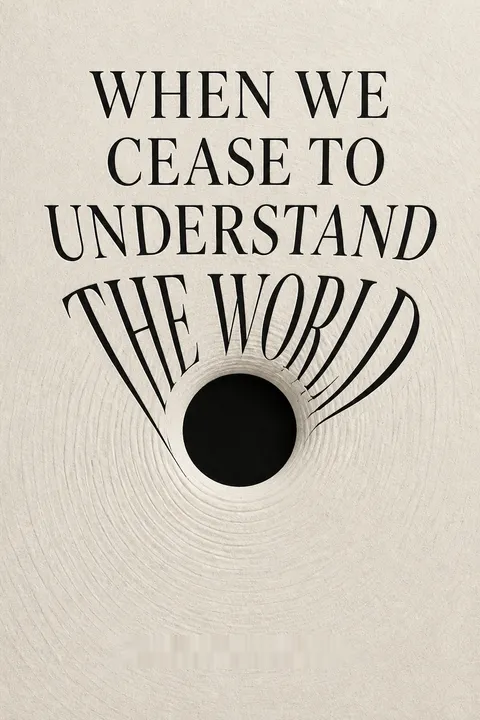
Labatut's When We Cease to Understand the World is a meditation on the perilous beauty of knowledge and the limits of human comprehension. Through a tapestry of intertwined biographies, the book explores how the greatest scientific and mathematical breakthroughs of the modern era have brought both enlightenment and catastrophe. The narrative reveals that every act of understanding is shadowed by unintended consequences, and that the pursuit of mastery over nature often leads to new forms of ignorance and peril. Labatut suggests that the true danger lies not in what we do not know, but in what we can no longer understand—the point at which our creations outpace our capacity to grasp their meaning or control their effects. The book is both a celebration of human ingenuity and a warning against hubris, urging humility in the face of mystery. In an age where the fruits of genius shape every aspect of our lives, Labatut's work is a poignant reminder that the greatest questions remain unanswered, and that the heart of the world may always elude our grasp.
Review Summary
When We Cease to Understand the World blends fact and fiction to explore the lives of scientists and mathematicians who made groundbreaking discoveries. Readers praise Labatut's masterful writing and ability to make complex scientific concepts accessible. The book examines the dark side of scientific progress and the fine line between genius and madness. While some critics find the fictional elements problematic, many appreciate the unique approach to storytelling. The work is lauded for its thought-provoking nature and has been shortlisted for prestigious literary awards.
People Also Read








Characters
Fritz Haber
Haber is the embodiment of science's double-edged sword: his invention of synthetic fertilizer saves billions from starvation, yet the same chemistry enables the horrors of chemical warfare and genocide. Driven by patriotism and ambition, he is both a benefactor and a destroyer, haunted by personal tragedy—his wife's suicide and his own exile. Haber's psychological complexity lies in his ability to compartmentalize, justifying his actions as service to progress and country, even as the consequences spiral beyond his control. His legacy is a cautionary tale about the moral responsibilities of scientific discovery and the unpredictable paths of innovation.
Karl Schwarzschild
Schwarzschild's brilliance shines in his solution to Einstein's equations, revealing the existence of singularities—points where the laws of physics break down. His work, accomplished amid the horrors of war, becomes a metaphor for the psychological and societal voids that can consume individuals and nations. Schwarzschild is introspective, sensitive to the darkness within and without, and his early death from disease mirrors the collapse he predicts in the cosmos. His legacy is both scientific and existential, raising questions about the limits of knowledge and the dangers of concentrated power.
Johann Conrad Dippel
Dippel straddles the line between genius and madness, his experiments with life and death foreshadowing both scientific breakthroughs and literary horror. His quest for the elixir of life and his gruesome dissections reflect the perennial human desire to transcend natural limits. Dippel's influence lingers in the creation of Prussian Blue and the myth of Frankenstein, symbolizing the unintended consequences of unchecked ambition. Psychologically, he is driven by a need for recognition and a willingness to transgress boundaries, making him both a pioneer and a cautionary figure.
Erwin Schrödinger
Schrödinger is a complex figure, torn between the desire for clarity and the allure of mystery. His wave equation revolutionizes physics, yet he is plagued by doubts about its meaning and implications. His personal life is marked by restlessness, romantic entanglements, and a yearning for transcendence. Schrödinger's psychological landscape is one of oscillation—between certainty and ambiguity, passion and detachment. His famous cat paradox encapsulates his struggle to reconcile the contradictions at the heart of reality, making him a symbol of the modern scientific predicament.
Werner Heisenberg
Heisenberg's genius lies in his willingness to embrace the unknown. His uncertainty principle shatters the classical worldview, forcing science to accept probability and indeterminacy at its core. He is driven by a relentless pursuit of truth, even when it leads to discomfort and alienation. Heisenberg's psychological resilience allows him to withstand criticism and isolation, but his insights come at the cost of existential vertigo. His legacy is both liberating and unsettling, marking the end of certainty and the beginning of a new era of humility before the mysteries of nature.
Alexander Grothendieck
Grothendieck's life is a study in extremes: from revolutionary genius to reclusive mystic. His abstractions transform mathematics, yet he ultimately rejects the world he helped create, retreating into isolation and spiritual quest. Grothendieck is driven by an insatiable hunger for understanding, but also by a profound sense of responsibility and fear of the consequences of knowledge. His psychological journey is marked by periods of intense creativity, followed by withdrawal and self-doubt. Grothendieck's story is a meditation on the costs of genius and the limits of human comprehension.
Shinichi Mochizuki
Mochizuki is a modern echo of the solitary genius, his proof of a major mathematical conjecture so advanced that it defies understanding. He is intensely private, resistant to explanation, and seemingly indifferent to recognition. Mochizuki's psychological profile is one of isolation, obsession, and perhaps a touch of paranoia. His work challenges the very notion of shared knowledge, raising questions about the accessibility and purpose of discovery. Mochizuki stands as a symbol of the growing gap between individual insight and collective comprehension.
Niels Bohr
Bohr is the intellectual anchor of the quantum revolution, advocating for complementarity and the acceptance of ambiguity. He is both mentor and adversary, guiding younger scientists while challenging their assumptions. Bohr's psychological strength lies in his ability to hold contradictory ideas in tension, seeking synthesis rather than resolution. His influence shapes the direction of physics, but also embodies the uncertainties and compromises of the modern scientific enterprise.
Albert Einstein
Einstein is the conscience of classical physics, refusing to accept the abandonment of causality and objective reality. His genius is matched by his stubbornness, and his debates with Bohr and Heisenberg become legendary. Psychologically, Einstein is both visionary and nostalgic, longing for a universe governed by reason and law. His inability to reconcile with quantum mechanics marks the twilight of an era, and his legacy is one of both triumph and tragedy.
The Night Gardener
The night gardener is a minor but resonant figure, embodying the themes of loss, humility, and the limits of understanding. Once a promising mathematician, he retreats into solitude and manual labor, tending gardens as a form of penance and reflection. His conversations with the narrator are laced with melancholy and wisdom, offering a counterpoint to the grand ambitions of the scientists and mathematicians. Psychologically, he is marked by resignation, acceptance, and a quiet reverence for the mysteries that remain unsolved.
Plot Devices
Intertwined Biographies and Historical Vignettes
Labatut structures the book as a series of interwoven biographies, blending fact and fiction to explore the psychological and ethical dimensions of scientific discovery. Each chapter focuses on a pivotal figure or event, using personal stories to illuminate broader themes. This device allows the narrative to move fluidly across time and discipline, drawing connections between disparate moments and ideas. The use of historical vignettes grounds abstract concepts in lived experience, making the stakes of knowledge tangible and immediate.
Metaphor and Symbolism
Throughout the book, scientific concepts—singularities, uncertainty, wave functions—are used as metaphors for psychological, social, and existential phenomena. The singularity becomes a symbol of collective catastrophe; the uncertainty principle reflects the limits of self-knowledge; the garden stands for the fragile balance between creation and decay. This layering of meaning deepens the narrative, inviting readers to see science not just as a body of knowledge, but as a lens for understanding the human condition.
Foreshadowing and Recurrence
Labatut employs foreshadowing and recurrence to create a sense of inevitability and interconnectedness. Early chapters hint at later developments, and motifs—such as the color blue, the motif of poison, or the image of the black sun—reappear in new contexts. This technique reinforces the idea that the consequences of discovery are unpredictable and far-reaching, and that the boundaries between past, present, and future are porous.
Blurring of Fact and Fiction
The book deliberately blurs the line between historical fact and imaginative reconstruction, challenging readers to question the reliability of knowledge and the nature of truth. This device mirrors the uncertainties faced by the characters themselves, and underscores the central theme: that understanding is always provisional, and that the pursuit of certainty can lead to paradox and confusion.
Psychological Interiorization
Labatut delves deeply into the inner lives of his characters, portraying scientific discovery as a psychological and spiritual quest. The narrative often shifts from external events to internal states—dreams, obsessions, breakdowns—emphasizing the personal costs of genius and the dangers of venturing too far into the unknown. This focus on interiority humanizes the great figures of science, revealing their vulnerabilities and doubts.
Download PDF
Download EPUB
.epub digital book format is ideal for reading ebooks on phones, tablets, and e-readers.








































