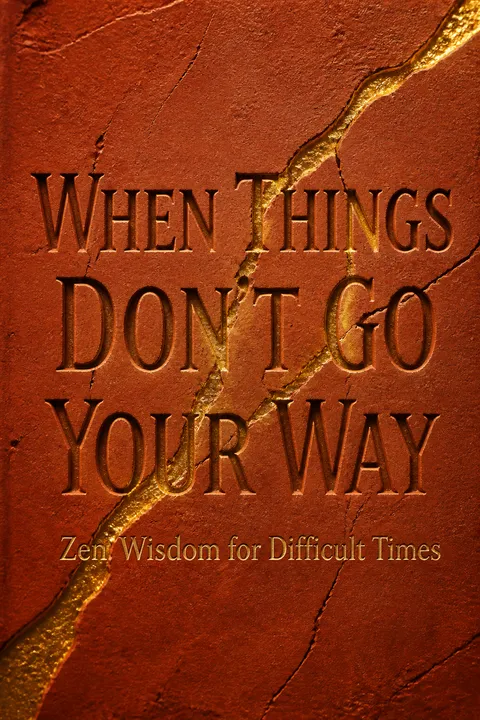


Key Takeaways
When life shatters, give yourself permission to not be all right
Sit with the pain instead of fleeing it. Haemin Sunim, a bestselling Zen teacher, was publicly savaged in 2020 after a TV appearance: a senior monk branded him a "parasite," false rumors claimed he owned a Ferrari, and the Korean media piled on. The founder of the School for Broken Hearts found his own heart broken. Rather than perform serenity, he let himself feel it fully.
Emotions must be honored in sequence. He moved through rage (screamed, journaled, climbed mountains), then grief and tears, and finally reached the root: fear. Tracing that fear led to a childhood memory of being lost in a market and nearly abducted. Only by meeting that frightened inner child could he heal. Suppressing dark feelings, he learned, blocks awakening rather than proving it.
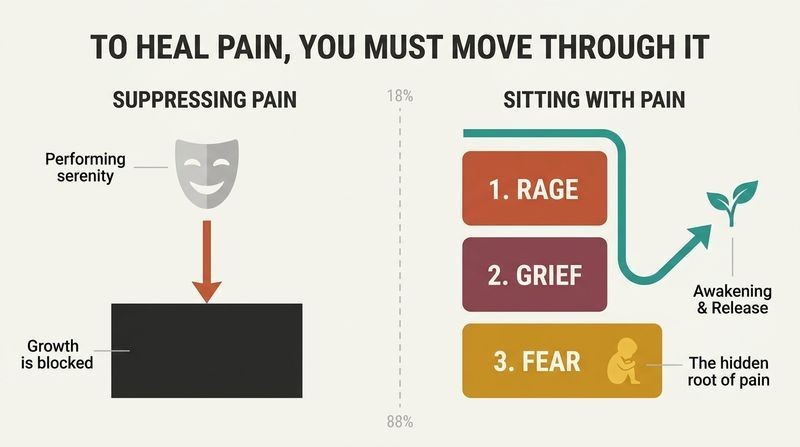
The insight aligns with modern affective science: suppression amplifies distress, while acceptance dampens it. Psychologist James Gross's research on emotion regulation shows expressive suppression raises physiological arousal and impairs memory, whereas acknowledgment calms the nervous system. Haemin's sequence (anger to grief to fear) mirrors what trauma clinicians call peeling defensive layers to reach core wounds, echoing internal family systems therapy. What's notable is a monk conceding that decades on the cushion did not dissolve his attachment wounds. That honesty rebuts the spiritual-bypassing myth: enlightenment is not emotional anesthesia. The steelman is strong, though "just feel it" can risk rumination for some; structure and support, which he used, matter.
Your suffering comes from grasping and resisting, not from the event itself
The mind is the culprit, not the world. Haemin distills the Buddhist diagnosis of unhappiness: the mind either grasps (chases pleasant things it lacks) or resists (pushes away unpleasant things it has). Modern psychology calls chronic resistance "stress." A raw experience is neither good nor bad; it simply is. The mind supplies the verdict.
Proof is in the variability. If a person were intrinsically unpleasant, everyone would dislike them equally. Instead, one person finds someone charming while another finds them insufferable, because each mind interprets through its own conditioning. As long as the mind swings between wanting what it lacks and rejecting what it has, it stays restless and blames external things for inner discomfort. Real peace comes from noticing this habit and turning attention inward rather than demanding the world rearrange itself.
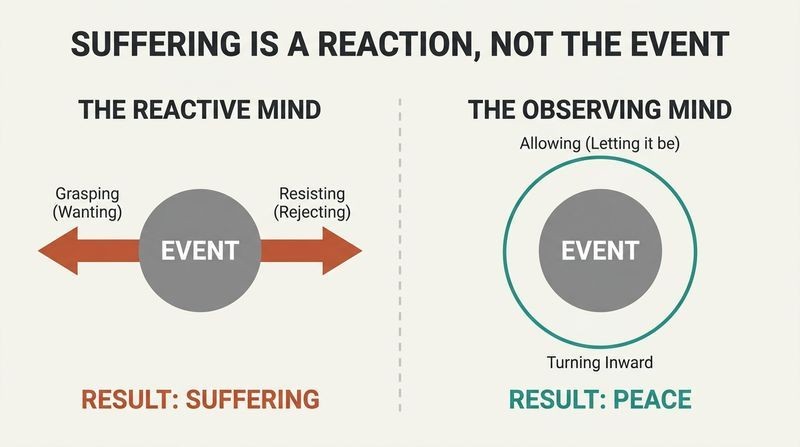
This is essentially Stoic and cognitive-behavioral before its time. Epictetus said people are disturbed not by events but by their judgments of events; Albert Ellis built REBT on the same premise. Haemin's contribution is the grasping-resisting pair as a single restless motion, a useful diagnostic. A fair critique: the framing risks minimizing genuinely harmful situations, and Haemin guards against this, insisting the point is not to excuse abuse or blame victims for their pain. The nuance worth holding is that interpretation shapes suffering without erasing injustice. Naming the mind as intermediary restores agency precisely where circumstances feel fixed.
Prime your mind each morning to welcome discomfort before it arrives
Two practices tame the restless mind. First, gratitude starves grasping. A thankful mind isn't scanning for what it lacks, so both wanting and rejecting shrink. Haemin suggests concrete habits: text three to five daily gratitudes to a "gratitude buddy," keep a pebble that prompts thanks each time you pass it, or genuinely thank cashiers and drivers.
Second, rehearse acceptance in advance. Instead of praying hardship never comes, treat it as a default setting of life. While brushing your teeth, tell your mind a few times, "Bring on discomfort, I will accept you gladly." When something unpleasant actually hits, count down three, two, one, and walk straight into it. (Genuinely dangerous situations are the exception: leave those fast.) As Rumi put it, the wound is where the light enters.
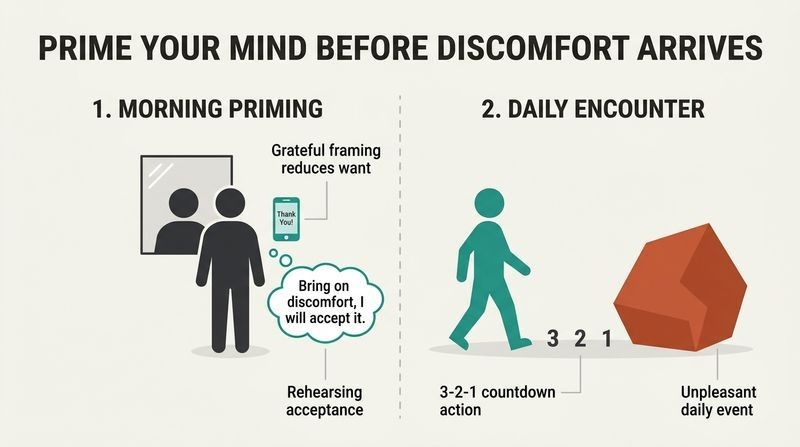
Gratitude's benefits are among the better-replicated findings in positive psychology: Emmons and McCullough found gratitude journaling improved wellbeing and even sleep. The morning inoculation resembles Stoic premeditatio malorum, deliberately imagining adversity to blunt its sting, and modern exposure therapy, where anticipatory acceptance reduces avoidance. The countdown trick echoes Mel Robbins's five-second rule for defeating hesitation. One caution: gratitude weaponized as forced positivity can become its own suppression, invalidating real grief. The practice works best as genuine noticing, not obligatory cheer. Haemin's framing, that discomfort is part and parcel rather than an anomaly, is the quietly radical part.
Decide whether the universe is abundant or stingy; the choice shapes everything
Gut-level trust is often inherited. Haemin distinguishes how you think about the universe scientifically from how you feel about it in your gut. Do you sense a benevolent force providing what you need, or a dead, zero-sum arena where everyone competes for scraps? This feeling, formed in childhood, quietly passes down generations.
Two father figures, two universes. His biological father, born into Korean War scarcity where he raced siblings for a second potato, experienced the universe as a place of lack: hardworking and responsible, but distrustful and cold to outsiders. His monastic teacher, by contrast, trusts completely, gives away whatever he owns, and always picks up the check, believing there are enough "pies" for everyone. Haemin argues this feeling is a choice, and that more benevolent thoughts and acts generate a more benevolent experienced world.
This maps onto attachment theory: secure attachment, formed when caregivers reliably meet needs, produces adults who trust the world, while inattentive parenting breeds a scarcity-vigilant stance. The intergenerational transmission Haemin describes is documented in studies of attachment patterns passing from parent to child. There's also overlap with the psychology of scarcity (Mullainathan and Shafir), which shows deprivation itself narrows cognition and trust. The debatable leap is the metaphysical claim that benevolent thoughts summon a benevolent universe, which flirts with law-of-attraction thinking. The defensible core stands regardless: your baseline expectation of abundance or threat is a lens you can consciously recalibrate through evidence and practice.
Rejection reveals the chooser's biases, not your worth
Fit, not merit, drives most no's. Chasing an academic job, Haemin fell in love with a college during a three-day interview, imagined his apartment there, then got a form rejection email. Devastated, he blamed his intellect and accent. But as he interviewed elsewhere, he saw each committee wanted a specifically shaped piece: one needed a postmodern theorist, another a medieval historian. The verdict said more about their idiosyncratic needs than his value.
Three antidotes to the sting.
1. People prefer the familiar, so being unfamiliar, not inferior, often loses.
2. Recall the people you have rejected; mutual liking is impossible to guarantee.
3. Share the pain with people who love you, since sorrow shared is halved.
He also stopped falling in love prematurely, staying present instead, and eventually landed the offer he wanted.
Neuroscience explains why rejection cuts so deep: Naomi Eisenberger's fMRI work shows social rejection activates the same brain regions as physical pain, which is why "it hurts" is literal. Haemin's reframe leans on the fundamental attribution error in reverse, we read rejection as a global verdict on ourselves rather than a narrow situational mismatch. The familiarity point echoes the mere-exposure effect, where repeated contact breeds preference. One useful extension: his "practice makes better" observation reframes rejection as reps, converting a self-esteem wound into a skill-acquisition curve. That cognitive shift, from worth to fit, from failure to data, is what makes the advice durable rather than merely consoling.
Every relationship is a mirror showing you your hidden pettiness
Closeness exposes what you cannot see alone. As a Princeton grad student, Haemin moved in with Jason, a friend he adored. Within months they were bickering over politics, buying separate rice cookers because Jason wouldn't eat day-old rice, and falling silent after Haemin accidentally threw out a camera manual. The friendship curdled over trivialities.
Conflict is data, not disaster. Citing Krishnamurti, Haemin notes we only discover our tendencies, fears, and vulnerabilities through the mirror of relationships. Cohabiting revealed his own selfish, petty, ungenerous streaks he'd been blind to. His practical repairs: give each other real space, negotiate expectations early (chores, money, food), adjust routines to coexist, and raise irritations kindly rather than bottling them. Others usually annoy us unknowingly, so the flaw we spot in them often sleeps within us too.
The mirror metaphor connects to Jung's shadow: the traits that irritate us most in others are often our own disowned qualities projected outward. Haemin's honesty about his pettiness models what Jung called making the darkness conscious. Relationship research supports the practical layer too; Gottman's studies show it's not the presence of conflict but how couples repair it that predicts survival, validating Haemin's emphasis on raising issues gently and reconciling. A subtle addition worth flagging: not every clash is a projection. Sometimes incompatibility is real and separation is healthy. The mirror lens is powerful but shouldn't become a tool for excusing genuinely mismatched or harmful dynamics.
Hunt for small but certain happiness instead of distant milestones
A cultural correction to YOLO. In Seoul, Haemin heard that "you only live once" spending had left people worse off, so they'd turned to SBCH, small but certain happiness, a phrase coined by novelist Haruki Murakami. Murakami's examples: tearing into warm fresh bread, a drawer of neatly folded underwear, afternoon light through leaves. The idea relocates happiness from someday to now.
Milestones are a treadmill. Marriage, promotions, and dream houses bring real joy, but if only they count, you spend most of life merely waiting, and each achievement spawns a bigger goal. Haemin's own SBCH: a favorite radio program, a park bench under oak trees, leafing through new books, dinner with friends who see him as an ordinary human. Happiness, he argues, is a matter of appreciation rather than ownership, available the moment you slow down to notice what's already here.
This tracks with hedonic adaptation research: Brickman's famous lottery-winner study found large windfalls barely move long-term happiness because we recalibrate to any new baseline. Frequent small pleasures resist adaptation better than rare big ones, exactly Haemin's argument, and Sonja Lyubomirsky's work confirms variety and frequency of positive experiences outperform intensity. The distinction between appreciation and ownership is philosophically rich: you cannot own a sunset, yet it can flood you with joy. One tension worth naming: SBCH could be misread as an anesthetic for the ambitious or a pacifier for the materially deprived. Haemin isn't dismissing goals, only refusing to postpone all joy until they arrive.
Beyond every summit waits another summit; goals never end suffering
The partner who wasn't happy. Haemin's accountant friend made partner at his firm in his forties, a rare feat rewarded with a company car, office, and secretary. Yet his face was joyless: he'd discovered tiers of partners, and a junior one had no real power. Beyond the mountain he'd climbed stood another mountain.
Haemin lived the same illusion. Becoming a monk revealed further ranks to climb; reaching Harvard revealed that divinity students ranked below law and MBA students. Entering the world you dreamed of doesn't end the game; it just reveals new rules and hierarchies. His deeper point: when you buy the coveted house or bag, it isn't the object that brings peace but the momentary rest of a mind that has paused its seeking. Learn to rest the mind now, and you skip the endless chase.
This is the hedonic treadmill again, but Haemin adds a sharp mechanism: the pleasure of acquisition is actually the relief of a briefly quieted craving, not the object itself. That reframe is close to Buddhist tanha and to Schopenhauer's pendulum swinging between desire and boredom. It also anticipates the "arrival fallacy" named by psychologist Tal Ben-Shahar, the discovery that reaching a long-sought goal fails to deliver expected lasting satisfaction. The practical payoff is counterintuitive: rather than earning peace through achievement, you can access the resting state directly through gratitude and presence. The claim invites scrutiny, since striving also builds skill and meaning, but as a corrective to achievement addiction it lands.
Loneliness is your mind resisting solitude, not the absence of people
Same situation, opposite feelings. One free Saturday, Haemin felt suddenly lonely despite often savoring time alone. Investigating his own mind, he found the loneliness appeared only when the thought arose that he needed someone to feel better. Before that thought, he was fine. Loneliness, he concluded, is mental resistance to the present, and boredom misread as isolation.
Connection, not company, is the cure. May Sarton's line captures it: loneliness is the poverty of self, solitude the richness. When lonely among people, the missing ingredient is feeling that someone is on your side. Citing Carl Rogers, Haemin argues we hide behind social masks fearing judgment, which blocks real bonds. The remedies: show your genuine self so others reveal theirs, join a group around a real interest, and reach out first, since the world responds only after you knock.
The reinterpretation is empowering and largely sound: Sherry Turkle and John Cacioppo both distinguish objective isolation from subjective loneliness, and Cacioppo's research shows loneliness is a perception that can persist in crowds and vanish in solitude. Framing it as resistance to a thought gives a cognitive handle. Yet there's a limit worth flagging: chronic loneliness is also a genuine public-health risk, associated with mortality comparable to smoking, and not every case dissolves through reframing. Some requires actual social connection and, sometimes, clinical support. Haemin honors this by urging people to seek groups and therapists, balancing the inner reframe with outer action rather than spiritualizing the problem away.
Summon the courage to say "I can't"; quitting can be wisdom
Giving up as a doorway. Haemin quotes a Korean poem that opens "You can certainly do it" and ends, surprisingly, "I can't do it," arguing that admitting a path isn't yours takes as much courage as persevering. He'd become a professor by glancing sideways at what peers did, not by asking what he wanted. By year four he faced the truth: he was too introverted for grant-chasing and networking, and he'd studied religion to awaken, not to publish papers.
Control matters more than pleasure. He cites psychologist Taekyun Hur: learning to give up is essential to happiness, and giving up means finding a new path, not going passive. Against everyone's advice, Haemin left academia to found the School for Broken Hearts, now teaching over 3,000 students a year across two branches. Autonomy, doing what aligns with your own desires, drives happiness more than any externally approved success.
The autonomy claim is well-grounded in self-determination theory (Deci and Ryan), which identifies autonomy as a basic psychological need whose satisfaction predicts wellbeing far more reliably than external markers of success. Haemin's story also confronts the sunk-cost fallacy, our tendency to keep investing in a losing path because we've already invested so much. Reframing quitting as strategic redirection rather than failure is echoed in Annie Duke's work on the underrated skill of knowing when to fold. The distinction between the two me's, the self you want to be versus the self others expect, gives the abstract idea psychological texture. The risk, of course, is romanticizing quitting; discernment about which struggles are worth enduring remains the harder art.
You are the awareness behind your thoughts, not the thoughts themselves
Find the space between thoughts. Haemin's deepest teaching: notice the silent gap after one thought ends and before the next begins. Thoughts and feelings have form, so we cling to them as "me." But if they were truly you, you'd vanish when they vanish, which you don't. You existed before them and remain after. What persists is awareness itself: formless, boundless, unbreakable, like a blue sky through which clouds of thought merely pass.
Roundy's ocean. The book closes with a parable: a little fish named Roundy journeys through the terrifying, pitch-black Cave of Death to meet the great Ocean that gave life to all. Inside the darkness he finds not fear but peace, and realizes the Ocean he sought was present in that silence all along. Emerging, he sees the transparent water everywhere: "I am in you, you are in me." Enlightenment is intimacy, not arrival.
This is classic nondual teaching, resonant with Advaita Vedanta's witness-consciousness and Eckhart Tolle's popularization of the observing self. Contemplative neuroscience offers partial corroboration: studies of long-term meditators (Judson Brewer's work on the default mode network) show experienced practitioners can decouple from self-referential thought, quieting the brain's narrative machinery, which subjectively feels like resting as awareness rather than as one's thoughts. The fish-and-ocean parable is a graceful vehicle for a slippery idea, echoing the mystic's paradox that the sought is the seeker. Skeptics will note such claims resist empirical proof and can invite spiritual grandiosity. But as a practical stance toward mental suffering, disidentifying from passing thoughts, it has measurable therapeutic power in mindfulness-based cognitive therapy.
Analysis
Haemin Sunim writes in a genre crowded with serene monks dispensing frictionless wisdom, and what distinguishes this book is its willingness to bleed. The 2020 scandal that opens the collection, a fellow monk publicly branding a bestselling author a "parasite," gives the abstract Buddhist teachings a wound to grow from. The structure is deliberately dual: prose essays paired with hundreds of short aphoristic stanzas, mimicking the alternation between narrative mind and contemplative pause that the book itself prescribes. This makes it hard to summarize, because much of its value is atmospheric and cumulative rather than argumentative.
Intellectually, the book performs a quiet synthesis. It translates core Buddhist diagnoses (grasping, resisting, impermanence, non-self) into the vocabulary of contemporary Western psychology (stress, attachment, cognitive reframing, autonomy). Haemin repeatedly cites Carl Rogers, Thich Nhat Hanh, and Korean psychologists alongside Rumi and Jung, positioning himself as a bridge figure fluent in both a Korean monastic tradition and the therapeutic culture of the American academy where he was trained. The through-line is that suffering arises less from circumstance than from the mind's relationship to circumstance, and that the exit is acceptance rather than control.
The book's limitation is the flip side of its warmth. Its remedies lean interior, and at moments (the abundant-universe metaphysics, the law-of-attraction flavored stanzas) it drifts toward magical thinking that a more rigorous reader will resist. It underweights structural suffering, poverty, injustice, illness, that no amount of reframing dissolves. Yet Haemin repeatedly guards his flank, insisting acceptance is not resignation and that professional help is sometimes necessary. The net result is unusually humane: a spiritual teacher modeling failure, rage, and jealousy rather than transcendence of them, arguing that the darkest passages are where growth and even light enter. Its target reader is anyone mid-storm who needs permission, not a program.
Review Summary
When Things Don't Go Your Way received overwhelmingly positive reviews, with readers praising its wisdom, relatability, and comforting tone. Many found it helpful for mental health and self-reflection. The book's short chapters and personal anecdotes were appreciated, as was its ability to address common life struggles. Some readers noted its simplicity, while others found profound insights, particularly in the final chapter. A few criticized it as cliché or lacking depth, but most found value in its teachings on acceptance and resilience.
People Also Read





Glossary
Grasping and resisting
Mind chasing or pushing awayHaemin's paired diagnosis of unhappiness drawn from Buddhism. Grasping is the mind reaching for pleasant things it lacks and craving to possess them; resisting is the mind pushing away unpleasant things, which modern psychology labels stress. Both keep the mind restless. Peace comes not from rearranging external reality but from noticing this habitual swinging motion and turning attention inward.
Small but certain happiness (SBCH)
Joy in tiny daily pleasuresA phrase coined by novelist Haruki Murakami and popularized in Korea, describing happiness found in small, reliable everyday pleasures (warm bread, sunlight through leaves, a tidy drawer) rather than in distant milestones. Haemin presents it as an antidote to milestone-chasing, relocating happiness from a hoped-for future to appreciation of the present moment.
Querencia
Personal place of refugeA Spanish word for the spot in a bullring where a bull retreats to gather strength. Haemin adapts it to mean a personal sanctuary where you rest and recover when life exhausts you. His own is Mihwang Temple at Korea's southern tip; he urges everyone to find a beautiful place, even a cafe corner, for restoration.
Alone together
Connected digitally, isolated emotionallyA term from MIT psychologist Sherry Turkle describing how people share physical space while their minds wander to separate screens and apps. Haemin uses it to explain the paradox of rising loneliness in a hyperconnected age: text-based contact lets people leave conversations without cost, robbing them of the vulnerability and depth that only face-to-face meeting provides.
The two me's
Self you want versus expectedHaemin's model of inner conflict: the "me of me" is the self you genuinely want to be, driven by inner desires, while the "me of others" is the self family and society expect, shaped by internalized demands. Authoritarian upbringing lets the me of others dominate. Health lies in balancing the two rather than surrendering to either.
School for Broken Hearts
Haemin's nonprofit healing schoolA nonprofit organization Haemin founded in Seoul after leaving his American professorship, offering programs on emotional healing and personal growth. It now has a second branch in Busan and serves over 3,000 students a year with about fifty instructors, embodying his argument that saying "I can't" to one path can open a more fulfilling one.
FAQ
What's "When Things Don't Go Your Way" about?
- Zen Wisdom for Difficult Times: The book offers Zen Buddhist teachings to help readers navigate challenging periods in life.
- Personal Journey: Haemin Sunim shares his personal experiences and insights as a Zen teacher and human being.
- Emotional and Spiritual Growth: It emphasizes the importance of self-discovery, emotional maturity, and spiritual growth through life's difficulties.
- Practical Advice: The book provides practical advice and reflections to offer comfort, hope, and encouragement.
Why should I read "When Things Don't Go Your Way"?
- Guidance for Modern Life: It provides guidance on meditation and overcoming modern life's challenges.
- Personal Stories: Haemin Sunim shares relatable personal stories that illustrate his teachings.
- Emotional Support: The book offers emotional support and practical advice for dealing with difficult emotions.
- Spiritual Insights: Readers gain spiritual insights that can lead to personal growth and enlightenment.
What are the key takeaways of "When Things Don't Go Your Way"?
- Acceptance of Emotions: Embrace difficult emotions rather than avoiding them, as they can lead to personal growth.
- Mindfulness and Gratitude: Practice mindfulness and gratitude to find peace and contentment in the present moment.
- Self-Discovery: Use challenges as opportunities for self-discovery and emotional maturity.
- Balance in Relationships: Achieve a balance between personal desires and societal expectations for harmonious living.
How does Haemin Sunim suggest dealing with difficult emotions?
- Sit with Emotions: Allow difficult emotions to stay with you and observe them without judgment.
- Face Emotions Directly: Instead of diverting attention, face emotions directly to understand their root causes.
- Express Emotions: Find healthy ways to express emotions, such as journaling, talking to friends, or physical activities.
- Embrace Vulnerability: Accept vulnerability as a part of the human experience and a path to healing.
What is the significance of mindfulness in "When Things Don't Go Your Way"?
- Present Moment Awareness: Mindfulness helps focus on the present moment, reducing stress and anxiety.
- Emotional Regulation: It aids in regulating emotions by acknowledging and understanding them.
- Connection with Others: Mindfulness fosters deeper connections with others by promoting empathy and understanding.
- Path to Enlightenment: It is a step toward spiritual awakening and discovering one's true self.
How does Haemin Sunim address the concept of loneliness?
- Psychological Barriers: Loneliness often stems from psychological barriers and fear of judgment.
- True Self Expression: Encourage expressing the true self to form deeper, meaningful connections.
- Family Dynamics: Discusses how family dynamics can contribute to feelings of loneliness.
- Overcoming Loneliness: Suggests finding supportive relationships and practicing self-acceptance.
What advice does Haemin Sunim give for facing uncertainty?
- Courage to Say "I Can't": Acknowledge limitations and explore new paths that align with personal desires.
- Pause and Reflect: Take time to pause and reflect on life's direction and personal goals.
- Embrace Change: Accept change as a natural part of life and an opportunity for growth.
- Set New Goals: Be open to setting new goals and exploring different possibilities.
What role does gratitude play in "When Things Don't Go Your Way"?
- Counteracts Restlessness: Gratitude helps counteract the mind's tendency to grasp and resist.
- Focus on Positivity: Encourages focusing on positive aspects of life to cultivate a peaceful mind.
- Daily Practice: Suggests daily gratitude practices to enhance emotional well-being.
- Connection with Others: Promotes appreciation for relationships and the support of others.
How does Haemin Sunim suggest finding happiness in everyday life?
- Small but Certain Happiness: Focus on small, everyday joys rather than distant, grand goals.
- Appreciate the Present: Find happiness in the present moment by appreciating simple pleasures.
- Balance Ambition: Balance ambition with contentment to avoid burnout and stress.
- Mindful Living: Live mindfully to discover happiness in the journey, not just the destination.
What are the best quotes from "When Things Don't Go Your Way" and what do they mean?
- "Welcome your pain...": Embrace pain as a teacher that reveals deeper truths and catalyzes growth.
- "Pain teaches life lessons...": Pain is a more effective teacher than pleasure, leading to personal development.
- "The greatest glory in living...": True glory lies in resilience and the ability to rise after falling.
- "Let it be okay to be disliked...": Authenticity is more important than seeking approval from others.
How does Haemin Sunim address the concept of self-discovery?
- True Self Awareness: Encourages discovering the true self beyond thoughts and feelings.
- Balance of Selves: Find harmony between personal desires and societal expectations.
- Spiritual Journey: Self-discovery is a spiritual journey toward understanding one's essence.
- Integration of Self: Accept all aspects of oneself, including vulnerabilities and strengths.
What is the significance of the story of Roundy in "When Things Don't Go Your Way"?
- Metaphor for Self-Discovery: Roundy's journey represents the quest for self-discovery and enlightenment.
- Facing Fears: Illustrates the importance of facing fears and embracing the unknown.
- Inner Peace: Highlights the realization that peace and connection are found within oneself.
- Universal Connection: Emphasizes the interconnectedness of all beings and the presence of a benevolent force.
About the Author


Download PDF
Download EPUB
.epub digital book format is ideal for reading ebooks on phones, tablets, and e-readers.








































