Key Takeaways
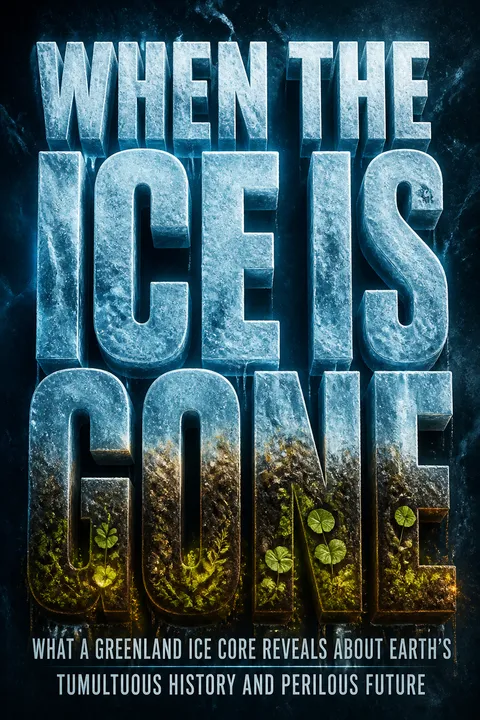
1. The frozen soil beneath Greenland's ice sheet reveals a dynamic, fragile past where the island was once green and ice-free.
Under the microscope, we saw irrefutable evidence that ice wasn’t a stable, permanent fixture on the island.
A shocking discovery. In July 2019, geologists at the University of Vermont melted frozen soil samples retrieved from nearly a mile beneath the Greenland Ice Sheet. Expecting only barren dirt, they instead discovered perfectly preserved ancient tundra vegetation, including twigs, mosses, and leaves. This unexpected find shattered the long-held scientific assumption that Greenland's massive ice sheet had remained a permanent, stable fixture for millions of years.
Key elements of the find:
- The samples originated from the 1966 Camp Century drilling project in northwestern Greenland.
- Under the microscope, scientists observed twigs, leaves, and fungal spores from a frozen ecosystem.
- The presence of these fossils proved that Greenland's ice sheet had completely melted at least once in the recent geologic past.
A fragile future. This breakthrough provided a stark warning to a world currently facing rapid global warming. If Greenland's ice sheet—which currently holds enough water to raise global sea levels by twenty-four feet—could melt entirely due to natural climate cycles, it is far more fragile than previously believed. The discovery transformed a forgotten jar of dirt into a key to understanding our planet's perilous future.
2. Ernst Sorge's work at Eismitte established that layers of snow preserve a sequential, readable archive of Earth's history.
By demonstrating that layers of snow preserve a faithful and detailed record of the past, the pit at Eismitte laid the groundwork for ice-core science, a way to decipher hundreds of thousands of years of Earth’s climate history, one layer at a time.
Reading the snow. During Alfred Wegener's fateful 1930 expedition to the center of Greenland, geologist Ernst Sorge spent a brutal winter hand-shoveling a fifty-foot pit into the ice sheet. He meticulously measured snow density, temperature, and layering, discovering that winter snow is denser than summer snow. This seasonal variation created a distinct, readable "layer cake" of Earth's atmospheric history, preserved in nature's deep freeze.
Sorge's pioneering observations:
- He formulated "Sorge's law of densification," describing how weight compresses snow into firn and then solid glacial ice.
- By counting the seasonal layers, he successfully dated snow that had fallen twenty years prior.
- His work proved that glaciers act as physical archives of past precipitation and atmospheric conditions.
Founding a new science. Sorge's discovery revolutionized geology by shifting the focus from static ice to a dynamic historical record. It established the conceptual foundation for modern ice-core science, showing that drilling into an ice sheet is equivalent to excavating a library of Earth's climate. This simple act of digging a snow pit opened the door to reconstructing hundreds of thousands of years of planetary history.
3. Post-WWII military logistics and Cold War anxieties catalyzed the birth of modern polar science and ice-coring technology.
The collection of the world’s first deep ice core at Camp Century, Greenland, was the culmination of a far broader Cold War effort to understand, operate in, and defend cold places.
Military-driven science. During World War II, the United States realized how little it knew about operating in the brutal Arctic environment after numerous aircraft crashed on Greenland's ice sheet. In the subsequent Cold War era, the Pentagon poured millions of dollars into polar research to prepare for a potential conflict with the Soviet Union over the North Pole. This funding established the Snow, Ice, and Permafrost Research Establishment (SIPRE), bringing together engineers and scientists to master the cryosphere.
Milestones of early polar engineering:
- Project Mint Julep (1953) tested snow compaction techniques to build runways on the ice sheet.
- Henri Bader championed an interdisciplinary approach, combining geology, physics, and engineering to study ice.
- The 1950 Taku Glacier expedition in Alaska recovered the first American ice core, proving that rotary drilling in ice was possible.
A dual-use legacy. While the military sought tactical advantages, scientists like Henri Bader and Chester Langway used these operations to advance fundamental geophysics. The heavy machinery, aircraft, and logistics provided by the Army allowed researchers to access remote areas and develop deep-drilling techniques. Consequently, the tools designed to secure a frozen battlefield ultimately laid the groundwork for modern climate change research.
4. Camp Century was a futuristic, nuclear-powered sub-ice city built to test the feasibility of a secret under-ice missile network.
There’s good evidence that a top secret, fantastical Cold War idea called Project Iceworm drove the U.S. Army to build Camp Century.
The city under ice. Carved entirely into the Greenland Ice Sheet in 1959, Camp Century was a marvel of military engineering. The Army used Swiss Peter Snow Millers to cut deep trenches, which were then covered with steel arches and buried under snow to create a network of twenty-eight tunnels. To power this remote outpost, the military installed the PM-2A, a portable nuclear reactor that generated electricity and steam to melt ice for water.
Inside the sub-ice outpost:
- The camp housed up to 200 soldiers and scientists in insulated wooden buildings erected inside the tunnels.
- It featured modern amenities, including a library, a theater, a hospital, and a water supply system called a "Rod well."
- The secret objective, Project Iceworm, aimed to hide 600 nuclear missiles on a 1,600-mile under-ice railway.
An impossible dream. Ultimately, Project Iceworm proved to be an engineering fantasy due to the relentless flow of the ice sheet. Glaciers behave like plastic under pressure, and the tunnel walls crept inward at rates of up to four feet per year, threatening to crush the structures. The nuclear reactor was decommissioned and removed in 1964, leaving Camp Century to be reclaimed by the accumulating snow.
5. Ice-core bubbles act as frozen time capsules, preserving ancient atmospheres and proving that modern CO2 levels are unprecedented.
In ice cores, Bender saw the way to determine whether people had altered the chemistry of Earth’s atmosphere beyond its normal range of variation.
Atmospheric time capsules. As snow is compressed into glacial ice, it traps tiny pockets of air in bubbles, sealing them off from the surrounding environment. In 1957, military scientist James Bender realized that these bubbles preserve actual samples of ancient atmospheres. This insight transformed ice cores into the ultimate tool for reconstructing the history of greenhouse gases, providing a baseline of Earth's atmosphere before human industrialization.
What the bubbles revealed:
- They allowed scientists to measure historical concentrations of carbon dioxide (CO2) and methane.
- Analysis showed that pre-industrial CO2 levels hovered consistently around 280 to 300 parts per million (ppm).
- During the coldest periods of the Ice Age, CO2 concentrations plummeted to about 180 ppm.
A stark comparison. When Charles Keeling began measuring atmospheric CO2 on Mauna Loa in 1958, his data showed a steady, modern rise. By comparing Keeling's curve with the air trapped in ice cores, scientists proved that modern CO2 levels—now exceeding 420 ppm—are higher than they have been for millions of years. This empirical evidence linked fossil fuel combustion directly to the unprecedented alteration of Earth's atmosphere.
6. Analyzing lead and volcanic ash in ice cores connects global industrial pollution and historical societal collapses to atmospheric changes.
It should be possible to follow quantitatively and qualitatively the degree of atmospheric contamination by industrial activity through analysis of snows down to layers which fell in pre-industrial times.
Fingerprints in the ice. Glacial ice does not just preserve water; it traps everything that falls from the sky, including dust, volcanic ash, and industrial pollutants. Geochemist Claire Patterson used ice samples from Camp Century to measure environmental lead contamination, establishing the first clean-room protocols to avoid modern lead dust. His analysis of Greenland ice layers revealed a dramatic, 500-fold increase in lead concentrations since the onset of the Industrial Revolution and the introduction of leaded gasoline.
Historical events recorded in ice:
- Lead levels in Greenland ice rose and fell in sync with the rise and fall of the Roman Empire's silver smelting.
- Volcanic ash from the 43 BCE eruption of Alaska's Okmok II volcano coincided with crop failures and the fall of the Roman Republic.
- Ash from the 79 CE eruption of Mount Vesuvius was found perfectly preserved nearly 1,400 feet below the ice surface.
A global ledger. These discoveries demonstrated that Greenland's ice sheet acts as a global ledger of human activity and natural disasters. By linking volcanic eruptions to historical famines and societal collapses, ice cores have shown how sensitive human civilizations are to abrupt climate disruptions. Patterson's work in Greenland ultimately provided the scientific backing needed to ban leaded gasoline worldwide, saving countless lives.
7. Reaching the bottom of the Greenland Ice Sheet in 1966 yielded a priceless, long-lost sub-ice sediment core that was nearly forgotten.
Working in frigid snow tunnels, with no heat and no daylight, the Army engineers had just finished drilling the world’s first complete deep ice core.
Hitting bedrock. On July 2, 1966, after six years of mechanical failures and extreme conditions, drillers B. Lyle Hansen and Herb Ueda reached the bottom of the Greenland Ice Sheet at Camp Century. Using an electromechanical drill, they penetrated 4,506 feet of ice and retrieved eleven and a half feet of frozen soil from the subglacial bed. This "permacrete" core was the first of its kind, representing a priceless geological prize that was subsequently shipped to the United States for storage.
The journey of the core:
- The core was stored in freezers at the Cold Regions Research and Engineering Laboratory (CRREL) in New Hampshire.
- In 1975, curator Chester Langway moved the collection to the University at Buffalo.
- When the National Science Foundation transferred the national archive to Colorado in the 1990s, Langway secretly shipped the sub-ice core to Denmark.
Lost and found. For nearly thirty years, the scientific community believed the Camp Century sub-ice sediment was lost. It remained forgotten in a Copenhagen freezer until a routine inventory in 2018 revealed the vintage glass jars labeled "Camp Century sub-ice." This serendipitous rediscovery allowed modern geologists to apply advanced analytical techniques to a sample that had been kept frozen since the height of the Cold War.
8. Luminescence dating of the Camp Century soil fossils proves Greenland was ice-free during a natural warm period 416,000 years ago.
The frozen soil revealed that ice from below Camp Century vanished at least once in the past, long before people found and began to burn oil, gas, and coal.
Dating the green Greenland. To determine exactly when the plants found in the Camp Century soil grew, scientists utilized luminescence dating, a technique that measures when mineral grains were last exposed to sunlight. The results were astonishing: the soil beneath the mile-thick ice sheet was ice-free approximately 416,000 years ago. This period, known as Marine Isotope Stage 11 (MIS 11), was a natural interglacial warm interval with atmospheric CO2 levels similar to pre-industrial times.
Scientific insights from MIS 11:
- The climate during MIS 11 was only slightly warmer than today, yet it was warm enough to melt northwestern Greenland's ice.
- Tundra vegetation, including shrubs, mosses, and insects, thrived where a glacier now sits.
- The melting of the Greenland Ice Sheet during this period raised global sea levels by at least five to twenty feet.
A sobering analog. This finding provided a critical reality check for modern climate models. It proved that Greenland's ice sheet is highly sensitive to prolonged, moderate warmth, even without human-induced greenhouse gas emissions. If a natural CO2 level of 280 ppm could trigger a near-complete collapse of the ice sheet, our current trajectory of over 420 ppm makes a future ice-free Greenland highly probable.
9. Modern climate change is driving rapid ice loss in Greenland, threatening global coastlines with catastrophic sea-level rise.
Melt Greenland’s ice, and sea level around the world would go up, on average, about twenty-four feet.
Accelerating melt. Today, satellite data from NASA's GRACE mission show that the Greenland Ice Sheet is losing an average of 280 billion tons of ice every year. This massive loss of land-based ice is the primary driver of global sea-level rise, which threatens low-lying coastal cities worldwide. As the Arctic warms at four times the global average—a phenomenon known as Arctic amplification—the rate of melting continues to accelerate.
The global consequences of melting ice:
- A complete melt of Greenland's ice sheet would raise global sea levels by twenty-four feet, displacing hundreds of millions of people.
- Sinking coastal megacities like Jakarta, Shanghai, and Miami face imminent inundation.
- The influx of freshwater into the North Atlantic is already disrupting global ocean currents and weather patterns.
A feedback loop. The loss of ice triggers a dangerous feedback loop: as white, reflective ice melts, it exposes dark rock and water, which absorb more solar energy and accelerate further warming. This "death spiral" means that once a critical tipping point is crossed, the collapse of the ice sheet becomes irreversible. The history preserved in the Camp Century core warns us that we are rapidly approaching this threshold.
10. The melting ice sheet will eventually expose abandoned Cold War toxic and radioactive waste, creating a complex geopolitical liability.
No one anticipated the environmental significance of a long-abandoned city below the ice or of global warming at the scale and rapidity we now face.
A toxic legacy. When the U.S. military abandoned Camp Century and other sub-ice bases in the 1960s, they left behind thousands of tons of waste, assuming it would remain frozen forever. This waste includes millions of gallons of raw sewage, diesel fuel, toxic PCBs, and radioactive coolant from the nuclear reactor. However, as climate change shifts the ice sheet's equilibrium line, these buried hazards are slowly moving toward the ablation zone, where they will eventually melt out.
The hazards buried in the ice:
- Approximately 10,000 tons of physical and chemical waste remain at Camp Century alone.
- Carcinogenic trichloroethylene (TCE) used as drilling fluid sits in the deep borehole.
- Radioactive isotopes from the PM-2A reactor's hot waste sump are bound within the ice.
A geopolitical headache. Within the next century, meltwater will begin carrying these pollutants into Greenland's coastal waters, threatening local ecosystems and fisheries. This impending environmental disaster presents a complex legal and political challenge, as Denmark, the United States, and now-independent Greenland must negotiate who is responsible for the multi-million-dollar cleanup. The ruins of a Cold War triumph have transformed into a modern ecological liability.
Download PDF
Download EPUB
.epub digital book format is ideal for reading ebooks on phones, tablets, and e-readers.








































