

Key Takeaways
A dream outlasts every goal because it survives failure
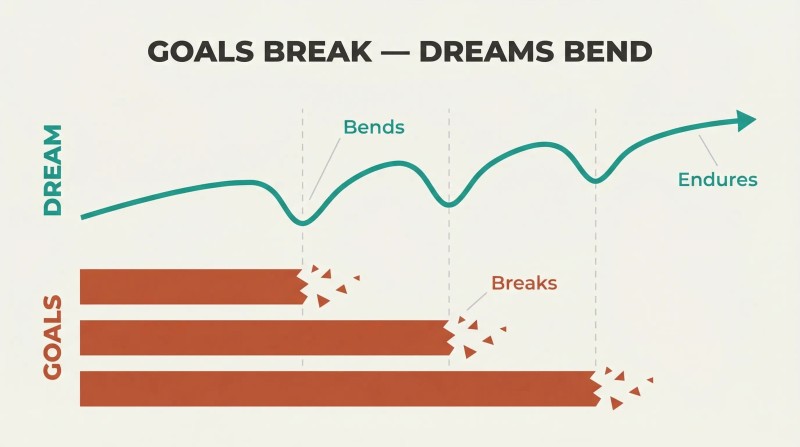
Dreams aren't goals with lipstick. Simon Squibb — who was homeless at fifteen, built and sold a creative agency to PwC, and now asks strangers on the street about their dreams — draws a sharp line between the two. Goals are binary: pass or fail. Resolutions crumble when willpower fades. But a dream is engineered for survival. You can have a terrible year without abandoning it. You can switch careers and still be working toward it. No annual review will grade your dream "unsatisfactory."
Stallone turned down over $300,000 for the Rocky script because starring in it — not the payday — was his dream. Malala Yousafzai survived an assassination attempt and redoubled her education campaign. A dream bends under pressure; it doesn't break. That durability is precisely why Squibb argues it should organize your life.
Hard work without purpose is just a faster treadmill
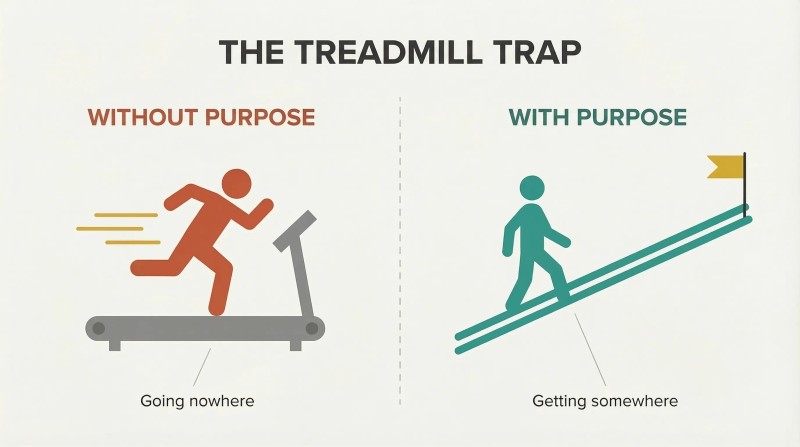
Squibb calls the hard-work gospel Myth #1. For fifteen years, he credited Fluid's success to grinding long hours. But his best ideas came on holiday. The business made the most money after he stepped back to chairman and let someone else run it. Results improved every time he delegated to good people rather than hoarding work.
The deeper problem: treating hard work as the end goal trains you NOT to dream. School teaches memorize, pass, get a job, buy a house, repeat. This prescriptive path tells you to keep your head down rather than question whether the treadmill leads anywhere worth going. Squibb's reframe: success comes from working smart on something you love, not from punishing yourself with volume.
Mine your deepest pain — it's where purpose hides
Squibb's Three Questions framework for discovering your dream proceeds in order:
1. What do I genuinely like doing?
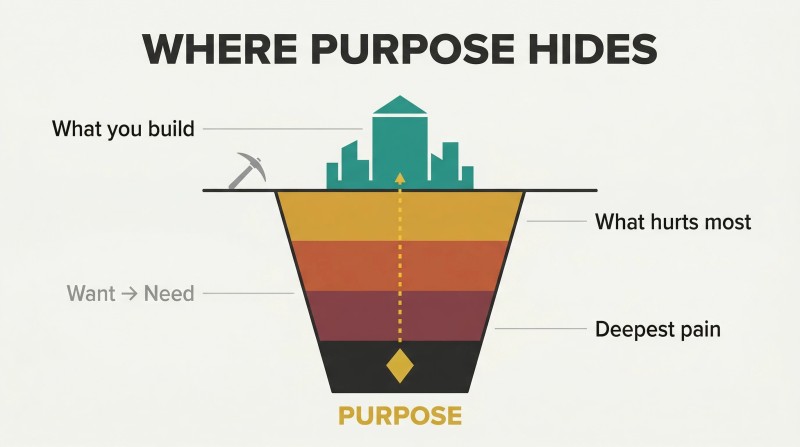
2. What is my deepest pain?
3. How can I help others?
The second question is the engine. Sophie, who needed life-saving surgery after childbirth, couldn't find comfortable jeans during recovery — so she created I Am Denim, now stocked by Debenhams and featured in Vogue. Sara Blakely was selling fax machines door-to-door when visible underwear lines drove her to invent Spanx, making her the youngest female billionaire in America.
Squibb traces his own purpose to being abandoned at eight in a town centre, dyslexia humiliations in school, and homelessness at fifteen. That pain fuels HelpBnk and everything he does today. Pain turns "want" into "need" — and need is what builds empires.
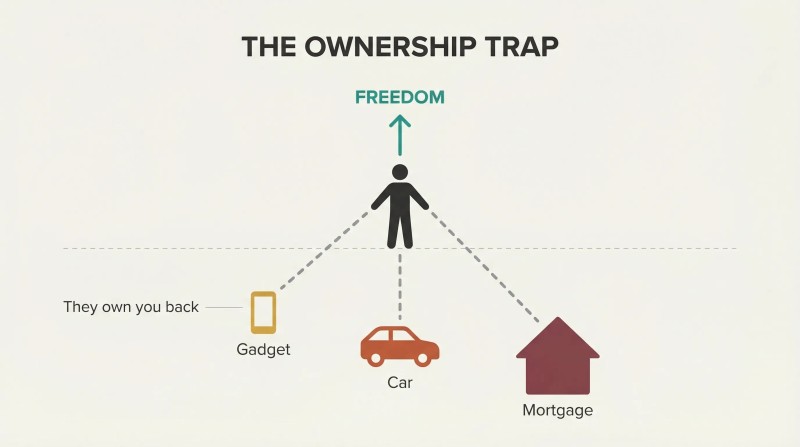
Every possession you acquire quietly owns you back
Squibb bought the Porsche he'd dreamed of since sleeping in staircases. The euphoria lasted one week. By week three, he was anxious driving it, bored talking about it, and spending days at the garage over a scratch. Selling it felt almost as good as buying it. Every possession you shed, he discovered, makes you lighter.
He extends this to housing: a mortgage traps you in your job, absorbs savings that could fund a business, and fills mental bandwidth with maintenance. Had he been locked into a UK mortgage, he'd never have moved to Hong Kong — sleeping on a friend's sofa — where his career took off. The real trap starts young: save for the gadget your friends have, then scale up with paychecks. The psychology never changes, just the price tag.
Escape the paycheck trap by owning what you create
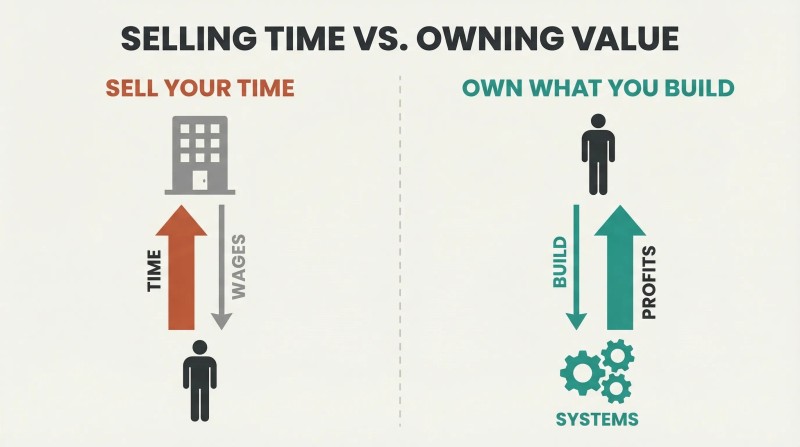
Most people sell time: they work harder for marginal raises until there's nothing left to give. Squibb calls this the "escalator" — salary must keep climbing to match expanding costs, and you're terrified to step off. Your employer captures most of the value; you get a fraction back as wages.
Entrepreneurs flip the equation. They build teams and systems that generate profit without stretching themselves thinner. At Fluid, Squibb earned more as chairman — doing far less — than at any prior point, living off risks he'd taken years earlier. His advice for employees: ask your boss for equity. If they refuse, find a role with ownership, or start a side hustle. The goal is owning a piece of what you build rather than renting out your hours indefinitely.
Start your business poor — scarcity forces the discipline money kills
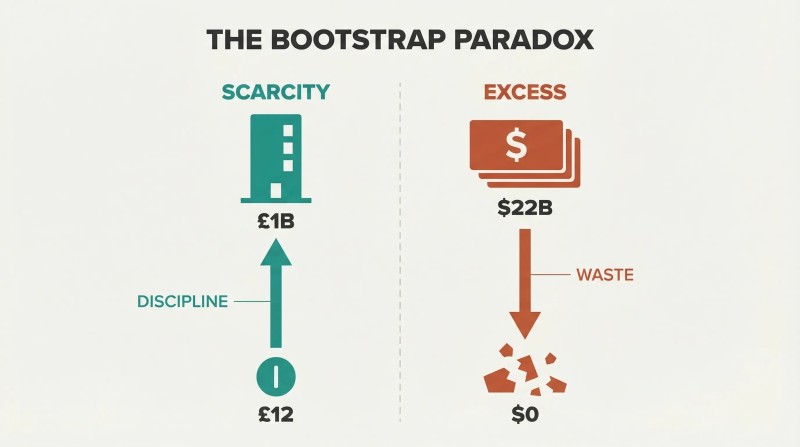
Gymshark founder Ben Francis started at 19 as a Pizza Hut delivery driver, sewing clothes in his parents' garage with a machine his grandmother taught him to use. Eight years later, the company was valued north of £1 billion. Meanwhile, WeWork raised $22 billion and filed for bankruptcy — excessive capital eliminated the discipline that survival demands.
Squibb learned this viscerally when his DevaShard comic book joint venture burned $1.5 million after he traded bootstrapping for a "rich mindset," leasing a fancy office with a cinema room for three people. His rules now: don't write a business plan (it's an illusion of progress). Register a company for £12, build a website with free tools, and start selling today. Justify every penny or don't spend it.
Three paying customers make your dream a real business
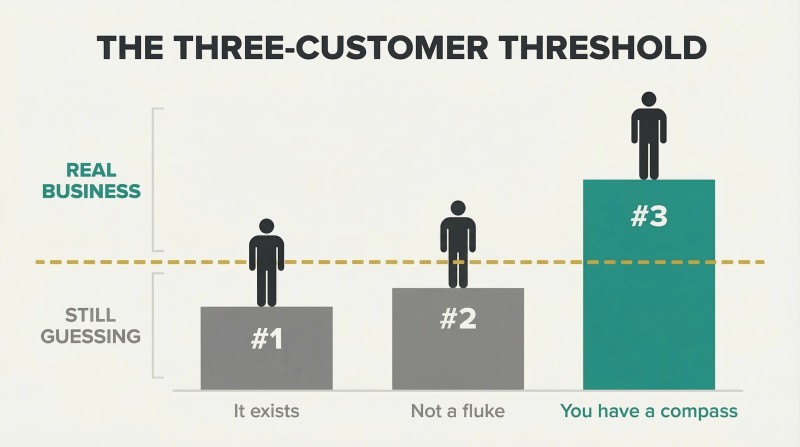
Your first customer proves the dream can exist outside your head. The second proves it wasn't a fluke. But Squibb argues the third is the threshold: three customers give you minimum viable feedback on what people actually want — which often diverges from what you assumed.
He invested in an Asian experience-gifts company pitched purely on market data and demographics. It failed. A competitor with an identical model succeeded because its founder had a personal mission rooted in childhood. The difference was never the idea but the purpose-driven execution behind it. Before three real customers, you're guessing at demand. After three, you have a compass — and the confidence that comes from people paying real money for something you made.
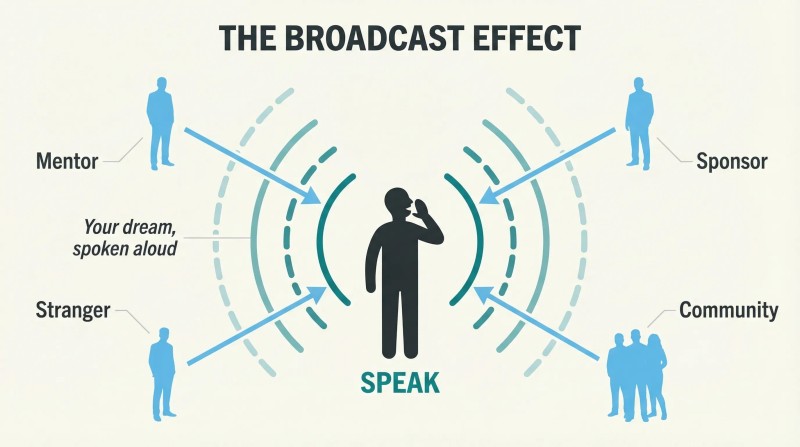
Say your dream out loud — help appears from unexpected places
Squibb bought a derelict staircase in Twickenham for £25,000 and installed a doorbell where strangers pitch their dreams on camera. Hundreds came — one drove six hours from Scotland. The transformation of saying a dream aloud is immediate: a McDonald's worker named Delon, who initially claimed no dream, returned in ten minutes to declare he wanted to be a Twitch streamer. Squibb was the first person he'd ever told.
Sharing unlocks hidden support. Sam in Hong Kong launched her catering business Chez Sam within 72 hours of speaking her dream. Caitlin, a photographer, landed a lastminute.com sponsorship after her video reached 10 million viewers. When HelpBnk opened registrations, helpers outnumbered help-seekers — proving people desperately want to give when given the chance.
Keeping mediocre performers drives away your best people
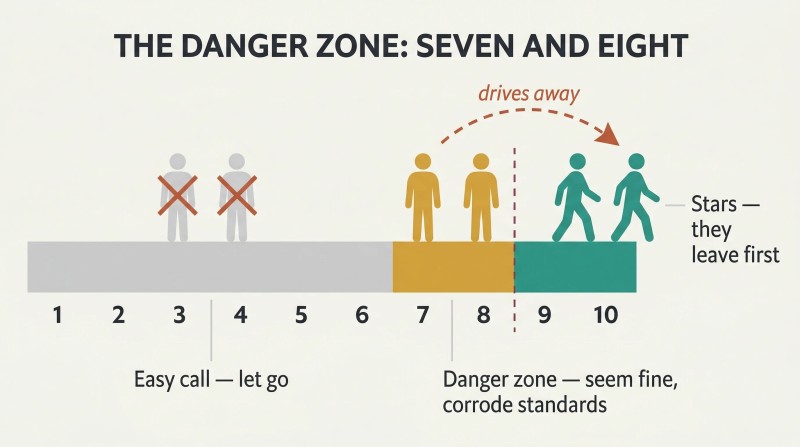
Squibb's Rule of Seven and Eight targets the hardest firing decisions. Below six on a ten-point scale? Obviously struggling — easy call. Nines and tens are stars you fight to retain. The danger zone is seven and eight: competent enough to justify keeping, inconsistent enough to corrode standards. Tolerate them, and top performers conclude you don't value excellence. They leave.
Retention requires ownership, not perks. Squibb insists on giving employees equity stakes — anything less means they're building value they'll never share. At HelpBnk, he exclusively hires people who've run businesses or plan to, knowing most will eventually leave to start their own companies. His math: owning 51% of a thriving company beats 100% of one hemorrhaging talent because you refused to share.
Persist until you get lucky, then pivot to stay lucky
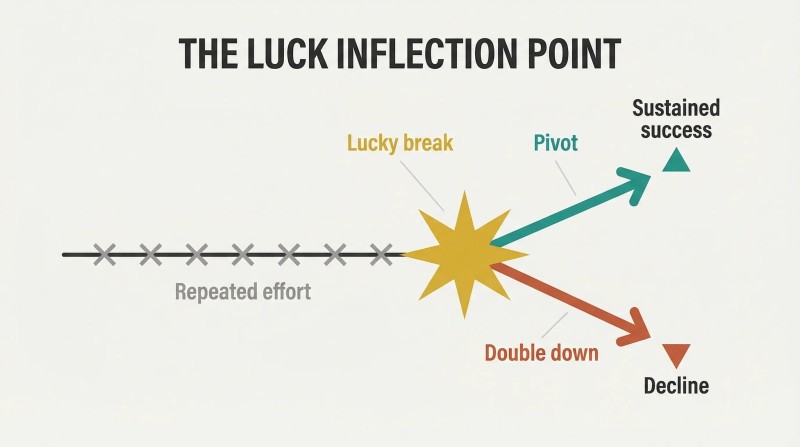
Two sculptors abandoned the marble block that became Michelangelo's David, deeming it unworkable. He spent three years in near-darkness, barely eating, sleeping in his clothes — creating what's widely regarded as the greatest sculpture ever made. At Fluid, Squibb wrote a list of fifty dream clients and contacted every one in month one. Zero replied. Nine years later, he'd worked with all fifty.
But persistence isn't stubbornness. Instagram started as a failed check-in app called Burbn. Netflix mailed DVDs. Nvidia had exactly one month of cash when it shipped the chips that saved the company. Most strikingly, Blockbuster didn't die from lack of innovation — it built a competitive streaming service, then fired the CEO running it. It failed from giving up too early, not from failing to see the future.
Analysis
Squibb's book occupies a peculiar niche: simultaneously a motivational manifesto, a practical startup guide, and an autobiography structured as a series of street-interview parables. The core intellectual move — elevating 'dream' above 'goal' as a psychological construct — draws on what researchers would recognize as self-determination theory: intrinsic motivation consistently outperforms extrinsic rewards. But Squibb arrives at this through lived experience rather than citations, which gives the argument visceral credibility even when it lacks academic rigor.
The most contrarian contribution is his assault on property ownership. In a culture where homeownership is sacred — particularly in the UK — his framing of 'mortgage vs. freedom' is genuinely provocative. He's arguing that the conventional middle-class trajectory (degree, career, mortgage, pension) is an elaborate trap designed to make you too financially encumbered to take risks. Whether you agree or not, it forces uncomfortable arithmetic about what security actually costs.
The weakest aspect is a survivorship bias Squibb partially acknowledges but never resolves. His advice to quit your job, reject possessions, and bootstrap a business worked spectacularly for someone with unusual resilience forged by childhood homelessness. For readers with dependents, healthcare needs, or less psychological armor, the 'just start' ethos can feel incomplete. The book would benefit from more granular risk management for people who genuinely cannot afford total failure.
What elevates the work beyond typical entrepreneur-memoir is the Three Questions framework, which elegantly connects personal archaeology (likes, pain, service to others) to business formation. The Rule of Seven and Eight is equally sharp — a management insight most leadership books dance around. Squibb's willingness to name hard truths about firing, about possessions, about the mythology of hard work, gives the book a backbone that purely inspirational works lack. His street-interview methodology also produces something rare: entrepreneurial wisdom emerging from ordinary people rather than being dispensed by billionaires.
Review Summary
What's Your Dream? receives mostly positive reviews, with readers praising its motivational content and practical advice for aspiring entrepreneurs. Many find it inspiring and helpful for starting businesses, though some critics note that the information isn't entirely novel. Readers appreciate the author's personal experiences and straightforward approach. The book is particularly recommended for those feeling unfulfilled in their current jobs or considering entrepreneurship. While some reviewers found it basic, others valued its encouraging message and actionable insights.
People Also Read


Glossary
#GiveWithoutTake
Help others expecting nothing backSquibb's core philosophy and social movement advocating for helping others without expecting anything in return. It underpins HelpBnk's model where all help is free, and Squibb's street interviews where he gives people money, mentorship, or promotion to pursue their dreams. The principle is that removing transactional expectations creates chain reactions of generosity.
Three Questions
Framework for discovering your dreamSquibb's sequential framework for uncovering your dream through life experience: (1) What are my likes and dislikes? (2) What is my pain? (3) How can I help others? Answered in order, they progress from self-knowledge to motivation to real-world application, connecting personal passions and wounds to a dream with commercial and social viability.
Seven Steps
Staircase of dream-blocking excusesSquibb's diagnostic framework identifying seven common blockers that prevent people from pursuing dreams, arranged as steps to climb: (1) 'I don't have time,' (2) 'I'm trapped,' (3) 'I don't need it,' (4) 'I don't know what,' (5) 'I don't know how,' (6) 'I'm worried what they'll think,' and (7) 'I've tried before.' Each represents a limiting belief with a specific counter-strategy.
Burnout motivation
Survival-driven motivation that depletes youSquibb's term for the unhealthy motivation where survival needs—paying rent, feeding family—become your sole purpose. It drains your psychological 'battery' daily because effort yields nothing beyond keeping the wolf from the door. Squibb contrasts this with purpose-driven motivation, which restores energy even during hard work, citing studies showing purposeful firefighters and priests experience significantly less burnout.
Selling time / Buying time
Employee trap vs. entrepreneur freedomSquibb's distinction between two career models. Selling time means trading hours for a salary, capped by how much labor you can physically give, with most value captured by the employer. Buying time means building operations, teams, and systems that generate returns without proportional personal effort—creating increasing freedom as the business grows rather than increasing entrapment.
Risk muscle
Risk-taking ability strengthened by practiceSquibb's metaphor for the ability to evaluate and take risks, which he argues strengthens with repeated use like a physical muscle. As you take more calculated risks, your judgment about which ones to pursue improves, fear diminishes, and you learn to derisk bold moves through partnerships, pilots, and careful scenario planning rather than blind gambling.
Rule of Seven and Eight
Fire middling performers to keep starsSquibb's management principle for the hardest firing decisions. On a 1–10 performance scale, employees at six or below are clearly struggling and easy to let go. Nines and tens are stars to retain. The dangerous zone is seven and eight—competent enough to justify keeping, but inconsistent enough to erode team standards. Tolerating them signals to top performers that excellence isn't distinctly valued, causing the best people to leave.
Three Ts
Train, trust, tear yourself awaySquibb's framework for founders who need to overcome 'founder syndrome' and step back from their business. Train people by developing their capabilities in areas you currently handle. Trust people by delegating real decision-making authority. Tear yourself away by physically reducing your presence so others can grow into leadership. Applied sequentially, the Three Ts prepare a business to thrive without its founder.
#TakeFour
Daily four-minute helping practiceSquibb's proposed daily habit from the book's afterword: spend four minutes helping a stranger. One minute to learn who they are, one minute to discover what they need, one minute to offer help, and one minute to pass the practice on to someone else. Designed as a micro-entry point to the #GiveWithoutTake philosophy and as a way to reconnect with people in an increasingly transactional digital world.
FAQ
What's What's Your Dream? about?
- Finding Your Passion: The book is centered on helping individuals discover their dreams and passions, emphasizing the importance of pursuing what truly matters to them.
- Practical Steps: It offers actionable steps and insights from Simon Squibb's experiences as an entrepreneur, guiding readers on how to turn their dreams into reality.
- Community Empowerment: Squibb promotes a culture of helping one another, advocating for giving without expecting anything in return.
Why should I read What's Your Dream??
- Inspiration and Motivation: The book is filled with inspiring stories and examples of individuals who have successfully pursued their dreams, motivating readers to take action.
- Practical Guidance: It provides practical advice on overcoming common barriers to pursuing dreams, making it a useful resource for anyone feeling stuck.
- Personal Growth: Reading this book can lead to significant personal growth, as it challenges readers to reflect on their lives and consider what they truly want.
What are the key takeaways of What's Your Dream??
- Dreams Matter: Having a dream is essential for a fulfilling life, as it provides direction and purpose.
- Overcoming Myths: The book debunks myths about success, such as the belief that hard work alone guarantees success, encouraging readers to rethink their approaches.
- Actionable Steps: Squibb outlines specific steps to help readers identify their dreams, including asking themselves critical questions about their likes, pain, and how they can help others.
What are the best quotes from What's Your Dream? and what do they mean?
- “A dream is a powerful and necessary thing.”: This quote highlights the importance of having a dream as a driving force in life, essential for motivation and fulfillment.
- “You need to escape the trap of aspirations that aren’t real dreams.”: It emphasizes differentiating between superficial goals and genuine dreams that resonate with one's true self.
- “When you have a dream, and when you have identified a purpose, it changes your life.”: This underscores the transformative power of dreams and purpose, suggesting they lead to a more meaningful existence.
How can I discover my dream according to What's Your Dream??
- Reflect on Likes and Dislikes: Start by identifying what you enjoy and dislike, as this can provide clues to your true passions.
- Consider Your Pain: Understanding the pain points in your life can help you find purpose, as many successful dreams are rooted in overcoming personal struggles.
- Ask How You Can Help Others: Think about how your dream can serve others, which can provide additional motivation and clarity.
What is the significance of purpose in What's Your Dream??
- Driving Force: Purpose is essential for achieving dreams, providing the motivation needed to overcome obstacles and challenges.
- Connection to Pain: Purpose often arises from personal pain, suggesting that understanding this connection can lead to a more profound commitment to one’s dream.
- Enhances Well-being: Having a clear purpose is linked to improved mental health and overall well-being, making it crucial in the pursuit of happiness.
How does Simon Squibb suggest overcoming fear of failure in What's Your Dream??
- Embrace Failure as Learning: View failure as a necessary part of the journey, providing valuable lessons that contribute to future success.
- Shift Mindset: Accept failure as a stepping stone rather than a setback, promoting resilience and perseverance.
- Take Action Despite Fear: Emphasize the importance of taking action regardless of fear, suggesting that doing can help diminish anxiety and build confidence.
What are the seven steps to pursuing a dream outlined in What's Your Dream??
- Identify Barriers: Recognize common excuses that prevent pursuing dreams, such as lack of time or feeling trapped.
- Free Yourself: Create the mental and financial space needed to pursue a dream, including cutting unnecessary costs and changing one’s mindset.
- Build a Boat: Prepare for action by acquiring the necessary skills, knowledge, and support to successfully launch your dream.
What is the #TakeFour method mentioned in What's Your Dream??
- Simple Concept: The #TakeFour method encourages taking four minutes each day to help someone else, fostering community.
- Building Connections: Engaging with others helps create connections that can lead to new opportunities, emphasizing giving without expecting anything in return.
- Daily Practice: This method incorporates the book's philosophy of #GiveWithoutTake into daily life, reinforcing that helping others can lead to personal growth.
How does Simon Squibb suggest finding your first customer?
- Start with Conversations: Ask people about their dreams and needs to discover potential customers who resonate with your vision.
- Be Their First Customer: Become the first customer of someone with a dream, which helps them and validates your business idea.
- Leverage Social Media: Use platforms like social media to connect with potential customers, engaging with your audience to identify their needs.
How does What's Your Dream? address the concept of risk?
- Calculated Risks: Emphasizes taking calculated risks rather than jumping in blindly, understanding potential outcomes for informed decisions.
- Risk as a Muscle: Describes risk-taking as a muscle that can be developed over time, improving with practice.
- Embrace Failure: Encourages embracing failure as part of the process, with each setback providing valuable lessons for growth and success.
How can I apply the lessons from What's Your Dream? to my own life?
- Reflect on Your Dreams: Identify what your dreams are and what motivates you to pursue them, forming the foundation for action.
- Take Action: Implement practical steps like finding your first customer and being willing to take risks, starting small and building momentum.
- Stay Persistent: Embrace persistence as a key trait, understanding that challenges will arise but maintaining focus on your purpose will help overcome them.
Download PDF
Download EPUB
.epub digital book format is ideal for reading ebooks on phones, tablets, and e-readers.








































