
Key Takeaways
1. The Panoramic Agony: Jesus's View from the Cross
In short, we can make our own the sphere of vision and the emotions that were His, seeing with His eyes and feeling with His heart, remembering, judging, and foreseeing with Him so that, still in this same sense of imagining that we have changed places with Him, it is no longer we who live but Christ who lives in us.
A unique perspective. The author invites readers to imaginatively "put on Jesus Christ" by placing themselves on the Cross, experiencing His physical and emotional state. This perspective allows for a profound understanding of His final moments, seeing the world through His divine eyes and feeling with His sacred heart.
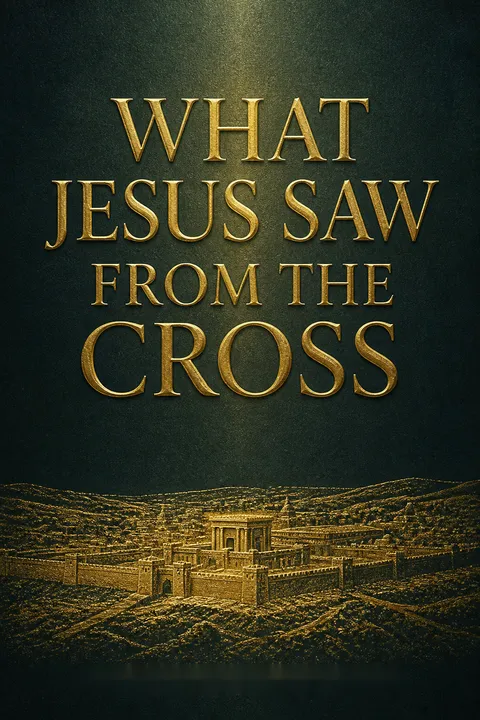
Calvary's setting. From the Cross, Jesus's gaze sweeps over Jerusalem and its surrounding landscape. He sees the Gate of Ephraim, the Temple, the Tower of Antonia, and the Mount of Olives. The scene, though outwardly fair with spring flowers like cyclamens and red anemones, is soon to be shrouded in a symbolic darkness, mirroring the spiritual desolation.
The Cross itself. The gibbet, likely ten feet high, is a square-hewn beam with a crosspiece, designed for public display. It is a tool of Roman infamy, yet Jesus transforms it into an instrument of glory, fulfilling His prophecy: "If I be lifted up from the earth I will draw all things to myself." The physical torment is immense, but His mind remains unfettered, ready for final contemplation.
2. Zion: The Cradle of Prophecy and Paradox
Little land greater than the world, you contain and give us eternity!
Zion's humble origins. Jesus's first glance from the Cross falls upon Zion, the "City of David," a small, once-impregnable citadel. Despite its modest physical size—a mere five acres of huts—its name was destined for eternal significance, becoming the "metropolis of the King of ages."
Israel's paradoxical history. Zion symbolizes Israel's unique and often contradictory history. This tiny people, chosen by God, radiated power over humanity, yet frequently fell into idolatry despite being custodians of monotheism. Their story is a blend of the childish and cruel with the sublime and miraculous, always directed by an unknown goal.
Prophecy fulfilled. From Zion, a vibration of prophecy was set forth, anticipating the Messiah's coming, life, death, resurrection, and eternal rule. The Hebrew books meticulously foretold these events, sentence by sentence. Jesus, living these ancient prophecies, now fulfills them, making Zion not just a place of preparation but also a place where past and future converge in His eternal path.
3. The Temple: A Condemned House of God
What in the Temple had been hidden and hedged around with symbols, on the Cross now stands unveiled.
A sorrowful gaze. Jesus gazes at His Father's house, the Temple, with ardent worship mingled with unspeakable sorrow. The shadow of His Cross, if extended, would cover the sacred edifice, symbolizing the old covenant yielding to the new. The Temple, once "the tabernacle of God in the midst of men," is now condemned, its Law abrogated.
History of the Temple. Jesus reflects on the Temple's long history, built and rebuilt three times:
- Solomon's Temple (1013 B.C.): Magnificent, built with Tyrian aid, a fixed abode for Yahweh.
- Zerubbabel's Temple (536-516 B.C.): Reconstructed after captivity, on a smaller scale.
- Herod's Temple (begun 20 B.C.): Grandiose, white marble, silver, and gold, but a facade of hypocrisy.
Prophecy of destruction. Jesus had warned His disciples that "there shall not be left a stone upon a stone." This prophecy, given on the Mount of Olives, foretold Jerusalem's fall and the Temple's destruction, a sanction for its impenitence and rejection of Him. The Temple, once a vibrant center of Jewish life, would become a "den of thieves," its spiritual splendor lost, destined for desolation.
4. The Cenacle: Birthplace of Eternal Life and Spirit
The Cenacle is truly for Jesus the Bethlehem of His work, as that tiny village was the Bethlehem of His birth; the Cenacle is the second 'House of Bread.'
The "end" of love. Half a mile from Calvary, to Jesus's right, lies the Cenacle, the upper room on Mount Zion. This sacred space witnessed the "end" of Jesus's love for His own, where He instituted the Eucharist and promised the Holy Spirit. It is the spiritual Bethlehem of His work, a place of profound intimacy and preparation for the Church's future.
Eucharist and new priesthood. In this room, Jesus transformed the Jewish Passover into the Eucharistic Passover, offering His body and blood as spiritual food and establishing a perpetual sacrifice. He ordained His Apostles as priests, commanding them, "Do this for a commemoration of me." This act, performed amidst the shadow of betrayal, ensured His eternal presence on earth.
The Spirit's outpouring. The Cenacle is also where the Holy Spirit descended at Pentecost, fulfilling Jesus's promise. This divine Spirit would:
- Create the Holy Church, a source of sanctity.
- Organize the Church, establishing its hierarchy and functions.
- Bear testimony to Christ through word, martyrdom, and miracles.
- Unify and conquer the world, making the Church a perennial fountain of life.
5. Gethsemane and Olivet: The Agony and the Ascent
His courage has returned. He is back in His Heaven, and now, setting aside the infirmities of time, He is in harmony with the decrees of eternity.
The Mount of Olives. This mountain, a pediment to the Cross, holds immense significance for Jesus. It was His retreat, a place of prayer and teaching, and the site of His agony in Gethsemane. From its slopes, He often viewed Jerusalem, and it would later be the point of His Ascension, symbolizing His departure and glorious mission.
Gethsemane's agony. In Gethsemane, the "oil-press," Jesus experienced superhuman agony. Confronted by a horrible vision of death and the world's sin, He "fell" prostrate, sweating blood. His disciples, whom He humbly asked to watch, slept. This dereliction, combined with the weight of all iniquity, was part of the chalice He had to drink, a suffering beyond human comprehension.
Submission and triumph. Despite His immense suffering, Jesus prayed three times, "Not what I will, but what Thou wilt." This act of perfect submission brought Him peace and restored His courage. An angel appeared to strengthen Him, reminding Him of the Cross's glories. From this moment, He faced His arrest and Passion with firm resolve, transforming His agony into a prelude to victory and His eventual ascent to Heaven.
6. The Human Spectacle: Passersby and Their Verdict
Truly He may say, 'I am a worm and no man.'
The Way of the Cross. Jesus's journey from the praetorium to Golgotha was through crowded, narrow streets, filled with tens of thousands of pilgrims for Passover. Crushed beneath His Cross and recent scourging, He stumbled frequently, jostled by animals and people. The soldiers, impatient and brutal, offered no respite, adding to His torment.
A mixed multitude. The crowds were a mix of:
- Friends: Secret or avowed, following Him, making the first Stations of the Cross.
- Sympathizers: Moved by compassion for an unjustly treated man.
- Indifferent: Merchants, coquettes, absorbed in their own lives, oblivious to the divine drama.
- Scoffers: Hurling insults, mocking His claims of kingship and healing power.
Simon and the women. As Jesus faltered, Simon of Cyrene was compelled to carry His Cross, becoming an "everlasting symbol" of shared burden. A group of women, "daughters of Zion," wept for Him, prompting Jesus's austere lesson: "Weep not for me, but for yourselves and for your children," foretelling Jerusalem's doom. Tradition also places Veronica, wiping His face, and Mary, His mother, exchanging a glance of profound sorrow and shared sacrifice.
7. The Circle of Love: Devotion Amidst Desertion
His will and testament made, Jesus relapses into His silence, and Mary into her meditation.
Disciples' desertion. As Jesus hangs on the Cross, He sees only a few loved ones. The Twelve, who "had continued with Him in His temptations," are mostly absent, scattered in terror. Peter, after his rash defense, denied Him three times. Yet, Jesus, discerning their hearts, blesses them, knowing their future transformation into pillars of His Church.
The holy women. A group of devoted women, including Mary Magdalene, Mary of Clopas, and Salome, stand valiantly by the Cross. They had followed Jesus from Galilee, ministering to Him, and now offer their compassionate presence. Their role foreshadows woman's vital place in Christianity, embodying charity and unwavering devotion.
Mary Magdalene's love. Magdalene, having been raised from her "seven devils," is prostrate at the foot of the Cross, embracing it, welcoming His blood. Her love, cleansed and boundless, anticipates His burial, having already anointed Him in Simon's house. She is a symbol of spiritual resurrection and repentant sinners, her tears and self-surrender mirroring His sacrifice.
Mary, the Co-Redemptress. Above all, Mary, the Mother of Sorrows, stands erect, her heart transfixed by seven swords. She is the Co-Redemptress, united with Jesus in His suffering, sharing His pain as she shared His life. Her grief is immense, yet tempered by hope, as she sees the fruits of the Cross and accepts her role as mother to all humanity, a legacy bequeathed by Jesus with His words: "Woman, behold thy son."
8. The Architects of Betrayal: Enemies and Their Guilt
"Their tongue is a sharp sword," says the Psalm; "their hands are unarmed," adds St. Augustine; "not so their mouth; from thence issues a sword that slays Christ."
The soldiers' brutality. Jesus's executioners, Roman mercenaries, are not primarily responsible for His death but for the "base cruelty and barbarous insolence" with which they carry out orders. They scourged Him beyond legal limits, mocked Him as a "king" with a crown of thorns and a reed scepter, and derided His thirst. Jesus's prayer, "Father, forgive them, for they know not what they do," primarily excuses their ignorance of His divine identity.
The fickle mob. The crowd, initially sympathetic, was swayed by the Jewish leaders. Disappointed by Jesus's lack of political Messiahship and inflamed by Pilate's scornful references to "their king," they turned to fury, demanding "Crucify Him!" Their cry, "His blood be upon us and upon our children," sealed their collective responsibility, a tragic answer to Him who would have gathered them "as the hen gathers her chickens."
Pilate, Herod, and the Sanhedrin. Pilate, a cowardly politician, sought to release Jesus but succumbed to pressure, fearing Caesar. Herod, frivolous and seeking amusement, scorned Jesus's silence. The Sanhedrin—comprising Sadducees (political, skeptical) and Pharisees (religious, legalistic)—united in their hatred. They saw Jesus as a threat to their influence and Mosaic Law, condemning Him for "blasphemy" and "sedition," their "sharp tongues" delivering a death sentence.
Judas's ultimate betrayal. Judas, "one of the Twelve," driven by avarice and disappointed ambition, betrayed Jesus for thirty pieces of silver. Despite Jesus's patient warnings and acts of love, Judas's heart remained hardened. His kiss, a symbol of love turned to treason, was the "last refinement of torture." His subsequent despair and suicide, a refusal of pardon, marked the "greater sin," as Jesus told Pilate, for he betrayed the Son of Man with a kiss.
9. The Tomb: A Temporary Gate to Eternal Life
This tomb which is the hope of the world is also, and especially on Calvary, the hope of Christ.
The tomb's proximity. Jesus's tomb, a few paces from the Cross in a garden district, was a rock-hewn sepulcher, typical of Jewish burial places. It featured a trench, a vestibule, and a burial chamber with a niche for the body, sealed by a heavy millstone. This proximity symbolizes that suffering and death, through Jesus, lead to resurrection and ascension.
Joseph and Nicodemus. Joseph of Arimathea, a secret disciple, provided his new tomb, an act of honor akin to Simon carrying the Cross. Nicodemus, the nocturnal visitor, brought a hundred pounds of aloes and myrrh for embalming. These hasty preparations, forced by the imminent Sabbath, were provisional, anticipating the solemn embalming that would never occur.
The ultimate "sign." For Jesus, the tomb was not an end but a "passing phase," a "gate of death" that immediately became a "gate of life." It was His most convincing manifestation, the "sign of Jonah," proving His power over death. His burial completed the Passion, but His Resurrection would inaugurate a new principle of regeneration for humanity, making the tomb a triumphal arch rather than a dungeon.
10. Heaven: The Unveiled Vision of Divine Union
His last gesture is like His first: 'Behold I come.' This is the keynote and the consummation of His whole life. It is a gesture of trust and love, of union and of surrender.
Heaven's embrace. From the Cross, Jesus's contemplation extends to Heaven, the ultimate reality. The blue vault, stars, and natural beauty are symbols of the divine, reflecting God's presence and Providence. Jesus, as Son of Man, loved nature, seeing in its harmony the eternal Will of His Father, and in its vastness, the boundless creation He sustains.
Inner Heaven and prayer. Christ carries His Heaven within Him, a perpetual "Beatific Vision" that transcends earthly suffering. His life is a continuous prayer, an "unspeakable groanings" of desire directed toward God. On the Cross, this prayer intensifies, becoming a "living homage" and a "silent eloquence" that encompasses all human prayers and sacrifices, uniting earth with the King of Heaven.
Victory and ascension. Even amidst the "My God, my God, why hast Thou forsaken me?" cry—a temporary dereliction—Jesus's inner Heaven remains. This ultimate suffering is followed by renewed confidence, as He sees the heavens open. His vision of victory encompasses His Ascension, a spiritual state of freedom and peace, where He prepares a place for all humanity, leading His "brethren" to the "city of the air," a Heaven earned through His sacrifice.
Review Summary
What Jesus Saw from the Cross receives predominantly high praise, averaging 4.26 out of 5 stars. Readers value its vivid, poetic meditations on Christ's Passion, describing it as ideal Lenten reading. Many appreciate Sertillanges' unique perspective—imagining the crucifixion through Christ's own eyes—and his attention to the women surrounding Jesus. Critics note occasional dryness, density, and some theological disagreements. Mother Teresa's endorsement is frequently cited. Most recommend reading it slowly, in small increments, to fully absorb its rich theological and spiritual depth.
People Also Read






About the Author
Other books by Antonin Sertillanges
Download PDF
Download EPUB
.epub digital book format is ideal for reading ebooks on phones, tablets, and e-readers.








































