
Key Takeaways
1. From Blue-Collar Roots to White House Rhetoric
I came from where they don't come from.
Unexpected Path. Peggy Noonan's journey began in a working-class Irish-Catholic family in Brooklyn, a world of different rules and immutable facts. Her early life was marked by financial struggles, moving from Brooklyn to Long Island and then New Jersey, instilling in her a grounded perspective. This background, far removed from the typical Washington elite, shaped her unique viewpoint and later informed her understanding of the "common man."
Early Influences. Her childhood was steeped in the political fervor of the Kennedy era, leading her to plaster cars with campaign stickers and make speeches to chickens. This early engagement, combined with a love for reading newspapers and the "new journalism," ignited her passion for words and public discourse. Her eventual move to CBS radio in Boston marked her entry into professional journalism, where she learned to write for the ear and distill complex situations into concise, impactful lines.
Political Awakening. Noonan's political transformation began with disillusionment with the left's contempt for America and its working class, leading her to embrace conservative ideas. This shift, from a Democratic family background to becoming a Republican, was a personal "realignment" that mirrored the quiet political changes of the 1980s. Her desire to serve a president whose views she shared ultimately led her to the Reagan White House, a place she felt she was "right for the job."
2. Speechwriting: The Art of Political Persuasion
A speech is part theater and part political declaration; it is a personal communication between a leader and his people; it is art, and all art is a paradox, being at once a thing of great power and great delicacy.
The Essence of a Speech. Noonan views speechwriting as a profound art form, akin to poetry, capable of moving hearts and shaping history. She emphasizes that great speeches are not merely technological broadcasts but enduring constants of political history, defining leaders and national identity. The challenge lies in crafting narratives with momentum and color, respecting the audience's distractions, and making them feel included in a "spinning thing."
Battling Bureaucracy. The White House speechwriting process was a constant struggle, often likened to forcing "beautiful vegetables through a meat grinder" or a "fondue pot where everyone has a fork." Noonan fought against bureaucratic edits that diluted the message, particularly from foreign policy professionals who prioritized bland diplomacy over candid communication. Her "Strasbourg Speech Committee" memo famously challenged the "pedants" and "pedagogues" who sought to strip rhetoric of its power and drama.
Soundbites and Authenticity. While acknowledging the prevalence of soundbites, Noonan argues that truly great ones emerge naturally from the text, not as manufactured one-liners. She criticizes the "Where's-the-beef-ization" of modern rhetoric, where young speechwriters prioritize short, catchy phrases over the overall integrity of the speech. Her experience taught her that authenticity and a deep understanding of the audience are paramount, urging politicians to hire "history majors, literature majors, writers" who can translate impulses into "literature that is alive, and true."
3. The Enigmatic Ronald Reagan
He gleams; he is a mystery. He is for everyone there, for everyone who worked with him. None of them understand him. In private they admit it.
A Man of Contradictions. Ronald Reagan, despite his public persona as the "Great Communicator," remained an enigma to those closest to him. Described as "the kindest and most impersonal man," he possessed an "awesome cool warmth" and a "lack of curiosity that is, somehow, disorienting." His humility and unassuming nature often led aides to perceive him as disengaged, yet he held firm on core convictions like taxes and SDI.
The Actor-President. Reagan's background as an actor profoundly shaped his presidency. He "saw the role and put it on, like a costume," always playing "Ronald Reagan." This theatrical approach made him seem both "phony and authentic," capable of delivering lines with perfect timing and emotional resonance. He drew on Hollywood's ethos of cheering people up, seeing the presidency as a stage to inspire and comfort the nation, often using humor to defuse tension or make a point.
Disengagement and Intuition. While often disengaged from policy details, Reagan possessed an intuitive understanding of the American people and what would capture their imagination. His "disengagement" was partly a refuge from the White House's intensity and partly a reflection of his trust in his staff. He relied on his "factoids" and common sense, believing that if he could "imagine these things, these people, he could not abandon them." His ability to connect with ordinary citizens, often through personal letters and simple gestures, was a testament to his deep-seated populism.
4. White House as a Battlefield
Each speech was a battle in an ever-ending war; when the smoke cleared there was Reagan, holding the speech and saying the words as the mist curled about his feet. I would watch and think, That's not a speech it's a truce. A temporary truce.
Constant Infighting. The Reagan White House was a hotbed of intrigue and betrayal, a "Macho Mountain" where power was constantly shifting. Noonan observed a pervasive culture of "backstabbing and knifing each other," with aides leaking stories and subtly undermining colleagues. This environment made it difficult to discern true allegiances, as "even their enmity isn't authentic."
Ideologues vs. Pragmatists. A fundamental "conservative/pragmatist split" cleaved the administration, manifesting in constant disagreements over policy and strategy. Ideologues prioritized core conservative principles, while pragmatists focused on political viability and public opinion. This division often led to "lowest-common-denominator art" in speeches, as various factions vied for influence over the president's message.
The First Lady's Influence. Nancy Reagan wielded significant, though often unseen, power, influencing personnel decisions, trips, and even policy. Her actions were driven by a fierce protectiveness of her husband's image and popularity, rather than ideology. This created a "pincer formation" with the Chief of Staff, making everyone feel vulnerable and contributing to the intense internal dynamics of the White House.
5. Media's Shaping Influence on Politics
By the Reagan era television reached critical mass, reached the saturation point. It was no longer only the thing that takes the place of the fireplace, the thing we gather round to hear of myth and story; TV had by the eighties become not the final arbiter of reality, but reality itself.
TV as Reality. Television fundamentally transformed American politics and culture in the 1980s, becoming the primary lens through which people experienced the world. This "saturation point" meant that political events were often staged for the cameras, and public figures became "actors" performing for an "invisible camera." The media's pervasive influence flattened regional differences and homogenized public discourse.
The Rise of Soundbites and Polls. The era saw the ascendancy of the "soundbite" and the "focus group" as dominant forces in political communication. Speeches were often crafted with short, catchy phrases in mind, leading to the "Where's-the-beef-ization" of rhetoric. Polls, while offering "hard data," began to drive policy decisions, with leaders prioritizing popularity over conviction. Noonan argues that this approach, while seemingly democratic, ultimately disempowers the public by reducing complex issues to superficial metrics.
Authenticity vs. Artifice. Noonan laments the increasing "artifice" in public life, where politicians adopt "prefab epiphanies" and "studied, predictable natural mannerisms." She observes that while the public is "sophisticated" about television, it still "fools us." This creates a disconnect between the "textured nature of reality in the books versus the flatness of the reality in the room," leading to a pervasive sense of "inauthenticity" in American politics.
6. Reagan's Populist Genius
Reagan's genius was in seeing and reacting to the fact that in the modern era it was the state that was the bully, the eastern intellectuals, the establishment, the bureaucrats who 'can't park their bicycles straight.'
Understanding the American Populist. Noonan argues that Reagan's success stemmed from his deep, intuitive understanding of the American populist spirit. He tapped into the resentment of ordinary people who felt "someone or something was keeping them from getting ahead." Unlike previous populists who targeted railroads or Wall Street, Reagan identified the modern "bully" as the overgrown state, eastern intellectuals, and entrenched bureaucracy.
Inclusive Conservatism. A key aspect of Reagan's genius was his ability to make this populist message "benign" and inclusive. He avoided identifying any racial or ethnic group as the enemy, instead embracing disparate groups under the banner of freedom and opportunity. His "Come walk with me" message, though sometimes undermined by his own party's exclusivity, aimed to unite a broad coalition of Americans who felt overlooked by the establishment.
Old-Fashioned Convictions. Reagan's convictions were rooted in his Depression-era childhood, where he learned the value of hard work and the burden of excessive taxation. His "old-fashioned" conservatism, focused on individual freedom and limited government, resonated as "new again" in the 1980s. He believed in the "redemption of man" and the power of common sense, often expressing these beliefs through simple, relatable stories rather than complex intellectual arguments.
7. The "Kinder, Gentler Nation" and the Bush Transition
I want a kinder, gentler nation.
Crafting a New Vision. Noonan's involvement in George Bush's 1988 acceptance speech was crucial, especially after Dukakis's convention speech gained momentum. Bush, often perceived as lacking charisma, needed to articulate his own vision while building on Reagan's legacy. Noonan worked to capture Bush's "diffidence and his determination," his "quiet" nature, and his deep-seated values of "kindness, caring, decency, heart."
Bush's Authentic Voice. The speech aimed to present Bush as a "national candidate" with extensive experience, contrasting him with Dukakis without resorting to personal attacks. Key themes included his rejection of federal gun control, support for the Pledge of Allegiance, and belief in the sanctity of human life. Noonan helped Bush overcome his aversion to using "I" in speeches, crafting sentences that conveyed his personal convictions and experiences, such as his time in Texas and his concerns for children in inner cities.
"A Thousand Points of Light." The phrase "a thousand points of light" became a defining metaphor for Bush's vision of America as a "nation of communities." This concept, inspired by the work of William Shambra and Michael Novak, emphasized the power of diverse, voluntary organizations—from the Knights of Columbus to local Bible study groups—to address societal needs. It represented a shift from a centralized national community to a decentralized network of local initiatives, reflecting Bush's belief in individual action and community involvement.
8. The Enduring Power of Authenticity and Humor
Humor allows us to step out of the moment, look at it, and sum it up with no great reverence. It is a gift nature gives the mature intellect.
Humor as a Shock Absorber. Reagan, like Lincoln, possessed a profound sense of humor that served as a "shock absorber of life." His wit, often "genial blackness" or "racy," allowed him to defuse tense moments, connect with people, and illustrate complex points. He loved stories and one-liners, using them to humanize his image and make his political messages more palatable to the public.
Unfazed and Unflappable. Reagan's "invincible good nature" and lack of ego made him remarkably unfazed by criticism or personal attacks. He rarely showed anger or malice, even when dealing with adversaries. This quality, combined with his ability to make decisions and trust his team, allowed him to navigate difficult situations with a calm demeanor, often winking at aides to signal his understanding of underlying dynamics.
The Great Comforter. Beyond his political acumen, Reagan was a "great comforter," capable of embodying the nation's empathy in moments of tragedy. His ability to connect with grieving families, as seen after the Challenger disaster or the Gander plane crash, was deeply authentic. He believed in God and the inherent meaning of life, offering solace and a sense of coherence to a nation grappling with loss, allowing people to "show pain again, allowed to act out their grief."
9. The Price of Power and the Quest for Meaning
There isn't, as you'd thought when you were young and in school, a place full of excellence and truly superior people. There is no safe place of high merit. Because if it isn't here, it isn't.
Disillusionment with Power. Noonan's time in the White House, initially filled with awe, eventually led to a profound sense of disillusionment. She realized that the pinnacle of power was not a "safe place of high merit" but a "beautiful clock that makes all the right sounds, but when you open it up, there is nothing inside." This realization, coupled with the constant bureaucratic wrangling, made her feel "on the periphery of a void."
Personal Cost of Politics. The political environment, with its "backstabbing" and "leaks," took a personal toll. Noonan observed how individuals, including herself, could become "addicted to anxiety" and the "adrenaline pumped out by fear." The constant need to navigate political currents and protect one's position often overshadowed the pursuit of meaningful work, leading to a sense of "inauthenticity" and a struggle to maintain personal integrity.
Seeking Closure and a New Path. Her decision to leave the White House was a quest for "closure" and a return to her true calling as a writer. She recognized that her talent was "on the side of [her] work," not harnessed to a political viewpoint. The opportunity to write Reagan's farewell address provided a symbolic end to her political journey, allowing her to reflect on the era and her own transformation, ultimately choosing a path of independent creative endeavor over the demands of political power.
Review Summary
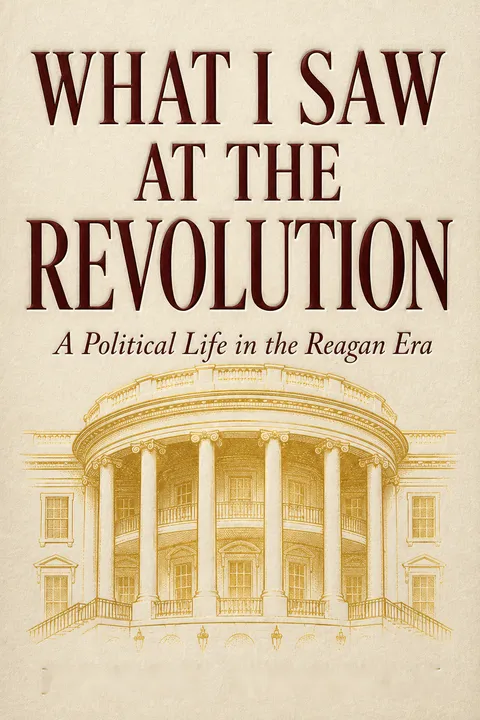
What I Saw at the Revolution by Peggy Noonan receives praise for its exceptional writing quality and insider perspective on the Reagan White House. Reviewers appreciate Noonan's honest portrayal of Reagan, though some note her adoring tone borders on hagiography. The book offers fascinating insights into speechwriting, White House politics, and Reagan's character as both authentic and performative. Many value her candid discussions of gender dynamics and internal conflicts with colleagues. Critics note occasional score-settling and stream-of-consciousness style. Overall, readers find it an engaging, well-written political memoir valuable even for those who disagree politically.
People Also Read





About the Author
Other books by Peggy Noonan
Download PDF
Download EPUB
.epub digital book format is ideal for reading ebooks on phones, tablets, and e-readers.








































