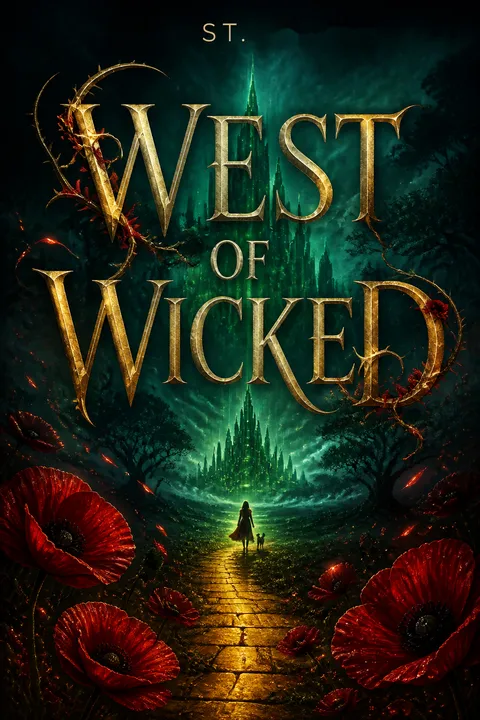

Plot Summary
Storms and Abandonment
Dorothy's earliest memory is being handed over to strangers during a violent Kansas storm, her mother's face streaked with blood and desperation. Aunt Em and Uncle Henry, childless and weary, take her in, offering her a home built from the wreckage of disaster. Dorothy grows up on the farm, learning to hammer nails and bake bread, but always haunted by the sense that she is temporary, that love is conditional, and that her real family will never return. The prairie's endless work and the quiet ache of loss shape her, leaving her both grateful and guarded, unable to fully let herself be loved or to believe she truly belongs.
Kansas Roots, Restless Heart
Dorothy's adulthood is marked by gratitude for her adoptive family and a gnawing restlessness. She loves Em and Henry, and her dog Toto, but feels trapped by obligation and fear of abandonment. Her relationship with Edward, the neighbor boy turned lover, is safe but unsatisfying—she craves something deeper, something that will leave a mark. Edward proposes, painting a future of gardens and family, but Dorothy's heart recoils. She cannot commit, haunted by the emptiness of not knowing her origins and the terror of losing everything again. Her intuition, sharpened by trauma, tells her she is meant for something more, but guilt and loyalty keep her rooted in Kansas.
Love, Guilt, and Escape
Dorothy's nights are spent in Edward's barn, seeking pleasure and distraction, but her fantasies drift to darker, more dangerous men. She feels guilty for not loving Edward enough, for wanting more than the gentle life he offers. Aunt Em, wise and perceptive, urges Dorothy to listen to her intuition and choose her own path, not one dictated by fear or obligation. As a storm approaches, Dorothy resolves to make a choice, but fate intervenes before she can act, thrusting her into a new world where her longing for escape becomes literal.
Cyclone to Oz
A violent cyclone rips Dorothy's house from its Kansas foundation, hurling her and Toto into the unknown. The chaos is surreal—windows shatter, the house spins, and Dorothy clings to Toto as the world turns upside down. When the storm subsides, Dorothy awakens in a shattered house, surrounded by unfamiliar darkness and a sky cursed to perpetual twilight. She is disoriented, injured, and alone, but soon discovers she has landed in a land called Oz, where nothing is as it seems and her arrival is both a miracle and a threat.
Blood on the Snowdrops
In the field where Dorothy's house lands, she is attacked by Delphine, the Witch of the East, who believes Dorothy is an agent of her rival. In a desperate struggle, Dorothy kills Delphine with a kitchen knife, an act that shocks her as much as it liberates the local people. The witch's death is met with celebration—she was a tyrant, feared and hated. Dorothy, bloodied and bewildered, is hailed as a sorceress and liberator, but she feels only horror and confusion at what she has done and what is expected of her.
Witch Slain, World Changed
Cleo, Delphine's former ward, witnesses the witch's death and feels both terror and relief. The people of the East End rejoice, freed from Delphine's cruel magic, but Dorothy is overwhelmed by guilt and the surreal adulation of strangers. The magical slippers, taken from the witch's corpse, become a symbol of power and responsibility. Dorothy is swept into a new role she never wanted, her actions setting off political tremors across Oz and drawing the attention of other powerful—and dangerous—figures.
The Curse of Darkness
Dorothy learns that Oz is cursed: the sky is always dark, the land divided by magical boundaries, and the people live in fear of witches, beasts, and the mysterious Wizard of Oz. She is told that only the Wizard can help her return home, but the journey is perilous, the path lined with monsters and political intrigue. The magical slippers, which cannot be removed except by her own will, mark her as a target for those who covet their power. Dorothy's longing for home is now tangled with the fate of a world she barely understands.
Slippers, Sorceresses, and Schemes
The Good Witch of the North appears, attempting to claim the slippers, but they magically return to Dorothy. She is advised to follow the Yellow Brick Road to the Emerald City, where the Wizard resides. Along the way, Dorothy is warned about the Tinman, a mercenary without a heart, and the Witch of the West, who is both powerful and unpredictable. The political landscape is treacherous—alliances shift, and Dorothy's presence is both a blessing and a threat to the balance of power in Oz.
The Good Witch's Decree
Dorothy, now equipped with the magical slippers and a sense of purpose, prepares to journey to the Emerald City. She is joined by Toto and, soon after, by Rook—a mysterious man with no memory, found beaten and tied in a cornfield. Their bond is immediate and intense, marked by mutual rescue and growing attraction. As they travel, Dorothy's sense of self deepens; she is no longer just a lost girl, but a catalyst for change in a land desperate for hope.
Packing for the Unknown
Dorothy and Rook find refuge in Glimming Hollow, a city celebrating its liberation from the witch. They are honored guests, but the festivities mask underlying tensions. Dorothy is fitted for a ball, Rook for a suit, and both are swept into the city's politics. The Tinman, meanwhile, is on their trail, driven by a bargain with the Witch of the West to retrieve Dorothy in exchange for his brother's freedom. The sense of impending danger grows as Dorothy and Rook's relationship intensifies, blurring the line between ally and lover.
The Scarecrow's Awakening
Rook, dubbed the Scarecrow, struggles with amnesia but displays uncanny skills and knowledge. His connection with Dorothy deepens, culminating in a passionate encounter that is both a release and a reckoning. Their intimacy is interrupted by violence—betrayal at the city's ball, an attack by guards, and the relentless pursuit of the Tinman. The boundaries between friend and foe, memory and identity, become increasingly blurred as Dorothy and Rook fight for survival.
Tinman's Bargain
The Tinman, revealed as Silas, is a mercenary cursed to live without a heart, dependent on a magical drug to survive. He is manipulated by the Witch of the West, who holds his brother Gabriel hostage. Silas's mission is to capture Dorothy and deliver her alive, but his encounters with her and Rook stir memories and doubts. The Tinman's brutality is matched by moments of unexpected mercy, hinting at a complexity beneath his hardened exterior.
City of Celebration
In Glimming Hollow, Dorothy and Rook are celebrated as heroes, but the city's joy is fragile. The ball thrown in their honor becomes a stage for betrayal as the Tinman and his allies close in. Dorothy's growing feelings for Rook are complicated by guilt over Edward and the unresolved mysteries of her past. The city's politics, the magical infrastructure powered by the Yellow Brick Road, and the ever-present threat of curses create a sense of both wonder and unease.
Revelations and Revelry
At the ball, Dorothy learns more about the history of Oz—the disappearance of the gods, the rise of the witches, and the true nature of the curses that afflict the land. She is warned not to trust the Wizard, and her own magical abilities begin to manifest in subtle ways. The celebration is shattered by an alarm signaling the Tinman's arrival, forcing Dorothy and Rook to flee once more, their bond tested by violence and loss.
The Tinman's Hunt
The Tinman's relentless pursuit leads to a brutal confrontation in the woods. Rook is gravely wounded, seemingly killed by the Tinman's axe, and Dorothy is captured and delivered to the Witch of the West. The trauma of loss and the terror of captivity push Dorothy to the brink, but also awaken new reserves of strength and magic within her. The lines between victim and hero, captor and captive, blur as the true stakes of the conflict are revealed.
Betrayal at the Ball
In the aftermath of the ball, Dorothy is imprisoned in the Witch's castle, where she discovers that the Witch of the West is the very woman who abandoned her in Kansas. The revelation is devastating—Dorothy's quest for home and identity is bound to the fate of Oz and the legacy of the witches. The Tinman, torn between duty and conscience, becomes an uneasy ally as they plot to overthrow the witch and escape.
Flight and Capture
Dorothy's latent magical abilities come to the fore as she confronts the Witch of the West, ultimately killing her with water—a substance deadly to the witch. The act is both vengeance and tragedy, as Dorothy realizes the witch was her mother, and her own powers are both a gift and a curse. Rook, miraculously alive, returns, but his true identity is revealed in a final, devastating twist: he is the Wizard of Oz, and his betrayal is the final blow in Dorothy's journey from innocence to hard-won wisdom.
The Witch's True Face
In the aftermath, Dorothy is left bleeding and betrayed, the Tinman broken and defeated. The Wizard's machinations are revealed—he orchestrated the entire conflict to seize power and eliminate his rivals. The cycle of violence and ambition continues, but Dorothy's journey has transformed her. She is no longer the lost girl from Kansas, but a force capable of changing the fate of worlds. The story ends with the promise of further reckonings, as the true nature of power, love, and destiny in Oz remains unresolved.
Analysis
A dark, adult reimagining of Oz's mythosWest of Wicked transforms the familiar tale of Dorothy's journey into a meditation on trauma, power, and the search for identity. The novel interrogates the costs of survival—how abandonment, violence, and longing shape the self, and how the quest for home can become a quest for self-knowledge and agency. By blending fairy tale structure with psychological realism, the story exposes the dangers of nostalgia and the seductive allure of power. Dorothy's journey is not just a physical quest, but an emotional and existential one—her longing for home is complicated by the realization that home is not a place, but a state of being, forged through choice, loss, and transformation. The novel's final twist—that the Wizard is both lover and betrayer—underscores the dangers of misplaced trust and the cyclical nature of violence and ambition. Ultimately, West of Wicked is a story about the necessity of forging one's own destiny, even when the path is fraught with pain and uncertainty. It asks: What are we willing to sacrifice for belonging, and what does it mean to truly go home?
Review Summary
West of Wicked receives mostly positive reviews, averaging 3.96/5. Readers praise its fast-paced dark retelling of The Wizard of Oz, featuring familiar characters with fresh, edgier twists. The full cast audiobook narration receives consistent acclaim. Common criticisms include underdeveloped world-building, insufficient character depth, and less spice than expected from this author. Many readers felt the story prioritized plot setup over romance. The cliffhanger ending generated significant excitement, with most reviewers eager to continue the series despite mixed feelings about the first installment.
People Also Read


Characters
Dorothy Gale
Dorothy is a young woman shaped by abandonment and the relentless demands of survival on a Kansas farm. Her psyche is marked by deep-seated fears of loss and a desperate need for belonging, making her both fiercely loyal and emotionally guarded. Throughout her journey in Oz, Dorothy is forced to confront her own capacity for violence, love, and leadership. Her relationships—with Em and Henry, with Edward, and especially with Rook—reveal her longing for connection and her terror of vulnerability. As she navigates the treacherous politics and magic of Oz, Dorothy's latent powers awaken, culminating in acts of both liberation and destruction. Her arc is one of self-discovery, as she moves from passive victim to active agent, ultimately forced to reckon with the cost of power and the ambiguity of home.
Rook / Scarecrow / Wizard of Oz
Rook is introduced as a mysterious, memoryless man found beaten and tied in a cornfield. His charm, intelligence, and growing bond with Dorothy mask a deeper, more dangerous identity: he is the Wizard of Oz, orchestrator of the land's fate. Psychologically, Rook is a study in duality—capable of tenderness and brutality, vulnerability and cunning. His amnesia is both genuine and a mask, allowing him to manipulate those around him while exploring his own desires and regrets. His relationship with Dorothy is passionate and complex, blending genuine affection with calculated ambition. As the story unfolds, Rook's true nature is revealed, exposing the depth of his ambition and the lengths he will go to achieve power, even at the cost of love and trust.
Tinman / Silas
The Tinman, or Silas, is a mercenary cursed to live without a heart, dependent on a magical drug to survive. His psyche is defined by apathy, addiction, and a deep-seated rage at his own condition. Despite his brutality, Silas is capable of moments of mercy and loyalty, particularly toward his brother Gabriel. His interactions with Dorothy and Rook reveal a man struggling with the remnants of conscience and the burden of impossible choices. Silas's arc is one of reluctant complicity—he is both a tool of the witches and a potential agent of change, his actions shaped by desperation and the faint hope of redemption.
Cleo
Cleo is the former ward of Delphine, the Witch of the East, raised in captivity and conditioned to silence and obedience. Her psyche is marked by trauma, guilt, and a yearning for agency. Cleo's decision to betray Delphine sets the story in motion, and her subsequent journey is one of self-discovery and emancipation. She is both witness and participant in the upheaval of Oz, her actions driven by a mix of fear, loyalty, and the desire to finally choose her own fate. Cleo's arc is one of gradual empowerment, as she learns to trust her instincts and claim her place in a world that has always sought to control her.
Aunt Em
Aunt Em is Dorothy's adoptive mother, a woman of strength, wisdom, and quiet sorrow. Her role is both practical and emotional—she grounds Dorothy, offering love and stability while encouraging her to listen to her intuition and seek her own path. Em's own sacrifices and regrets mirror Dorothy's struggles, and her presence looms large even after Dorothy is swept away to Oz. Psychologically, Em represents the possibility of unconditional love and the pain of letting go.
Uncle Henry
Uncle Henry is Dorothy's adoptive father, a man shaped by loss and the relentless demands of farm life. His love is expressed through action—building, providing, distracting from pain. Henry's own grief and avoidance of vulnerability echo Dorothy's struggles, and his quiet support is a source of strength for her. He embodies the endurance and limitations of familial love in the face of trauma.
Edward Gilbert
Edward is Dorothy's childhood friend and lover, offering her a vision of stability and domestic happiness. Psychologically, Edward is earnest, gentle, and deeply in love, but unable to satisfy Dorothy's deeper longings. His repeated proposals and inability to see Dorothy's true needs create a dynamic of guilt and frustration. Edward represents the life Dorothy feels she should want, but cannot accept without betraying herself.
Delphine, Witch of the East
Delphine is a Cardinal Witch whose power is rooted in exploitation and fear. Her psyche is marked by addiction, paranoia, and a desperate need for validation. Delphine's cruelty is both a product of her own trauma and a means of maintaining control. Her death at Dorothy's hands is both liberation and tragedy, setting off a chain reaction that destabilizes Oz and reveals the costs of unchecked power.
Witch of the West
The Witch of the West is both Dorothy's biological mother and a powerful, cursed ruler. Her psyche is defined by foresight, regret, and the burden of impossible choices. She is both protector and antagonist, her actions driven by a desire to shape destiny and atone for past sins. Her death at Dorothy's hands is a moment of both revelation and loss, exposing the tangled web of love, power, and sacrifice that defines Oz.
Gabriel
Gabriel is the Tinman's younger brother, held hostage by the Witch of the West as leverage. His psyche is marked by hope, resilience, and a longing for freedom. Gabriel's presence humanizes Silas and serves as a reminder of what is at stake in the struggle for power. His unique abilities and connection to the lost gods of Oz hint at deeper mysteries yet to be resolved.
Plot Devices
Reimagined Fairy Tale Structure
The novel uses the familiar scaffolding of The Wizard of Oz—a journey through a magical land, the quest for home, the gathering of companions—but subverts it with adult themes of trauma, sexuality, addiction, and political intrigue. The structure is episodic, with each chapter introducing new challenges, allies, and revelations, mirroring Dorothy's psychological journey from innocence to experience.
Magical Realism and Curses
The pervasive curses in Oz—eternal darkness, impassable deserts, personal afflictions—serve as both literal obstacles and metaphors for psychological wounds. Magic is both a source of power and a burden, its rules arbitrary and often cruel. The magical slippers, the Tinman's heartlessness, and Dorothy's latent abilities are all plot devices that externalize internal struggles, forcing characters to confront the costs of power and the limits of agency.
Unreliable Memory and Identity
Rook's amnesia, Dorothy's fragmented memories, and the shifting identities of key characters create a sense of uncertainty and suspense. The gradual revelation of true identities—Rook as the Wizard, the Witch of the West as Dorothy's mother—reshapes the narrative, forcing both characters and readers to question motives, loyalties, and the nature of truth.
Political Intrigue and Betrayal
The power struggles between witches, the Wizard, and the people of Oz create a backdrop of constant danger and shifting alliances. Betrayal is a recurring motif—Cleo's betrayal of Delphine, the Tinman's reluctant complicity, Rook's ultimate betrayal of Dorothy. Foreshadowing is used throughout, with warnings about the Wizard and the true nature of the slippers hinting at the final twist.
Psychological Realism and Intimacy
The novel foregrounds the psychological complexity of its characters, using close third-person narration and introspective passages to explore trauma, desire, guilt, and hope. Intimate scenes—both sexual and emotional—are used not just for titillation, but to reveal character and advance the plot. The interplay between vulnerability and power, love and violence, is central to the story's emotional arc.
Download PDF
Download EPUB
.epub digital book format is ideal for reading ebooks on phones, tablets, and e-readers.








































