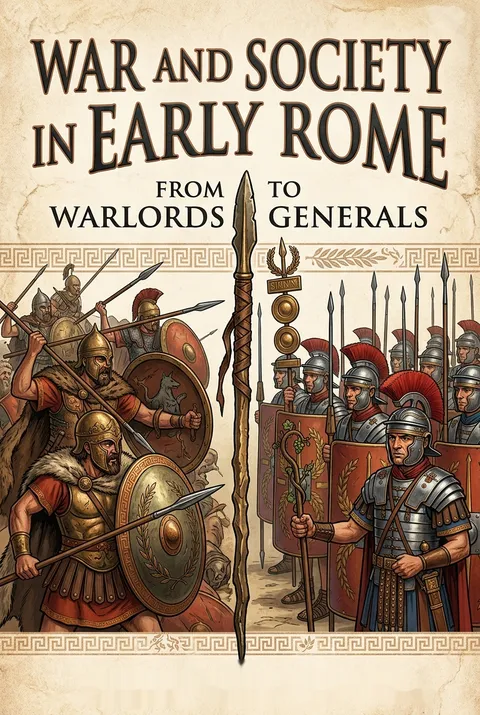

Key Takeaways
1. Early Rome's Dual Nature: Mobile Clans and Settled Communities.
The present volume will therefore argue for a broad reinterpretation of early Rome where the interaction between particular elements in Roman and Latin society (namely “mobile, extra-mural gentes” versus “settled/urban population” and later “Roman” versus “Latin”) is explored as possible explanations for change in various aspects of early Roman society and warfare.
Challenging tradition. Early Roman history is often viewed through the anachronistic lens of later republican writers, presenting a cohesive, state-centric society from its inception. This book, however, argues that early Rome was fundamentally divided, with two distinct social groups shaping its development. This reinterpretation moves beyond the traditional patrician-plebeian conflict to a more foundational societal split.
Two distinct groups. One group comprised mobile, aristocratic clans or gentes, led by powerful warlords, whose influence was based on military strength and portable wealth. The other was a more settled, urban population, focused on agrarian principles and community cohesion. These groups, though often intertwined, maintained distinct identities and behavioral norms, influencing everything from politics to military organization.
Warfare as a lens. By examining warfare, the book reveals how these dualities drove change. The initial dominance of clan-based raiding for personal gain gradually shifted as the urban population grew and gentes became more sedentary, leading to a need for unified defense and territorial acquisition. This behavioral approach offers a clearer, more consistent narrative than relying solely on problematic literary sources.
2. Reinterpreting History: Beyond Anachronistic Narratives.
Despite being based on roughly the same collection of sources and evidence (the incrementally increasing archaeological record for the period being the only real difference), and the eminence and acumen of the scholars involved, each of these works presents a strikingly different view of the early city and its development.
Problematic sources. Understanding early Rome is inherently difficult due to the nature of its sources. Literary accounts, written centuries after the events, are often anachronistic, idealized, and influenced by later political agendas. They frequently project late republican structures and problems onto earlier periods, creating a distorted view.
Archaeology's role. The ever-growing archaeological record provides a crucial, albeit indirect, counterpoint to literary biases. While archaeological evidence for military activity is often scant or difficult to interpret, it offers contemporary insights into social structures, economic shifts, and settlement patterns. This allows for a reconstruction of general modes of behavior rather than specific, often fabricated, events.
A new methodology. This study adopts a "metanarrative" approach, focusing on broad themes and trends in behavior, particularly warfare, rather than specific historical minutiae. It prioritizes contemporary archaeological and indirect literary evidence, filtering out anachronistic interpolations to reveal underlying social and cultural shifts. This helps to "re-humanize" early Roman warfare, moving beyond mechanistic military analyses.
3. Regal Warfare: Clan-Dominated Raiding for Personal Gain.
Indeed, the period saw the continuation of the archaic way of war with the dominance the region’s powerful warlike clans and the sustained importance of portable wealth as the primary motivation for warfare.
Warlords in power. During the sixth century BC, central Italian warfare was largely dominated by powerful, mobile aristocratic clans, or gentes, led by warlords. These figures, like Macstarna or Sextus Tarquinius, commanded personal armies of family members, sodales (sword-mates), and clientes, moving between communities and exerting influence through military and economic strength.
Raiding for wealth. The primary motivation for these conflicts was the acquisition of portable wealth, such as livestock, precious metals, and luxury items, rather than territorial conquest. This wealth was crucial for maintaining prestige and rewarding followers, reinforcing the warlord's personal power.
- Tarquinius Superbus raided Volsci, Gabii, Suessa Pometia, and Ardea for booty.
- Sextus Tarquinius expanded his followers in Gabii by distributing plunder.
- The importance of spolia (booty) and spolia opima (enemy commander's arms) highlights the value of portable wealth.
Ephemeral control. While these warlords could dominate settlements, their control was often transient and superficial, as seen with Rome's reges who were often foreign elites. The lack of permanent structures for elite habitation, despite lavish burials, further suggests a focus on mobile assets over fixed territorial power. This contrasts sharply with later state-centric warfare.
4. The Servian Constitution: A Later Blueprint, Not Early Reality.
As a result, it is now generally accepted that the traditional model of the Servian Constitution, as presented in the literary sources, probably did not exist as such in the sixth and fifth centuries.
Anachronistic reforms. The traditional narrative attributes a revolutionary Servian Constitution to Rome's sixth century, reorganizing society and the army along timocratic (wealth-based) and geographic lines. However, this elaborate system, including bronze coinage for wealth assessment, is highly anachronistic and unlikely for such an early period.
Contradictory evidence. Literary sources outside the specific descriptions of the Servian reforms often contradict its existence, showing:
- Continued use of gentes in warfare.
- Recruitment of men in debt, defying wealth-based classes.
- Dominance of the comitia curiata for another century.
- Discrepancies in rural tribe numbers and class existence.
A later development. The Servian Constitution, particularly its full centuriate assembly, likely represents a later rationalization by second and first-century historians, possibly reflecting the system as it existed in the mid-third century BC. Its core principles, however, may have emerged around 509 BC, marking a shift towards incorporating wealthy gentes into a new power structure, rather than a complete overhaul of society.
5. Early Republic: Warlords Endure, Land Becomes a Strategic Asset.
The early years of the Republic saw the emergence of the community as not only a focal point for aristocratic unity, but also as an increasingly vocal and powerful entity in its own right.
Warlords persist. Despite the fall of the rex in 509 BC and the establishment of the Republic, independent, mobile aristocratic warbands continued to play a prominent role. Figures like Lars Porsenna, Tarquinius Superbus (in exile), Coriolanus, and Attus Clausius exemplify clan leaders moving between communities, gaining power, and conducting military actions.
- Porsenna of Clusium dominated Rome briefly after 508 BC.
- Tarquinius Superbus moved between Gabii, Tarquinia, Veii, and Tusculum seeking military support.
- Coriolanus, exiled from Rome, led Volscian forces against the city.
- Attus Clausius arrived in Rome with followers, quickly becoming influential.
Shift to land. A significant economic shift occurred in Latium during this period, with land gaining importance over portable wealth. This was driven by:
- Increased population density and intensive agriculture.
- Decline in interregional trade and luxury goods.
- Influx of mountain tribes, increasing competition for arable land.
Community's rise. This economic shift aligned the interests of the sedentary urban population and the increasingly settled gentes, leading to a greater focus on defending and acquiring land. The community began to assert itself, laying the groundwork for a unified military force and state-centered goals, though raiding for portable wealth still persisted.
6. The Struggle of the Orders: Rome's Internal Integration.
The tension between these groups, although often misunderstood and misinterpreted by Rome’s later historians, seems to represent one of the major driving forces in Roman society which came to a head, most often, in military matters.
Dual governance. The early Republic maintained a dual political structure: a patrician-dominated system (senate, praetores) based on clan power, and an urban, "plebeian" system (curiae, tribunes) focused on internal community affairs. The praetores, successors to the rex, still relied on imperium granted by the curiae, highlighting the community's legitimizing role.
Formalizing relationships. The mid-fifth century saw the first concerted efforts to unify these systems, beginning with the decemviri and the Laws of The Twelve Tables (451-450 BC). This codified social and economic relationships, standardizing rules for all within Rome's pomerium, a crucial step for integration.
- The Twelve Tables addressed inheritance and property, reflecting the growing importance of land.
- It laid groundwork for a unified patrician-plebeian community.
Military pressure as driver. The "Struggle of the Orders" was often exacerbated by military needs. Plebeian boycotts of levies, particularly during prolonged warfare, demonstrated their military importance and forced the patrician elite to consider their demands. This pressure pushed for greater inclusion and a more unified military structure.
7. New Magistracies: Unifying Rome's Diverse Military.
The creation of the office of the censorship in 443 marked another major step in the development of the Roman state which was linked to the creation of a unified patrician-plebeian army and state.
Military tribunes. The introduction of tribuni militum in 449 BC, alongside the Valerio-Horatian laws, marked a significant step in integrating plebeians into Rome's military. These tribunes, associated with urban tribes and the plebeian population, likely commanded a new, community-based military force, distinct from traditional clan armies.
Consular tribunes. The tribuni militum consulari potestate (consular tribunes), created in 444 BC, represented a compromise. While patricians still dominated, plebeians became eligible, and the office combined aspects of the patrician praetorship with the community-based tribunate. Crucially, consular tribunes likely lacked imperium, suggesting a shift from the personal authority of warlords to a more state-derived command.
The Censorship. The creation of the censorship in 443 BC was pivotal. Censors were tasked with:
- Counting and categorizing the Roman population by wealth and tribe.
- Organizing the comitia centuriata and comitia tributa.
This formalized the timocratic "Servian" system, integrating diverse populations into a single military and political framework, and reflecting a new, unified Roman state.
8. Stipendium Militum: State-Funded Warfare and Strategic Depth.
The payment or reimbursement of soldiers by the state illustrated that a fundamental shift had occurred from the early fifth century in how warfare was understood by the community of Rome.
Payment for service. The introduction of stipendium militum (payment for soldiers) around 400 BC, often associated with the siege of Veii, marked a profound change. It signified that the Roman state, not just individual warlords, recognized warfare as a communal benefit and was willing to fund it strategically. This reduced soldiers' reliance on immediate booty.
Strategic awareness. State payment indicated a new level of strategic awareness in Rome. Warfare was no longer solely a reactive response to raids but could be a proactive, long-term endeavor. The state, by providing reimbursement, began to usurp the role of individual generals as the primary "patron" distributing wealth from war, fostering loyalty to the state itself.
Democratization of warfare. Stipendium militum also broadened military participation. It offset the costs of prolonged campaigns, making service accessible to poorer citizens who couldn't afford to fight without support. This expanded the pool of recruits beyond the wealthy elite, contributing to a more inclusive, community-based army.
9. The Gallic Sack: A Catalyst for Roman Transformation.
Livy described the year 389 as marking the rebirth of the city (secunda origine), and while Roman historians writing during the late Republic may have still only had a vague grasp of events during the period, it is clear that they were right in recognizing this year as the beginning of an era of immense change in Rome.
A turning point. The Gallic sack of Rome in 390 BC, despite potentially exaggerated physical destruction in literary accounts, served as a profound catalyst for Rome's internal and external transformation. It exposed the vulnerabilities of Rome's archaic military system and accelerated the integration of its diverse social groups.
End of archaic warfare. The sack effectively ended the dominance of the archaic, clan-based praetorship and its associated warbands. Rome permanently adopted the consular tribunate, signifying a full-time commitment to a unified, community-based military structure that incorporated both patricians and plebeians. This shift was driven by the need for a larger, more cohesive force against threats like the Gauls.
Emergence of tumultus. The threat of future Gallic incursions led to the development of the tumultus Gallicus, a state of emergency requiring all citizens to enlist. This emphasized community defense over individual or clan interests, solidifying the idea of the community as the fundamental unit of Roman society and warfare.
10. Post-Sack Expansion: Redefining Roman Citizenship and Territory.
Expanding the citizen body represented an effort by Rome to maximize manpower reserves in the face of increased military pressure.
Rapid expansion. Following the Gallic sack, Rome embarked on a determined process of internal and external expansion. This included significant building projects, like the "Servian Walls," and a dramatic reinvention of its citizen body and territory.
Mass enfranchisement. After conquering Veii in 396 BC, Rome incorporated its population and those from Capena and Falerii, creating four new rural tribes on the ager Veientanus in 387 BC. This mass enfranchisement, rather than a reward for a few, was a strategic move to rapidly expand Rome's manpower reserves against increased military threats, particularly from the Gauls.
New forms of control. Rome's approach to land and communities evolved. While colonization declined in Latium, new methods like the municipium (e.g., Tusculum in 381 BC) emerged. This granted Roman citizenship while maintaining local autonomy, allowing Rome to expand its influence and military base without the centrifugal problems of earlier colonies. This disassociated "soil" from "state," creating a new, more flexible concept of Roman identity.
11. From Warlords to Generals: The Rise of Plebeian Military Command.
This development broke the long-standing link between control of aristocratic warbands and military leadership in Rome and so represented the true transition from warlords to generals.
Consulship's reinvention. The reintroduction of the consulship in 367 BC marked a pivotal moment. This new magistracy, open to both patricians and plebeians, combined the archaic privileges of the praetor (like imperium and the right to triumph) with the larger, community-based military structure of the consular tribunate. This satisfied both aristocratic desire for prestige and the need for inclusive military leadership.
Plebeian generals. The advent of plebeian consuls, starting with L. Gernucius (cos. 362 BC), fundamentally changed Roman military leadership. These generals, often more aggressive in territorial expansion, lacked the traditional clan-based military background of patricians but commanded larger, community-backed forces. Their rise reflected the shift from personal, clan-driven warfare to state-sanctioned military endeavors.
New nobilitas. The consulship offered Rome's plebeian elite a path to nobilitas (social standing) through military achievement, fostering a new, integrated "Roman Nobility." This institutionalized competition for power within the civic structure, further cementing state control over military affairs and diminishing the influence of independent warlords.
12. The Latin Uprising: Forging a Roman-Latin Military Identity.
As a result, the culmination of Rome’s integration of the Latins c. 340 represented not only the emergence of the Roman army as Rome’s late republican authors would have recognized it, as a joint Roman-Latin force, but also the final coalescing of an increasingly concrete Roman identity built not only from the unification of the her urban and elite parts, but also in opposition to her Latin allies.
Latin disunity. Rome's efforts to unite Latium against the Gallic threat were largely unsuccessful. By the mid-fourth century, many Latin communities, like Tibur and Praeneste, prioritized their own ambitions, even allying with Gallic warbands or forming anti-Roman coalitions. This reflected a new political climate where powerful communities, led by settled gentes, overshadowed regional unity.
The Latin War. This growing tension culminated in the Latin Uprising around 340 BC. Initially directed at the Samnites, the Latins eventually turned on Rome. Rome's decisive victories at Vesuvius and Trifanum led to the dissolution of the Latin League and a comprehensive settlement.
A new Roman-Latin identity. The settlement of 338 BC was multifaceted, incorporating Latin communities into Rome's socio-political and military matrices through various means:
- Municipia: Lanuvium, Aricia, Nomentum, Pedum gained Roman citizenship.
- Territorial Cession: Tibur and Praeneste lost land but retained independence as dependent satellites.
- Confiscation: Velitrae and Antium saw aristocracy displaced and navies confiscated.
This integration created a powerful, joint Roman-Latin military force and solidified a distinct Roman identity, defined both internally and in opposition to its newly incorporated allies.
People Also Read


Download PDF
Download EPUB
.epub digital book format is ideal for reading ebooks on phones, tablets, and e-readers.








































