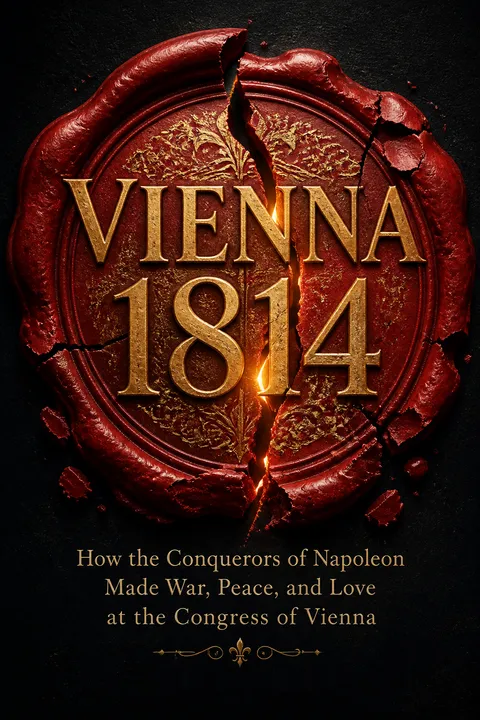

Key Takeaways
1. The Congress of Vienna blended serious diplomacy with unprecedented, decadent celebration.
"the Congress does not move forward, it dances."
A glittering vanity fair. The peace conference of 1814 transformed the Austrian capital into a shimmering baroque playground filled with masked balls, grand banquets, and medieval-style jousts. While the war-torn continent desperately needed reconstruction, the arriving royalty and diplomats indulged in unrestrained, decadent celebrations.
Diplomacy through pleasure. The Austrian hosts, despite being on the verge of bankruptcy, spared no expense to entertain their illustrious guests at the Hofburg Palace. Important state affairs were routinely negotiated not in formal offices, but during hunts, dinners, and dances.
- Over forty banquet tables were set daily at exorbitant costs to feed the royal mob.
- The Festivals Committee was constantly challenged to design increasingly extravagant spectacles.
- Priceless works of art, stolen by Napoleon, became bargaining chips amidst the revelry.
A sparkling chaos. This unprecedented blend of high-stakes negotiation and unabashed frivolity created a unique atmosphere where world maps were redrawn between waltzes. What was expected to be a brief three-week meeting quickly degenerated into a nine-month diplomatic pageant.
2. The "Big Four" powers attempted to secretly partition Europe behind closed doors.
"This committee is the core of the congress; the congress exists only when the committee is in being, and it is terminated when the committee dissolves itself."
Exclusive coalition control. The victorious allies—Austria, Great Britain, Russia, and Prussia—believed their immense sacrifices in defeating Napoleon gave them the sole right to determine Europe's future. They formed an elite inner cabinet, the "Big Four," to make all major territorial decisions in secret before the general congress even opened.
Marginalizing minor states. By keeping negotiations confidential, the major powers hoped to avoid the chaotic, parliamentary-style disputes of a larger assembly. They designed a system where smaller states would only be called upon to rubber-stamp pre-determined agreements.
- Secret protocols were drafted to establish a directing committee composed only of the allies.
- The general congress was repeatedly postponed to allow the Big Four to reach a perfect consensus.
- Minor principalities and independent cities found themselves completely excluded from the decision-making process.
A geopolitical cartel. This closed-door approach aimed to establish a stable balance of power by dividing the spoils of the French Empire among the victors. However, the allies' underlying rivalries and mutual distrust quickly threatened to tear this exclusive cartel apart.
3. Prince Talleyrand brilliantly disrupted the exclusive coalition to restore France's influence.
"If there are still Allied Powers, then I don’t belong here."
Defying defeat. Arriving in Vienna as the representative of a defeated and despoiled nation, Prince Talleyrand refused to play a submissive role. He masterfully exploited the divisions among the Big Four, positioning himself as the champion of the excluded smaller states.
Challenging secret diplomacy. Talleyrand launched a brilliant public relations campaign, circulating formal protests that exposed the illegality of the Big Four's secret meetings. He demanded that the peace conference adhere strictly to the principles of public law and open its doors to all treaty signatories.
- He successfully forced the allies to abandon their divisive "Allied Powers" terminology.
- The exclusive four-power coalition was expanded to include France, Spain, Portugal, and Sweden.
- Talleyrand transformed the French embassy into a highly influential social and diplomatic hub.
Restoring French prestige. Through sheer charisma, intellect, and diplomatic maneuvering, Talleyrand shattered France's isolation. Within weeks of his arrival, the representative of the vanquished empire had become an indispensable arbiter of the European peace.
4. The fate of Poland and Saxony became the central, highly volatile crisis of the peace.
"Rather war than that I should renounce what I hold."
The Polish-Saxon deadlock. Geopolitical tensions reached a boiling point over the territorial ambitions of Russia and Prussia. Tsar Alexander demanded the creation of a Russian-controlled Kingdom of Poland, while Prussia sought to annex the entire Kingdom of Saxony as compensation for its lost Polish lands.
Threat of renewed war. This joint Russo-Prussian land grab alarmed Great Britain and Austria, who feared it would completely destroy the balance of power in central Europe. The dispute became so bitter that the former allies openly threatened to settle the matter on the battlefield.
- Russia maintained a massive army of occupation in Poland to back its diplomatic demands.
- Prussia's aggressive "lions of diplomacy" insisted on the total annihilation of the Saxon state.
- The king of Saxony remained a prisoner of war, unable to defend his crown in person.
A fragile compromise. To break the dangerous stalemate, Lord Castlereagh and Prince Metternich were forced to engage in complex, high-stakes bargaining. The crisis eventually led to a secret defensive alliance with France, demonstrating how quickly the wartime coalition had fractured.
5. An extensive, intrusive espionage network monitored every move of the delegates.
"Since a certain number of representatives of the different powers attending the Congress have already arrived in Vienna and the rest will be following them in a steady stream, you should not only keep me informed of the arrival and address of each one, but by virtue of a secret watch intelligently maintained you should also make it your business neither to lose track of their whereabouts nor of the company they keep."
Total surveillance state. Under the direction of Baron Franz von Hager, the Austrian police ran an incredibly vast and sophisticated intelligence operation. Every visitor to Vienna, from reigning emperors to minor diplomats, was subjected to constant, covert monitoring.
Infiltrating the embassies. Spies successfully recruited household servants, carriage drivers, and hotel porters to gather intimate details about the delegates' private lives. The Secret Cipher Office, or "Cabinet Noir," routinely intercepted, copied, and decoded foreign diplomatic mail.
- Chambermaids rummaged through wastepaper baskets to retrieve discarded drafts and notes.
- Lacking modern technology, agents painstakingly reassembled torn scraps of paper, known as chiffons.
- High-society courtesans and salon regulars were placed on the police payroll to report on late-night gossip.
Information for the Emperor. Every morning, Emperor Francis I personally read the detailed, daily dossiers compiled by his spymaster. This pervasive surveillance network ensured that the Austrian hosts always maintained a hidden advantage in the diplomatic chess game.
6. High-society rivalries and romantic liaisons deeply entangled the course of diplomacy.
"Metternich was mad with love, pride and vanity…wasting all his mornings getting up only at ten and then running off to sigh at the feet of Sagan…"
The battle of the salons. The Palm Palace became a hotbed of political intrigue, housing two rival high-society queens: the Duchess of Sagan and Princess Catherine Bagration. Their fierce personal animosity and competing evening soirees divided the congress into distinct diplomatic factions.
Love as a political weapon. Romantic affairs directly influenced state policy, as both women had previously been Metternich's lovers and were now attracting the attentions of the Russian tsar. The Duchess of Sagan's salon became the informal "Austrian headquarters," while Princess Bagration's hosted the Russian and Prussian delegations.
- Metternich's obsession with the Duchess of Sagan frequently distracted him from critical state negotiations.
- Tsar Alexander exploited Metternich's romantic vulnerabilities to undermine his diplomatic credibility.
- The custody battle over the Duchess's illegitimate daughter became a high-stakes bargaining chip between empires.
Intrigue in the boudoir. These complex romantic entanglements proved that the fate of nations was often decided in bedrooms rather than conference rooms. The personal rivalries of the peacemakers added a highly volatile, unpredictable element to the negotiations.
7. The principle of legitimacy emerged as a powerful shield for weaker nations.
"Legitimacy, in other words, was 'the safeguard of nations,' and Talleyrand hoped it would serve as a guiding principle in restoring Europe."
A moral counterweight. To counter the raw power politics of the victorious allies, Prince Talleyrand introduced the revolutionary concept of legitimacy. He argued that a lasting peace could only be built on the rule of law and the restoration of rightful, established sovereigns.
Defending the vulnerable. This principle served as a powerful shield for smaller states threatened with annexation by their larger neighbors. By framing the preservation of kingdoms like Saxony as a moral duty, Talleyrand made it difficult for the victors to simply seize territory at will.
- Legitimacy challenged the Napoleonic doctrine of conquest as a source of legal right.
- It provided a strong argument for restoring the Bourbon dynasty to the throne of Naples.
- The concept forced the Great Powers to justify their territorial adjustments in the language of justice.
A stabilizing force. While critics dismissed legitimacy as a convenient tool to protect outdated aristocratic privileges, it ultimately provided a stabilizing framework for the postwar order. It helped transform a lawless scramble for power into a structured negotiation based on mutual recognition.
8. The sudden escape of Napoleon shattered the festive atmosphere and forced a military reunion.
"The English commissioner Campbell has just entered the harbor to inquire whether anyone has seen Napoleon at [Livorno], in light of the fact that he has disappeared from the island of Elba."
A shocking awakening. In March 1815, the dazed peacemakers received the terrifying news that Napoleon Bonaparte had escaped his sunny exile on Elba. The festive, waltzing atmosphere of the congress evaporated instantly as the reality of his return to France dawned on the delegates.
Uniting divided allies. The common threat of the "man of destiny" forced the deeply divided allies to immediately set aside their bitter territorial disputes. Facing a renewed total war, the Great Powers quickly mobilized their armies and declared Napoleon an international outlaw.
- The allies signed a formal treaty renewing their wartime coalition and pledging 150,000 troops each.
- Napoleon's rapid march to Paris demonstrated the fragility of the newly restored Bourbon regime.
- The Duke of Wellington was dispatched to Belgium to assume command of the Anglo-Allied forces.
The final showdown. This dramatic turn of events transformed the peace conference into a war council, culminating in the decisive Battle of Waterloo. The escape from Elba proved that the specter of the French Empire could only be banished by a final, bloody trial of strength.
9. The Congress established a groundbreaking system of collective security and conference diplomacy.
"Set in ballrooms, bedrooms, and palaces, Vienna, 1814 tells the story of how these unlikely revelers created what Henry Kissinger called the longest period of peace Europe has ever known."
A new international order. Despite its unabashed frivolity and decadence, the Congress of Vienna succeeded in creating a remarkably durable peace. The delegates established a system of collective security, known as the "Concert of Europe," designed to prevent any single power from dominating the continent.
Diplomacy by conference. The signing of the Final Act on June 9, 1815, marked the birth of a new era of international relations. For the first time in history, the major powers agreed to hold periodic conferences to resolve disputes peacefully before they erupted into war.
- The neutrality of Switzerland was formally guaranteed, creating a permanent buffer state.
- International rivers were opened to free navigation, reducing economic friction between nations.
- The slave trade was formally condemned, marking a pioneering step for international human rights.
A lasting legacy. While the congress was heavily criticized for ignoring national aspirations, its diplomatic framework successfully prevented a general European war for a full century. The unlikely revelers of Vienna had managed to construct one of the most successful peace settlements in history.
Download PDF
Download EPUB
.epub digital book format is ideal for reading ebooks on phones, tablets, and e-readers.








































