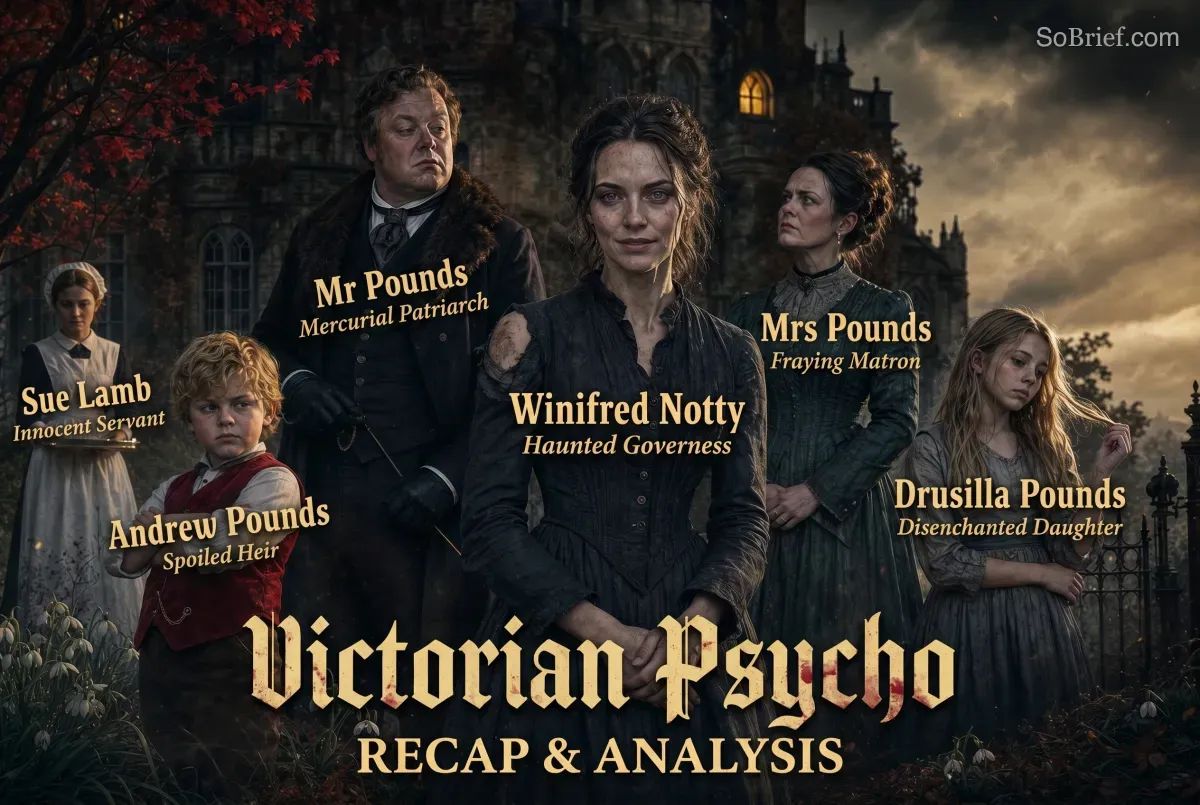

Plot Summary
Prologue
Victorian England drowns in death — in the drinking water, the wax museums, the babies slipped into strangers' coffins, the rat pits beneath pubs. Death is crushed into paint, papered on walls. From this charnel atmosphere, a single declaration emerges: Mr Pounds2 is a mystery the narrator intends to solve.
That sentence is the book's first lie by omission. Winifred Notty1 already suspects who Mr Pounds2 is. She has her dead mother's hidden letters and a boar crest to prove it. She just needs to get inside his house.
The Governess Arrives Smiling
Ensor House squats on the Yorkshire moors like a banker about to deliver terrible news. Winifred Notty1 arrives by open phaeton — a new governess for the Pounds family, or so her advertisement claims.
She meets her employers at absurd distance across a whale-length dining table: Mr Pounds,2 a phrenology obsessive with too-close eyes; Mrs Pounds,3 already suspicious, already miserable. The previous governess disappeared without explanation. Over dinner, Winifred1 catalogues the boar crest on the porcelain — the same crest from her dead mother's hidden letters.
She meets her charges: Andrew,5 eight, bratty, the sole male heir who threatens dismissal on sight; and Drusilla,4 thirteen, languid and vain. In three months, Winifred1 announces to the reader, everyone in this house will be dead.
Bred on Laudanum and Knives
Winifred1 was born illegitimate and unwanted. At thirteen months, her mother6 tried strangling her with dressmaker's tape but ran out of length. At three, she was handed to a foster mother who drugged infants with laudanum and quietly killed them — Winifred1 survived only because her mother6 kept paying.
When the foster mother demanded more money and ejected them, her mother6 stabbed Winifred1 in the shoulder with a bread knife, then pulled it out, unable to finish. The child didn't cry. She never had. At sixteen, a rabid man broke into the parsonage and bit her arm; she bludgeoned him with a fourteen-pound clock weight, cauterized her wound with a hot iron, and laughed. She realized then what she'd always been: a person incapable of fear.
The Phrenology Twins
Weekly walks across the moors become Winifred's1 campaign. Mr Pounds2 speaks of his children with rare warmth; Winifred1 collects his discarded papers like relics. Mrs Pounds,3 watching from her window, retaliates — first by forbidding Winifred1 from dinner, then by forcing her to sleep overnight in the dog kennel after finding paw prints on Andrew's5 bed.
Winifred1 crawls in beside the dog without protest and emerges at dawn smiling. The real prize comes when Mr Pounds2 measures her skull with a craniometer in the library and declares their cranial structures identical — phrenology twins, two minds better suited than any he's measured. That night Winifred1 writes her employer's surname as her own on a slip of paper, over and over, and eats it.
Andrew's Teeth Turn Black
Winifred1 lures Andrew5 into the stall of Creole, Mr Pounds'2 least favorite horse, pretending she's hidden his missing tin soldier there. While Andrew5 retrieves it, she sinks her teeth into the horse's hide.
Creole screams and kicks, catching Andrew's5 shoulder and slamming him face-first into stone — his front teeth turn permanently black. Meanwhile, the lecherous portrait painter's14 love letters to Drusilla4 are discovered and burned by Mrs Pounds.3 The painter14 is dismissed. Drusilla4 vanishes further into irrelevance.
Mrs Pounds3 gives Winifred1 notice: stay through Christmas, then leave. Alone in her room, Winifred1 rereads her mother's hidden letters — written by her biological father, bearing the boar crest, demanding that her mother6 kill her. She unfolds his straight razor, wrapped inside them.
The Baby Swap
When Mrs Pounds3 hosts an afternoon tea, one of her guests — Mrs Fancey9 — arrives with an infant son. Left alone with baby William in the nursery, Winifred1 gulps a vial of laudanum and hallucinates the baby speaking in a monarchical drawl, mocking her illegitimacy, declaring only heirs deserve love.
She draws her father's straight razor and cuts the baby's throat. Then panic: she sprints from the house, skirts hiked, to a nearby farm where she snatches a replacement from a wicker cot.
She dresses the stolen child in the dead infant's bloodstained furs, scrapes a mole from its chin, and returns it to Mrs Fancey,9 who notices nothing. The dead baby is mailed in a doll's box to a nunnery. That night, Drusilla4 whispers that she knows Winifred's1 secret.
Glass in Miss Lamb's Throat
Sue Lamb,8 the pretty young housemaid Winifred1 has been obsessively summoning by bell, recoils when Winifred1 bites her earlobe. Lamb8 calls her a deviant and threatens to tell Mr Pounds2 everything — the servants have been whispering about the governess's peculiar behaviors.
Winifred1 smashes her milk glass against the children's globe and drives the shard into Lamb's8 neck. The body crumples silently behind a desk. Mrs Pounds3 enters mid-sentence complaining about Drusilla's4 posture, oblivious to the boots protruding from behind the furniture.
After she leaves, Winifred1 drags the corpse through the long gallery to a secret garret she discovered her first night — a hidden attic room where generations of Pounds women were once confined. The dog follows, licking the blood trail clean.
The Mummy Unrolled
Carriages line the drive as the Pounds' social circle descends for a fortnight of Christmas festivities: the Fanceys9 with their swapped baby, buck-toothed Marigold11 and her contemptuous husband, the widowed Mrs Manners and her accomplished daughter, the fearsome Dowager12 with her cherub-carved cane, and red-haired Mr Fishal.10
His surprise: an Egyptian mummy unwrapped before the ladies in their evening gloves, scarabs dropping to the library carpet while Mrs Fancey9 quietly slides a necklace under her shoe. Winifred1 pockets a letter opener during the spectacle.
That night Mr Pounds2 visits her bedroom and leads her to the library to share his collection of erotic illustrations. He caresses her cheek and whispers their shared identity as phrenology twins. A maid walks in with coal and silently retreats.
The Locket Shot from Her Hand
During the shooting party, Winifred1 slips away to the gamekeeper's cottage and pockets a leghold trap. At lunch, a gilded locket containing the dismissed painter's14 portrait falls from Drusilla's4 bodice.
Mrs Pounds3 stomps on it; then Mr Pounds2 retrieves his hunting rifle and shoots the locket from Drusilla's4 outstretched, trembling hand. The guests applaud. Later, alone with Winifred,1 Drusilla4 reveals her actual secret — not knowledge of murder but of love. She knows Winifred1 adores her father and wishes they'd marry so the governess might stay forever.
The painter14 has rejected Drusilla4 by letter, describing her character as alarming. Winifred1 dampens the sleeping girl's forehead with a sponge — the gentlest act she has performed since arriving at Ensor House.
The Ghost They Made
Winifred1 prowls the house nightly, creeping into guest chambers and crouching in dark corners. Servants begin seeing her silhouette — or think they do. A laundry maid tears down sheets in hysteria after spotting a face behind the linen; candles vanish from the buttery; a kitchen maid claims she was pushed down the cellar stairs.
When Winifred1 mistakes the hall boy Fergus15 for a portrait in the dark gallery, she stabs him in the eye with the stolen letter opener and drags his dying body to her bedroom as guests investigate the noise from the hallway.
He dies whispering for help against her cupped palm. More bodies join the hidden garret. Mrs Pounds,3 preparing for the festivities, gifts Winifred1 an arsenic-green dress for the Christmas ball — a color rumored to kill.
Father, It's Me
Christmas morning. Winifred1 follows Mr Pounds2 to the library and delivers her gift: words. She tells him she is his daughter — that her mother6 worked in the Pounds house on Harley Street, that she carries his letters demanding her death, that she followed the boar crest across years and employers to find him.
She holds out the painted eyes she spent weeks cutting from the gallery portraits — the crime for which an innocent housemaid was transported overseas. Mr Pounds'2 face empties.
He calls it gross disrespect, demands she leave immediately, then snarls a vicious insult and storms from the room. Winifred1 stands barefoot in the library, alone with her smile. In the drawing room, as Miss Manners plays Christmas carols on the piano, Winifred1 looks down and finds she is holding a cleaver.
The Twelve Days of Christmas
Winifred1 chops off Miss Manners' hand with the cleaver. She strangles Mr Fancey9 with his bootlace and beats the Dowager's12 skull with her own cane. Mr Fishal10 is impaled on mounted stag antlers. In the dining room, Mr Pounds2 catches his ankle in the leghold trap Winifred1 planted that morning.
She loads a crossbow from the armory — but her bolt strikes his shoulder, not his heart. When he lunges with a carving knife, Drusilla4 steps between them and drives a rapier through his chest. Together they finish the household: Mrs Pounds3 and Andrew5 shot, Marigold11 stabbed, servants cut down with every weapon the medieval house provides.
For twelve days they live among the dead — seating corpses at dinner, freeing horses through the halls. On the twelfth, police arrive. Drusilla4 has tied her own wrists and sobs that Winifred1 killed them all.
Led Laughing to the Gallows
Winifred1 is led to her execution before a roaring crowd of thirty thousand. Men perch on lampposts; sellers hawk broadsides bearing her likeness. At trial, Drusilla4 testified in dark bonnet and black lace that Winifred1 killed them all. Now she mounts the scaffold wearing Mr Fancey's9 wig, raises her bound hands in a gesture of mock humility. Asked about her guilt, she calls the whole affair grand.
She refuses the nightcap — she wants to see. In the crowd, Drusilla's4 eyes brim with the tears Winifred1 never could produce. The bolt is drawn. Memories cascade: childhood hands snapping a duck's beak, whippets set ablaze like shooting stars, and always the boar crest — always her father's2 eyes staring from the portraits she cut open to find him.
Epilogue
Winifred's1 crimes will circulate among the working classes, soiled booklets passed between scabbed hands for shared pennies. Phrenologists will argue her skull proved nobility. Little girls everywhere will learn they too can aspire to kill — it is not only the men.
A plaster cast is taken of Winifred's1 head after the hanging. The chin, she would have noted, is much too large. Her corpse sways for the customary hour. Then it is cut down, and the story begins again in someone else's mouth.
Analysis
Victorian Psycho operates as both a savage satire of Victorian social hierarchies and a psychological study of what emerges when a system built on repression, classification, and casual cruelty produces exactly the monster its logic demands. Winifred Notty1 is not an aberration of her era but its inevitable product. The same society that drugged babies with laudanum in farming houses, transported housemaids to penal colonies on suspicion, and measured skulls to divine moral worth created the precise conditions for a woman who kills without remorse and frames her violence in the genteel vocabulary of her betters.
The first-person narration is the novel's most subversive weapon. Winifred1 addresses the reader directly, winking, making us accomplices in dark humor before we register the horror underneath. Her unreliable perspective destabilizes every scene — was the baby truly swapped? Did she stab Drusilla4 on Christmas Eve? The text refuses stable answers because Winifred1 herself cannot distinguish memory from hallucination. This epistemological vertigo mirrors the Victorian capacity for willful blindness: Mrs Pounds3 walks past protruding boots, Mrs Fancey9 accepts a different baby, the guests dismiss midnight screams as regional temperament.
The novel devours the Gothic governess tradition it inhabits. Where Jane Eyre discovers a madwoman in the attic, Winifred1 puts bodies there. Where Victorian fiction typically punishes female desire and rewards submission, Feito's protagonist submits to nothing and desires everything — family, name, belonging — with a ferocity that annihilates the social order designed to exclude her. The massacre's class dimension is devastating: servants bred in obedience never organize against their killer, aristocrats flee individually, and the hierarchical deference that maintained the household becomes its extinction event. Drusilla's4 final performance — bound wrists, rehearsed tears, the whispered accusation — reveals the novel's deepest insight: in a world that measures skulls to detect evil, the real danger was always narrative control. Who tells the story of who the monster is determines who survives.
Review Summary
Victorian Psycho follows Winifred Notty, a disturbed governess who arrives at Ensor House to care for the Pounds family's children. The novel is described as a darkly humorous, gory, and unhinged tale set in Victorian England. Readers found it shocking, twisted, and engaging, with many praising Feito's sharp writing and the book's satirical take on Victorian society. However, some criticized its excessive violence and lack of depth. The story's fast pace, unreliable narrator, and macabre humor divided opinions, with most agreeing it's not for the faint-hearted.
Characters
Winifred Notty
The governess with no fearThe novel's first-person narrator, Winifred is a governess who presents an impeccable, pasted-on smile to the world while concealing a void where fear and empathy should reside. Born illegitimate, raised on laudanum in a baby farm, then adopted by a puritanical stepfather7 who attempted to exorcise her, she catalogs human expressions like skins to be worn. She refers to her inner violence as the Darkness—a presence she speaks of as a separate creature coiled inside her body. What drives Winifred is not cruelty for its own sake but a desperate, warped hunger for belonging: she wants a father, a family name, a place on the portrait gallery wall. Her intelligence is formidable, her self-awareness chilling, and her narration hovers perpetually between dark comedy and genuine menace.
Mr Pounds
Phrenology-obsessed patriarchThe master of Ensor House, a wealthy mill owner who inherited the estate from his great-uncle. Mr Pounds is consumed by phrenology—the pseudoscience of skull measurement—which he uses to rationalize his judgments of everyone from his children to his wife's cousin Margaret, whom he banned for possessing a singularly bad head. His treatment of Mrs Pounds3 is casually cruel, dismissing her anxieties while encouraging the governess's attention. He values Andrew5 primarily as heir and legacy. His mills killed hundreds of child workers before the Factory Act. His relationship with Winifred1 develops from detached employer to something more intimate and destabilizing, rooted in a narcissism he mistakes for intellectual kinship. The boar crest of his family adorns everything he owns—a symbol that means more to Winifred1 than he suspects.
Mrs Pounds
The suspicious second wifeThe second wife of John Pounds2, acutely aware of her precarious position in the household. Her insecurity manifests as relentless beauty rituals—belladonna eye drops, clove-blackened eyebrows, hogs-lard hair—and paranoid episodes where she believes servants mock her appearance. She has buried ten children and keeps their daguerreotypes on her dresser, some with irises painted onto closed eyelids. Her cruelty toward Winifred1 stems from territorial anxiety rather than innate sadism; she recognizes the governess as a threat to her marriage before anyone else does. She controls the household through rigid meal schedules and petty punishments, but her power always depends on her husband's whims. Her Darkness, as Winifred1 perceives it, was not born with her—it was the product of sustained emotional suppression under a dismissive husband.
Drusilla Pounds
The overlooked eldest daughterThe Pounds' thirteen-year-old daughter, perpetually overshadowed by Andrew5, the male heir. Drusilla's defining features are her sparse horsehair-like locks and her quiet, watchful intelligence. She absorbs information about everyone—governesses, painters, her father's affections—and deploys it with strategic patience. Her brief infatuation with the portrait painter14 reveals a hunger for attention that her parents refuse to satisfy. She whispers cryptic claims about knowing secrets, keeping Winifred1 in sustained anxiety. Her relationship with the governess1 shifts gradually from wariness to something more intimate, bonded by their shared status as women the Pounds household considers expendable. Drusilla is cunning beyond her years, capable of performing both innocence and authority with equal conviction. Whether she is victim or collaborator remains the novel's most unsettling question.
Andrew Pounds
The bratty sole male heirThe eight-year-old Pounds heir, all bravado and entitlement. He threatens dismissal as a greeting, throws toys during lessons, and directs servants like a petty tyrant. Beneath his bluster lies a boy desperate for connection—he calls Winifred1 dear Fred and embraces her after small kindnesses. His anger rehearses the adult cruelty his class will demand of him.
Mother
Winifred's tormented motherWinifred's1 biological mother, a former servant in a wealthy London household who bore an illegitimate daughter. She attempted to kill Winifred1 multiple times in infancy yet also protected her from complete abandonment. She hid letters from Winifred's father beneath her mattress—evidence of his identity and his cruelty. A woman torn between maternal instinct and the conviction she had birthed something evil.
The Reverend
The puritanical stepfatherWinifred's1 stepfather, the curate of Hopefernon who married her mother6 out of parish loneliness. A God-fearing man who attempted to exorcise Winifred1, set leeches on her body, and struck her mother6 with the Bible he preached from. He regarded Winifred's1 broken blood vessels as markings of sin and taught her mother6 not to want more children, wielding religion as domestic control.
Sue Lamb
The pretty young housemaidA young housemaid at Ensor House with pink skin and a smile full of gums. She becomes Winifred's1 fixation—summoned repeatedly by bell, observed through keyholes, idealized for her warmth. She is courting the apprentice gardener and possesses an unguarded honesty that makes her both endearing and dangerously forthright when she discovers how the other servants view the governess1.
Mrs Fancey
Visiting society matronA competitive society matron who names her baby carriage before its occupant. She arrives at Ensor House with ironclad expectations of deference and an infant she considers the embodiment of her family legacy.
Mr Fishal
Mummy-bearing party guestA red-haired guest who arrives bearing an Egyptian mummy he excavated using child labor. Theatrical and oblivious, his name is the novel's broadest pun—Art Fishal, artificial.
Marigold
Buck-toothed earnest guestA wide-eyed guest married to a man who openly despises her. She provides inadvertent comedy through earnest romantic remarks directed at entirely inappropriate targets and situations.
The Dowager
Cane-wielding elderly tyrantAn ancient matriarch whose cherub-carved coral cane doubles as weapon and scepter. She refuses to accept Winifred1 as an equal and delights in the suffering of those beneath her station.
Mrs Able
Watchful housekeeperThe housekeeper of Ensor House with a wandering eye and a voice so quiet it seems tethered to her mouth. She regards Winifred1 with instinctive wariness from the start.
Mr Johnson
The lecherous portrait painterA painter hired to depict Mrs Pounds3 as the goddess Flora. He pursues thirteen-year-old Drusilla4 despite the age gap, writing letters that oscillate between romantic fervor and crude self-promotion.
Fergus
The unlucky hall boyA child servant at Ensor House whose nightly duties polishing boots place him in the wrong dark hallway at the worst possible moment.
Plot Devices
The Boar Crest
Winifred's compass to her fatherThe heraldic boar crest of the Pounds family appears on porcelain, door knockers, hunting-rifle stocks, and—crucially—on the letters Winifred's1 mother6 hid beneath her mattress. This symbol is Winifred's1 primary means of identifying her biological father across multiple employments. She has worked for several men named John Pounds, using the crest as her compass. When she arrives at Ensor House and sees it reproduced on the family's possessions, she knows she has found him. The crest also appears carved onto the swan's beak at Christmas dinner and haunts Winifred's1 final memories. It functions simultaneously as proof of lineage and as the mark of a predatory dynasty that discards its inconvenient offspring.
The Darkness
Winifred's name for her voidWinifred's1 personification of the psychopathic emptiness inside her, described throughout as a creature with a rubber tail, a python's heft, or a bat's thumb hooking onto organs. The Darkness is not merely metaphorical—Winifred1 speaks to it, feels it move, describes it slithering and coiling with physical specificity. She also perceives Darkness in others: in Mrs Pounds3 it grows silently, suppressed into being; in Mr Pounds2 it smells of briar and molasses. This device externalizes Winifred's1 dissociation from her own violence, allowing her to narrate atrocities while maintaining the detached, genteel tone of a Victorian governess. The Darkness also raises the novel's central ambiguity: is Winifred1 describing a psychological condition, or does she genuinely believe herself possessed?
The Secret Garret
Hidden room for hidden bodiesA windowless room concealed behind a medieval hunting tapestry in the gallery, accessed through a child-sized door in the wall paneling. Winifred1 discovers it during her first night exploring Ensor House and correctly surmises it was used historically to imprison the family's female hysterics. She repurposes it to store the bodies of those she kills during her tenure. The garret's dual function—confining women and concealing murder victims—connects the domestic oppression of Victorian womanhood to Winifred's1 violence. Its existence within the house's fabric, hidden behind decorative art depicting a hunt, mirrors how the household's gentility conceals the brutality sustaining it.
Father's Letters and Razor
Proof of blood, instrument of bloodLetters written by Winifred's1 biological father to her mother6, demanding that she kill their illegitimate child. The letters bear the Pounds family boar crest in gold leaf and a signature underlined with virulent coils. Winifred's1 mother6 kept them hidden under her mattress; the Reverend7 found and shredded them, but they reappeared, mended with thread. After her mother's6 death by fire, Winifred1 retrieved them unburned—she marvels that they survived the blaze, as though written by the devil himself. Wrapped inside the letters is her father's straight razor with a horn-scales handle inlaid with flower pins. Together, the letters and razor represent the father's dual legacy: the demand for her death and the instrument she repurposes for someone else's.
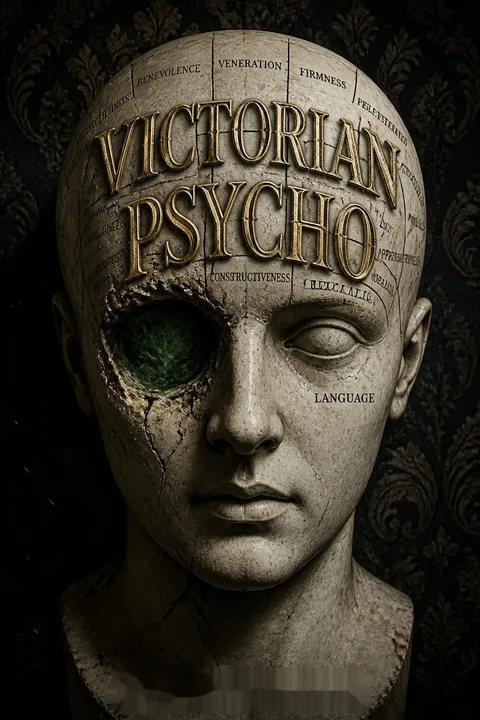
Phrenology
Pseudoscience that binds and blindsMr Pounds'2 obsession with measuring skulls to determine moral and intellectual character. He uses a wooden-and-brass craniometer to assess his children, his guests, and Winifred1 herself. The skull measurement scene becomes a pivotal bonding moment: Mr Pounds2 declares that he and Winifred1 possess identical cranial structures, making them phrenology twins. This pseudoscientific connection provides Winifred1 with the intimacy she craves and Mr Pounds2 with intellectual vanity. At breakfast, guests later debate whether phrenology can identify murderers—Mr Pounds2 argues it should catch all criminals, unaware he is seated with one. The device satirizes Victorian faith in scientific classification while showing how systems designed to detect evil consistently fail to recognize it at close range.
FAQ
Synopsis & Basic Details
What is Victorian Psycho about?
- A Governess's Dark Descent: Victorian Psycho follows Winifred Notty, a new governess at the isolated Ensor House, as she navigates the dysfunctional and cruel Pounds family. What begins as a darkly humorous observation of Victorian society and domestic life quickly spirals into a chilling psychological thriller, revealing Winifred's own deeply disturbed past and her escalating capacity for violence.
- Unraveling Family Secrets: The narrative delves into the hidden cruelties and secrets of the Pounds household, from the distant Mr. Pounds and the paranoid Mrs. Pounds to their spoiled children, Andrew and Drusilla. Winifred's arrival acts as a catalyst, exposing the family's rot and her own twisted desires for belonging and revenge.
- A Gothic Tale of Madness: Set against a bleak moorland backdrop, the story is a modern gothic reimagining that blurs the lines between reality and delusion. It explores themes of trauma, class, gender, and the monstrous feminine, culminating in a shocking Christmas massacre and Winifred's infamous public execution.
Why should I read Victorian Psycho?
- Unforgettable Anti-Heroine: For readers seeking a truly unique and unsettling protagonist, Winifred Notty offers a compelling, darkly witty, and utterly amoral perspective. Her internal monologues are both horrifying and hilariously sardonic, providing a fresh take on the unreliable narrator trope.
- Sharp Social Commentary: Beyond the violence, the novel delivers biting satire of Victorian societal norms, class hypocrisy, and the oppressive expectations placed on women and children. It uses grotesque imagery and black humor to critique the era's superficiality and hidden brutalities.
- Masterful Psychological Horror: If you enjoy stories that delve deep into the human psyche, Victorian Psycho offers a disturbing exploration of trauma, detachment, and the origins of evil. The constant blurring of reality and delusion keeps readers on edge, questioning every event and character motivation.
What is the background of Victorian Psycho?
- Victorian Social Critique: The novel is steeped in the social and cultural anxieties of the Victorian era, particularly concerning class distinctions, the rigid roles of women, and the emerging "sciences" like phrenology. It critiques the hypocrisy of the upper classes who, despite their outward propriety, harbor deep-seated cruelties and neglect.
- Gothic Literary Tradition: Feito draws heavily from classic gothic literature, particularly governess narratives like Jane Eyre and The Turn of the Screw, but subverts their conventions. Ensor House itself, with its hidden passages, dark history, and oppressive atmosphere, is a quintessential gothic setting that mirrors the characters' internal turmoil.
- Historical Medical Practices: The story incorporates historical details such as the widespread use of laudanum to quiet children, the practice of "mummy unwrapping" as entertainment, and the brutal conditions of workhouses and asylums. These elements ground the psychological horror in a disturbing historical reality, highlighting the era's casual cruelty.
What are the most memorable quotes in Victorian Psycho?
- "Every thing is in flames.": This epigraph, attributed to Charles Darwin, sets a pervasive tone of destruction and chaos from the very beginning, foreshadowing the literal and metaphorical fires that consume characters and the house itself. It hints at an inherent, almost natural, destructive force at play.
- "I was sixteen years old when I realized I was unable to feel fear. At least, not in the way other people experience it – in that undignified, acutely desperate sort of way.": This pivotal quote from Chapter VII, "In Which I Make a Short Assessment of Fear," defines Winifred's core psychological trait, explaining her chilling detachment and enabling her escalating acts of violence. It positions her as an anomaly, immune to a fundamental human emotion.
- "Does not everyone deserve joy?": Uttered by Winifred in Chapter XXVII amidst the Christmas Eve carnage, this question encapsulates her twisted moral philosophy. It suggests her horrific actions are, in her mind, a form of liberation or a perverse pursuit of "joy" for herself, challenging conventional notions of good and evil.
What writing style, narrative choices, and literary techniques does Virginia Feito use?
- First-Person Unreliable Narration: The novel is entirely told from Winifred Notty's perspective, a narrator whose perceptions are increasingly skewed by delusion, trauma, and a chilling lack of empathy. This narrative choice immerses the reader in her disturbed mind, blurring the lines between reality and fantasy and forcing constant re-evaluation of events.
- Darkly Humorous and Sardonic Tone: Feito employs a distinctive voice characterized by dry wit, biting sarcasm, and grotesque humor, even in the face of horrific events. Winifred's detached observations and cynical internal monologues provide a unique blend of comedy and horror, making the disturbing content surprisingly engaging.
- Vivid and Visceral Imagery: The prose is rich with sensory details, particularly those related to decay, bodily fluids, and unsettling natural phenomena. Feito uses striking metaphors and similes (e.g., "breasts jiggling in my corset," "squelch of viscera squeezed in a fist," "eyes are two bullet holes") to create a visceral and often repulsive atmosphere that underscores the novel's themes of mortality and corruption.
Hidden Details & Subtle Connections
What are some minor details that add significant meaning?
- The Boar Crest Motif: The recurring boar crest, found on Mr. Pounds' cigar case, his father's letters, and even carved onto the roast swan's beak, subtly links Winifred to the Pounds lineage and their inherent "evil." It symbolizes the inherited darkness and the predatory nature of the family, suggesting Winifred's actions are a fulfillment of a violent legacy, not just an aberration.
- The "Slaughtered Ox" Painting: The Rembrandt copy of "Slaughtered Ox" in the dining room, which Mr. Pounds proudly displays, serves as a constant, gruesome backdrop to the family's meals and conversations. It foreshadows the eventual slaughter of the household, symbolizing the vulnerability of the "meat" (the guests and servants) to the "butcher" (Winifred) and the Pounds' own detached appreciation for suffering.
- The Church Bells' Shifting Significance: The Grim Wolds church bells initially mark the mundane passage of time, but as Winifred's sanity unravels, their chimes become increasingly distorted and symbolic. They toll "midnight" repeatedly, signifying a timeless, inescapable doom, and later transform into "coffin bells" ringing from Hopefernon, linking the present chaos to Winifred's traumatic past and the dead.
What are some subtle foreshadowing and callbacks?
- The Driver's Chilblained Hand: In Chapter I, the driver's hand resting on Winifred's thigh is a subtle, unsettling detail that hints at the pervasive undercurrent of inappropriate touch and violation that will later define many relationships and incidents in the house, from the lecherous painter to Winifred's own predatory advances.
- Mrs. Pounds' "Mother?" Query: When Winifred first explores the master bed-chamber in Chapter IV, Mrs. Pounds stirs and asks "Mother?" This seemingly throwaway line subtly foreshadows Winifred's eventual revelation of her parentage and her twisted desire to become the "mother" figure of the household, albeit through destruction.
- The "Green Dress" and Charlotte Plummer: The green dress Mrs. Pounds gives Winifred is explicitly linked to a rumor that the color "killed Charlotte Plummer" due to arsenic in the dye. This detail directly foreshadows the fatal consequences of Winifred wearing the dress, symbolizing not only Mrs. Pounds' subtle malice but also Winifred's embrace of a deadly, toxic identity.
What are some unexpected character connections?
- Winifred and Mr. Pounds' "Phrenology Twin": The revelation that Winifred and Mr. Pounds possess "the very same skull" and "identical dent on the left temple" is a chilling pseudo-scientific confirmation of their shared psychological makeup and inherent "Darkness." This connection goes beyond biological fatherhood, suggesting a deeper, almost fated, bond of shared pathology.
- Drusilla's Quiet Observational Power: While often dismissed as vain or sulky, Drusilla consistently observes Winifred with a keen, unsettling awareness, culminating in her whispered "I know your secret" and her later participation in the massacre. Her quiet rebellion and eventual complicity reveal a deeper, more complex connection to Winifred than initially apparent, mirroring Winifred's own hidden depths.
- The Servants' Collective Consciousness: The servants, though largely nameless and expendable, form a collective entity that observes and whispers about the family's and Winifred's escalating madness. Their shared ghost stories and their eventual, futile attempts to escape highlight their collective vulnerability and their role as silent witnesses to the unfolding horror, often more perceptive than their masters.
Who are the most significant supporting characters?
- Miss Lamb (Sue Lamb): Beyond being a victim, Miss Lamb represents Winifred's fleeting and ultimately destructive attempts at genuine human connection and desire. Her innocence and vulnerability highlight Winifred's predatory nature, and her brutal murder marks a significant turning point in Winifred's descent into unbridled psychopathy.
- Drusilla Pounds: Drusilla evolves from a spoiled child into Winifred's accomplice and eventual betrayer. Her quiet observation and eventual participation in the murders, particularly her decisive act of killing Mr. Pounds, reveal a latent capacity for violence and a complex, almost mirrored, relationship with Winifred, making her more than just a charge.
- The Reverend: Winifred's adoptive father, the Reverend, is a pervasive, haunting presence in her flashbacks. His attempts to "exorcise" her, his fear of her "evil soul," and his eventual death by fire (at Winifred's mother's hand, then a match girl's) are foundational to Winifred's psychological makeup, shaping her detachment and her understanding of "evil."
Psychological, Emotional, & Relational Analysis
What are some unspoken motivations of the characters?
- Winifred's Quest for Belonging: Beneath her detachment and violence, Winifred harbors a deep, unspoken yearning for family and acceptance, particularly from Mr. Pounds. Her actions, including the murders, can be interpreted as a twisted attempt to secure her place within the Pounds lineage and gain her father's recognition and love, even if it means destroying everyone else.
- Mrs. Pounds' Desperate Need for Control: Mrs. Pounds' paranoia and cruelties stem from a profound insecurity and a desperate need to assert control in a household where she feels increasingly powerless, especially against her husband's indifference and Winifred's growing influence. Her obsession with propriety and her attempts to humiliate Winifred are manifestations of this underlying fear of losing her status.
- Mr. Pounds' Narcissistic Legacy: Mr. Pounds' primary motivation is the perpetuation of his own legacy and image, as seen in his obsession with phrenology and his preference for Andrew as the "sole male heir." His emotional distance and objectification of others serve to protect his self-image and maintain his patriarchal authority, even at the cost of genuine connection.
What psychological complexities do the characters exhibit?
- Winifred's Performative Emotions: Winifred's inability to feel fear or genuine emotion leads her to "peel hides" of human expressions, performing appropriate reactions (like sorrow or amiability) to manipulate others. This psychological complexity highlights her profound detachment and the chilling artifice of her interactions, making her a master manipulator who understands human behavior without experiencing it herself.
- The Cycle of Intergenerational Trauma: The novel subtly portrays how trauma is passed down through generations. Winifred's mother's abuse and the Reverend's attempts to "cure" her contribute to Winifred's psychopathy, which then manifests in her interactions with the Pounds children, particularly Drusilla, who eventually participates in the violence, suggesting a perpetuation of the cycle.
- The Blurring of Sanity and Madness: The narrative constantly questions the nature of Winifred's "madness." Is it a result of her traumatic past, an inherent evil, or a logical response to the hypocritical and cruel society she inhabits? Her hallucinations and unreliable narration force the reader to confront the ambiguity of sanity, suggesting that the "normal" world is itself a form of madness.
What are the major emotional turning points?
- The Rabid Man Encounter: Winifred's encounter with the rabid man in Chapter VII, where she feels no fear and laughs while cauterizing her own wound, is a crucial turning point. It solidifies her self-awareness of her unique emotional detachment and marks the moment she fully embraces this "advantage," setting her on a path of calculated, unfeeling violence.
- Miss Lamb's Murder: The murder of Miss Lamb in Chapter XVIII, triggered by Lamb's rejection and fear, represents Winifred's definitive descent into psychopathy. It signifies her inability to form healthy attachments and her willingness to destroy anything that threatens her twisted desires, moving beyond calculated acts to impulsive, rage-fueled violence.
- The Christmas Day Confession: Winifred's confrontation with Mr. Pounds on Christmas Day, where she reveals herself as his daughter, is the emotional climax of her personal quest. While it doesn't bring the desired familial connection, it is a moment of raw vulnerability and desperate longing, immediately followed by the ultimate act of patricide, signifying the complete collapse of her hopes for a "family."
How do relationship dynamics evolve?
- Winifred's Shifting Power with the Pounds: Initially, Winifred is a subordinate governess, subject to the Pounds' whims and humiliations (e.g., the kennel). However, through manipulation, observation, and escalating acts of violence, she gradually usurps their power, becoming the dominant force in the household, culminating in their annihilation.
- The Twisted Mother-Daughter Dynamic: The relationship between Winifred and Mrs. Pounds evolves from initial rivalry to a perverse mirroring. Mrs. Pounds' paranoia and attempts to control Winifred are met with Winifred's own manipulative "tenderness" and eventual destruction, reflecting a distorted mother-daughter struggle for dominance and recognition.
- Drusilla's Transformation and Complicity: Drusilla's relationship with Winifred shifts from a wary student-teacher dynamic to a chilling partnership in crime. Drusilla's quiet observation and eventual participation in the murders, particularly her decisive act against her father, suggest that Winifred's influence awakens a latent darkness within her, transforming her into an accomplice.
Interpretation & Debate
Which parts of the story remain ambiguous or open-ended?
- The Reality of Winifred's Parentage: While Winifred claims Mr. Pounds is her father and presents "evidence" (the boar crest, shared eyes, phrenology match), the narrative leaves it ambiguous whether this is a genuine revelation or a powerful delusion. Her unreliable narration and the "dream" vs. "reality" motif at the end ("I am left to wonder if it was all a dream") keep the truth of her paternity open to interpretation.
- The Nature of Winifred's "Darkness": The novel never definitively explains the origin of Winifred's psychopathy. Is she born "evil" as her mother claimed ("yours is an evil soul, wrapped in darkness")? Is it a consequence of her extreme childhood trauma and the laudanum? Or is it a coping mechanism developed in response to a cruel world? This ambiguity invites readers to debate the interplay of nature vs. nurture in her monstrousness.
- The "Ghost" of Ensor House: The "ghost" that haunts Ensor House and causes chaos among the guests and servants is strongly implied to be Winifred herself, but the narrative never explicitly confirms it. This ambiguity allows for a supernatural interpretation while also highlighting Winifred's ability to manipulate perceptions and create a terrifying, unseen presence.
What are some debatable, controversial scenes or moments in Victorian Psycho?
- The Baby Swap and Murder: The scene where Winifred murders Mrs. Fancey's baby and replaces it with a farm child is highly controversial due to its graphic nature and the victim's innocence. It sparks debate about the limits of an anti-heroine's actions and whether such extreme violence is justifiable within the narrative's satirical framework or simply gratuitous.
- The Mummy Unwrapping Scene: Mr. Fishal's "surprise" of unwrapping a mummy for entertainment, complete with graphic descriptions of the corpse, is a controversial moment that highlights the Victorian era's morbid fascination with death and colonial exploitation. It forces readers to confront the casual dehumanization and objectification prevalent in the upper classes, mirroring Winifred's own detached view of human life.
- Drusilla's Complicity and Betrayal: Drusilla's active participation in the Christmas Eve massacre, particularly her killing of Mr. Pounds, followed by her immediate betrayal of Winifred to the police, is a highly debatable character arc. It raises questions about her own moral compass, whether she was truly corrupted by Winifred, or if she was always capable of such acts and merely seized an opportunity for survival or revenge.
Victorian Psycho Ending Explained: How It Ends & What It Means
- The Annihilation of the Pounds Household: The novel culminates in a brutal Christmas Day massacre where Winifred, often aided by Drusilla, systematically murders the entire Pounds family, their guests, and most of the servants. This act is a violent culmination of Winifred's repressed rage, her quest for belonging, and her desire to dismantle the oppressive Victorian social order represented by Ensor House.
- Winifred's Public Execution and Infamy: Winifred is eventually captured, tried, and publicly executed, with Drusilla testifying against her. Her unrepentant demeanor on the gallows ("It was grand") and her final thoughts, which blur memories and dreams, solidify her status as a monstrous yet strangely liberated figure. Her execution becomes a spectacle, transforming her into a cautionary tale and a symbol of female transgression.
- A Critique of Societal "Evil": The ending of Victorian Psycho is not merely a tale of a madwoman's rampage but a profound commentary on the nature of "evil" itself. Winifred's actions, while horrific, are presented as a response to the systemic cruelties and hypocrisies of Victorian society. Her final thoughts, particularly the line "Little girls everywhere will know they can aspire to kill, too – 'tis not only the men that do," suggest a subversive message about female agency and the breaking of patriarchal norms, even through extreme violence.
Download PDF
Download EPUB
.epub digital book format is ideal for reading ebooks on phones, tablets, and e-readers.








































